1
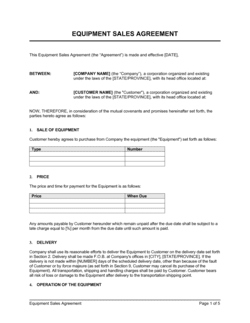
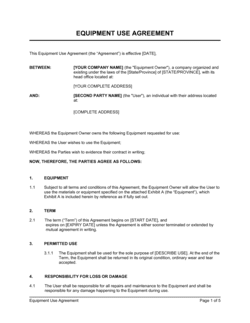
Identify both parties using their full legal entity names
Enter the seller's and buyer's registered legal names, entity types, states or provinces of incorporation, and principal addresses. Do not use trade names or abbreviations.
💡 Confirm the exact legal name against a current corporate registry filing — a mismatched entity name on a contract can create enforceability issues if the agreement is ever litigated.
2
Describe the equipment precisely with serial numbers
Complete the equipment description block with make, model, year, serial number, and a list of all included attachments or accessories. Attach photographs as Schedule A.
💡 Photograph and document the equipment's condition on both the sale date and the repurchase date — this evidence resolves the most common repurchase disputes.
3
Set the original sale price and payment schedule
Enter the total purchase price, deposit amount, payment method, and due dates for any installment payments. Specify what happens if a payment is missed — interest, acceleration, or default.
💡 State the currency explicitly, especially for cross-border transactions involving USD, CAD, GBP, or EUR.
4
Specify the repurchase structure — option or obligation
Choose clearly whether the repurchase clause is an option (one party may elect to exercise it) or an obligation (one party must complete it). Define who holds the right, the exercise window, and the required notice period.
💡 If the repurchase is contingent on a trigger event — expiry of a lease, a buyer request, or a performance milestone — define that trigger with a specific date or measurable condition, not a vague phrase like 'upon request.'
5
Define the repurchase price formula
Choose a fixed price, a depreciation-based formula, or fair market value with a defined appraisal mechanism. Enter all variables — depreciation rate, floor price, ceiling price — so the repurchase price can be calculated mechanically without negotiation.
💡 Include a floor price to protect the seller in case market values collapse beyond the depreciation schedule.
6
Document the condition standard and inspection right
Attach a condition checklist as Schedule B defining acceptable wear and tear versus damage requiring repair. Grant the repurchasing party a defined inspection window — typically 5–10 business days — before repurchase closes.
💡 Tie any price adjustment for below-standard condition to an independent appraiser's estimate to remove subjectivity from the dispute.
7
Confirm title transfer mechanics and risk of loss
State explicitly when title passes on the original sale (typically at payment) and when it passes on repurchase (at payment of the repurchase price). Confirm that the buyer bears all risk of loss between the two dates.
💡 Require the buyer to maintain property and liability insurance covering the full replacement value of the equipment for the entire period between sale and repurchase.
8
Execute before the equipment changes hands
Both parties must sign the agreement — and any attached Bill of Sale — before or simultaneously with the physical transfer of the equipment on the original sale date.
💡 Use a dated signature block that ties execution to a specific calendar date; 'as of' backdating creates evidentiary problems if the agreement is challenged.