1
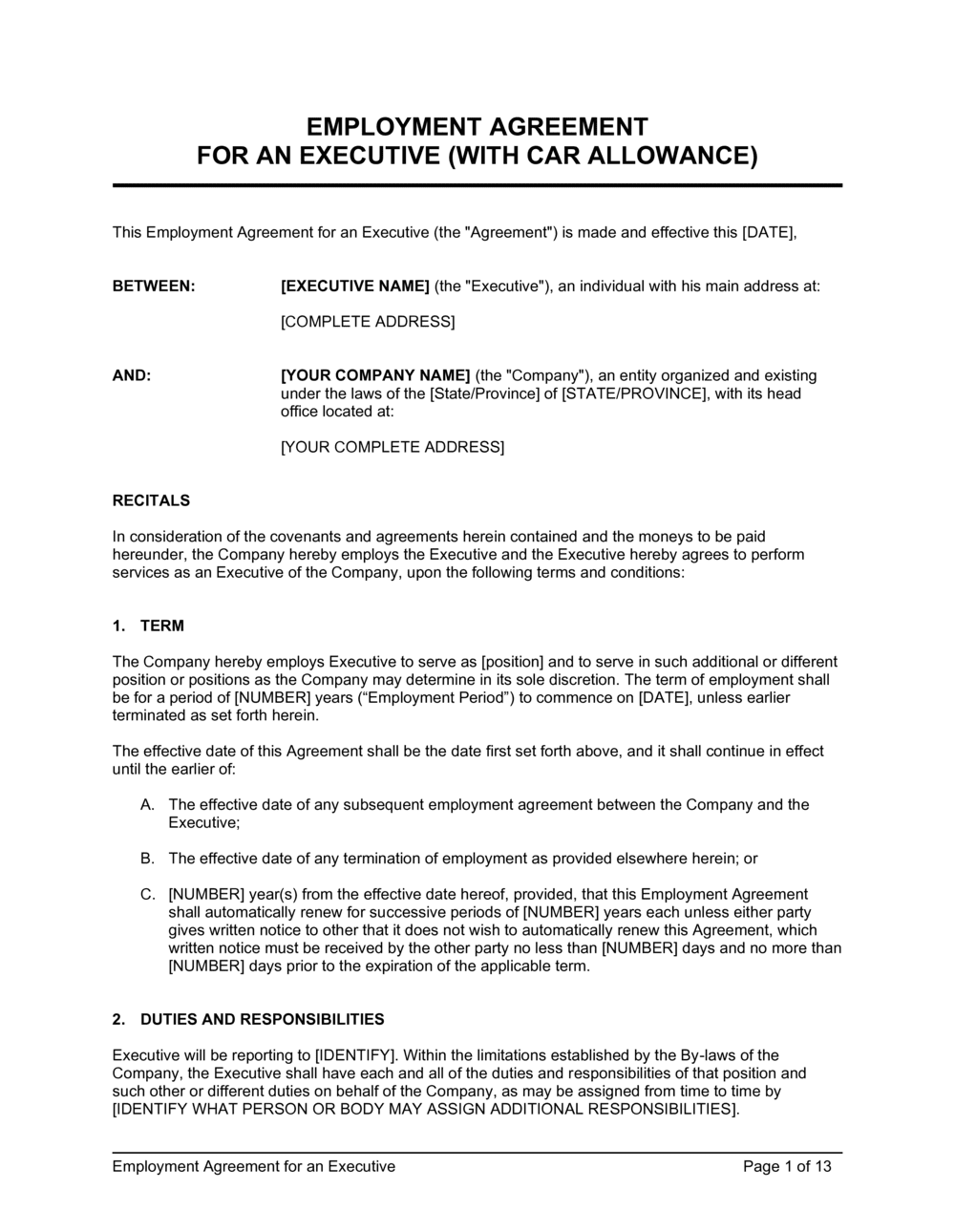
Enter the parties and confirm the legal entity name
Use the company's full registered corporate name — not a trade name or brand — and the executive's legal name as it appears on government ID. Include exact title, reporting line, and start date.
💡 Cross-reference the corporate registry filing to confirm the exact entity name; mismatches with equity plan documents create enforcement gaps later.
2
Set the term type and auto-renewal notice period
Decide between an initial fixed term with auto-renewal or a fully at-will arrangement. For fixed terms, set the renewal notice period at 60–90 days so both parties have adequate planning time.
💡 At-will employment has no legal equivalent in Canada, the UK, or the EU — use notice-period termination clauses in those jurisdictions instead.
3
Complete the compensation and bonus block
Enter base salary, payment frequency, annual bonus target percentage, and the performance criteria that govern payout. Mark all bonuses explicitly as discretionary unless they are contractually guaranteed.
💡 State the currency explicitly when the executive works in a country different from the company's home jurisdiction — USD and CAD, or GBP and EUR, are frequently confused.
4
Document the equity grant and reference the award agreement
Record the grant size, type, vesting schedule, and cliff period. Cross-reference the governing equity incentive plan and the separate award agreement that will contain full vesting mechanics and tax treatment.
💡 Confirm board approval of the grant before the agreement is executed — some equity plans require board or compensation committee action as a condition to grant validity.
5
Define cause, good reason, and severance terms
Draft narrow, objective definitions of 'cause' (limited to fraud, gross misconduct, or material breach) and 'good reason' (material reduction in title, compensation, or duties). Then set the severance multiplier and benefits continuation period.
💡 A severance release requirement is standard — include a 60-day execution window and confirm it meets applicable ADEA requirements for executives over 40 in the US.
6
Calibrate non-compete and non-solicitation scope
Set duration (typically 12 months for most executives, up to 24 months for CEOs with board-level customer access) and geographic scope proportionate to the executive's actual competitive footprint. Apply jurisdiction-specific restrictions.
💡 Remove or replace the non-compete entirely for California, Minnesota, and other jurisdictions that ban post-employment restrictions — retaining only the non-solicitation clause.
7
Draft the change-of-control clause with a clear definition
Set the trigger threshold (typically 50% of voting securities), the protected window post-closing (typically 12–24 months), the enhanced severance multiplier (1×–3×), and whether equity accelerates on single or double trigger.
💡 Double-trigger acceleration is generally preferred by investors over single-trigger because it retains executive incentives through a post-acquisition integration period.
8
Execute before the start date and store the signed copy
Both parties must sign before the executive's first day. Post-start-date signatures create a 'fresh consideration' problem in common-law jurisdictions that can void IP assignment and non-compete clauses. Use electronic signature with a timestamp.
💡 If circumstances delay signing past day one, document a specific additional benefit — bonus, equity top-up, or additional PTO — provided as fresh consideration at the time of late signing.