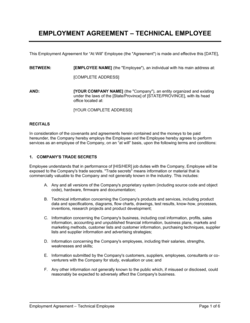
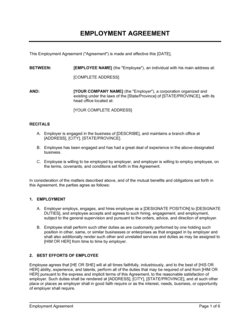
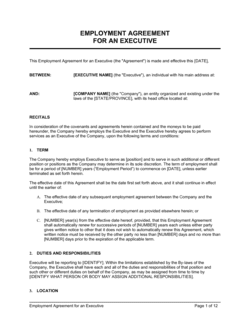
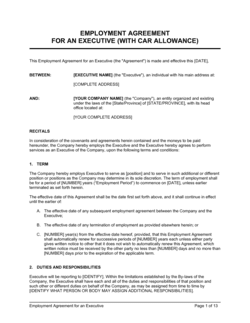
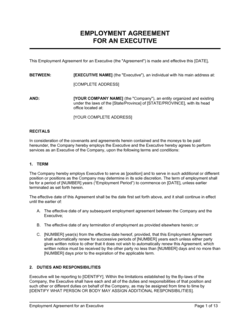
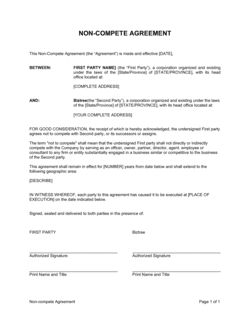
Employment Agreement Key Employee Template

Free Word download • Edit online • Save & share with Drive • Export to PDF

3 pages25–35 min to fillDifficulty: ComplexSignature requiredLegal review recommended
Learn more ↓
FreeEmployment Agreement Key Employee Template

At a glance

What it is
An Employment Agreement Key Employee is a legally binding contract between an employer and a senior or mission-critical staff member that goes beyond a standard employment contract to address retention bonuses, enhanced severance, change-of-control protections, and tightly scoped non-compete obligations. This free Word download gives you a professionally structured, attorney-informed starting point you can edit online and export as PDF for execution before the employee's first day.
When you need it
Use it when hiring or formalizing the arrangement with any employee whose departure would materially harm the business — a VP of Sales, lead engineer, founding team member, or any role with deep access to trade secrets, key client relationships, or proprietary technology. It is also appropriate when a standard employment contract lacks the retention mechanics and post-employment protections the role demands.
What's inside
Position and reporting structure, base compensation and bonus structure, retention and signing bonus terms, equity references, enhanced severance and change-of-control provisions, IP assignment, confidentiality, non-compete and non-solicitation restrictions, termination procedures, and governing law.

What is an Employment Agreement Key Employee?

An Employment Agreement Key Employee is a legally binding contract between an employer and a senior or mission-critical employee that governs every material dimension of a high-value employment relationship — job title, base salary, retention and signing bonuses with clawback provisions, equity plan references, change-of-control protections, IP assignment, confidentiality, non-compete and non-solicitation restrictions, and an enhanced severance formula. Unlike a standard employment contract, it is specifically designed for employees whose departure would cause material harm to the business: VPs, lead engineers, senior sales leaders, and founding team members who carry client relationships or proprietary knowledge that cannot easily be replaced. This free Word download gives you a structured, professionally drafted starting point you can edit online and export as PDF for execution before the employee's first day.

Why You Need This Document

Without a key employee employment agreement, you are exposed across every dimension simultaneously. A departing VP of Sales with no non-solicitation clause can call every client they served on their way out the door. A lead engineer who was never asked to sign an IP assignment may claim that the algorithm powering your product belongs to them — a dispute that can halt a funding round or acquisition in due diligence. A key hire who received a $50,000 signing bonus and resigned four months later has no contractual obligation to repay without a written clawback clause. And a change-of-control event that accelerates equity for every key employee without a double-trigger provision can reduce your acquisition price by millions before the deal closes. A properly executed key employee agreement, signed before the first day of work, closes all of these gaps for the cost of a template and, where the stakes warrant it, a focused legal review.

Which variant fits your situation?

If your situation is…Use this template
Hiring a standard full-time employee below director levelEmployment Agreement (At-Will)
Engaging a C-suite executive with equity, golden parachute, and board reportingExecutive Employment Agreement
Hiring for a defined project or fixed end dateFixed-Term Employment Contract
Engaging an independent senior specialist without employment statusIndependent Contractor Agreement
Retaining a key employee specifically through a merger or acquisition eventEmployee Retention Agreement
Hiring a part-time or hourly senior specialistPart-Time Employment Contract
Onboarding a remote key employee in a different countryRemote Work Employment Agreement

Common mistakes to avoid

❌ Signing after the employee's first day

Why it matters: In common-law jurisdictions — the US, Canada, UK, and Australia — a contract signed after work has already begun lacks fresh consideration for restrictive covenants. IP assignment, non-compete, and clawback clauses signed on or after day one can be voided by a court.

Fix: Execute the agreement before or on the morning of the first day. If circumstances require a later signature, document and provide a concrete additional benefit — a cash payment, extra PTO grant, or salary increase — as fresh consideration at the time of signing.

❌ Single-trigger change-of-control acceleration

Why it matters: Equity that vests automatically on a change of control without requiring termination removes the incentive for the key employee to remain through integration and routinely reduces acquisition offer prices when discovered in due diligence.

Fix: Use double-trigger acceleration: vesting accelerates only if both a change of control occurs and the employee is subsequently terminated without cause or resigns for good reason within 12 months of the event.

❌ No mutual release condition on enhanced severance

Why it matters: Paying an enhanced severance multiple without requiring a signed release leaves the employer exposed to employment claims filed concurrently with or after the severance payment — the employee collects both.

Fix: Make enhanced severance contingent on the employee executing a mutual release within 21 days of separation (29 days for employees over 40 in the US, to comply with the ADEA). Include a reimbursement obligation if a claim is later filed.

❌ Omitting a prior inventions schedule

Why it matters: Without a signed Schedule B, a key employee who later claims that a core product feature or algorithm was their pre-existing personal invention has no documented baseline to refute. This dispute can block fundraising rounds or an acquisition.

Fix: Include Schedule B in every key employee agreement and require the employee to complete and sign it at execution, even if the list is blank.

❌ Using the same non-compete template for all seniority levels

Why it matters: A broad 24-month non-compete covering an entire industry nationally for a regional sales manager is struck down as unreasonable in most jurisdictions, voiding the clause entirely and leaving the employer with no post-employment protection.

Fix: Tailor duration, geography, and industry scope to the employee's actual role. A regional manager warrants a regional restriction for 6 to 12 months; a VP with national customer access may warrant a national restriction for 12 to 18 months.

❌ Retention bonus with no definition of 'actively employed'

Why it matters: An employee on unpaid leave, long-term disability, or garden leave on a vesting date may claim entitlement to a retention installment on the argument that they were never formally separated. Courts have awarded these payments when the contract was silent.

Fix: Define 'actively employed' explicitly — typically excluding periods of unpaid leave exceeding 30 days, long-term disability leave, and any notice period served on garden leave — and confirm that installments vest only when the definition is satisfied.

The 10 key clauses, explained

Parties, position, and reporting structure

In plain language: Identifies the employer's legal entity and the employee by full name, states the exact job title, department, and who the employee reports to — including any board or committee reporting for senior roles.

Sample language
This Employment Agreement is entered into on [DATE] between [EMPLOYER LEGAL NAME], a [STATE/PROVINCE] [ENTITY TYPE] ('Company'), and [EMPLOYEE FULL NAME] ('Employee'). Employee is engaged as [JOB TITLE] reporting to [TITLE / NAME], effective [START DATE].

Common mistake: Using a trade name rather than the registered legal entity name. If the contracting entity doesn't match payroll records and corporate registry filings, enforcing IP assignment or non-compete clauses against the correct entity becomes legally complicated.

Compensation, signing bonus, and clawback

In plain language: States the base salary, payment frequency, signing bonus amount, and the clawback condition — typically requiring repayment on a pro-rated basis if the employee voluntarily resigns within 12 to 24 months of the payment date.

Sample language
Company shall pay Employee a base salary of $[AMOUNT] per year, payable bi-weekly. Employee shall receive a one-time signing bonus of $[AMOUNT] within [30] days of hire, subject to pro-rated repayment if Employee voluntarily resigns within [24] months of the payment date.

Common mistake: Paying a signing bonus without a written clawback clause. Without it, a departing employee has no contractual obligation to repay, and recovery requires costly litigation.

Performance bonus and discretionary bonus language

In plain language: Defines the annual bonus target as a percentage of base salary, the performance metrics that trigger it, and critically, confirms the bonus is discretionary unless otherwise stated.

Sample language
Employee is eligible for an annual performance bonus of up to [X]% of base salary, based on achievement of targets set by the Company each year. Payment is at the sole discretion of the Board / CEO and is not earned until paid.

Common mistake: Omitting the word 'discretionary' when a bonus has been paid consistently for multiple years. Courts in several jurisdictions have found that a regularly paid bonus becomes a contractual entitlement even without an explicit written promise.

Retention bonus and vesting schedule

In plain language: Specifies a cash retention incentive paid in installments contingent on the employee remaining actively employed through each vesting date — typically structured as two or three tranches over 12 to 36 months.

Sample language
Company shall pay Employee a retention bonus of $[TOTAL AMOUNT] in [NUMBER] equal installments of $[INSTALLMENT AMOUNT] on [DATE 1], [DATE 2], and [DATE 3], provided Employee remains actively employed on each payment date. Installments not yet paid are forfeited upon voluntary resignation or termination for Cause.

Common mistake: Failing to define 'actively employed' — employees on unpaid leave, disability, or garden leave may argue entitlement to an installment that the employer intended to withhold.

Equity and equity plan reference

In plain language: References any stock option grant, restricted stock unit award, or profits interest, confirming that the specifics are governed by a separate equity award agreement and the company's equity incentive plan.

Sample language
Subject to Board approval, Employee shall be granted [NUMBER] stock options / RSUs with an exercise price equal to fair market value on the grant date, vesting [VESTING SCHEDULE], pursuant to the Company's [PLAN NAME] and a separate award agreement.

Common mistake: Including vesting schedules and exercise prices in the employment contract body rather than in a separate award agreement. When plan terms change, the employment contract creates conflicting obligations that require amendment.

Change-of-control and double-trigger acceleration

In plain language: Defines what constitutes a change of control — typically a sale of 50% or more of company equity or assets — and the rights triggered: accelerated equity vesting, enhanced cash severance, or the right to resign with full benefits.

Sample language
If within [12] months following a Change of Control, Employee's employment is terminated without Cause or Employee resigns for Good Reason, Employee shall receive [X] months' base salary as severance and all unvested equity shall accelerate and vest immediately.

Common mistake: Using single-trigger acceleration — vesting all equity automatically upon a change of control without requiring termination. Acquirers frequently reduce offer prices when they discover single-trigger provisions, and key employees lose the incentive to stay through the integration period.

IP assignment and prior inventions carve-out

In plain language: Assigns all work product and inventions created during employment to the employer, while carving out inventions the employee developed entirely on their own time using no company resources — a legally required exclusion in several US states.

Sample language
Employee assigns to Company all right, title, and interest in any Inventions conceived, developed, or reduced to practice during employment that relate to the Company's business. Schedule B lists all Prior Inventions Employee retains ownership of as of the date of this Agreement.

Common mistake: No prior inventions schedule at all. An employee who later claims a core product idea was a pre-existing personal invention — and has no signed Schedule B — creates a material IP ownership dispute that can threaten fundraising or an acquisition.

Confidentiality and trade secret protection

In plain language: Prohibits the employee from using or disclosing the company's confidential information during and after employment, and specifies the return or destruction of all confidential materials upon separation.

Sample language
Employee shall not, during or after employment, use or disclose any Confidential Information without prior written consent. 'Confidential Information' includes trade secrets, source code, customer lists, pricing, financial data, and strategic plans. Upon separation, Employee shall promptly return or certify destruction of all such materials.

Common mistake: Defining confidential information so broadly — 'everything Employee learns about the Company' — that courts apply a reasonableness standard and void the clause entirely, leaving the employer with no protection at all.

Non-compete and non-solicitation

In plain language: Restricts the employee from joining direct competitors, soliciting the employer's customers, or recruiting its employees for a defined period and geography after departure — calibrated to the employee's seniority and actual competitive exposure.

Sample language
For [12] months following separation, Employee shall not (a) engage in a Competing Business within [GEOGRAPHIC SCOPE], (b) solicit any customer or prospective customer Employee had contact with in the [24] months prior to separation, or (c) recruit or hire any Company employee.

Common mistake: Applying the same non-compete duration and geography to a key employee as to a junior hire. Courts routinely strike down overbroad restrictions as unreasonable; calibrating scope to the role's actual competitive impact produces more consistently enforced clauses.

Termination, notice periods, and enhanced severance

In plain language: States notice requirements for voluntary and employer-initiated termination, defines termination for Cause with specific grounds, and sets the enhanced severance formula payable on termination without Cause — typically a multiple of monthly base salary plus benefit continuation.

Sample language
Company may terminate this Agreement without Cause on [60] days' written notice. In the event of termination without Cause, Employee shall receive [X] months' base salary as severance, paid in regular payroll installments, and [X] months of continued medical benefits, contingent on execution of a mutual release within [21] days of separation.

Common mistake: No mutual release condition on severance. Paying enhanced severance without requiring a signed release leaves the employer exposed to concurrent employment claims — the employee receives the payment and then sues anyway.

How to fill it out

  1. 1

    Confirm the employer's registered legal entity name

    Look up the company's exact registered name in the applicable corporate registry — state secretary of state, provincial registry, or Companies House. Enter it precisely, not a trade name or DBA.

    💡 Cross-reference the name against your payroll and tax filings before execution — mismatches create enforceability gaps on IP assignment and restrictive covenants.

  2. 2

    Define the role, duties, and reporting structure

    Enter the job title, department, and direct reporting line. For roles reporting to the board or a committee, name them explicitly. Move granular duties to a Schedule A so the main contract remains stable when responsibilities evolve.

    💡 Have the employee initial Schedule A separately at signing to confirm they reviewed the full scope of duties.

  3. 3

    Set base salary, signing bonus, and clawback terms

    Enter base salary in the stated currency, payment frequency, and the signing bonus amount. Set the clawback window — typically 12 to 24 months — and confirm whether repayment is pro-rated or full.

    💡 For employees relocating to accept the role, pro-rated repayment over 24 months is standard and easier to enforce than a full clawback on month 23.

  4. 4

    Structure the retention bonus tranches

    Set the total retention bonus amount and split it into two or three installments tied to specific calendar dates. Define 'actively employed' to include or exclude employees on approved leave, and confirm the forfeiture trigger.

    💡 Front-load the largest tranche — pay 60% at 12 months and 40% at 24 months — to create the strongest retention incentive in the first year.

  5. 5

    Draft the change-of-control provision carefully

    Define what constitutes a change of control (typically 50%+ ownership transfer or asset sale), choose double-trigger over single-trigger acceleration, and set the severance multiple and benefit continuation period.

    💡 Run the change-of-control section by an M&A lawyer or experienced advisor before execution — acquirers scrutinize these clauses in due diligence and poorly drafted provisions reduce deal value.

  6. 6

    Complete the IP assignment and prior inventions schedule

    Have the employee list all pre-existing inventions on Schedule B before signing. Review the list for anything that could be confused with the company's core technology or product direction, and address any overlap in writing.

    💡 A blank Schedule B is as protective as a completed one if signed — it confirms the employee acknowledges they have no relevant prior inventions to disclose.

  7. 7

    Calibrate non-compete scope to the role

    Set the geographic scope to the actual markets the employee will work in — not globally for a regional manager. Set the duration proportionate to seniority: 6 to 12 months for most key employees, up to 18 months for roles with direct access to customer relationships or technology roadmaps.

    💡 Remove the non-compete clause entirely for employees working in California, Minnesota, or other jurisdictions that ban post-employment restrictions — replace it with a stronger non-solicitation clause.

  8. 8

    Execute before the start date and store the signed copy

    Both parties must sign and date the agreement before the employee's first day of work. Post-start execution in common-law jurisdictions risks voiding restrictive covenants for lack of fresh consideration. Store the fully-executed copy in a secure document repository.

    💡 Use an eSign platform to timestamp execution precisely — an exact timestamp is critical evidence if the signing date is ever disputed relative to the start date.

Frequently asked questions

What is a key employee employment agreement?

A key employee employment agreement is a legally binding contract between an employer and a senior or mission-critical employee that covers all standard employment terms — compensation, duties, termination — plus provisions specific to high-value hires: retention bonuses, signing bonuses with clawbacks, change-of-control protections, accelerated equity vesting, and enhanced severance. It is more detailed and more heavily negotiated than a standard employment contract because the financial and operational stakes of losing the employee are materially higher.

How is a key employee agreement different from a standard employment contract?

A standard employment contract covers the essentials — title, salary, benefits, IP assignment, non-compete, and termination. A key employee agreement adds retention and signing bonuses with clawback provisions, a change-of-control clause that triggers accelerated vesting or enhanced severance on an acquisition, a severance multiple based on salary rather than a per-year-of-service formula, and more precisely drafted restrictive covenants calibrated to the employee's actual competitive exposure. The equity and change-of-control provisions alone make professional legal review advisable before execution.

Who qualifies as a key employee for this type of agreement?

There is no statutory definition of 'key employee' for contract purposes. In practice, the designation applies to any employee whose departure would materially damage the business — typically VP-level and above, technical founders, lead engineers on core IP, sales leaders with primary customer relationships, and any employee with access to trade secrets whose recruitment by a competitor would cause direct harm. The agreement is also appropriate for long-tenured employees being promoted into critical roles.

Are retention bonuses legally enforceable?

Retention bonuses are generally enforceable when supported by a written agreement that clearly states the payment amount, vesting dates, and forfeiture conditions. The clawback provision — requiring repayment of a signing or early retention installment on early voluntary departure — is also enforceable in most jurisdictions when the repayment formula is clearly stated and the amount is reasonable relative to the employee's compensation. Courts occasionally scrutinize clawbacks that effectively trap an employee below market compensation if they stay, so the retention amount should be genuinely additive.

What is double-trigger acceleration and why does it matter?

Double-trigger acceleration means that unvested equity accelerates and vests only when two events both occur: a change of control of the company and a subsequent involuntary termination or constructive dismissal of the employee within a defined window — typically 12 months. Single-trigger acceleration vests equity on the change of control alone, regardless of what happens to the employee. Double-trigger is strongly preferred by acquirers because it preserves the retention incentive through integration and avoids inflating the acquisition cost with an immediate equity payout.

Are non-compete clauses in key employee agreements enforceable?

Enforceability depends entirely on jurisdiction and the scope of the restriction. California, Minnesota, North Dakota, and Oklahoma ban most post-employment non-competes regardless of seniority. In jurisdictions that permit them, courts enforce restrictions that are reasonable in duration — typically 6 to 18 months for senior roles — geographic scope, and breadth of restricted activity. Broader restrictions are either blue- pencilled to a reasonable scope or voided entirely, depending on the state or country. Non-solicitation clauses covering customers and colleagues are generally more consistently enforced than non-competes and should always be included as a backstop.

How much severance should a key employee agreement include?

Key employee severance is typically expressed as a salary multiple rather than the statutory per-year-of-service formula used in standard contracts. Common ranges are 3 to 6 months' base salary for director-level roles and 6 to 12 months for VP-level and above, with 12 to 24 months triggered by a change-of-control termination. Any formula must meet or exceed statutory minimums in the governing jurisdiction — in Canada, the UK, and EU member states, statutory floors apply regardless of what the contract says. In the US, there is no federal statutory severance requirement, but enhanced amounts are market standard for key hires.

Does a key employee agreement need to be reviewed by a lawyer?

For most key employee hires, a one-to-two-hour template review by an employment lawyer is advisable and typically costs $300 to $800. Legal review becomes essential when the employee works in a jurisdiction with complex employment law — California, Ontario, the UK, France, or Germany — when the equity provisions are material and negotiated, when the change- of-control provisions interact with an M&A transaction, or when the non- compete must withstand scrutiny in a competitive market. The cost of a review is consistently less than the cost of litigating an ambiguous clause.

What happens if the agreement is signed after the employee starts work?

In common-law jurisdictions — the United States, Canada, the United Kingdom, and Australia — a contract requires fresh consideration to be enforceable. An employee who is already working has given nothing new in exchange for post-start restrictions. Courts have voided IP assignment, non-compete, and clawback clauses on this basis. The fix is to execute the agreement before day one. If that is not possible, provide documented additional consideration — a cash payment, salary increase, or bonus — at the time of signing and reference it explicitly in the agreement.

What is a good reason resignation provision and why is it included?

A 'good reason' resignation provision allows the employee to resign and still receive full severance — as though they were terminated without cause — if the employer takes specific adverse actions: materially reducing the employee's base salary, significantly diminishing their role or reporting level, relocating their primary work location beyond a defined distance, or failing to cause a successor company to assume the agreement following an acquisition. The provision protects the key employee from constructive dismissal without compensation and gives the employer a defined, manageable list of actions to avoid in order to preserve the employment relationship.

How this compares to alternatives

vs Standard employment contract

A standard employment contract covers the core employment terms for a typical hire — salary, duties, IP assignment, non-compete, and termination. A key employee agreement adds retention bonuses, signing bonus clawbacks, change-of-control protections, equity acceleration provisions, and enhanced severance multiples. Use the standard contract for roles below director level; use this agreement when the employee's departure would materially harm the business or where negotiated retention incentives are part of the offer.

vs Executive employment agreement

An executive employment agreement targets C-suite and board-reporting officers — CEO, CFO, CTO — and adds D&O indemnification, golden parachute provisions, detailed equity negotiation, and often involves board approval. A key employee agreement is appropriate for VP-level and senior director roles that are mission-critical but below C-suite, where the retention mechanics are important but the governance and indemnification layers of an executive agreement are not warranted.

vs Independent contractor agreement

An independent contractor agreement engages a self-employed professional for project-based work with no employment entitlements — no benefits, no withholding, no severance. A key employee agreement creates a full employment relationship with all associated statutory obligations. Misclassifying a key employee as a contractor to avoid retention costs exposes the business to back taxes, benefit liability, and penalties in every major jurisdiction.

vs Employee retention agreement

An employee retention agreement is a standalone document focused exclusively on incentivizing an existing employee to stay through a specific event — a merger, system migration, or ownership transition — via a time-vested cash payment. A key employee employment agreement is the primary governing contract for the entire employment relationship, of which retention mechanics are one component. Use a standalone retention agreement when you need to add retention incentives to an existing contract without renegotiating the full agreement.

Industry-specific considerations

Technology / SaaS

IP assignment covers source code, algorithms, and training data; double-trigger equity acceleration referenced alongside a separate option agreement; non-compete scoped to direct SaaS competitors in the relevant product category.

Financial Services

FINRA or FCA registration conditions as employment prerequisites; bonus clawback provisions aligned with regulatory compensation recoupment rules; enhanced confidentiality covering client data and trading strategies.

Healthcare / Life Sciences

HIPAA confidentiality obligations incorporated by reference; IP assignment explicitly covering clinical data, biomarkers, and regulatory filings; non-solicitation covering key referring physicians or research partners.

Manufacturing

Trade secret protection for proprietary processes and formulations is the primary driver; non-compete geography typically aligned to specific regional markets rather than global; safety certification and licensing conditions precedent to full duties.

Professional Services

Client non-solicitation is the most commercially critical clause given fee-based relationships; billing targets and utilization rates may be referenced as performance bonus triggers; non-compete duration calibrated to client relationship cycles.

Private Equity / Portfolio Companies

Management retention packages tied to hold period milestones; change-of-control provisions aligned with projected exit timeline; equity roll-over provisions referenced in a separate management incentive plan.

Jurisdictional notes

United States

At-will employment is the default in 49 states, but key employee agreements routinely displace at-will status with notice-based termination and enhanced severance. Non-compete enforceability varies sharply by state — California, Minnesota, and Oklahoma ban most post-employment restrictions, making a robust non-solicitation clause the primary protection in those states. ADEA requires a 21-day review period and 7-day revocation window for releases signed by employees over 40. Several states require a prior inventions carve-out in IP assignment clauses.

Canada

At-will employment does not exist in Canada — notice-based termination is mandatory, and contractual severance must meet or exceed provincial Employment Standards Act minimums. Ontario common-law notice can reach one month per year of service for long-tenured key employees, making an explicit severance cap in the contract commercially important. Quebec agreements must be in French for provincially-regulated employers. Non-competes are enforceable only if reasonable in duration, geography, and scope — restrictions exceeding 12 months face significant scrutiny.

United Kingdom

Employers must provide a written statement of employment particulars on or before day one. Garden leave clauses are well-established and routinely enforced for key employees during notice periods, making them an effective alternative to non-competes. Post-termination non-competes are enforceable if reasonable and supported by adequate consideration — typically the role itself if signed at hire. Enhanced severance payments may attract income tax rather than receiving the first £30,000 tax-free threshold treatment if they are contractually guaranteed.

European Union

The EU Transparent and Predictable Working Conditions Directive requires written employment terms within seven days of hire. Post-employment non-competes typically require financial compensation to the employee — ranging from 25% to 100% of salary depending on the member state — to be enforceable. GDPR applies to any personal data collected or processed under the agreement, including performance monitoring and background check records. France, Germany, and the Netherlands impose particularly strict termination and notice requirements that must be reflected in any key employee agreement covering employees in those countries.

Template vs lawyer — what fits your deal?

PathBest forCostTime
Use the templateDirector-level domestic hires in a single US state or Canadian province where equity provisions are minimalFree30–45 minutes
Template + legal reviewVP-level hires, roles with material equity or change-of-control provisions, or any hire in California, Ontario, the UK, or EU jurisdictions$400–$9002–4 days
Custom draftedC-adjacent roles with multi-million-dollar retention packages, cross-border employment, or agreements tied to an active M&A transaction$2,000–$6,000+1–3 weeks

Glossary

Key Employee
An employee whose specialized knowledge, client relationships, or operational role makes their departure materially harmful to the business.
Retention Bonus
A cash payment conditional on the employee remaining with the company for a defined period — typically 12 to 24 months — paid as a lump sum or in installments.
Signing Bonus
A one-time payment made at or shortly after hire, often subject to clawback if the employee leaves within a specified period.
Change-of-Control Provision
A clause that triggers specific rights or payments — accelerated vesting, enhanced severance, or the right to resign with full severance — upon a merger, acquisition, or change in majority ownership.
Non-Compete Clause
A post-employment restriction preventing the employee from working for direct competitors or starting a competing business within a defined geography and time period.
Non-Solicitation Clause
A restriction preventing a departing employee from recruiting the employer's staff or soliciting the employer's clients for a defined period after leaving.
IP Assignment
A clause transferring ownership of all work product, inventions, and intellectual property created by the employee in connection with their role to the employer.
Garden Leave
A notice period during which the employee is paid their full salary but is required to stay away from the office and clients, preventing competitive harm during the transition.
Clawback
A contractual right allowing the employer to recover previously paid bonuses or compensation if specified conditions — misconduct, early departure, or restatement — occur within a defined window.
Constructive Dismissal
A situation where an employer unilaterally changes a key employee's role, compensation, or conditions to such a degree that the employee is effectively forced to resign, which courts treat as termination.
Severance Multiplier
The formula used to calculate enhanced severance for key employees — typically expressed as a multiple of base salary, such as 6 or 12 months, rather than the statutory per-year-of-service minimum.

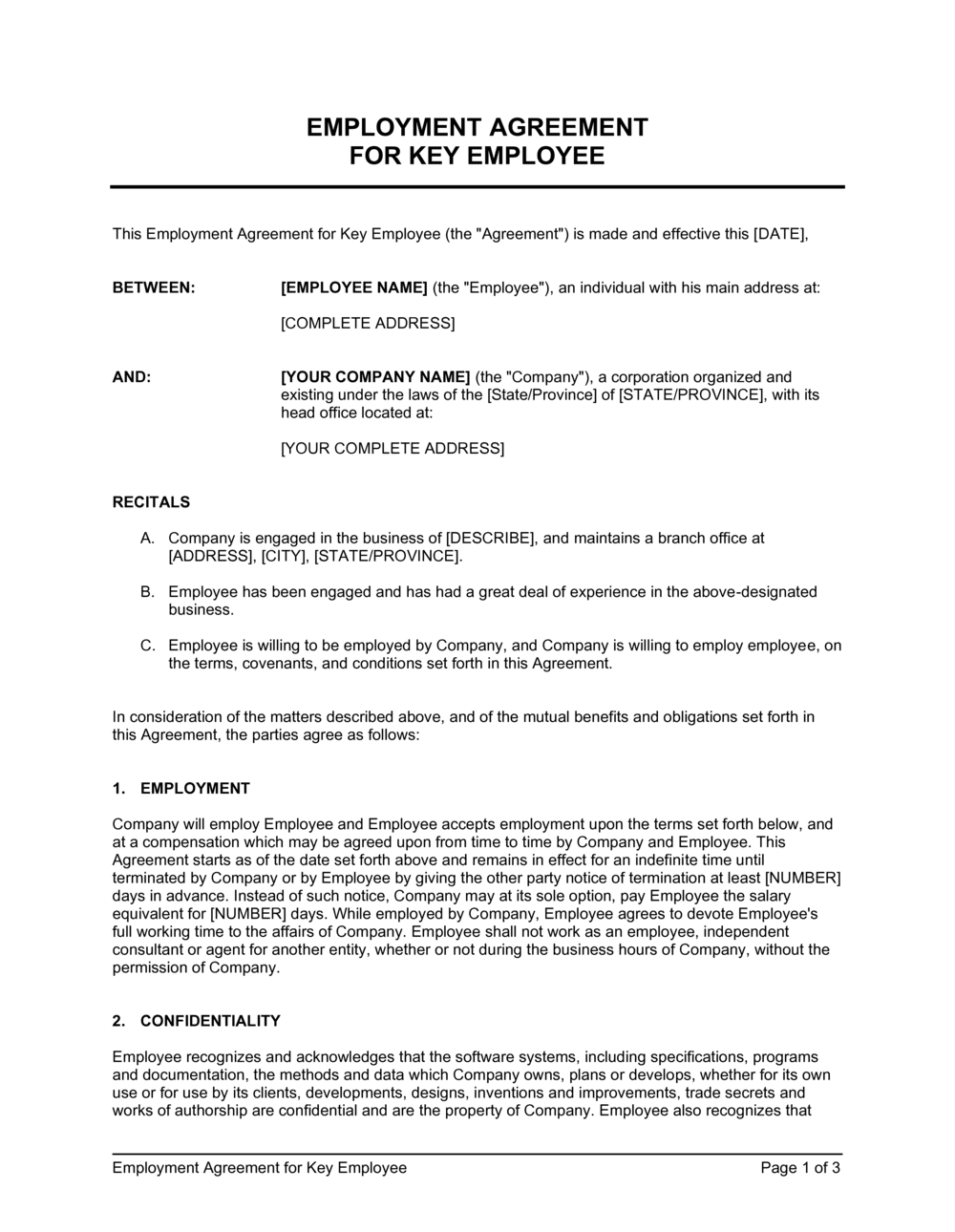
Part of your Business Operating System

This document is one of 3,000+ business & legal templates included in Business in a Box.

  • Fill-in-the-blanks — ready in minutes
  • 100% customizable Word document
  • Compatible with all office suites
  • Export to PDF and share electronically

Create your document in 3 simple steps.

From template to signed document — all inside one Business Operating System.
1
Download or open template

Access over 3,000+ business and legal templates for any business task, project or initiative.

2
Edit and fill in the blanks with AI

Customize your ready-made business document template and save it in the cloud.

3
Save, Share, Send, Sign

Share your files and folders with your team. Create a space of seamless collaboration.

Save time, save money, and create top-quality documents.

★★★★★

"Fantastic value! I'm not sure how I'd do without it. It's worth its weight in gold and paid back for itself many times."

Managing Director · Mall Farm
Robert Whalley
Managing Director, Mall Farm Proprietary Limited
★★★★★

"I have been using Business in a Box for years. It has been the most useful source of templates I have encountered. I recommend it to anyone."

Business Owner · 4+ years
Dr Michael John Freestone
Business Owner
★★★★★

"It has been a life saver so many times I have lost count. Business in a Box has saved me so much time and as you know, time is money."

Owner · Upstate Web
David G. Moore Jr.
Owner, Upstate Web

Run your business with a system — not scattered tools

Stop downloading documents. Start operating with clarity. Business in a Box gives you the Business Operating System used by over 250,000 companies worldwide to structure, run, and grow their business.

Start free · No credit card required