Employee Suggestion for Company Meeting Template

Free Word download β€’ Edit online β€’ Save & share with Drive β€’ Export to PDF

1 pageβ€’15–25 min to fillβ€’Difficulty: Standard
Learn more ↓
FreeEmployee Suggestion for Company Meeting Template

At a glance

What it is
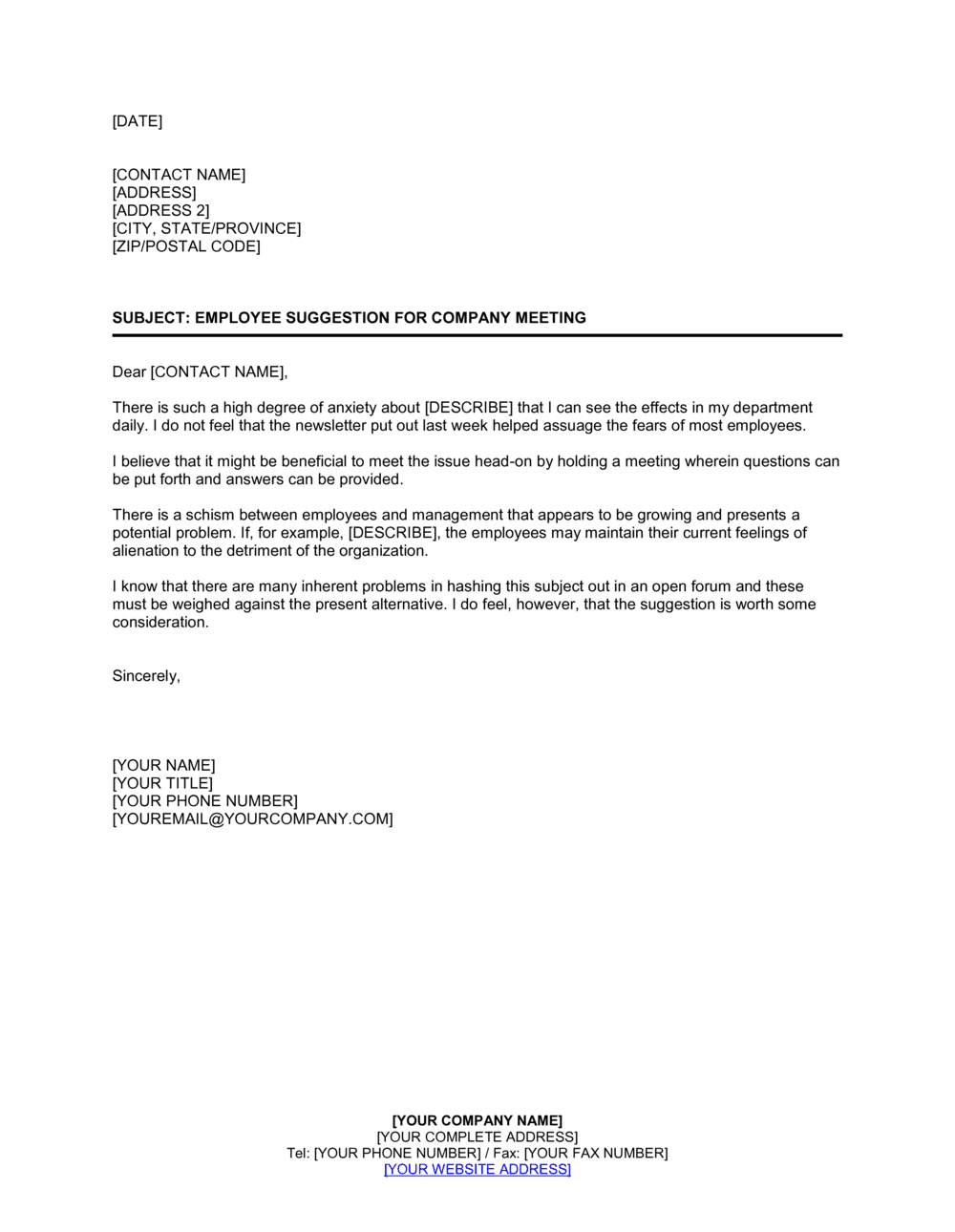
An Employee Suggestion For Company Meeting form is a structured one-page document that lets staff members formally submit ideas, concerns, or agenda topics they want addressed at an upcoming company or team meeting. This free Word download gives managers and HR teams a consistent format for collecting, logging, and prioritizing employee input before any meeting takes place.
When you need it
Use it before scheduled all-hands meetings, team huddles, or quarterly reviews when you want staff input on agenda items. It is also useful when employees have process improvement ideas or workplace concerns they want raised in a structured, documented way.
What's inside
Employee identification details, the meeting the suggestion relates to, a description of the suggestion or agenda topic, supporting rationale, a proposed outcome, and a section for management follow-up notes and disposition.

What is an Employee Suggestion For Company Meeting?

An Employee Suggestion For Company Meeting form is a structured one-page document that gives employees a formal, documented channel to submit ideas, concerns, or topics they want addressed at an upcoming team or company-wide meeting. Rather than relying on informal emails or verbal requests that get lost before agenda-setting, the form captures the suggestion, its supporting rationale, and the employee's desired outcome in a consistent format that managers can review, prioritize, and respond to systematically. It bridges the gap between the people closest to day-to-day operations and the meeting rooms where decisions get made.

Why You Need This Document

Without a structured intake process, employee ideas surface randomly β€” in hallway conversations, last-minute emails, or not at all β€” making it impossible to build a meeting agenda that reflects what staff actually need to discuss. The cost of that gap is real: recurring frustrations go unaddressed, good process improvement ideas never reach the people who can act on them, and employees conclude that their input is not valued. A standardized suggestion form fixes this by creating a transparent, time-bounded process with a documented response loop. Every submission gets reviewed, every submitter gets an answer, and every meeting agenda reflects genuine organizational priorities rather than whoever spoke up last.

Which variant fits your situation?

If your situation is…Use this template
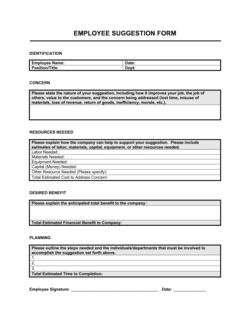
Collecting ongoing improvement ideas outside of a scheduled meetingEmployee Suggestion Form
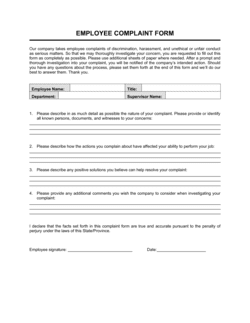
Formally documenting a workplace grievance through HREmployee Complaint Form
Capturing structured feedback after a meeting has taken placeMeeting Feedback Form
Recording all discussion points and decisions during a meetingMeeting Minutes Template
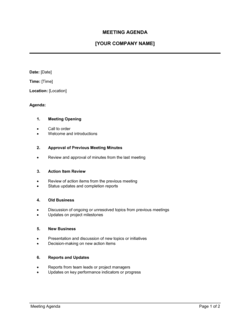
Outlining topics in sequence before a meeting beginsMeeting Agenda Template
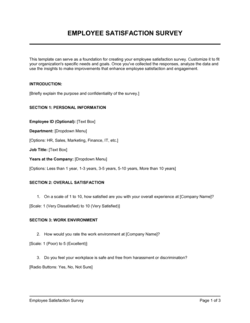
Gathering anonymous staff feedback on company culture or managementEmployee Satisfaction Survey

Common mistakes to avoid

❌ No submission deadline on the form

Why it matters: Without a deadline, employees submit suggestions the day before the meeting, leaving no time to review, prioritize, or add items to the agenda.

Fix: Print the submission deadline directly on the form and set it at least three business days before the agenda is finalized.
❌ Skipping the manager review section after receiving submissions

Why it matters: Employees who submit suggestions and never receive a documented response β€” accepted, deferred, or declined β€” assume the process is performative and stop using it.

Fix: Complete the manager review notes field within 48 hours of the submission deadline and communicate the outcome to each submitter before the meeting.

❌ Accepting vague one-line suggestions without prompting for detail

Why it matters: A suggestion that reads 'fix the scheduling process' cannot be turned into a meaningful agenda item or actioned after the meeting.

Fix: Add an instruction line below the description field: 'Please provide at least two sentences describing the specific issue or change you are proposing.'

❌ Collecting suggestions but never assigning follow-up owners

Why it matters: Action items recorded without a named owner and due date are almost never completed, which erodes employee trust in the suggestion process over time.

Fix: Ensure the follow-up section includes a mandatory owner field β€” leave it blank only when the decision is explicitly 'no action required.'

The 9 key fields, explained

Employee Name and Contact Information

Date of Submission

Meeting Reference

Suggestion or Topic Description

Supporting Rationale

Proposed Outcome or Solution

Priority Level

Manager Review Notes

Follow-Up Action and Owner

How to fill it out

  1. 1

    Distribute the form before the meeting deadline

    Share the template with your team at least five to seven business days before the scheduled meeting. Set a clear submission deadline so suggestions can be reviewed and the agenda finalized.

    πŸ’‘ State the submission deadline directly on the form itself β€” employees who receive the form without a deadline tend to submit at the last minute or not at all.

  2. 2

    Have employees complete the identification fields

    The employee enters their full name, department, job title, and contact email. If you want to offer anonymous submission, instruct them to leave this section blank and note that anonymity is permitted.

    πŸ’‘ If anonymity is an option, make it explicit in the instructions β€” employees will not assume it unless you say so.

  3. 3

    Specify the target meeting

    The employee fills in the name and date of the meeting they want the suggestion considered for. This prevents suggestions from being misrouted or held for the wrong session.

    πŸ’‘ Pre-populate the meeting name and date on the template before distributing it so employees cannot accidentally reference a past or unrelated meeting.

  4. 4

    Write a clear suggestion description

    The employee states the idea or topic in two to five sentences β€” specific enough that someone unfamiliar with the context can understand it without follow-up questions.

    πŸ’‘ Prompt employees with a simple sentence starter: 'I would like the team to discuss...' or 'I suggest we consider...' to reduce vague one-word entries.

  5. 5

    Complete the rationale and proposed outcome fields

    The employee explains why the topic matters and what a successful meeting outcome would look like. These two fields are the most important for helping managers prepare a substantive agenda item.

    πŸ’‘ Encourage employees to include at least one concrete example or data point in the rationale β€” even a single supporting fact strengthens the submission significantly.

  6. 6

    Set a priority level and submit

    The employee selects Low, Medium, or High priority and submits the form by the deadline. Managers collect all submissions before reviewing them together.

    πŸ’‘ Review all submissions as a batch rather than one at a time β€” seeing the full set helps you spot overlapping themes and prioritize the agenda more efficiently.

  7. 7

    Complete the manager review and follow-up sections

    The receiving manager documents the review decision, adds agenda placement notes, and records any follow-up actions with a named owner and due date before the meeting.

    πŸ’‘ Send every submitting employee a brief acknowledgment β€” even a one-line email β€” confirming their suggestion was received and whether it made the agenda.

Frequently asked questions

What is an employee suggestion form for company meetings?

An employee suggestion form for company meetings is a structured document that gives staff a formal channel to submit ideas, concerns, or agenda topics they want discussed at an upcoming meeting. It captures the suggestion, the employee's rationale, and their desired outcome β€” and includes a manager review section to record the disposition and any follow-up actions.

Why should companies use a structured suggestion form instead of email?

Email suggestions get buried, lose context, and are never systematically reviewed or logged. A structured form ensures every submission includes the same core information β€” description, rationale, proposed outcome, and priority β€” making it far easier to triage, respond to, and track across meetings. It also creates a documented record of what was raised and how it was handled.

When should employees submit their suggestions?

Employees should submit suggestions at least three to five business days before the target meeting so managers have time to review submissions, determine agenda placement, and notify submitters of the outcome. Setting and printing the deadline directly on the form is the most reliable way to ensure timely submissions.

Can suggestion forms be submitted anonymously?

Yes, if your organization chooses to allow it. Anonymous submissions encourage more candid feedback, particularly on sensitive topics like management practices or workplace culture. To enable anonymity, simply instruct employees that the name and contact fields are optional and confirm in writing that submissions without identification are accepted.

What happens after a suggestion is submitted?

The receiving manager or HR contact reviews the submission, records a decision in the manager review section β€” accepted for the agenda, deferred to a future meeting, or declined with a brief reason β€” and notifies the employee. If the suggestion is added to the agenda and discussed, any resulting action items are recorded in the follow-up section with a named owner and due date.

How is this form different from a general employee suggestion box?

A general suggestion box collects open-ended ideas at any time without a specific meeting or deadline in mind. This form is scoped to a particular upcoming meeting, requires the employee to link the suggestion to a specific agenda need, and includes a structured manager response section β€” making it more actionable and easier to close the loop with the submitter.

How many suggestions should be accepted per meeting agenda?

There is no universal rule, but most team meetings can absorb two to four employee-submitted topics without crowding out standing agenda items. For all-hands or quarterly meetings, five to eight may be appropriate. The priority field on the form helps managers select the most time-sensitive or widely relevant submissions when the volume exceeds what can be covered.

Should suggestion forms be stored after the meeting?

Yes. Retaining completed forms β€” including the manager review and follow-up sections β€” creates a searchable record of employee concerns raised over time, helps identify recurring themes, and demonstrates due diligence if a workplace dispute ever references an unaddressed concern. Store completed forms in your HR filing system or a shared drive folder organized by meeting date.

How this compares to alternatives

vs Employee Suggestion Form (general)

A general employee suggestion form collects open-ended improvement ideas at any time, independent of a scheduled meeting. This form is specifically scoped to an upcoming meeting agenda, includes a meeting reference field, and requires a structured manager response before the meeting takes place. Use the general form for ongoing idea collection and this one when you need to feed structured input into a specific meeting.

vs Meeting Agenda Template

A meeting agenda template is completed by the meeting organizer to outline discussion topics in sequence. The employee suggestion form is completed by individual staff members to propose what should be on that agenda. They work together: suggestions collected via this form inform and populate the agenda template.

vs Employee Complaint Form

An employee complaint form is used to formally report a grievance β€” misconduct, policy violation, or interpersonal conflict β€” that typically triggers an HR investigation. An employee suggestion form raises an idea or agenda topic in a constructive, forward-looking way. Use the complaint form when something has gone wrong and requires a formal response; use this form when an employee wants to contribute to a meeting discussion.

vs Meeting Minutes Template

Meeting minutes are completed during or after a meeting to record what was discussed and decided. The employee suggestion form is completed before the meeting to shape what gets discussed. Both documents form part of the same meeting governance cycle β€” suggestions inform the agenda; minutes record the outcome.

Industry-specific considerations

Professional Services

Used before quarterly practice meetings to surface billable efficiency ideas, client feedback themes, and staffing concerns from fee-earners who rarely attend planning sessions.

Manufacturing

Frontline workers use the form to flag safety hazards, equipment issues, or process bottlenecks before shift-lead or safety committee meetings where corrective action can be authorized.

Retail

Store associates submit scheduling, merchandising, and customer experience suggestions before manager meetings, channeling floor-level insight that rarely reaches leadership otherwise.

Healthcare

Clinical and administrative staff submit protocol improvement ideas or patient flow concerns before department meetings, creating a documented record that supports compliance and accreditation reviews.

Template vs pro β€” what fits your needs?

PathBest forCostTime
Use the templateAny organization collecting employee input before team or company-wide meetingsFree5 minutes to customize; 5–10 minutes per employee submission
Template + professional reviewOrganizations adding anonymous submission protocols or integrating the form into an HR workflow$0–$100 (HR advisor or office manager review)1–2 hours
Custom draftedLarge enterprises embedding suggestion collection into an HRIS or meeting management platform$500–$2,000+ (system configuration or custom form development)1–2 weeks

Glossary

Suggestion
A formally submitted employee idea or recommendation intended to improve a process, address a concern, or add a topic to a meeting agenda.
Agenda Item
A specific topic scheduled for discussion during a meeting, identified in advance so participants can prepare.
Disposition
The outcome or decision made regarding a submitted suggestion β€” accepted, declined, deferred, or referred to another person or team.
Rationale
The employee's explanation of why the suggestion is relevant or beneficial, providing context that helps managers evaluate its merit.
Follow-Up Action
A task or next step assigned to a specific person after a suggestion is reviewed, ensuring accountability for the response.
Submission Date
The date the employee completed and submitted the form, used to track timeliness and prioritize items for upcoming meetings.
Anonymous Submission
A form variant in which the employee's name is omitted, allowing candid feedback without fear of identification or retaliation.
Escalation
The process of forwarding a suggestion or concern to a higher level of management when the immediate supervisor is unable or unsuitable to address it.

Part of your Business Operating System

This document is one of 3,000+ business & legal templates included in Business in a Box.

  • Fill-in-the-blanks β€” ready in minutes
  • 100% customizable Word document
  • Compatible with all office suites
  • Export to PDF and share electronically

Create your document in 3 simple steps.

From template to signed document β€” all inside one Business Operating System.
1
Download or open template

Access over 3,000+ business and legal templates for any business task, project or initiative.

2
Edit and fill in the blanks with AI

Customize your ready-made business document template and save it in the cloud.

3
Save, Share, Send, Sign

Share your files and folders with your team. Create a space of seamless collaboration.

Save time, save money, and create top-quality documents.

β˜…β˜…β˜…β˜…β˜…

"Fantastic value! I'm not sure how I'd do without it. It's worth its weight in gold and paid back for itself many times."

Managing Director Β· Mall Farm
Robert Whalley
Managing Director, Mall Farm Proprietary Limited
β˜…β˜…β˜…β˜…β˜…

"I have been using Business in a Box for years. It has been the most useful source of templates I have encountered. I recommend it to anyone."

Business Owner Β· 4+ years
Dr Michael John Freestone
Business Owner
β˜…β˜…β˜…β˜…β˜…

"It has been a life saver so many times I have lost count. Business in a Box has saved me so much time and as you know, time is money."

Owner Β· Upstate Web
David G. Moore Jr.
Owner, Upstate Web

Run your business with a system β€” not scattered tools

Stop downloading documents. Start operating with clarity. Business in a Box gives you the Business Operating System used by over 250,000 companies worldwide to structure, run, and grow their business.

Start freeΒ Β·Β No credit card required