Board Resolution Approving the Award of a Contract Template

Free Word download • Edit online • Save & share with Drive • Export to PDF

1 page20–25 min to fillDifficulty: StandardSignature requiredLegal review recommended
Learn more ↓
FreeBoard Resolution Approving the Award of a Contract Template

At a glance

What it is
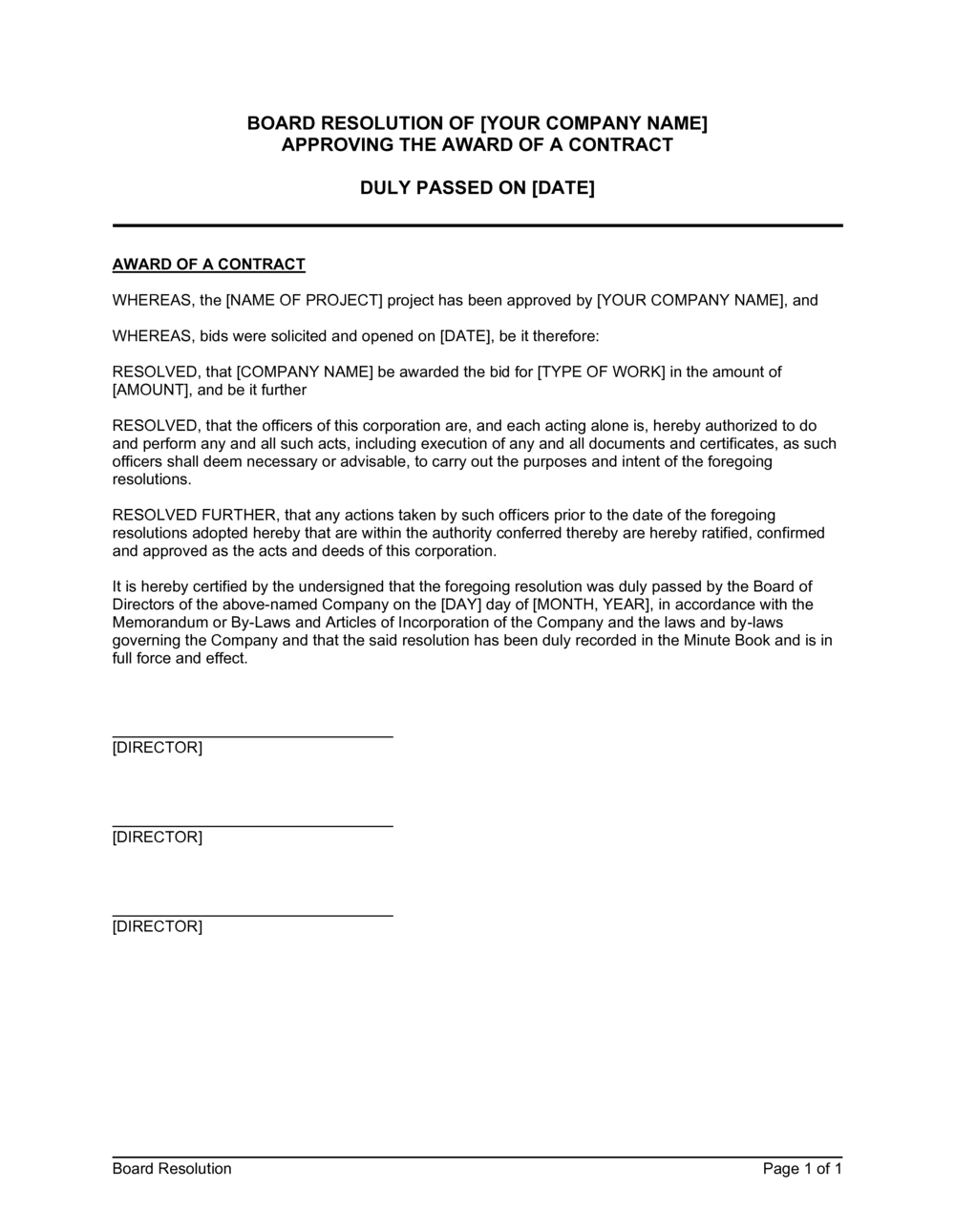
A Board Resolution Approving the Award of a Contract is a formal corporate governance document through which a company's board of directors officially authorizes the execution of a specific contract on behalf of the organization. This free Word download gives you a structured, immediately editable template you can adapt to your company's details and export as PDF for your corporate records.
When you need it
Use it whenever a material contract — a vendor agreement, a construction contract, a major service engagement, or a supply deal — requires board-level authorization under the company's bylaws, articles of incorporation, or applicable corporate law before a signatory can bind the organization.
What's inside
Meeting or consent details, a recitals block establishing context, the operative resolution clause authorizing the specific contract, the identity and authority of the authorized signatory, and the effective date — along with signature blocks for the required number of directors or the corporate secretary.

What is a Board Resolution Approving the Award of a Contract?

A Board Resolution Approving the Award of a Contract is a formal corporate governance document through which a company's board of directors officially records its decision to authorize the organization to enter into and execute a specific contract with a named counterparty. It is an internal governance act — not the contract itself — that creates the documented corporate authority allowing a designated officer to bind the company. The resolution becomes a permanent part of the corporate minute book and provides counterparties, lenders, and regulators with proof that the signatory had proper authority at the time the agreement was executed. Most bylaws, corporate statutes, and sophisticated counterparties require one before any material contract can be validly signed on the company's behalf.

Why You Need This Document

Without a board resolution, a contract signed by an officer who exceeded their delegated authority may be voidable — and even where courts protect the counterparty under apparent authority doctrine, the company faces internal governance liability and reputational damage. Lenders conducting due diligence on a credit facility, acquirers reviewing your data room during M&A, and government procurement offices processing a contract award will all request certified evidence that the board approved the agreement. An officer who signs a major contract without one creates a gap in the corporate record that is costly and sometimes impossible to close retroactively. This template gives you a properly structured, jurisdiction-ready resolution you can complete in under 30 minutes — eliminating the governance gap before it becomes a transaction problem.

Which variant fits your situation?

If your situation is…Use this template
Approving a major construction or infrastructure contractBoard Resolution Approving the Award of a Contract (Construction)
Authorizing a real estate purchase or lease agreementBoard Resolution Authorizing Purchase of Real Property
Approving a loan or credit facilityBoard Resolution Authorizing Borrowing
Ratifying a contract already signed before board approvalBoard Resolution Ratifying Corporate Actions
Approving an amendment or renewal of an existing contractBoard Resolution Approving Contract Amendment
Authorizing contract execution without a full board meeting (written consent)Written Consent of the Board of Directors in Lieu of Meeting
Delegating contract-signing authority to an officer for routine agreementsBoard Resolution Delegating Authority to Officers

Common mistakes to avoid

❌ Passing the resolution after the contract is signed

Why it matters: A resolution adopted after execution does not authorize the signing — it can only ratify it, and ratification is not available in all jurisdictions or for all contract types. Lenders and acquirers who discover retroactive approvals may question the governance culture of the entire organization.

Fix: Adopt the resolution before or simultaneously with contract execution. Build a governance calendar that triggers resolution drafting as soon as a contract enters final negotiation.

❌ Using a generic template that doesn't name the specific contract

Why it matters: A resolution that authorizes 'any contract with Vendor X' or 'services agreements generally' provides no useful record of what the board actually reviewed and can be read to authorize far broader commitments than intended.

Fix: Identify the contract by its full title, counterparty legal name, value, and date in both the recitals and the operative clause, and attach the final or near-final contract as Exhibit A.

❌ Omitting the contract value or financial cap

Why it matters: A resolution without a stated value provides no financial-control record, fails many lenders' and auditors' documentation requirements, and leaves no evidence that the board understood the financial commitment it was approving.

Fix: Always state the total contract value or a not-to-exceed cap. For variable-fee arrangements, state the approved annual budget amount and the total multi-year commitment.

❌ Failing to confirm quorum or unanimous consent

Why it matters: A resolution adopted without the required quorum is voidable under most corporate statutes. If a counterparty or court later scrutinizes the resolution, the absence of a quorum statement shifts the burden of proof onto the corporation.

Fix: Include an explicit quorum confirmation in the preamble for meeting-based resolutions, or use a written consent signed by all directors to eliminate the quorum question entirely.

The 9 key clauses, explained

Meeting or consent preamble

In plain language: States whether the resolution was passed at a duly convened board meeting or by written consent in lieu of meeting, records the date, and confirms quorum or unanimous agreement.

Sample language
At a duly convened meeting of the Board of Directors of [COMPANY LEGAL NAME] (the 'Corporation') held on [DATE], at which a quorum was present and acting throughout, the following resolution was duly adopted.

Common mistake: Failing to confirm quorum in the preamble. If the resolution is later challenged, the absence of a quorum statement can render the resolution voidable under most corporate statutes.

Recitals block

In plain language: Provides factual background — what contract is being approved, who the counterparty is, why the board is being asked to act, and any prior actions or recommendations that led to this resolution.

Sample language
WHEREAS, the Corporation has negotiated the terms of a [DESCRIPTION OF CONTRACT] with [COUNTERPARTY LEGAL NAME] (the 'Counterparty') for [DESCRIPTION OF GOODS/SERVICES]; and WHEREAS, the Board has reviewed the terms of the proposed contract and determined that entering into it is in the best interests of the Corporation.

Common mistake: Using vague recitals that do not identify the specific contract or counterparty. If a dispute arises about which agreement was approved, an undescriptive recitals block provides no guidance.

Operative resolution clause

In plain language: The core 'RESOLVED THAT' statement formally authorizing the corporation to enter into and execute the specified contract — the sentence that creates the legal authority.

Sample language
RESOLVED THAT the Corporation be and is hereby authorized to enter into and execute the [CONTRACT NAME] with [COUNTERPARTY LEGAL NAME], substantially in the form attached hereto as Exhibit A, on such terms as the authorized officer(s) deem appropriate.

Common mistake: Drafting the operative clause without referencing the attached contract or a description specific enough to identify it. A generic 'any contract with Counterparty' clause may authorize far more than the board intended.

Authorized signatory designation

In plain language: Identifies by name and title the specific officer or officers empowered to sign the contract and any ancillary documents on the corporation's behalf.

Sample language
RESOLVED FURTHER THAT [OFFICER NAME], [TITLE], be and is hereby authorized and directed to execute and deliver the Contract and all documents, instruments, and agreements related thereto on behalf of the Corporation.

Common mistake: Naming only a title without a name, or naming only a name without a title. Counterparties and their lawyers need to verify the signatory's authority, and an ambiguous designation creates friction at closing.

Scope of authority

In plain language: Clarifies the extent of the authorized signatory's powers — whether they can negotiate final terms, approve amendments, and execute ancillary documents, or only sign the contract as presented.

Sample language
RESOLVED FURTHER THAT the authorized officer is hereby granted authority to negotiate, agree upon, and finalize any modifications to the Contract that are not material in nature, and to execute all ancillary agreements, certificates, and instruments required to consummate the transaction.

Common mistake: Granting unlimited authority without any qualification. An open-ended scope clause can expose the corporation to liability for side agreements or amendments the board never reviewed.

Contract description and value

In plain language: Specifies the contract subject matter, the counterparty, the total contract value or budget authorization, and the term or delivery timeline so the resolution is self-contained as a record.

Sample language
The Contract relates to [DESCRIPTION OF SERVICES/GOODS], to be provided by [COUNTERPARTY NAME] at a total contract value not to exceed $[AMOUNT], commencing [START DATE] and expiring [END DATE], unless earlier terminated.

Common mistake: Omitting the contract value or cap. A board resolution that approves a contract without stating the financial commitment provides no financial-control record and may not satisfy audit or lender requirements.

Effective date

In plain language: States the date on which the resolution and the authority it grants take effect — which may be the date of the meeting, the date of signing, or another specified date.

Sample language
This Resolution shall be effective as of [DATE] and shall remain in full force and effect until the Contract has been fully executed or until revoked by subsequent action of the Board.

Common mistake: Leaving the effective date blank or stating it as 'immediately.' Counterparties and auditors need a specific date for their records, and an undated resolution can complicate enforceability analysis.

Certification clause

In plain language: A statement, typically signed by the corporate secretary or chair, certifying that the resolution was duly adopted, that the signatures are genuine, and that it is a true extract from the minute book.

Sample language
I, [CORPORATE SECRETARY NAME], Secretary of [COMPANY LEGAL NAME], hereby certify that the foregoing is a true, correct, and complete copy of a resolution duly adopted by the Board of Directors of the Corporation on [DATE], and that such resolution has not been amended or revoked and is in full force and effect.

Common mistake: Omitting the certification entirely when the resolution is sent to a counterparty or lender. Without a certification, the recipient has no assurance that the resolution was actually adopted or that it has not been superseded.

Director signatures

In plain language: Signature blocks for the required number of directors — or all directors in the case of a written consent — confirming their vote or written approval of the resolution.

Sample language
IN WITNESS WHEREOF, the undersigned, being all / a majority of the directors of [COMPANY LEGAL NAME], have executed this Resolution as of [DATE]. [DIRECTOR NAME], Director ____________________

Common mistake: Collecting only one director's signature when the bylaws or applicable statute require a majority or specific quorum. A single signature does not constitute a board resolution in most jurisdictions.

How to fill it out

  1. 1

    Confirm the authorization requirement in your bylaws

    Before drafting, review the company's bylaws and any board-adopted delegation-of-authority policy to confirm which contracts require board approval by type, value, or counterparty. Different thresholds apply in different organizations.

    💡 If the bylaws are silent on the threshold, default to board approval for any contract exceeding one month's revenue or $50,000 — a common internal benchmark.

  2. 2

    Enter the corporation's full legal name and meeting details

    Use the corporation's exact registered legal name as it appears in the articles of incorporation. Record the meeting date, time, and location — or state that the resolution is adopted by written consent in lieu of meeting.

    💡 Cross-reference the registered name against your jurisdiction's corporate registry to avoid mismatches that create enforceability questions.

  3. 3

    Draft the recitals with specific contract details

    Identify the counterparty by full legal name, describe the contract subject matter in one to two sentences, and summarize the business rationale the board considered. Attach the contract as Exhibit A.

    💡 Reference the contract by the exact title used in the agreement itself — 'Master Services Agreement dated [DATE]' not just 'services agreement' — to eliminate any ambiguity about what was approved.

  4. 4

    Write the operative resolution clause

    Draft the 'RESOLVED THAT' statement authorizing the corporation to execute the contract. Reference Exhibit A or provide a specific description of the contract. Add a 'RESOLVED FURTHER THAT' clause for each additional authorization — signatory designation, scope of authority, and so on.

    💡 Each discrete authorization should be its own 'RESOLVED FURTHER THAT' clause. Stacking multiple authorizations in one sentence creates ambiguity about what exactly was approved.

  5. 5

    Name the authorized signatory by name and title

    Designate the specific officer or director authorized to sign the contract. Include both the individual's full name and their corporate title. If more than one signatory is needed, list each one explicitly.

    💡 Check the counterparty's requirements — some require two authorized signatories or a specific officer title (e.g., CEO or CFO only) before they will countersign.

  6. 6

    State the contract value and term

    Insert the total contract value or a not-to-exceed cap, the start date, and the expiry or completion date. If the value is variable, state the approved budget amount rather than leaving it blank.

    💡 For multi-year contracts, break out the annual spend as well as the total commitment so the resolution provides useful financial-control context.

  7. 7

    Set the effective date and collect director signatures

    Enter a specific effective date for the resolution. Obtain signatures from the required number of directors per your bylaws — typically a majority — or from all directors if using a written consent mechanism.

    💡 For written consents, circulate the document for signature before the contract is executed, not after — post-execution consents are valid as ratification but carry more legal risk.

  8. 8

    Have the corporate secretary certify and file the resolution

    The corporate secretary should sign the certification clause, attach the resolution to the executed contract, and file both in the corporate minute book. Provide a certified copy to the counterparty or lender if requested.

    💡 Retain the counterparty-executed contract and the certified resolution together in a single file so due-diligence requests in future financing or M&A transactions can be answered in minutes.

Frequently asked questions

What is a board resolution approving the award of a contract?

A board resolution approving the award of a contract is a formal written decision by a company's board of directors authorizing the organization to enter into and execute a specific contract with a named counterparty. It identifies the contract, designates the officer authorized to sign, and becomes part of the corporate minute book as permanent evidence of the board's decision. Most corporate bylaws and many counterparties require one before a major contract can be validly executed.

When is a board resolution required to sign a contract?

A board resolution is typically required when the company's bylaws set a monetary or strategic threshold above which board approval is mandatory — commonly $50,000–$250,000 for mid-sized companies. It is also required when a counterparty, lender, or government agency demands evidence of corporate authorization, when the contract involves real property or intellectual property, or when corporate statutes in the applicable jurisdiction mandate it for specific transaction types.

Can a single director sign a contract without a board resolution?

In most jurisdictions, an officer with apparent or actual authority — typically a CEO or president — can bind the corporation to routine contracts without a board resolution. However, for material contracts, most bylaws require board approval above a defined threshold. Even where not strictly required, a counterparty who requests evidence of authority will expect a board resolution, and signing without one creates enforceability risk if the officer's authority is later disputed.

What is the difference between a board resolution and a written consent?

A board resolution is typically adopted at a duly convened meeting of the board where directors vote in person, by phone, or by video. A written consent — sometimes called an action by unanimous written consent — achieves the same result without a meeting, provided all directors (or, in some jurisdictions, a majority) sign the consent document. Both have the same legal effect; the written consent is faster but requires every director's signature rather than just a quorum.

Does a board resolution need to be notarized?

Notarization is not required in most jurisdictions for a standard board resolution to be valid. The certification by the corporate secretary typically provides sufficient authentication for counterparties and lenders. However, certain government contracts, real property transactions, and cross-border filings may require a notarized or apostilled resolution — confirm the counterparty's requirements before finalizing the document.

Can a board resolution be signed after the contract is already executed?

A post-execution resolution functions as a ratification, not an authorization, and ratification is subject to additional legal requirements in some jurisdictions — including that the board had the power to approve the act at the time it was taken. Some counterparties and most lenders will not accept a retroactive resolution as equivalent to a pre-execution authorization. The correct practice is to adopt the resolution before the contract is signed.

How long should a board resolution be kept on file?

Board resolutions should be retained permanently as part of the corporate minute book. There is no statute of limitations that allows corporate governance records to be destroyed — lenders, acquirers, and regulators routinely request resolutions going back five to ten years or more during due diligence or audits. Store certified copies with the executed contract they authorized.

Does every contract require a separate board resolution?

No — many companies adopt a standing delegation-of-authority policy that authorizes specific officers to execute contracts within defined parameters (e.g., up to $100,000, for terms not exceeding two years, with approved vendors) without requiring a separate resolution each time. A specific board resolution is needed for contracts that exceed those delegated thresholds, involve new counterparties not covered by the policy, or are otherwise flagged as requiring board review.

What happens if a contract is signed without the required board approval?

A contract executed without required board approval may be voidable by the corporation on the grounds that the signatory lacked authority. Whether the corporation can actually void it depends on whether the counterparty had knowledge of the authority limitation and whether the doctrine of apparent authority applies. Courts in most jurisdictions protect good-faith counterparties who relied on reasonable indications of authority — meaning the corporation may be bound regardless, while the officer who exceeded their authority faces internal liability.

How this compares to alternatives

vs Written Consent of Directors in Lieu of Meeting

A written consent achieves the same legal result as a board resolution without requiring a formal meeting — all directors (or the required majority) sign the document outside of a meeting. Use a written consent when speed is critical and all directors are available to sign; use a meeting-based resolution when directors need to deliberate or when the bylaws require a formal meeting for certain decisions.

vs Corporate Resolution (General)

A general corporate resolution covers a broad range of board decisions — opening bank accounts, appointing officers, amending bylaws — and is not specific to contract approval. A board resolution approving a contract award is a specialized resolution focused on a single transaction, with contract-specific operative language, signatory designation, and a contract value statement that a general template does not include.

vs Letter of Intent

A letter of intent records preliminary commercial agreement between parties before a final contract is negotiated — it is generally non-binding on key terms. A board resolution, by contrast, is an internal corporate governance document that authorizes execution of the final, binding contract. The resolution typically follows the letter of intent once negotiation is complete.

vs Contract Signing Authority Policy

A contract signing authority policy is a standing internal document that pre-authorizes officers to execute contracts within defined parameters without recurring board approval. A board resolution is a transaction-specific document required when a contract exceeds those delegated limits or when external parties demand evidence of board authorization. The two work together — the policy handles routine contracts; the resolution handles exceptions.

Industry-specific considerations

Construction and Infrastructure

Large project contracts often exceed any officer's delegated authority and require board approval before commencement; the resolution should reference the contract value, milestone schedule, and retention terms.

Technology / SaaS

Enterprise software, cloud infrastructure, and data-processing agreements frequently require board-level sign-off on data governance, liability caps, and multi-year financial commitments above internal thresholds.

Healthcare

Vendor contracts involving patient data, medical devices, or outsourced clinical services typically require board authorization to satisfy regulatory compliance and accreditation requirements.

Financial Services

Banking regulations and financial institution bylaws commonly mandate board approval for material third-party contracts, outsourcing arrangements, and any agreement involving customer data or core banking functions.

Government and Public Sector

Public procurement rules frequently require a certified board or council resolution as a condition of contract award, particularly for contracts funded by grants or public budget appropriations.

Real Estate

Property acquisition, construction management, and long-term lease agreements almost always require board authorization, and the counterparty's title insurer or lender will request a certified resolution before closing.

Jurisdictional notes

United States

Corporate authority requirements are governed by state law — Delaware, California, and New York each have their own rules on board quorum, written consent, and officer authority. Most states allow action by unanimous written consent unless the articles prohibit it. For publicly traded companies, SEC and stock exchange rules impose additional approval requirements for material contracts.

Canada

The Canada Business Corporations Act (CBCA) and provincial equivalents govern board resolution requirements. Written resolutions signed by all directors have the same effect as a meeting resolution under most Canadian statutes. Quebec corporations operating under the Business Corporations Act must ensure resolutions comply with both provincial corporate law and, where applicable, French-language requirements for government-facing documents.

United Kingdom

Under the Companies Act 2006, private companies may pass written resolutions signed by a simple majority of eligible members; public companies must hold a formal meeting. Board minutes and resolutions must be retained for at least 10 years. Where a company's articles restrict director authority, a resolution is essential to demonstrate that the signatory acted within the scope granted by the board.

European Union

Corporate governance rules vary significantly by member state — German GmbH and AG requirements differ substantially from French SAS or SCI rules. Most civil-law jurisdictions require resolutions to be in writing and retained in the corporate records. GDPR considerations arise where the contract being approved involves data processing, and the resolution should reference any data protection impact assessment conducted before board approval.

Template vs lawyer — what fits your deal?

PathBest forCostTime
Use the templateStraightforward commercial contracts where the board simply needs to authorize a known counterparty and valueFree15–30 minutes
Template + legal reviewHigh-value contracts, government procurement, or regulated industries where the resolution must meet specific external requirements$150–$400 for a lawyer or corporate secretary review1–2 business days
Custom draftedComplex multi-party transactions, cross-border contracts, M&A-related agreements, or situations where the resolution must satisfy a regulator's specific form requirements$500–$2,000+3–7 business days

Glossary

Board Resolution
A formal written record of a decision made by a company's board of directors, which becomes part of the corporate minute book and binds the organization.
Quorum
The minimum number of directors that must be present or represented at a board meeting for the meeting to be validly constituted and for resolutions to be passed.
Unanimous Written Consent
A mechanism allowing directors to pass a resolution without holding a meeting, provided all directors sign a written consent document.
Authorized Signatory
The specific officer, director, or agent formally designated by the board resolution to execute the contract on behalf of the corporation.
Ultra Vires
A Latin term meaning 'beyond the powers' — describes a corporate act taken without proper authorization, which may be void or voidable.
Recitals
Background statements in a resolution that set out the context and rationale for the board's decision without themselves being the operative legal act.
Operative Clause
The 'RESOLVED THAT' language in a board resolution that constitutes the actual decision and creates binding corporate authority.
Corporate Minute Book
The official corporate record-keeping binder or system that contains articles of incorporation, bylaws, share registers, and all board and shareholder resolutions.
Ratification
A subsequent board approval that formally validates a contract or action that was taken before the resolution was passed, giving it retroactive authority.
Counterparty
The other party to the contract being approved — the vendor, service provider, customer, or entity on the opposite side of the agreement.

Part of your Business Operating System

This document is one of 3,000+ business & legal templates included in Business in a Box.

  • Fill-in-the-blanks — ready in minutes
  • 100% customizable Word document
  • Compatible with all office suites
  • Export to PDF and share electronically

Create your document in 3 simple steps.

From template to signed document — all inside one Business Operating System.
1
Download or open template

Access over 3,000+ business and legal templates for any business task, project or initiative.

2
Edit and fill in the blanks with AI

Customize your ready-made business document template and save it in the cloud.

3
Save, Share, Send, Sign

Share your files and folders with your team. Create a space of seamless collaboration.

Save time, save money, and create top-quality documents.

★★★★★

"Fantastic value! I'm not sure how I'd do without it. It's worth its weight in gold and paid back for itself many times."

Managing Director · Mall Farm
Robert Whalley
Managing Director, Mall Farm Proprietary Limited
★★★★★

"I have been using Business in a Box for years. It has been the most useful source of templates I have encountered. I recommend it to anyone."

Business Owner · 4+ years
Dr Michael John Freestone
Business Owner
★★★★★

"It has been a life saver so many times I have lost count. Business in a Box has saved me so much time and as you know, time is money."

Owner · Upstate Web
David G. Moore Jr.
Owner, Upstate Web

Run your business with a system — not scattered tools

Stop downloading documents. Start operating with clarity. Business in a Box gives you the Business Operating System used by over 250,000 companies worldwide to structure, run, and grow their business.

Start free · No credit card required