Exit Interview Form Template

Free Word download β€’ Edit online β€’ Save & share with Drive β€’ Export to PDF

3 pagesβ€’15–25 min to fillβ€’Difficulty: Standard
Learn more ↓
FreeExit Interview Form Template

At a glance

What it is
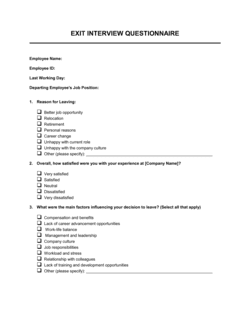
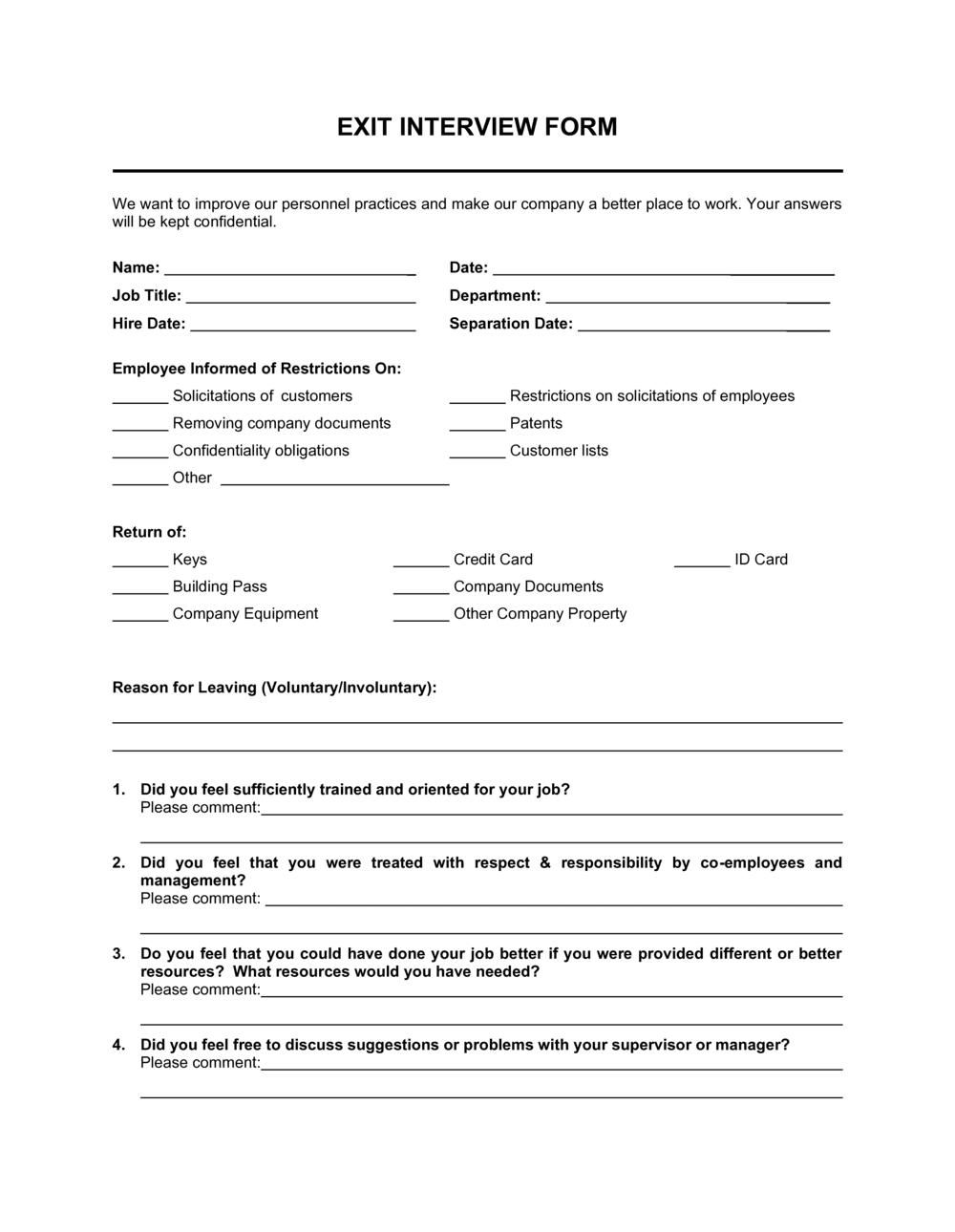
An Exit Interview Form is a structured HR document used to capture candid feedback from employees on their last day or during their final weeks of employment. This free Word download covers all standard exit interview topics β€” reasons for leaving, job satisfaction, manager and team experience, and suggestions for improvement β€” so HR can collect consistent, comparable data across every departure.
When you need it
Use it whenever an employee resigns, retires, or is otherwise departing voluntarily, as part of the standard offboarding process. Completing it before the employee's last day ensures candid, timely responses while the experience is fresh.
What's inside
Employee and role identification fields, primary reason for leaving, job satisfaction ratings, manager and team feedback, compensation and benefits assessment, suggestions for improvement, and an optional signature block for the interviewing HR representative.

What is an Exit Interview Form?

An Exit Interview Form is a structured HR document used to collect candid feedback from employees who are leaving an organization. It guides a conversation β€” or a self-completed written response β€” through the key dimensions of the employee experience: primary reason for leaving, satisfaction with the role and manager, team culture, compensation competitiveness, and suggestions for improvement. By using a consistent form for every departure, HR teams build a comparable dataset that reveals patterns invisible in any single conversation, such as recurring management issues, compensation gaps, or culture problems concentrated in specific departments.

Why You Need This Document

Without a structured exit form, departing employee feedback is lost to informal hallway conversations or not collected at all β€” and voluntary turnover costs between 50% and 200% of an employee's annual salary when recruitment, onboarding, and lost productivity are counted together. A standardized form ensures every departure produces usable data, not just impressions. It protects against bias in reporting by creating a written record rather than relying on memory, and it gives HR a defensible basis for presenting retention recommendations to leadership. This template gives you a ready-to-use form in minutes β€” customize the rating scales and free-text prompts to your organization, then use it consistently from the first resignation onward.

Which variant fits your situation?

If your situation is…Use this template
Conducting a structured in-person interview with HRExit Interview Form
Collecting feedback anonymously after departureEmployee Satisfaction Survey
Documenting the full offboarding process including asset returnsEmployee Offboarding Checklist
Terminating an employee and documenting the separationEmployee Termination Form
Issuing a formal resignation acceptance letterAcceptance of Resignation Letter
Measuring engagement across the entire workforce, not just departing employeesEmployee Engagement Survey

Common mistakes to avoid

❌ Conducting the exit interview on the last day

Why it matters: Employees on their last day are distracted by equipment returns, farewells, and final admin. Response quality drops significantly and emotional tone skews the data.

Fix: Schedule the interview during the second-to-last or third-to-last day of employment, when the employee is still mentally engaged but past the point of reconsideration.

❌ Having the departing employee's direct manager conduct the interview

Why it matters: Employees withhold candid feedback about management when the manager is in the room β€” eliminating the most valuable data the form is designed to capture.

Fix: Assign a neutral HR representative or a skip-level manager to conduct all exit interviews. Never route the completed form back to the direct manager without removing identifiable comments.

❌ Collecting responses without aggregating them

Why it matters: A single exit interview is an anecdote. Without quarterly or annual aggregation by department, tenure band, and reason code, the data cannot drive policy decisions.

Fix: Build a simple tracker β€” even a spreadsheet β€” that logs each response category so you can run turnover-reason frequency reports at the end of each quarter.

❌ Skipping the form for involuntary departures

Why it matters: Exit data collected only from voluntary leavers creates a biased picture of the employee experience and misses feedback relevant to performance management and culture.

Fix: Use a modified version of the form for all separations, adjusting the reason-for-leaving field to reflect involuntary circumstances while preserving culture and management feedback fields.

The 9 key fields, explained

Employee and role identification

Primary reason for leaving

Job satisfaction ratings

Manager and leadership feedback

Team and culture assessment

Compensation and benefits assessment

Suggestions for improvement

Would you recommend this employer

Interviewer notes and follow-up

How to fill it out

  1. 1

    Schedule the interview before the last day

    Book a 30-minute session during the employee's final week β€” not on their last day when emotions and logistics compete for attention. Send the form in advance so they can review the questions.

    πŸ’‘ Employees scheduled midweek give more complete responses than those interviewed on their final Friday afternoon.

  2. 2

    Complete the identification fields before the meeting

    Pre-fill the employee's name, job title, department, start date, and last day using your HRIS data so you do not spend interview time on administrative details.

    πŸ’‘ Verifying tenure against the HRIS before the interview catches data errors that would skew cohort-level analysis later.

  3. 3

    Walk through reason for leaving and satisfaction ratings together

    Have the employee select their primary departure reason and complete the 1–5 satisfaction ratings while you are present β€” this lets you ask clarifying follow-up questions on any low score.

    πŸ’‘ If an employee rates any dimension a 1 or 2, ask one open follow-up: 'Can you give me a specific example?' Specifics are what make the data actionable.

  4. 4

    Record manager and culture feedback verbatim

    Use the employee's own words in the open-text fields rather than paraphrasing. Direct quotes give managers and leadership teams the clearest signal of what needs to change.

    πŸ’‘ Reassure the employee that verbatim responses are aggregated and reviewed at a team level, not shared with their direct manager individually β€” this increases candor.

  5. 5

    Note compensation feedback in context

    If the employee flags compensation as a factor, ask whether it was the primary driver or one of several. Record both the rating and their qualitative explanation for accurate classification.

    πŸ’‘ A compensation complaint paired with a manager satisfaction score of 1 or 2 usually means the root cause is management, not pay.

  6. 6

    Complete the interviewer notes section after the employee leaves

    Record your observations, flag recurring themes (e.g., second departure citing the same manager in 90 days), and document any follow-up actions in the interviewer-only section.

    πŸ’‘ File the completed form in your HRIS within 24 hours while the conversation is fresh and before offboarding tasks displace it.

Frequently asked questions

What is an exit interview form?

An exit interview form is a structured HR document used to collect feedback from an employee who is leaving the organization. It typically covers their primary reason for leaving, satisfaction with their role and manager, compensation assessment, and suggestions for improvement. The goal is to gather consistent, comparable data that HR can use to identify retention risks and management issues across the organization.

Who should conduct the exit interview?

A neutral HR representative or people operations lead should conduct the interview β€” never the departing employee's direct manager. Employees give significantly more candid feedback when they are not speaking directly to the person they may be criticizing. For small businesses without an HR function, a skip-level manager or business owner is a reasonable alternative.

Are exit interviews confidential?

Responses should be treated as confidential at the individual level and shared with management only in aggregate or anonymized form. Communicating this clearly to the employee before the interview increases the quality and candor of their responses. If verbatim quotes are shared with leadership for coaching purposes, remove identifying details first.

When should the exit interview be scheduled?

Ideally during the employee's second-to-last or third-to-last day of employment β€” close enough to departure that their experience is fresh, but not so late that logistics and emotions dominate. Scheduling it in advance and sharing the form beforehand gives the employee time to reflect, which produces more thoughtful, specific answers.

What questions should an exit interview form include?

A complete form covers at minimum: primary reason for leaving, overall job satisfaction ratings, manager and leadership feedback, team culture assessment, compensation and benefits evaluation, suggestions for improvement, and whether the employee would recommend the company as an employer. Each section should include both structured (rating or multiple-choice) and open-text fields to balance quantitative tracking with qualitative insight.

What should HR do with exit interview data?

Aggregate responses quarterly by department, tenure band, and departure-reason category. Report trends to senior leadership and flag recurring themes β€” particularly around specific managers or teams β€” for coaching or structural intervention. Exit data is most valuable when combined with engagement survey results and stay interview findings to build a complete picture of the employee experience.

Is an exit interview form legally required?

No jurisdiction requires employers to conduct exit interviews. They are a voluntary HR best practice. However, the form can serve a useful secondary function: documenting that the employee confirmed confidentiality and IP obligations at offboarding, which can be relevant if a dispute arises later. Always have legal counsel review any compliance-related additions before including them.

What is the difference between an exit interview and an exit survey?

An exit interview is a live, structured conversation β€” in person or by video β€” guided by the form. An exit survey is the same set of questions delivered digitally for self-completion, often after the employee's last day. Interviews produce richer qualitative data and allow follow-up questions; surveys have higher completion rates for remote or distributed workforces and are easier to aggregate at scale. Many organizations use both in sequence.

How this compares to alternatives

vs Employee Satisfaction Survey

An employee satisfaction survey is administered to current employees to measure ongoing engagement across the workforce. An exit interview form is specific to departing employees and focuses on the reasons for leaving. Satisfaction surveys are preventive; exit forms are diagnostic. Both should feed the same retention analytics system.

vs Employee Offboarding Checklist

An offboarding checklist tracks the operational tasks of separation β€” equipment return, system access removal, final pay, and knowledge transfer. An exit interview form captures the qualitative human experience of employment. Both are used during offboarding, but they serve different purposes and should be kept as separate documents.

vs Employee Termination Form

A termination form documents an involuntary separation initiated by the employer, covering the reason for termination, final pay, and severance terms. An exit interview form is used for voluntary departures and focuses on gathering employee feedback. The two documents should never be combined β€” conflating them creates legal and HR process risk.

vs Performance Review Form

A performance review evaluates an employee's contributions and development while they are still employed. An exit interview form captures retrospective feedback at the moment of departure. Performance reviews inform development; exit interviews inform retention strategy. They capture different points in the employment lifecycle and should not substitute for each other.

Industry-specific considerations

Technology / SaaS

High voluntary turnover driven by competing offers makes consistent exit data essential for benchmarking compensation and identifying management issues before they cascade.

Healthcare

Exit feedback from clinical staff helps identify burnout drivers, staffing ratio concerns, and training gaps that directly affect patient care quality and regulatory compliance.

Retail / Hospitality

High seasonal and part-time turnover requires a short, efficient form that can be completed quickly and aggregated across large departing cohorts.

Professional Services

Client-facing roles mean departing employee feedback on workload, utilization targets, and leadership culture is directly tied to client retention and delivery quality.

Template vs pro β€” what fits your needs?

PathBest forCostTime
Use the templateHR teams and small businesses conducting standard offboarding for any voluntary departureFree5 minutes to customize, 30 minutes per interview
Template + professional reviewOrganizations adding compliance language, eNPS tracking, or integration with an HRIS or survey platform$100–$500 for an HR consultant or platform setup1–3 days
Custom draftedEnterprises with high-volume offboarding requiring automated data collection, reporting dashboards, and HRIS integration$1,000–$5,000+ for custom platform configuration2–4 weeks

Glossary

Exit Interview
A structured conversation or written survey conducted with a departing employee to gather candid feedback about their experience and reasons for leaving.
Voluntary Turnover
Attrition caused by an employee choosing to leave, as opposed to involuntary separation initiated by the employer.
Turnover Rate
The percentage of employees who leave an organization in a given period, calculated as departures divided by average headcount.
Retention Risk
The likelihood that a specific employee or group will leave, often identified through engagement surveys, performance patterns, or manager feedback.
Offboarding
The formal process of transitioning a departing employee out of the organization, covering knowledge transfer, equipment return, system access removal, and final pay.
Stay Interview
A proactive conversation with a current employee designed to understand what keeps them engaged and what might cause them to leave β€” the preventive counterpart to an exit interview.
Push Factor
A negative aspect of the current job β€” management style, compensation, or work environment β€” that motivates an employee to leave.
Pull Factor
An attractive feature of a new opportunity β€” higher pay, better title, or more interesting work β€” that draws an employee away from their current employer.
Actionable Feedback
Exit responses specific enough to inform a concrete change, such as identifying a recurring management issue or a compensation gap relative to market.

Part of your Business Operating System

This document is one of 3,000+ business & legal templates included in Business in a Box.

  • Fill-in-the-blanks β€” ready in minutes
  • 100% customizable Word document
  • Compatible with all office suites
  • Export to PDF and share electronically

Create your document in 3 simple steps.

From template to signed document β€” all inside one Business Operating System.
1
Download or open template

Access over 3,000+ business and legal templates for any business task, project or initiative.

2
Edit and fill in the blanks with AI

Customize your ready-made business document template and save it in the cloud.

3
Save, Share, Send, Sign

Share your files and folders with your team. Create a space of seamless collaboration.

Save time, save money, and create top-quality documents.

β˜…β˜…β˜…β˜…β˜…

"Fantastic value! I'm not sure how I'd do without it. It's worth its weight in gold and paid back for itself many times."

Managing Director Β· Mall Farm
Robert Whalley
Managing Director, Mall Farm Proprietary Limited
β˜…β˜…β˜…β˜…β˜…

"I have been using Business in a Box for years. It has been the most useful source of templates I have encountered. I recommend it to anyone."

Business Owner Β· 4+ years
Dr Michael John Freestone
Business Owner
β˜…β˜…β˜…β˜…β˜…

"It has been a life saver so many times I have lost count. Business in a Box has saved me so much time and as you know, time is money."

Owner Β· Upstate Web
David G. Moore Jr.
Owner, Upstate Web

Run your business with a system β€” not scattered tools

Stop downloading documents. Start operating with clarity. Business in a Box gives you the Business Operating System used by over 250,000 companies worldwide to structure, run, and grow their business.

Start freeΒ Β·Β No credit card required