- Asset Allocation
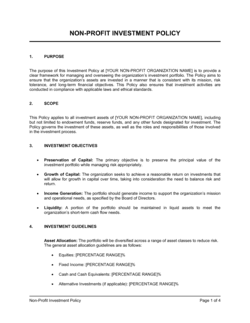
- The percentage split of a portfolio across broad asset classes such as equities, fixed income, real estate, cash, and alternatives.
- Risk Tolerance
- The degree of variability in investment returns an investor is willing to accept, typically expressed as a qualitative profile (conservative, moderate, aggressive) paired with a maximum drawdown threshold.
- Rebalancing
- The process of buying or selling assets to restore a portfolio to its target allocation after market movements push it outside permitted ranges.
- Benchmark
- A standard index or blended index used to measure whether the portfolio is generating returns commensurate with its risk profile — for example, 60% MSCI World / 40% Bloomberg Global Aggregate.
- Drawdown
- The peak-to-trough decline in portfolio value over a defined period, used as a measure of downside risk.
- Liquidity Requirement
- The minimum amount of portfolio assets that must be held in cash or near-cash instruments to cover anticipated operating or spending needs within a defined period.
- Permitted Range
- The minimum and maximum allocation percentage allowed for each asset class before rebalancing is triggered — for example, equities target 60%, permitted range 50–70%.
- Investment Horizon
- The length of time the investor expects to hold the portfolio before needing to draw on the capital, which directly determines appropriate risk levels and asset class selection.
- Diversification
- Spreading capital across multiple uncorrelated asset classes, geographies, and instruments to reduce the impact of any single position's loss on the total portfolio.
- Alternative Investments
- Asset classes outside traditional equities and bonds — including private equity, hedge funds, real estate, infrastructure, and commodities — typically used to improve diversification or enhance returns.
- Total Return
- The combined gain or loss from an investment, including both price appreciation and income (dividends, interest, or distributions).
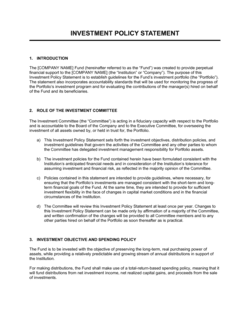
- Investment Policy Statement (IPS)
- A formal document that codifies an investor's objectives, constraints, and governance rules — the written foundation on which an investment portfolio strategy is built.