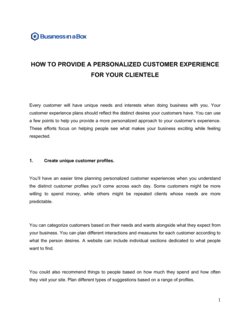
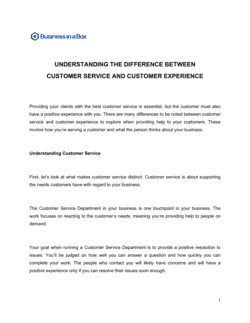
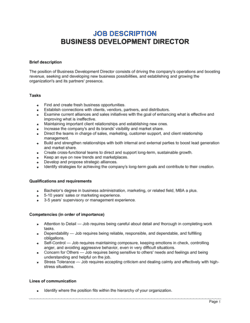
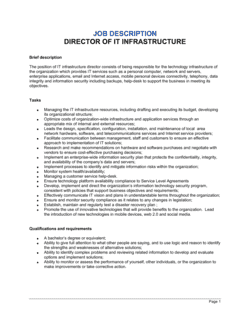
Director Of Customer Experience Job Description Template

Free Word download • Edit online • Save & share with Drive • Export to PDF

2 pages20–30 min to fillDifficulty: StandardSignature requiredLegal review recommended
Learn more ↓
FreeDirector Of Customer Experience Job Description Template

At a glance

What it is
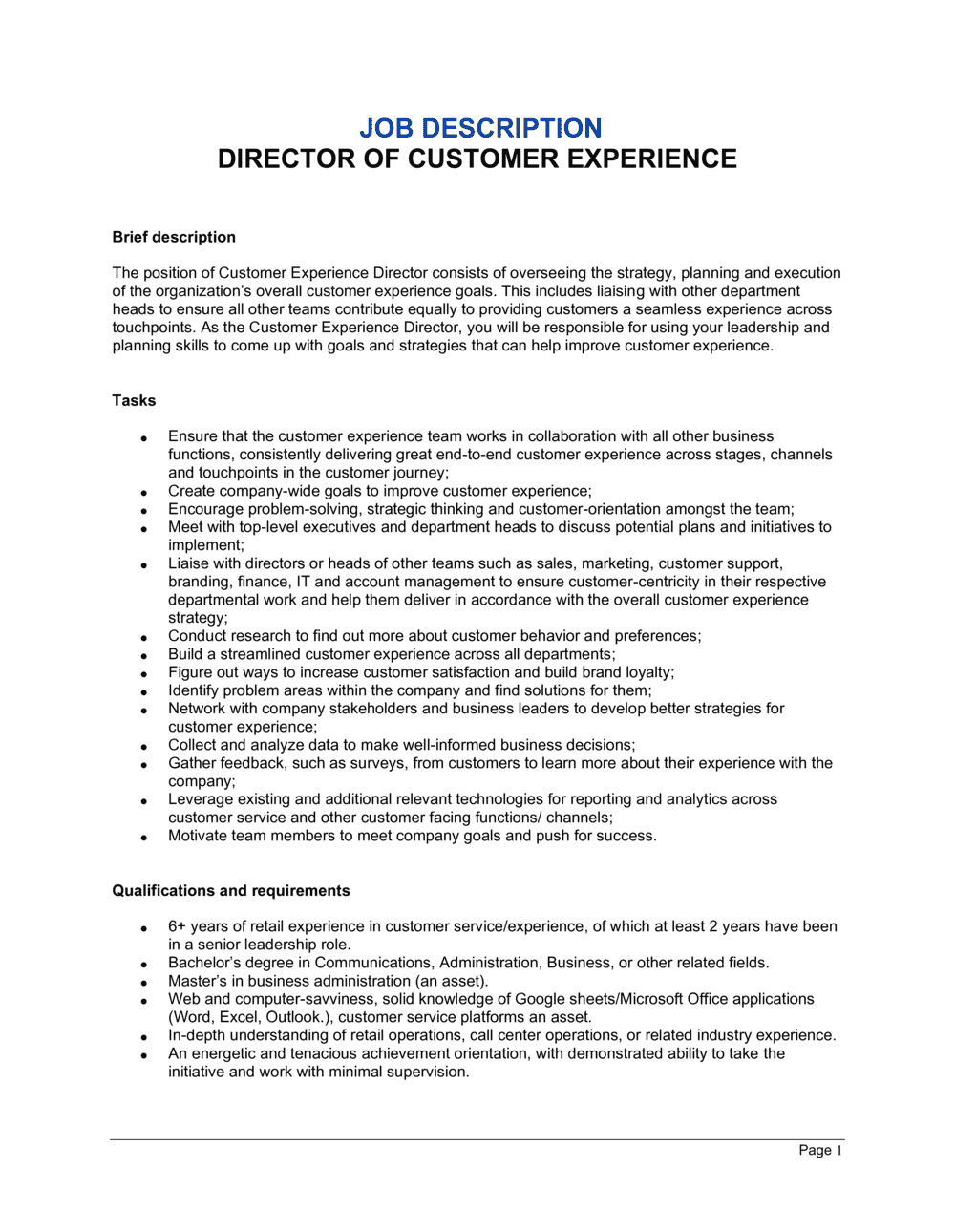
A Director of Customer Experience Job Description is a formal binding document that defines the scope, responsibilities, reporting structure, performance expectations, and qualifications for a senior CX leadership role. This free Word download gives you an editable, employer-ready template you can customize and export as PDF to post externally or incorporate into an employment offer package.
When you need it
Use it when creating a new Director of CX position, backfilling a departed leader, or restructuring a customer experience function that has grown beyond informal management. It is also required as supporting documentation when issuing an employment contract or letter of offer.
What's inside
Role summary and reporting structure, core duties and strategic responsibilities, key performance indicators, required and preferred qualifications, compensation range and benefits overview, and equal-opportunity and compliance language.

What is a Director of Customer Experience Job Description?

A Director of Customer Experience Job Description is a formal document that defines the scope, duties, performance expectations, reporting structure, qualifications, and compensation parameters for a senior CX leadership role. It functions as both a hiring tool — used to attract and screen qualified candidates — and a binding record of role expectations when signed and incorporated into an employment contract as a schedule or exhibit. Unlike a casual role summary or an internal org chart entry, a properly drafted job description creates an enforceable baseline for performance management, protects the employer in termination and discrimination proceedings, and ensures the candidate and hiring manager share a common, documented understanding of what the role requires.

Why You Need This Document

Hiring a Director of Customer Experience without a detailed, signed job description exposes your organization on several fronts simultaneously. Without defined KPIs, performance improvement plans and termination decisions rest on subjective judgment rather than documented standards — creating material wrongful dismissal and discrimination risk in every jurisdiction. Without a formal qualifications section, non-compliant postings can attract regulatory scrutiny for disparate-impact discrimination, particularly in jurisdictions where degree requirements must be objectively justified. In California, New York, Colorado, and Washington, posting a role without a salary range is itself a legal violation. And without a signature block — executed before the first day of employment — the job description carries significantly less weight as evidence of agreed expectations if a dispute arises during or after the employment relationship. This template closes all four gaps in 30–60 minutes, giving you a compliant, candidate-ready document that integrates directly with your employment contract package.

Which variant fits your situation?

If your situation is…Use this template
Hiring a senior executive with full P&L and organizational authority over CXChief Customer Officer Job Description
Filling a mid-level CX management role below director levelCustomer Experience Manager Job Description
Defining a specialist role focused on CX analytics and dataCustomer Insights Analyst Job Description
Creating a support-focused leadership role managing a service desk teamCustomer Service Manager Job Description
Hiring a CX operations leader to manage tooling, processes, and platformsVP of Customer Success Job Description
Defining a CX role within a specific vertical such as healthcare or financial servicesDirector of Patient or Member Experience Job Description
Formalizing a remote or distributed CX leadership positionRemote Work Employment Agreement

Common mistakes to avoid

❌ Omitting KPIs from the job description

Why it matters: Without defined performance metrics, the employer has no objective basis for performance improvement plans or termination for underperformance. Disputes default to subjective assessment, increasing discrimination and wrongful dismissal risk.

Fix: Include three to five specific, numeric KPIs tied to NPS, churn rate, CSAT, or revenue retention. State the measurement methodology and the review cadence.

❌ Over-specifying required qualifications beyond what the role genuinely needs

Why it matters: Requiring a specific degree or excessive years of experience when equivalent competence would suffice can constitute disparate-impact discrimination under Title VII and equivalent statutes in Canada, the UK, and the EU.

Fix: Review each required qualification against the actual job duties. Replace degree mandates with 'degree or equivalent experience' where justified, and move nice-to-have credentials to the preferred section.

❌ Posting without a salary range in pay-transparency jurisdictions

Why it matters: California, Colorado, New York, and Washington require salary ranges in job postings. Violations attract regulatory complaints, fines, and reputational damage that deters candidates.

Fix: Confirm applicable pay-transparency requirements for every jurisdiction where the role may be filled or where remote candidates will be sourced, and include the approved salary band before publishing.

❌ Writing the role summary too generically

Why it matters: A generic summary that could apply to any company attracts unqualified applicants and undersells the strategic scope of the role — leading to misaligned expectations and early attrition.

Fix: Reference the company's specific customer base, product type, and the measurable CX challenge the director will own. One concrete metric in the summary filters candidates more effectively than three paragraphs of generalities.

❌ Failing to obtain a signed acknowledgment before employment begins

Why it matters: An unsigned job description attached to an employment contract after the start date suffers the same consideration problem as post-start contract signing — it may not be enforceable as a performance standard.

Fix: Obtain both the employment contract and job description acknowledgment signatures before or on the first day of employment. Use a docusign-style workflow to timestamp execution.

❌ Excluding the EEO statement or using an outdated version

Why it matters: A missing or incomplete equal-opportunity statement exposes the employer to regulatory complaints during the hiring process, independent of any actual discriminatory conduct.

Fix: Use a current EEO statement that covers all federally protected classes plus any additional categories required by the state, province, or city where the role is posted. Review annually.

The 9 key clauses, explained

Role title and reporting structure

In plain language: States the official job title, the executive the role reports to (typically CEO, COO, or Chief Customer Officer), and any direct reports.

Sample language
The Director of Customer Experience reports directly to the [CHIEF OPERATING OFFICER / CEO] and leads a team of [NUMBER] CX professionals including [DIRECT REPORT TITLES].

Common mistake: Omitting the reporting line entirely — candidates and employment contracts both reference the job description, and an ambiguous hierarchy creates authority disputes during onboarding.

Role summary and strategic purpose

In plain language: A 3–5 sentence overview of why the role exists, the business problem it solves, and the outcomes the company expects the director to drive.

Sample language
The Director of Customer Experience owns the end-to-end customer journey for [COMPANY NAME]'s [PRODUCT / SERVICE] across all touchpoints. This role is responsible for translating customer insights into strategic initiatives that reduce churn, increase NPS, and build long-term loyalty.

Common mistake: Writing a generic summary that could describe any CX role. A role summary specific to the company's product, customer base, and growth stage attracts higher-quality applicants.

Core duties and primary responsibilities

In plain language: An itemized list of the role's day-to-day and strategic responsibilities — typically 8–12 bullet points covering strategy, execution, team leadership, and cross-functional collaboration.

Sample language
Responsibilities include: (a) designing and executing a multi-year CX strategy aligned to company OKRs; (b) leading customer journey mapping initiatives across [CHANNELS]; (c) owning VoC programs and translating insights into product and operational improvements; (d) managing a team of [NUMBER] direct reports.

Common mistake: Listing only tactical duties without strategic responsibilities. A director-level role that reads like a manager role will fail to attract senior candidates or justify the compensation band.

Key performance indicators (KPIs)

In plain language: The specific, measurable outcomes the Director of CX will be held accountable for — NPS, CSAT, churn rate, customer lifetime value, CES, and resolution time are common.

Sample language
Success will be measured against the following KPIs: (a) NPS of [TARGET] within [TIMEFRAME]; (b) annual churn rate below [X]%; (c) CSAT score above [X]% across all support channels; (d) first-contact resolution rate of [X]%.

Common mistake: Omitting KPIs from the job description entirely. Without defined metrics, performance reviews default to subjective judgment, creating termination and discrimination risk.

Required qualifications and education

In plain language: The minimum credentials, years of experience, and domain knowledge a candidate must possess to be considered — this section has legal implications for non-discriminatory hiring.

Sample language
Required: [X]+ years of progressive experience in customer experience, customer success, or a related field, including [X]+ years in a leadership role. Bachelor's degree in [FIELD] or equivalent work experience. Demonstrated track record managing NPS, CSAT, or churn reduction programs at scale.

Common mistake: Requiring credentials not genuinely necessary for the role — such as a specific degree when equivalent experience is acceptable. Over-specified requirements can expose the employer to disparate-impact discrimination claims.

Preferred qualifications and skills

In plain language: Desirable but non-mandatory attributes — certifications, specific industry experience, tools proficiency, or leadership credentials that distinguish top candidates.

Sample language
Preferred: Certified Customer Experience Professional (CCXP) designation; experience with [CX PLATFORM — Salesforce, Zendesk, Qualtrics]; background in [INDUSTRY]; MBA or equivalent postgraduate qualification.

Common mistake: Listing preferred qualifications as if they are required — using language like 'must have' instead of 'preferred' or 'nice to have.' This narrows the candidate pool without legal justification.

Compensation, benefits, and work arrangement

In plain language: States the salary range or band, bonus eligibility, equity participation (if applicable), benefits, and whether the role is remote, hybrid, or on-site.

Sample language
Base salary: $[MIN]–$[MAX] USD annually, commensurate with experience. Eligible for annual performance bonus of up to [X]% of base salary. Benefits include [HEALTH / DENTAL / VISION / 401(k)]. Work arrangement: [REMOTE / HYBRID / ON-SITE] at [LOCATION].

Common mistake: Omitting the salary range in jurisdictions where pay transparency is legally required — California, New York, Colorado, and Washington all mandate salary disclosure in job postings.

Equal opportunity and compliance statement

In plain language: Standard legal language affirming the employer's commitment to non-discriminatory hiring in compliance with applicable federal, state, and local employment laws.

Sample language
[COMPANY NAME] is an equal opportunity employer. We do not discriminate on the basis of race, color, religion, sex, national origin, age, disability, genetic information, sexual orientation, gender identity, or any other characteristic protected by applicable law.

Common mistake: Using a boilerplate EEO statement that omits protected classes required by local law — some states and cities mandate inclusion of categories beyond federal minimums, such as marital status or source of income.

Acknowledgment and signature block

In plain language: A section for the hiring manager and candidate to sign confirming they have read, understood, and accepted the job description as the defined scope of the role.

Sample language
I have read and understood the above job description and confirm it accurately reflects the duties and expectations of the [DIRECTOR OF CUSTOMER EXPERIENCE] role. Signed: [HIRING MANAGER NAME / TITLE] ___________ Date: _____ | [CANDIDATE NAME] ___________ Date: _____

Common mistake: Skipping the signature block on the assumption that signing the employment contract is sufficient. A signed job description is a separate record that protects the employer if scope creep or performance disputes arise later.

How to fill it out

  1. 1

    Define the reporting line and organizational context

    Identify the executive this role reports to and list all direct reports by title. Cross-check your org chart to ensure the hierarchy is accurate and consistent with the employment contract you plan to issue.

    💡 If this is a newly created role, document the business rationale in a separate position-approval memo before populating the job description — this record supports headcount approvals and budget sign-offs.

  2. 2

    Write the role summary with company-specific context

    Draft 3–5 sentences explaining why this role exists at your company specifically — reference your customer base, product type, and the CX challenge the director will address. Avoid generic language that applies to any employer.

    💡 Anchor the summary to a measurable outcome: 'reduce annual churn from 18% to 12%' is more compelling and precise than 'improve customer retention.'

  3. 3

    List core responsibilities in order of strategic importance

    Write 8–12 bullet points starting with the highest-impact strategic duties and ending with operational or administrative tasks. Use active verbs: 'design,' 'own,' 'lead,' 'manage,' and 'report' signal ownership clearly.

    💡 Separate 'strategic responsibilities' from 'operational duties' under two sub-headings if the role spans both — this helps candidates self-select and sets clear performance expectations.

  4. 4

    Define measurable KPIs for the first 12 months

    Enter specific, numeric targets for NPS, CSAT, churn rate, or whatever metrics your business tracks. Where targets are not yet defined, state the measurement methodology and note that targets will be set at onboarding.

    💡 Three to five KPIs is optimal — more dilutes accountability. Prioritize lagging indicators (churn, NPS) over leading indicators for director-level accountability.

  5. 5

    Calibrate the qualifications to the actual role requirements

    Review every required qualification and ask: 'Would we reject a candidate who meets all other criteria but lacks this?' If the answer is no, move it to preferred. Apply the same test to degree requirements versus equivalent experience.

    💡 In jurisdictions with pay-transparency laws, confirm the salary range is accurate before posting — retroactively changing a posted range can attract regulatory scrutiny.

  6. 6

    Insert the compensation range and work arrangement

    Enter the approved salary band, bonus structure, equity participation (if applicable), and whether the role is remote, hybrid, or fully on-site. Reference the benefits plan by category without locking in plan-specific details.

    💡 In California, Colorado, New York, and Washington, posting a salary range is legally required. Even where it is not mandated, published ranges reduce time-to-fill and attract more qualified applicants.

  7. 7

    Add the EEO statement and signature block

    Insert your company's standard equal-opportunity statement and verify it includes all protected classes required by federal, state, and local law. Add a signature block for the hiring manager and the selected candidate.

    💡 Have your legal or HR team review the EEO language annually — several states and cities have added protected categories in recent legislative cycles.

  8. 8

    Attach to the employment contract before offer issuance

    Incorporate the signed job description as Schedule A or an exhibit to the employment contract. Both documents should cross-reference each other by title and date.

    💡 Have the candidate initial each page of the job description at the same time they sign the employment contract — this prevents later claims that they were unaware of specific duties or KPIs.

Frequently asked questions

What does a Director of Customer Experience do?

A Director of Customer Experience owns the end-to-end customer journey for a company's products or services — designing CX strategy, leading voice-of-customer programs, managing cross-functional initiatives to reduce friction, and holding accountability for metrics like NPS, CSAT, churn rate, and customer lifetime value. They typically lead a team of CX managers, analysts, and specialists and report to the CEO, COO, or a Chief Customer Officer.

Is a job description a legally binding document?

A job description can be legally binding when signed by both parties and incorporated into an employment contract as a schedule or exhibit. In most jurisdictions, a job description attached to a signed offer letter or employment agreement becomes an enforceable record of role scope, duties, and performance expectations. Courts and employment tribunals regularly reference signed job descriptions in wrongful dismissal and discrimination cases. An unsigned job description carries less legal weight but can still be introduced as evidence of the parties' intentions.

What qualifications should a Director of Customer Experience have?

Typical requirements include seven to ten years of progressive CX, customer success, or service leadership experience, with at least three years in a director or senior manager role. A bachelor's degree in business, marketing, or a related field — or equivalent experience — is standard. Proficiency with VoC platforms (Qualtrics, Medallia), CRM tools (Salesforce), and support platforms (Zendesk, Intercom) is commonly preferred. The Certified Customer Experience Professional (CCXP) designation is a valued credential in senior CX hiring.

What KPIs should a Director of Customer Experience own?

The most common director-level CX KPIs are NPS, CSAT, Customer Effort Score, annual churn rate, net revenue retention, first-contact resolution rate, and average resolution time. For SaaS businesses, customer health score and expansion revenue from existing accounts are also standard. Limiting accountability to three to five primary KPIs — tied to measurable targets and reviewed quarterly — produces clearer performance management outcomes than tracking eight or more metrics simultaneously.

What is the difference between a Director of Customer Experience and a Chief Customer Officer?

A Chief Customer Officer (CCO) is typically a C-suite executive with full organizational authority over all customer-facing functions — including sales, support, success, and product feedback loops — and often holds P&L responsibility for customer revenue. A Director of CX operates one to two levels below, leading the CX function and reporting to a CCO, COO, or CEO. Directors execute strategy within defined budgets and teams; CCOs define the strategy at the enterprise level.

Do I need a lawyer to create a job description?

For a standard internal Director of CX role at a domestic employer, a high-quality template is typically sufficient. Engaging a lawyer is advisable when the role involves sensitive IP access, when hiring across multiple jurisdictions with conflicting pay-transparency or qualification requirements, or when the job description will be incorporated into a senior executive employment agreement with equity and material severance terms. A one-hour employment law review typically costs $200–$400 and is worthwhile for director-level hires where performance disputes carry significant financial exposure.

Which jurisdictions require salary ranges in job postings?

As of 2025, California, Colorado, New York State, New York City, Washington State, and several other US municipalities legally require employers to disclose salary ranges in job postings — including remote roles where candidates in those jurisdictions may apply. In Canada, British Columbia requires pay transparency in job postings as of November 2023. The EU Pay Transparency Directive requires member states to implement salary disclosure requirements by June 2026. Employers should confirm current requirements for each jurisdiction before posting.

How should a job description be incorporated into an employment contract?

The job description should be attached as a named schedule or exhibit to the employment contract — for example, 'Schedule A: Job Description, Director of Customer Experience, dated [DATE].' The body of the employment contract should reference the schedule explicitly: 'Employee shall perform the duties described in Schedule A, as amended by mutual agreement from time to time.' Both documents should be signed and initialed together before or on the first day of employment.

Can a job description be changed after an employee is hired?

Unilateral, material changes to an employee's duties — such as removing strategic responsibilities or reassigning direct reports — can constitute constructive dismissal in Canada, the UK, and the EU if the changes fundamentally alter the role. In the US, at-will employment generally permits duty changes with appropriate notice, provided they do not discriminate or violate a written contract. To amend a signed job description, document the change in writing, obtain the employee's written agreement, and provide consideration (such as a title change or salary adjustment) where required.

How this compares to alternatives

vs Customer Service Manager Job Description

A Customer Service Manager job description defines a mid-level role focused on day-to-day support team operations, ticket resolution metrics, and frontline staff performance. A Director of CX job description operates at a higher strategic level — owning journey design, VoC programs, and cross-functional CX initiatives. Use the manager template for a team lead hire; use the director template for a senior leader who reports to the C-suite.

vs Employment Contract

An employment contract is the binding legal agreement that governs the entire employment relationship — compensation, IP, confidentiality, non-compete, and termination terms. A job description defines the scope and expectations of the role. The two documents work together: the job description is typically attached as a schedule to the employment contract. Neither replaces the other.

vs Executive Employment Agreement

An executive employment agreement governs compensation, equity, severance, and restrictive covenants for C-suite hires. A job description defines the operational scope and performance expectations of the role. For a Director of CX hire that includes equity and enhanced severance, both documents are needed — the job description as a schedule and the executive agreement as the governing contract.

vs Job Offer Letter

A job offer letter confirms compensation and start date to secure a candidate's acceptance. A job description defines the full scope of duties, qualifications, and KPIs. The offer letter references the job description but does not replace it — a candidate who signs only an offer letter without a job description has no agreed record of performance expectations, which complicates performance management and termination.

Industry-specific considerations

SaaS / Technology

CX directors in SaaS own churn reduction, net revenue retention, and customer health scores — requiring deep integration with product, success, and support functions.

Retail / E-commerce

CX leadership in retail spans omnichannel consistency, returns experience, loyalty program performance, and post-purchase satisfaction across digital and physical touchpoints.

Financial Services

CX directors must align satisfaction programs with regulatory complaint-handling obligations under CFPB, FCA, and equivalent frameworks, adding compliance accountability to standard CX KPIs.

Healthcare

Patient experience directors are governed by HCAHPS survey requirements, HIPAA data-handling constraints, and accreditation standards — the job description must reference these specific regulatory obligations.

Professional Services

CX leadership in consulting or advisory firms centers on client relationship health, renewal rates, and net promoter metrics tied to individual engagement teams rather than product or platform interactions.

Hospitality and Travel

CX directors manage real-time service recovery, loyalty tier management, and platform review scores across properties or routes — with brand reputation directly tied to director-level CX decisions.

Jurisdictional notes

United States

Director-level CX roles are typically classified as FLSA-exempt executive or administrative employees, exempting them from overtime requirements — confirm the duties test is met before classifying. California, Colorado, New York, and Washington require salary ranges in job postings; remote roles that accept applicants from these states are also subject to these requirements. Non-discrimination language must cover all federally protected classes plus any additional categories required by the state and city of hire.

Canada

Job descriptions incorporated into employment agreements must align with provincial Employment Standards Act minimums on duties and compensation. British Columbia requires pay transparency in postings as of November 2023; other provinces are expected to follow. In Quebec, job postings and descriptions for provincially regulated employers must be available in French. Over-specifying qualifications can attract Canadian Human Rights Act scrutiny if requirements screen out protected groups without bona fide occupational justification.

United Kingdom

Job descriptions must not contain requirements that indirectly discriminate under the Equality Act 2010 — blanket degree requirements or excessive experience thresholds may constitute indirect discrimination if not objectively justified. The Equality and Human Rights Commission recommends including a statement that qualifications listed as required are subject to adjustment as a reasonable accommodation for disabled candidates. Signed job descriptions attached to employment contracts support written particulars obligations under the Employment Rights Act 1996.

European Union

The EU Pay Transparency Directive requires member states to implement salary disclosure in job postings by June 2026 — several member states (Germany, France, Spain) are already advancing national legislation. The EU Equal Treatment Directive prohibits discriminatory qualification requirements, and member states interpret indirect discrimination broadly. Job descriptions that include personal data fields (e.g., candidate age or marital status) must comply with GDPR data minimization requirements from the point of collection.

Template vs lawyer — what fits your deal?

PathBest forCostTime
Use the templateStandard Director of CX hires at domestic employers in a single jurisdiction with no equity componentFree30–60 minutes
Template + legal reviewCross-jurisdictional postings, roles with pay-transparency requirements, or job descriptions being incorporated into senior employment contracts$200–$400 (one-hour employment law review)1–3 business days
Custom draftedC-suite adjacent roles with equity, material severance, or multi-jurisdiction compliance requirements across the US, Canada, UK, or EU$800–$2,5001–2 weeks

Glossary

Customer Experience (CX)
The sum of all interactions and perceptions a customer has with a company across every touchpoint, from first awareness through post-purchase support.
Net Promoter Score (NPS)
A loyalty metric calculated by subtracting the percentage of detractors from the percentage of promoters among surveyed customers.
Customer Satisfaction Score (CSAT)
A survey-based measure of how satisfied customers are with a specific interaction or overall relationship, typically expressed as a percentage.
Customer Effort Score (CES)
A metric that measures how easy it is for customers to resolve an issue or complete a task, with lower effort correlating to higher retention.
Voice of the Customer (VoC)
A structured program for capturing customer feedback, expectations, preferences, and complaints across channels to inform product and service decisions.
Customer Journey Mapping
A visual representation of every step a customer takes when interacting with a company, used to identify friction points and improvement opportunities.
Churn Rate
The percentage of customers who stop doing business with a company in a given period, a primary outcome metric for CX leadership.
KPI (Key Performance Indicator)
A quantifiable measure used to evaluate progress toward a defined business objective — in CX, typically NPS, CSAT, CES, churn, and retention rate.
Omnichannel Experience
A customer experience strategy that delivers a consistent, integrated interaction across all channels — web, mobile, phone, in-store, and social.
FLSA (Fair Labor Standards Act)
US federal law that establishes minimum wage, overtime pay, and classification standards — determines whether a Director of CX role is exempt from overtime.
At-Will Employment
US employment doctrine under which either party may end the relationship at any time for any lawful reason, typically referenced in job description compliance language.

Part of your Business Operating System

This document is one of 3,000+ business & legal templates included in Business in a Box.

  • Fill-in-the-blanks — ready in minutes
  • 100% customizable Word document
  • Compatible with all office suites
  • Export to PDF and share electronically

Create your document in 3 simple steps.

From template to signed document — all inside one Business Operating System.
1
Download or open template

Access over 3,000+ business and legal templates for any business task, project or initiative.

2
Edit and fill in the blanks with AI

Customize your ready-made business document template and save it in the cloud.

3
Save, Share, Send, Sign

Share your files and folders with your team. Create a space of seamless collaboration.

Save time, save money, and create top-quality documents.

★★★★★

"Fantastic value! I'm not sure how I'd do without it. It's worth its weight in gold and paid back for itself many times."

Managing Director · Mall Farm
Robert Whalley
Managing Director, Mall Farm Proprietary Limited
★★★★★

"I have been using Business in a Box for years. It has been the most useful source of templates I have encountered. I recommend it to anyone."

Business Owner · 4+ years
Dr Michael John Freestone
Business Owner
★★★★★

"It has been a life saver so many times I have lost count. Business in a Box has saved me so much time and as you know, time is money."

Owner · Upstate Web
David G. Moore Jr.
Owner, Upstate Web

Run your business with a system — not scattered tools

Stop downloading documents. Start operating with clarity. Business in a Box gives you the Business Operating System used by over 250,000 companies worldwide to structure, run, and grow their business.

Start free · No credit card required