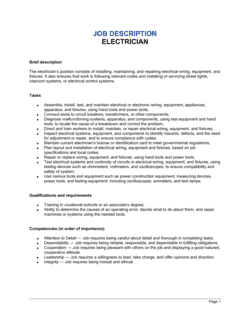
Director of Finance Job Description Template

Free Word download • Edit online • Save & share with Drive • Export to PDF

2 pages20–30 min to fillDifficulty: StandardSignature requiredLegal review recommended
Learn more ↓
FreeDirector of Finance Job Description Template

At a glance

What it is
A Director of Finance Job Description is a formal document that defines the scope, responsibilities, reporting structure, required qualifications, and compensation expectations for a senior financial leadership role. This free Word download gives you a structured, legally grounded starting point you can edit online and export as PDF for use in recruitment, employment contracts, and performance management.
When you need it
Use it when creating or backfilling a Director of Finance position, when aligning a hiring committee on the scope of the role before posting, or when incorporating defined duties into a binding employment agreement.
What's inside
Position summary, core duties and responsibilities, reporting relationships, required and preferred qualifications, key competencies, compensation range and benefits, and performance expectations. Each section is structured to serve dual purpose as a recruitment tool and a contractual role definition.

What is a Director of Finance Job Description?

A Director of Finance Job Description is a formal document that defines the scope, responsibilities, reporting relationships, required qualifications, and performance expectations for a senior financial leadership role. It serves two distinct functions simultaneously: as a recruitment tool that communicates the role to prospective candidates, and as a role-definition document that can be incorporated by reference into a binding employment agreement. A well-drafted Director of Finance job description covers core duties across financial planning, reporting, treasury, compliance, and team leadership — anchored by measurable KPIs and a defined compensation band.

Why You Need This Document

Hiring a Director of Finance without a documented role definition creates exposure on three fronts. First, without a clear record of essential functions and qualifications, discrimination claims and disparate-impact challenges become harder to defend during hiring. Second, a Director of Finance holds signing authority and access to sensitive financial data — without documented fiduciary and confidentiality obligations in the role definition, enforcement of a breach is significantly more difficult. Third, performance disputes and termination decisions for senior finance leaders almost always involve a review of what the role was documented to require: a vague or missing job description leaves the organization unable to demonstrate that expectations were clearly set. This template gives you a legally grounded, market-calibrated starting point that works as a recruitment posting, an onboarding anchor, and a performance management reference — all in a single document you can complete in under an hour.

Which variant fits your situation?

If your situation is…Use this template
Hiring a finance leader at the VP level with equity and broader strategic scopeVP of Finance Job Description
Recruiting a Chief Financial Officer with board-level responsibilitiesCFO Job Description
Defining a mid-level finance manager below director rankFinance Manager Job Description
Posting a controller role focused on accounting and complianceController Job Description
Filling a finance analyst role reporting to the Director of FinanceFinancial Analyst Job Description
Drafting a binding employment agreement to accompany the job descriptionEmployment Contract
Hiring a nonprofit finance director with fund accounting requirementsNonprofit Finance Director Job Description

Common mistakes to avoid

❌ Mixing required and preferred qualifications

Why it matters: When candidates cannot distinguish mandatory from preferred credentials, highly qualified applicants self-select out and under-qualified ones waste interviewing time — costing the organization weeks in a senior search.

Fix: Create two clearly labeled sections: 'Required qualifications' and 'Preferred qualifications'. Audit required items to confirm each one is genuinely disqualifying if absent.

❌ Omitting the compensation range

Why it matters: Pay-transparency laws now mandate salary range disclosure in job postings in California, Colorado, New York, Washington, and British Columbia, among others. Non-compliance exposes the employer to regulatory complaints and fines.

Fix: Research the market rate for a Director of Finance in your location and post a realistic band. A $40K range (e.g., $120K–$160K) is acceptable; a $1 range or no range is not.

❌ Writing duties in passive voice

Why it matters: Passive phrasing ('responsible for being involved in budgeting') creates ambiguity about ownership, complicating performance management and termination-for-cause documentation.

Fix: Rewrite every duty with an active ownership verb: 'Lead the annual budgeting process', 'Prepare monthly financial reports', 'Own relationships with external auditors'.

❌ No performance expectations or KPIs

Why it matters: Without measurable expectations documented at hiring, annual reviews become subjective, disagreements over performance escalate, and termination decisions become legally vulnerable.

Fix: Add 3–5 specific, measurable KPIs to the job description and reference them in the onboarding plan and first performance review template.

❌ Skipping the physical requirements and work environment section

Why it matters: In the US, omitting this section complicates ADA accommodation analysis and can leave the employer unable to document that a physical or location requirement is essential to the role.

Fix: Include a brief work-environment clause even for office-based roles: location, travel percentage, and a statement that accommodations will be made for qualified individuals with disabilities.

❌ Failing to align the job description with the employment contract

Why it matters: Courts read job descriptions and employment contracts together. If duties described in the job description are broader than those in the contract — or vice versa — the employee may claim a constructive dismissal when the role evolves.

Fix: Incorporate the job description by reference into the employment contract and ensure all duty language is consistent between the two documents before execution.

The 10 key clauses, explained

Position summary

In plain language: A 3–5 sentence overview of the role's purpose, where it sits in the organization, and the primary outcomes it is accountable for.

Sample language
The Director of Finance is a senior leadership role reporting to the [CFO / CEO] of [COMPANY NAME]. The Director is responsible for overseeing all financial planning, reporting, compliance, and treasury operations, and for providing strategic financial guidance to the executive team. This is a full-time, [LOCATION / REMOTE] position.

Common mistake: Writing a summary so generic it could describe any finance role. A vague summary attracts misaligned candidates and weakens the document's value as a role-definition anchor in the employment contract.

Core duties and responsibilities

In plain language: A structured list of the primary activities the Director of Finance is accountable for delivering, organized by functional area.

Sample language
Lead the annual budgeting and forecasting process; prepare and present monthly, quarterly, and annual financial reports to [CFO / CEO / Board]; manage cash flow and treasury functions; oversee accounts payable and receivable teams; ensure compliance with [GAAP / IFRS] and applicable tax regulations; coordinate annual audit with external auditors.

Common mistake: Using passive voice ('responsible for being involved in') instead of active ownership verbs ('lead', 'own', 'manage'). Passive language creates ambiguity about who actually owns each deliverable.

Reporting structure and team oversight

In plain language: Defines who the Director reports to and which roles report to them, establishing the formal accountability chain.

Sample language
This role reports directly to the [CFO / CEO]. Direct reports include: [CONTROLLER / ACCOUNTING MANAGER / FINANCE ANALYST / AP SUPERVISOR], totaling [X] full-time employees. The Director also works cross-functionally with the [Operations, Sales, and People] teams.

Common mistake: Omitting team oversight entirely. Candidates — and courts, in disputes over role scope — need to know whether the role is individual-contributor or managerial to evaluate fit and compensation.

Required qualifications

In plain language: The minimum education, credentials, years of experience, and technical skills that a candidate must have to be considered for the role.

Sample language
Bachelor's degree in Finance, Accounting, or related field required; CPA or CMA designation strongly preferred. Minimum [8] years of progressive finance experience, including [3] years in a leadership role. Advanced proficiency in [Excel / ERP system name]. Experience with [GAAP / IFRS] financial reporting required.

Common mistake: Setting credential requirements that exclude qualified candidates or create disparate-impact exposure — such as requiring a degree for a role where equivalent experience is demonstrably sufficient.

Preferred qualifications

In plain language: Additional skills, credentials, or experience that are desirable but not disqualifying if absent — used to differentiate among qualified applicants.

Sample language
MBA or advanced degree in Finance preferred. Experience in [INDUSTRY] strongly preferred. Familiarity with [SPECIFIC ERP — NetSuite / SAP / QuickBooks Enterprise] is an asset. Prior experience managing relationships with lenders, auditors, and board-level stakeholders.

Common mistake: Listing preferred qualifications that are indistinguishable from required ones. If you will not hire someone without a specific credential, move it to the required section — otherwise you waste interviewing time on mismatched applicants.

Key competencies and leadership attributes

In plain language: The behavioral and leadership traits the organization expects the Director of Finance to demonstrate consistently in the role.

Sample language
Strategic thinking and financial modeling acumen; ability to communicate complex financial data to non-financial stakeholders; strong people leadership and team development skills; high integrity and sound judgment in handling sensitive financial information; ability to manage competing priorities in a fast-paced environment.

Common mistake: Including so many competencies (12+) that none can be meaningfully evaluated. Limit to 5–7 behaviorally specific attributes that differentiate excellent performance from adequate performance.

Compensation range and benefits

In plain language: States the salary band, bonus eligibility, equity participation (if any), and benefits package associated with the role.

Sample language
Base salary range: $[MIN] – $[MAX] per year, commensurate with experience. Eligible for annual performance bonus of up to [X]% of base salary. Benefits include [health, dental, vision, 401(k) with X% match, PTO policy]. [Equity / stock options described in a separate agreement, if applicable.]

Common mistake: Omitting the compensation range entirely. Several US states and Canada now legally require salary range disclosure in job postings. Omitting it also increases time-to-hire by forcing salary negotiations earlier in the process.

Performance expectations and KPIs

In plain language: Defines the measurable outcomes the Director of Finance will be held accountable for in their first 12 months and on an ongoing basis.

Sample language
Success in this role is measured by: (a) delivery of monthly financial reports within [5] business days of month-end close; (b) annual budget variance of no more than [X]%; (c) successful completion of external audit with no material findings; (d) [ADDITIONAL KPI].

Common mistake: No performance expectations at all. Without defined KPIs, annual reviews become subjective, termination-for-cause decisions are harder to document, and the employee has no objective basis for understanding what success looks like.

Compliance, confidentiality, and fiduciary obligations

In plain language: States that the Director of Finance is bound by applicable financial regulations, internal controls, confidentiality obligations, and fiduciary duties to the organization.

Sample language
The Director of Finance shall maintain compliance with all applicable federal, state, and local financial regulations; adhere to the Company's internal controls and signing-authority policy; and treat all financial, strategic, and personnel information as strictly confidential both during and after employment.

Common mistake: Treating this clause as optional boilerplate. For a role with signing authority and access to sensitive financial data, an explicit fiduciary and confidentiality acknowledgment creates a documented basis for enforcement if a breach occurs.

Physical requirements and work environment

In plain language: Describes the working conditions, location, travel expectations, and any physical demands of the role — required in many jurisdictions to support ADA / human rights compliance.

Sample language
This position is [on-site / hybrid / remote], based at [OFFICE LOCATION]. Occasional travel to [branch offices / client sites / annual audit location] may be required, up to [X]% of time. The role involves prolonged periods of sedentary computer work. Reasonable accommodations will be made for qualified individuals with disabilities.

Common mistake: Skipping this section entirely. In the US, failure to document physical requirements can complicate ADA accommodation requests and disability-related termination disputes.

How to fill it out

  1. 1

    Define the organizational context

    Enter the company name, the role's reporting line (CFO or CEO), and the department structure. Confirm whether this is a new role or a replacement, and whether the position is full-time, part-time, or interim.

    💡 If the role reports to the CEO rather than a CFO, expand the strategic responsibilities section — the Director will be the most senior finance voice in the building.

  2. 2

    List core duties using active ownership verbs

    Draft 8–12 bullet points using verbs like 'lead', 'own', 'manage', 'prepare', and 'oversee'. Organize by functional area: financial planning, reporting, treasury, compliance, and team leadership.

    💡 Group related duties under subheadings if the list exceeds 10 items — it makes the document readable and signals clear role organization to candidates.

  3. 3

    Set the reporting structure and team size

    Specify who the Director reports to and list every role that reports to them by title. Include the total headcount managed and any matrix or dotted-line relationships.

    💡 Candidates use team size to calibrate compensation expectations — a Director managing five people commands a different market rate than one managing none.

  4. 4

    Separate required from preferred qualifications

    Move every qualification you would actually screen out a candidate for to the required list. Everything else — nice-to-haves — goes in preferred. Review both lists for inadvertent disparate-impact risk before posting.

    💡 Replace 'degree required' with 'degree or equivalent experience required' unless the role legally mandates a specific credential — this broadens your candidate pool without lowering standards.

  5. 5

    Fill in the compensation range

    Enter a realistic salary band based on market data for the role in the relevant geography. Add bonus percentage, equity reference (if applicable), and the benefits categories offered.

    💡 Check your state or province's pay-transparency laws before posting — Colorado, California, New York, and British Columbia all require salary range disclosure in job postings as of 2025.

  6. 6

    Define measurable performance KPIs

    Write 3–5 KPIs that are specific, measurable, and achievable within the first 12 months. Examples: month-end close cycle time, budget accuracy rate, audit outcome, or cash runway visibility.

    💡 These KPIs feed directly into the performance-review framework — copy them verbatim into the onboarding plan and the first performance review template.

  7. 7

    Add the compliance and confidentiality clause

    Review the signing-authority limits applicable to this role and reference the company's internal controls policy by name. Confirm that the fiduciary and confidentiality language aligns with the employment contract the candidate will sign.

    💡 If you are incorporating this job description by reference into the employment contract, ensure the language is consistent — courts will read both documents together in a dispute.

  8. 8

    Have HR and legal review before posting

    Have an HR partner review for internal equity and pay-transparency compliance, and have legal or outside counsel confirm that required-qualification language does not create disparate-impact exposure under EEOC guidelines or equivalent statutes.

    💡 A 1-hour employment-lawyer review of a senior-role job description typically costs $150–$350 and eliminates the most common regulatory compliance gaps before the posting goes live.

Frequently asked questions

What does a Director of Finance do?

A Director of Finance leads an organization's financial planning, reporting, compliance, and treasury functions. Day-to-day responsibilities typically include managing the budgeting and forecasting cycle, preparing financial statements, overseeing cash flow, coordinating external audits, and providing strategic financial analysis to the executive team. The role usually reports to a CFO or, in smaller organizations, directly to the CEO.

What qualifications does a Director of Finance need?

Most organizations require a bachelor's degree in finance, accounting, or a related field and 8–10 years of progressive finance experience, including at least 3 years in a leadership or management role. A CPA or CMA designation is strongly preferred in most markets. Advanced proficiency in financial modeling, ERP systems, and GAAP or IFRS reporting is typically required. An MBA or advanced degree is a common preferred qualification for strategic roles.

What is the difference between a Director of Finance and a CFO?

A CFO is the most senior financial officer in an organization and typically holds board-level accountability, investor relations responsibilities, and capital-structure authority. A Director of Finance generally focuses on operational financial management — reporting, budgeting, treasury, and compliance — and reports to the CFO or CEO. In smaller organizations without a CFO, the Director of Finance may perform both roles. The CFO sets financial strategy; the Director of Finance executes it.

Does a job description constitute a legally binding contract?

A job description is not itself an employment contract, but it can create legal obligations when incorporated by reference into a binding employment agreement. Courts in the US, Canada, and the UK have treated documented role duties as part of the employment relationship, particularly in constructive dismissal and duty-of-care disputes. For a senior finance role, explicitly incorporating the job description into the employment contract — and keeping both documents consistent — is considered best practice.

Should a Director of Finance job description include a salary range?

Yes, in most cases. Pay-transparency laws in California, Colorado, New York, Washington, and British Columbia now legally require salary range disclosure in job postings. Even where not legally required, including a compensation band reduces time-to-hire, improves candidate quality, and supports internal pay-equity compliance. A realistic range for a Director of Finance in a mid-size North American company typically runs $110,000–$180,000 base depending on industry, location, and team scope.

What KPIs should a Director of Finance be measured on?

Common KPIs include: month-end close cycle time (target 5 business days or fewer), budget-to-actual variance percentage, external audit outcome (clean opinion, no material findings), cash runway visibility (rolling 13-week forecast accuracy), and accounts receivable DSO (days sales outstanding). The most effective job descriptions document 3–5 specific KPIs so the employee understands what success looks like from day one.

Is a Director of Finance a fiduciary?

In most jurisdictions, a Director of Finance exercises delegated signing authority and has direct access to financial accounts, which creates practical fiduciary obligations — acting in the organization's financial interest, avoiding conflicts of interest, and maintaining accurate records. While the formal fiduciary standard applied to corporate directors and officers varies by jurisdiction, a well-drafted job description and employment contract should explicitly document these obligations to create an enforceable standard of conduct.

Do I need a lawyer to create a Director of Finance job description?

A high-quality template handles the structural and content requirements for most organizations. Legal review is recommended when the role carries significant signing authority or access to sensitive financial data, when the organization operates in multiple jurisdictions with differing pay-transparency or discrimination laws, or when the job description will be incorporated by reference into a binding employment contract. A 1-hour review typically costs $150–$350 and is worthwhile for a senior hire.

What is the difference between a Director of Finance and a Finance Manager?

A Finance Manager typically focuses on a specific function — such as FP&A, accounts payable, or management reporting — and may manage a small team. A Director of Finance has broader organizational accountability, oversees multiple finance functions, sits in the senior leadership tier, and is typically involved in strategic decision-making alongside the CEO or CFO. The Director role usually requires more years of experience, commands a higher compensation band, and carries greater fiduciary exposure.

How this compares to alternatives

vs CFO Job Description

A CFO job description defines the most senior financial officer role — one with board accountability, capital-structure authority, and investor relations responsibilities. A Director of Finance job description covers operational financial leadership reporting to the CFO or CEO. Use the CFO template when the role carries strategic authority over the entire financial function with no senior finance officer above it.

vs Finance Manager Job Description

A Finance Manager job description defines a mid-level role typically focused on one functional area — such as FP&A, reporting, or accounts payable — with a smaller team and narrower scope. The Director of Finance template is appropriate when the role oversees multiple finance functions, sits in the senior leadership tier, and carries organization-wide accountability for financial health.

vs Financial Analyst Job Description

A Financial Analyst job description defines an individual-contributor role focused on modeling, reporting, and analysis rather than leadership and decision-making. The Director of Finance template is the right choice when the role carries people management, strategic input, and fiduciary responsibilities that go well beyond analytical output.

vs Employment Contract

A job description defines the scope, duties, and qualifications of a role and is used as a recruitment and performance management tool. An employment contract is the binding legal agreement governing the full employment relationship — including IP assignment, non-compete, termination, and severance. For a Director of Finance, both documents are needed: the job description anchors role expectations, and the employment contract creates enforceable obligations.

Industry-specific considerations

Technology / SaaS

Emphasis on ARR reporting, SaaS unit economics (CAC, LTV, churn), equity compensation plan administration, and investor-grade financial reporting on a monthly cadence.

Healthcare

Revenue cycle management, payer contract analysis, HIPAA financial data requirements, and compliance with CMS billing and reimbursement regulations.

Manufacturing

Cost accounting, standard costing and variance analysis, capex and depreciation schedules, and supply-chain-linked cash flow forecasting.

Nonprofit

Fund accounting, grant compliance reporting, Form 990 preparation, board-level financial stewardship, and restricted versus unrestricted fund management.

Professional Services

Project-based billing, utilization rate reporting, work-in-progress accounting, and partner or equity distributions alongside standard P&L management.

Retail / E-commerce

Inventory valuation, gross margin by SKU or channel, payment processor reconciliation, and multi-entity or multi-currency consolidation for omnichannel operators.

Jurisdictional notes

United States

Pay-transparency laws requiring salary range disclosure in job postings are now in effect in California, Colorado, New York, Washington, Nevada, and several municipalities. EEOC guidelines require that all listed qualifications be job-related and consistent with business necessity — overbroad education requirements can create disparate-impact exposure. At-will employment is the default in 49 states, but a job description incorporated by reference into a contract can limit at-will flexibility if duties are described with excessive specificity.

Canada

British Columbia, Prince Edward Island, and Prince Edward Island now require pay transparency in job postings, with other provinces expected to follow. Human rights legislation in all provinces prohibits qualification requirements that create adverse-effect discrimination without bona fide occupational justification. In Quebec, job postings and descriptions for provincially regulated employers must be available in French. Employment standards minimums apply regardless of what the job description or contract states.

United Kingdom

The Equality Act 2010 requires that all essential qualifications and requirements be justifiable as proportionate means of achieving a legitimate aim — blanket degree requirements for roles where equivalent experience suffices can attract indirect discrimination claims. The UK does not currently mandate salary range disclosure in job postings, but the FCA and Companies House require certain financial officers to meet fit-and-proper standards. Job descriptions incorporated into employment particulars carry contractual weight under the Employment Rights Act 1996.

European Union

The EU Pay Transparency Directive (2023/970) requires member states to implement salary range disclosure obligations in job postings by June 2026. GDPR applies to personal data collected during the hiring process, including candidate CVs and assessment data — data minimization principles apply from the posting stage. Works council or employee representative consultation may be required before posting senior finance roles in France, Germany, the Netherlands, and other co-determination jurisdictions.

Template vs lawyer — what fits your deal?

PathBest forCostTime
Use the templateSmall to mid-size organizations creating or updating a Director of Finance role description for domestic hiringFree30–60 minutes
Template + legal reviewOrganizations in pay-transparency jurisdictions, roles with material signing authority, or descriptions incorporated into employment contracts$150–$350 for a 1-hour employment-lawyer review1–3 days
Custom draftedMulti-jurisdiction employers, publicly traded companies, or organizations with complex fiduciary and compliance frameworks$500–$2,000+1–2 weeks

Glossary

Job Description
A formal document that outlines the duties, responsibilities, required qualifications, and reporting structure of a specific role within an organization.
Director of Finance
A senior financial leadership role responsible for overseeing financial planning, reporting, compliance, and treasury functions, typically reporting to a CFO or CEO.
Essential Functions
The core duties that define a role and cannot be removed without fundamentally changing the job — legally significant under the ADA and equivalent statutes.
At-Will Employment
An employment arrangement in which either party may end the relationship at any time for any lawful reason — applicable in most US states but not in Canada, the UK, or the EU.
Fiduciary Duty
A legal obligation to act in the best financial interest of the organization, particularly relevant for officers handling funds, signing authorities, or financial reporting.
Signing Authority
The delegated power to execute financial commitments — contracts, disbursements, or loan agreements — on behalf of the organization up to a defined dollar threshold.
GAAP / IFRS
Generally Accepted Accounting Principles (US) and International Financial Reporting Standards (global) — the frameworks governing how financial statements must be prepared.
KPI (Key Performance Indicator)
A measurable metric used to evaluate whether a role or function is achieving its defined objectives — e.g., days sales outstanding, budget variance, or cash runway.
Compensation Band
A defined salary range for a role, typically expressed as a minimum, midpoint, and maximum, used to guide hiring, internal equity, and performance-based adjustments.
Direct Report
An employee who reports to and is supervised by a specific manager or director, creating a formal accountability relationship within the organizational hierarchy.
Succession Planning
A process of identifying and developing internal candidates who can fill key leadership roles — including the Director of Finance — when a vacancy occurs.

Part of your Business Operating System

This document is one of 3,000+ business & legal templates included in Business in a Box.

  • Fill-in-the-blanks — ready in minutes
  • 100% customizable Word document
  • Compatible with all office suites
  • Export to PDF and share electronically

Create your document in 3 simple steps.

From template to signed document — all inside one Business Operating System.
1
Download or open template

Access over 3,000+ business and legal templates for any business task, project or initiative.

2
Edit and fill in the blanks with AI

Customize your ready-made business document template and save it in the cloud.

3
Save, Share, Send, Sign

Share your files and folders with your team. Create a space of seamless collaboration.

Save time, save money, and create top-quality documents.

★★★★★

"Fantastic value! I'm not sure how I'd do without it. It's worth its weight in gold and paid back for itself many times."

Managing Director · Mall Farm
Robert Whalley
Managing Director, Mall Farm Proprietary Limited
★★★★★

"I have been using Business in a Box for years. It has been the most useful source of templates I have encountered. I recommend it to anyone."

Business Owner · 4+ years
Dr Michael John Freestone
Business Owner
★★★★★

"It has been a life saver so many times I have lost count. Business in a Box has saved me so much time and as you know, time is money."

Owner · Upstate Web
David G. Moore Jr.
Owner, Upstate Web

Run your business with a system — not scattered tools

Stop downloading documents. Start operating with clarity. Business in a Box gives you the Business Operating System used by over 250,000 companies worldwide to structure, run, and grow their business.

Start free · No credit card required