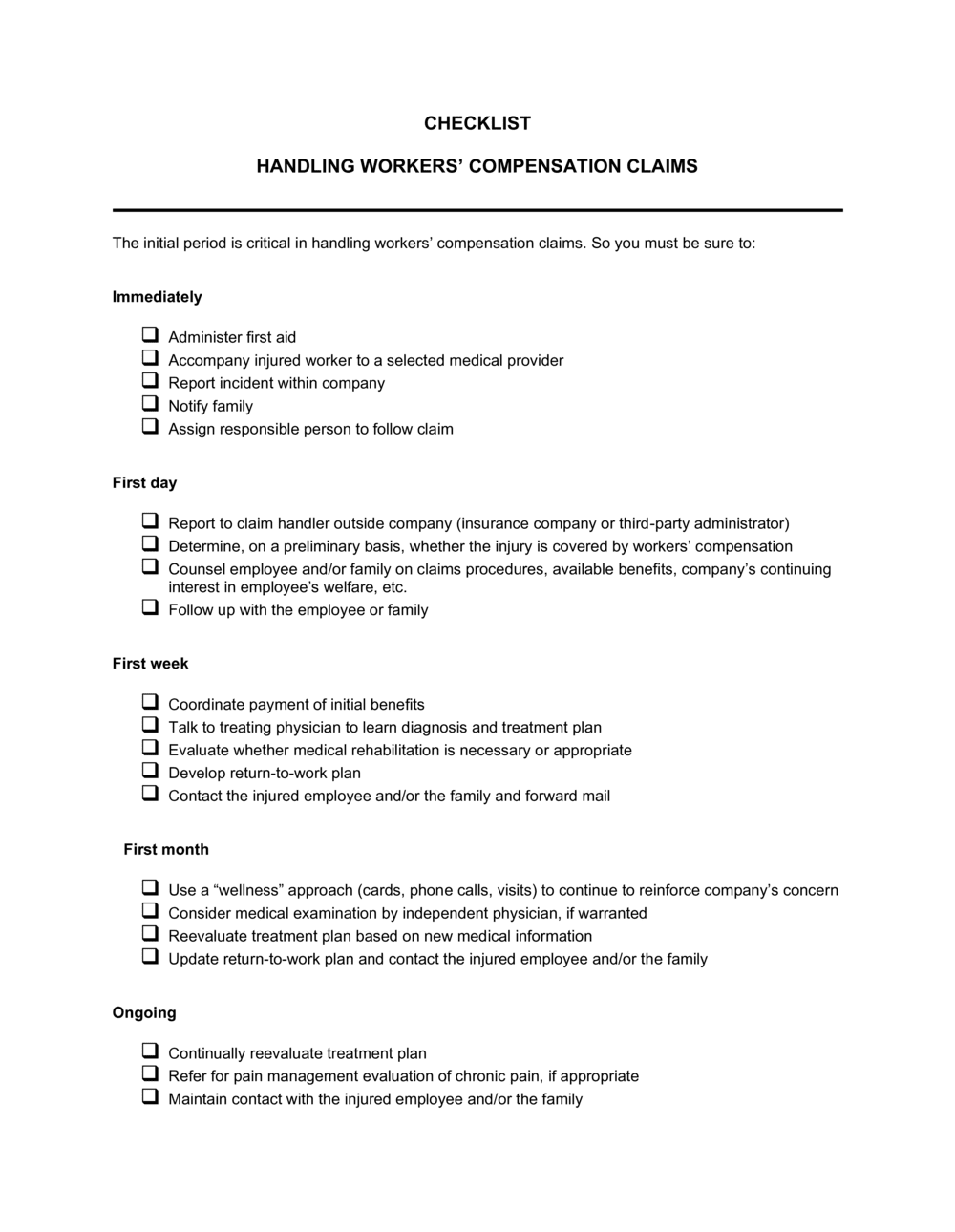
Checklist Worker's Compensation Claims

Free download β€’ Use as a template β€’ Print or share

6 pagesβ€’20–30 min to useβ€’Difficulty: Standard
Learn more ↓
FreeChecklist Worker's Compensation Claims Template

At a glance

What it is
A Workers' Compensation Claims Checklist is a structured form that guides HR managers, safety officers, and supervisors through every step required to document and process a workplace injury or occupational illness claim. This free Word download gives you a pre-built checklist you can edit online, complete on paper, and store in the injured employee's file.
When you need it
Use it immediately after a workplace injury or illness is reported β€” before any deadlines for notifying the insurer or state workers' compensation board pass. It is also useful during routine audits of open claims to confirm nothing has been missed.
What's inside
Incident identification fields, injured employee details, first-aid and medical treatment tracking, insurer notification steps, state filing requirements, witness information, return-to-work status, and a claim closure confirmation section.

What is a Workers' Compensation Claims Checklist?

A Workers' Compensation Claims Checklist is a structured form that guides employers through every administrative and regulatory step required to report, document, and manage a workplace injury or occupational illness claim. It captures injured employee details, incident facts, first-aid and medical treatment records, insurer notification confirmation, state First Report of Injury filing status, return-to-work tracking, and claim closure confirmation β€” all in a single reference document. By working through the checklist sequentially, HR managers and supervisors can be confident that no deadline is missed and no required documentation is overlooked.

Why You Need This Document

Missing a single step in the workers' compensation claim process can cost far more than the claim itself. Late insurer notification triggers coverage disputes. A missed state FROI deadline results in regulatory fines. Undocumented witness accounts leave employers without corroborating evidence when claims are disputed months later. Failing to issue a written modified-duty offer in writing means indemnity benefits continue to accrue even after a physician clears the employee for light work. Each of these errors directly increases claim costs and, over time, drives up your experience modification rate β€” raising the workers' comp premiums you pay every year. This checklist eliminates the guesswork by turning a complex, deadline-driven process into a straightforward task list any supervisor can follow from the moment an injury is reported.

Which variant fits your situation?

If your situation is…Use this template
Documenting the initial injury event for OSHA 300 log purposesIncident Report Form
Tracking all workplace injuries across multiple employees over a yearAccident and Injury Log
Outlining a formal return-to-work plan for a recovering employeeReturn-to-Work Agreement
Notifying the insurer of a new claim in writingWorkers' Compensation Claim Letter
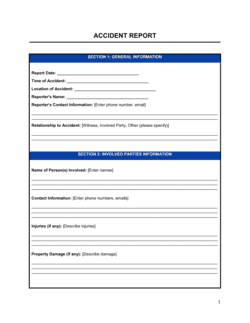
Investigating the root cause of a workplace accidentAccident Investigation Report
Recording employee health and safety incidents for regulatory complianceHealth and Safety Incident Report
Documenting a near-miss event before an injury occursNear-Miss Incident Report

Common mistakes to avoid

❌ Recording the report date instead of the injury date

Why it matters: State filing deadlines and statutes of limitations run from the actual date of injury. A wrong date can make a timely filing appear late or allow a lapsed claim to be reopened.

Fix: Always confirm the exact injury date directly with the employee and any witnesses before entering it on the checklist.

❌ Skipping the witness documentation field

Why it matters: Undocumented witnesses cannot be located quickly if the claim is disputed months later, leaving the employer without corroborating evidence.

Fix: Collect witness names and statements on the day of the incident, even for claims that appear straightforward.

❌ Delaying insurer notification past the policy deadline

Why it matters: Late notice can trigger a coverage dispute with the insurer, leaving the employer financially exposed for medical and indemnity costs.

Fix: Set a firm internal rule to notify the insurer within 24 hours of any injury report, regardless of perceived severity.

❌ Failing to document a written modified-duty offer

Why it matters: Without written documentation, an employer cannot prove it offered suitable alternative work β€” meaning indemnity payments may continue even after the physician clears the employee for light duty.

Fix: Issue a modified-duty offer letter the same day the physician's release is received and attach a copy to this checklist.

The 10 key fields, explained

Injured employee information

Incident date, time, and location

Injury description

Witness information

First-aid treatment provided

Medical treatment and provider details

Insurer notification details

State filing status

Return-to-work status

Claim closure confirmation

How to fill it out

  1. 1

    Complete injured employee and incident fields immediately

    As soon as an injury is reported, fill in the employee's legal name, job title, and the exact date, time, and location of the incident. Do not wait until the end of the shift.

    πŸ’‘ Keep a blank copy of this checklist at every supervisor's workstation so it can be started within minutes of the injury.

  2. 2

    Document first-aid treatment before the employee leaves the worksite

    Record every first-aid step taken β€” who administered it, what was used, and at what time. Note whether the employee refused first aid.

    πŸ’‘ Even a single acetaminophen tablet or ice pack counts as first aid and affects OSHA recordability β€” document it regardless of how minor it seems.

  3. 3

    Obtain witness names and statements

    Identify all coworkers present at or near the incident and record their names and contact information. Note whether a written statement was taken or is pending.

    πŸ’‘ Collect statements on the same day β€” memory fades and witness availability drops quickly after the incident.

  4. 4

    Confirm the treating medical provider

    Check whether the employee's state requires treatment through an insurer-designated provider panel. Direct the employee to an authorized provider and record the clinic name, address, and visit date.

    πŸ’‘ Post a list of authorized treating providers on the safety bulletin board so supervisors can direct injured workers without delay.

  5. 5

    Notify the insurer within the policy deadline

    Call or submit an online notice to the workers' comp insurer, then record the date notified, the claim number assigned, and the adjuster's contact information in this field.

    πŸ’‘ Most policies require notice within 24–72 hours. Set a calendar reminder for 24 hours after any injury report to confirm notification has occurred.

  6. 6

    File the First Report of Injury with the state board

    Confirm your state's FROI deadline (typically 7–14 days from injury date), complete the required state form, and record the filing date and responsible party here.

    πŸ’‘ Do not assume the insurer files on your behalf β€” verify this explicitly with your adjuster and document the confirmation.

  7. 7

    Track return-to-work status and document modified-duty offers

    Update the return-to-work field at each medical appointment. If the physician releases the employee to modified duty, issue a written offer within 24 hours and record whether it was accepted.

    πŸ’‘ A documented modified-duty offer that the employee declines can terminate indemnity benefit obligations in many states.

  8. 8

    Complete the closure confirmation when the claim resolves

    Record the closure date, the basis (MMI, settlement, or denial), the date of any final payment, and confirm the file has been archived according to your document retention policy.

    πŸ’‘ Retain closed workers' comp claim files for at least 5 years from the date of injury β€” longer if the claim involved a minor employee or occupational disease.

Frequently asked questions

What is a workers' compensation claims checklist?

A workers' compensation claims checklist is a structured form that walks HR managers, supervisors, and safety officers through every step required to document and process a workplace injury or occupational illness claim. It covers incident details, medical treatment, insurer notification, state filing, and return-to-work tracking in a single reference document, reducing the risk of missing a critical deadline or documentation step.

When should a workers' compensation claim checklist be started?

Start the checklist as soon as an injury or illness is reported β€” ideally within the same shift. Many states require the employer to file the First Report of Injury within 7–14 days of the injury date, and insurers typically require notice within 24–72 hours. Waiting until the next business day to begin documentation puts both deadlines at risk.

Who is responsible for completing the workers' comp checklist?

The injured employee's direct supervisor typically initiates the checklist, with HR completing the insurer notification and state filing sections. In small businesses without a dedicated HR team, the owner or office manager usually handles all steps. Assigning clear ownership for each section before an injury occurs prevents gaps when one actually happens.

Does completing this checklist satisfy OSHA recordkeeping requirements?

Not on its own. OSHA recordkeeping requires a separate OSHA 300 log entry for any recordable work-related injury or illness, plus an OSHA 301 incident report form. This checklist complements those forms by ensuring the workers' comp claim process runs in parallel with OSHA compliance, but it does not replace them.

What happens if the employer misses the state FROI filing deadline?

Penalties vary by state but commonly include fines ranging from $100 to $10,000 per violation, and in some states late filing can be treated as a misdemeanor. Beyond penalties, late filings can complicate the claim process and strain the employer's relationship with the insurer. Tracking the filing deadline on this checklist is one of its primary risk-reduction functions.

Can this checklist be used for occupational illness claims, not just injuries?

Yes. Occupational illnesses β€” such as repetitive-strain injuries, hearing loss from prolonged noise exposure, or respiratory conditions from chemical exposure β€” follow the same claims process as acute injuries. The key difference is that the injury date may be defined as the date the employee first became aware of the illness and its work-related cause, which should be documented carefully in the incident description field.

How long should completed workers' compensation claim checklists be retained?

Retain completed checklists for at least 5 years from the date of injury as a general baseline. If the claim involved a minor employee, extend retention until 5 years after the employee reaches age 18. Occupational disease claims may require retention for 30 years under certain OSHA standards. Always verify the specific retention requirement in your state.

Does using this checklist reduce workers' comp insurance premiums?

Consistent claim documentation supports faster claim closure and more accurate reserves, both of which contribute to a lower experience modification rate (EMR) over time. A lower EMR directly reduces workers' comp premiums. While the checklist itself does not lower premiums immediately, disciplined use across all claims builds the claims history that does.

Is a separate checklist needed for each injured employee?

Yes. Each checklist should correspond to a single employee and a single injury event. Keep completed checklists in the individual employee's workers' comp claim file alongside the FROI, medical records, and correspondence with the insurer and adjuster.

How this compares to alternatives

vs Incident Report Form

An incident report form documents the facts of a workplace accident for internal investigation and OSHA recordkeeping purposes. A workers' comp claims checklist extends beyond the incident to track insurer notification, state filing deadlines, medical treatment, and return-to-work status. Use the incident report form first, then the claims checklist to manage the ongoing claim process.

vs Accident Investigation Report

An accident investigation report focuses on root-cause analysis β€” identifying what went wrong and how to prevent recurrence. A workers' comp claims checklist focuses on administrative and regulatory compliance β€” ensuring the claim is filed correctly and on time. Both should be completed after a serious injury, but they serve different audiences and purposes.

vs Employee Disciplinary Form

A disciplinary form documents policy violations or performance issues. A workers' comp claims checklist documents a medical and administrative process. The two should never be combined or initiated simultaneously in response to the same incident β€” mixing them creates the appearance of retaliation, which is prohibited under workers' compensation statutes in every US state.

vs Return-to-Work Agreement

A return-to-work agreement formalizes the terms of an injured employee's modified-duty assignment β€” specific tasks, schedule, and physical restrictions. The workers' comp claims checklist tracks whether a return-to-work offer was made and accepted but does not define the terms. Use the checklist to confirm the offer was documented, and a separate return-to-work agreement to govern the actual assignment.

Industry-specific considerations

Construction

High injury frequency makes consistent claim documentation critical for managing EMR and meeting state contractor licensing insurance requirements.

Manufacturing

Machine-related injuries often involve OSHA recordability and potential third-party liability, requiring detailed incident and witness documentation from the first report.

Healthcare

Needle-stick injuries, patient-handling strains, and workplace violence incidents each have specific reporting pathways that this checklist helps coordinate alongside OSHA 300 log requirements.

Retail and Hospitality

High employee turnover and slip-and-fall incidents make standardized first-report documentation essential for tracking claims across multiple locations and part-time staff.

Template vs pro β€” what fits your needs?

PathBest forCostTime
Use the templateAny employer managing standard workplace injury claims with HR or supervisory staffFree15–30 minutes per claim
Template + professional reviewEmployers in high-risk industries or states with complex FROI requirements wanting a compliance review$150–$400 (HR consultant or workers' comp specialist review)1–2 days
Custom draftedLarge employers with multi-state operations needing jurisdiction-specific claim workflows built into HR systems$500–$2,000+ (HR or risk management consultant)1–3 weeks

Glossary

First Report of Injury (FROI)
The mandatory form filed with the state workers' compensation board to officially report a workplace injury β€” deadlines vary by state but are typically 7–14 days from the date of injury.
OSHA 300 Log
A federal recordkeeping form employers use to log all work-related injuries and illnesses that meet OSHA's recordability criteria during the calendar year.
Indemnity Benefits
Wage-replacement payments made to an injured worker who cannot perform their regular duties, typically calculated as two-thirds of the worker's average weekly wage.
Medical-Only Claim
A workers' comp claim where the injury requires medical treatment but does not result in lost work time beyond the day of injury or waiting period.
Lost-Time Claim
A workers' comp claim where the injury causes the employee to miss work beyond the state-mandated waiting period, triggering indemnity benefit payments.
Modified Duty
Temporary work assignments adjusted in scope or physical demand to accommodate an injured employee who cannot yet perform their full regular duties.
Subrogation
The insurer's right to recover claim costs from a third party whose negligence caused or contributed to the employee's workplace injury.
Experience Modification Rate (EMR)
A multiplier applied to a company's workers' comp premium that reflects its injury history relative to industry peers β€” a lower EMR means lower premiums.
Maximum Medical Improvement (MMI)
The point at which a treating physician determines that the injured worker's condition has stabilized and is unlikely to improve further with additional treatment.
Statute of Limitations
The deadline by which an injured worker must file a formal workers' compensation claim, typically 1–3 years from the date of injury depending on the state.

Part of your Business Operating System

This document is one of 3,000+ business & legal templates included in Business in a Box.

  • Fill-in-the-blanks β€” ready in minutes
  • 100% customizable Word document
  • Compatible with all office suites
  • Export to PDF and share electronically

Create your document in 3 simple steps.

From template to signed document β€” all inside one Business Operating System.
1
Download or open template

Access over 3,000+ business and legal templates for any business task, project or initiative.

2
Edit and fill in the blanks with AI

Customize your ready-made business document template and save it in the cloud.

3
Save, Share, Send, Sign

Share your files and folders with your team. Create a space of seamless collaboration.

Save time, save money, and create top-quality documents.

β˜…β˜…β˜…β˜…β˜…

"Fantastic value! I'm not sure how I'd do without it. It's worth its weight in gold and paid back for itself many times."

Managing Director Β· Mall Farm
Robert Whalley
Managing Director, Mall Farm Proprietary Limited
β˜…β˜…β˜…β˜…β˜…

"I have been using Business in a Box for years. It has been the most useful source of templates I have encountered. I recommend it to anyone."

Business Owner Β· 4+ years
Dr Michael John Freestone
Business Owner
β˜…β˜…β˜…β˜…β˜…

"It has been a life saver so many times I have lost count. Business in a Box has saved me so much time and as you know, time is money."

Owner Β· Upstate Web
David G. Moore Jr.
Owner, Upstate Web

Run your business with a system β€” not scattered tools

Stop downloading documents. Start operating with clarity. Business in a Box gives you the Business Operating System used by over 250,000 companies worldwide to structure, run, and grow their business.

Free Forever PlanΒ Β·Β No credit card required