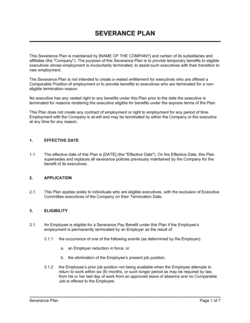
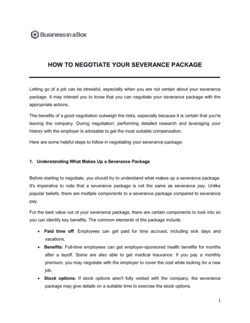
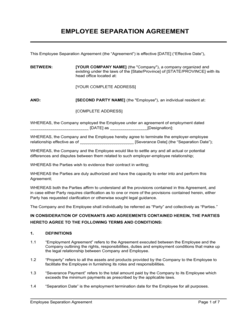
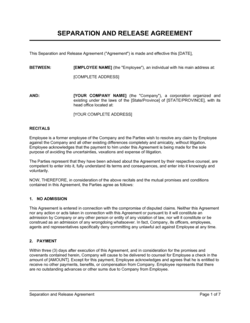
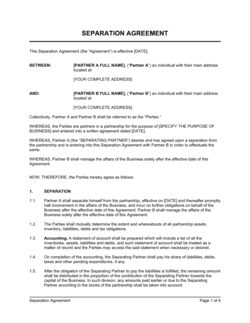
Severance Pay Agreement Template

Free Word download • Edit online • Save & share with Drive • Export to PDF

7 pages30–40 min to fillDifficulty: ComplexSignature requiredLegal review recommended
Learn more ↓
FreeSeverance Pay Agreement Template

At a glance

What it is
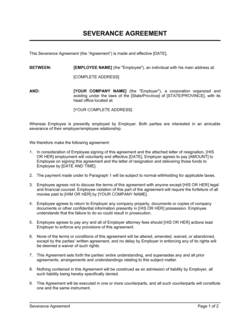
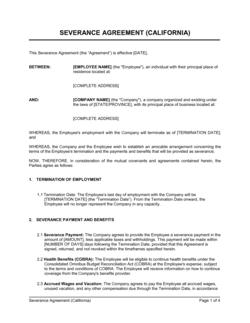
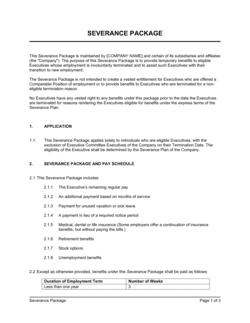
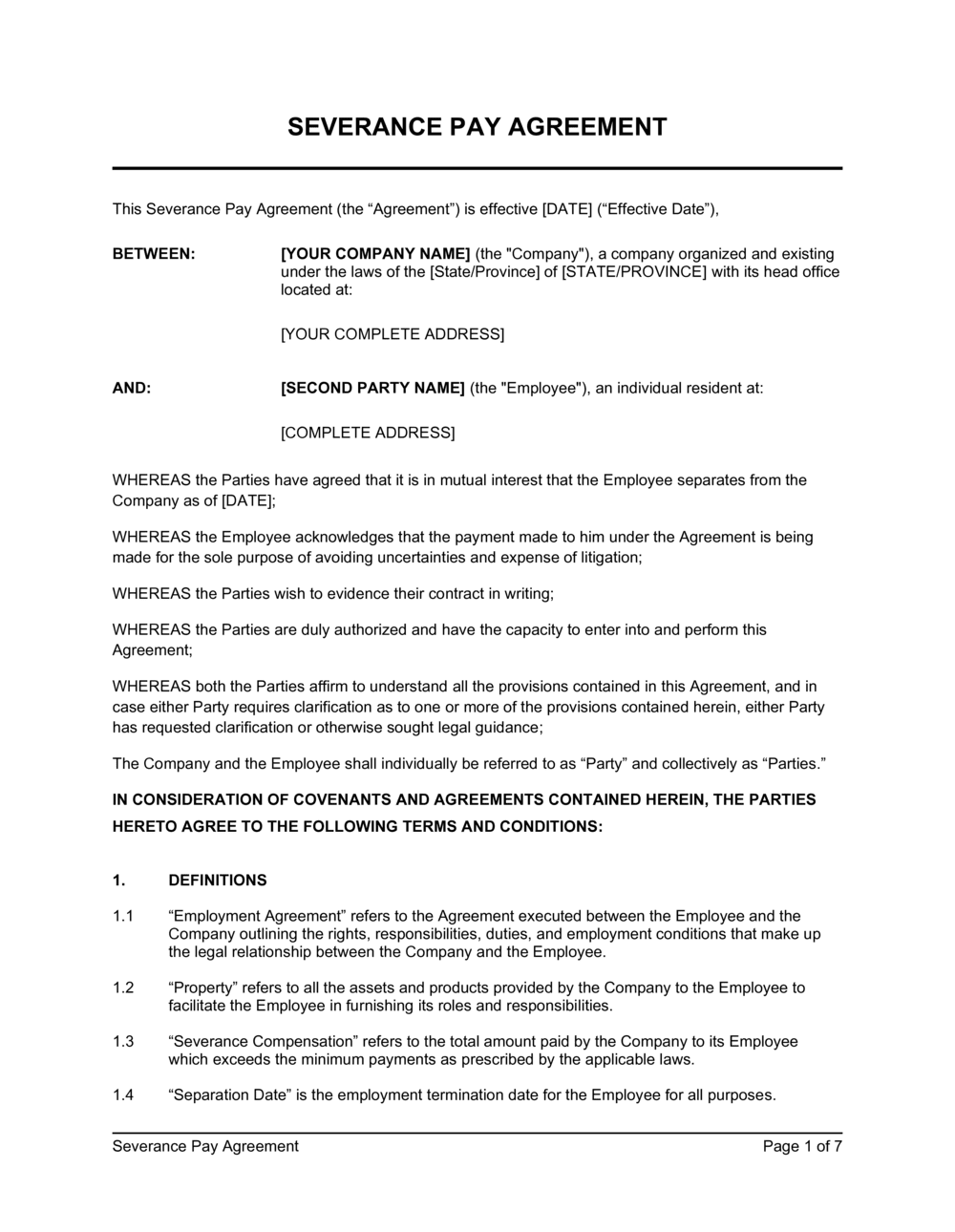
A Severance Pay Agreement is a legally binding contract between an employer and a departing employee that defines the compensation and benefits the employee will receive upon separation and, in exchange, secures a release of legal claims against the employer. This template is a free Word download you can edit online and export as PDF — covering severance amount, payment schedule, benefits continuation, confidentiality, non-disparagement, and a full release of claims in a single document.
When you need it
Use it when terminating an employee without cause, conducting a layoff or reduction in force, or negotiating a mutual separation where both parties want a clean, documented exit. It is also appropriate when an employee resigns under disputed circumstances and the employer wants a release before paying any exit package.
What's inside
Severance amount and payment schedule, COBRA and benefits continuation terms, a release and waiver of all employment-related claims, confidentiality and non-disparagement obligations, return of company property, references to any surviving restrictive covenants, and the governing law and review period disclosures required by the ADEA for employees over 40.

What is a Severance Pay Agreement?

A Severance Pay Agreement is a legally binding contract between an employer and a departing employee that documents the financial compensation and benefits the employee will receive upon separation, and in exchange secures a release of all employment-related legal claims against the employer. It functions as the definitive record of the exit terms — replacing any informal promises or offer letters — and creates enforceable obligations on both sides: the employer must pay the agreed amount on schedule, and the employee is bound by the release, confidentiality, and non-disparagement terms from the moment the revocation period expires. The agreement is typically triggered by a termination without cause, a layoff or reduction in force, or a negotiated mutual departure where both parties want a clean, documented end to the relationship.

Why You Need This Document

Without a signed severance pay agreement, the employer pays exit compensation with no legal protection in return — leaving every employment claim from discrimination to unpaid wages fully intact and actionable. A departing employee who receives a check and signs nothing can file an EEOC charge, a wage-and-hour lawsuit, or a wrongful termination claim weeks after cashing that payment. In jurisdictions like Canada and the UK, an undocumented separation exposes the employer to open-ended common-law notice claims that regularly reach 12 to 24 months of salary for long-tenured employees. The agreement also eliminates post-separation ambiguity about which prior restrictions survive — confidentiality, IP assignment, non-solicitation — reducing the likelihood that a former employee joins a competitor claiming the restrictions were released as part of the deal. A properly executed severance pay agreement, delivered with the required review period and signed before the last day of employment, closes all of these exposures for a fraction of the cost of a single employment dispute.

Which variant fits your situation?

If your situation is…Use this template
Terminating an employee over 40 in the United StatesSeverance Pay Agreement (ADEA-compliant)
Laying off a group of employees simultaneouslyWARN Act Layoff Notice + Group Severance Agreement
Executive departure with equity, clawback, or enhanced severanceExecutive Separation Agreement
Mutual separation where the employee resigns under disputed termsMutual Separation Agreement
Ending a fixed-term contract before the agreed end dateContract Termination Agreement
Separating an independent contractor rather than an employeeIndependent Contractor Termination Letter
Documenting a no-severance termination for causeEmployee Dismissal Letter

Common mistakes to avoid

❌ Severance amount falls below statutory minimums

Why it matters: In Canada, the UK, and many EU member states, contractual severance cannot be less than the statutory floor. An agreement that pays less is void to the extent of the shortfall — and the employer may owe the higher statutory amount plus penalties.

Fix: Before drafting the payment clause, calculate the statutory minimum for the employee's jurisdiction based on tenure and weekly pay. The contractual amount must equal or exceed that floor.

❌ Omitting ADEA disclosures for employees aged 40 and over

Why it matters: Without the mandatory 21-day review period, 7-day revocation window, and attorney-consultation notice, the waiver of age discrimination claims is legally void under the OWBPA — eliminating the primary protection the agreement was designed to provide.

Fix: Apply ADEA and OWBPA disclosures to any agreement involving an employee who is 40 or older at the time of separation, regardless of whether age is a factor in the termination.

❌ Release attempts to waive non-waivable rights

Why it matters: Courts in the US and EU have voided entire severance agreements — not just the offending clause — when they find the release attempts to bar EEOC charges, NLRA rights, or vested pension claims. The employer loses all protections of the agreement.

Fix: Limit the release to known and unknown employment-related claims that are legally waivable. Expressly carve out EEOC charge-filing rights, NLRA Section 7 rights, workers' compensation claims, and vested retirement benefits.

❌ No clawback provision for breach of post-employment obligations

Why it matters: Without a clawback clause, an employee who immediately violates confidentiality or non-solicitation terms has no financial disincentive — and the employer has no contractual basis to recover the severance already paid.

Fix: Include a clawback provision requiring the employee to repay the severance, less the statutory minimum, if they materially breach any surviving covenant within a defined period after separation.

❌ Agreement signed after the separation date without fresh consideration

Why it matters: In common-law jurisdictions, a release signed after the employee has already been separated and received their final pay may lack consideration — meaning the employee gave nothing new in exchange for what they already received. Courts have refused to enforce releases on this basis.

Fix: Ensure the agreement is presented to the employee before or on the last day of employment, and that the severance payment is clearly contingent on execution. If the timeline slips, add a documented additional benefit as fresh consideration.

❌ Benefits continuation clause has no defined end date

Why it matters: Open-ended benefits continuation language — such as 'Company will maintain benefits during the transition' — can be read as a continuing obligation that outlasts the intended period, creating indefinite premium liability.

Fix: State the exact calendar date on which employer-paid benefits end, name each plan included, and confirm that COBRA election rights begin the day after that date.

The 10 key clauses, explained

Parties, employment history, and separation date

In plain language: Identifies the employer and employee as legal entities, records the employee's position and length of service, and states the official last day of employment.

Sample language
This Severance Pay Agreement is entered into as of [DATE] between [EMPLOYER LEGAL NAME], a [STATE] [ENTITY TYPE] ('Company'), and [EMPLOYEE FULL NAME] ('Employee'). Employee was employed as [JOB TITLE] from [START DATE] through [SEPARATION DATE] ('Separation Date').

Common mistake: Using a trade name instead of the registered legal entity name. If the employer's name on the agreement doesn't match payroll records, enforcing the release or clawback in court becomes procedurally complicated.

Severance payment amount and schedule

In plain language: States the total severance amount, how it is calculated (e.g., 2 weeks per year of service), when payments begin, how frequently they are made, and whether they are subject to standard payroll deductions.

Sample language
In consideration of Employee's execution of this Agreement, Company shall pay Employee a severance amount of $[AMOUNT], equivalent to [X] weeks of base salary at Employee's final rate of $[WEEKLY RATE]/week, paid in equal installments on Company's regular payroll schedule beginning [DATE], subject to applicable withholding and deductions.

Common mistake: Failing to specify whether the severance amount is gross or net, and whether it is subject to standard tax withholding. Employees who expect a net figure and receive a gross payment frequently dispute the shortfall.

Benefits continuation

In plain language: Addresses health, dental, and vision coverage after separation — whether the employer will continue to pay premiums for a defined period, the employee's COBRA election rights, and any other ongoing benefits such as life insurance or EAP.

Sample language
Company shall continue Employee's group health coverage under its existing plan through [DATE] at Company's expense. Thereafter, Employee may elect continued coverage under COBRA. Company will notify Employee of COBRA election rights and deadlines separately.

Common mistake: Promising to 'maintain benefits' without specifying an end date or cost-split. Open-ended benefit continuation language creates indefinite liability and conflicts with plan documents.

Release and waiver of claims

In plain language: The core exchange of the agreement: the employee releases all known and unknown employment-related legal claims — discrimination, harassment, wage and hour, breach of contract — in return for the severance payment.

Sample language
In consideration of the payments described herein, Employee releases and forever discharges Company and its officers, directors, employees, and agents from any and all claims, known or unknown, arising from or related to Employee's employment or separation, including but not limited to claims under Title VII, the ADEA, the ADA, the FLSA, and applicable state law.

Common mistake: Using an overly broad release that attempts to waive claims that cannot legally be waived — such as future workers' compensation claims, NLRA rights, or EEOC charge-filing rights. An overbroad release can void the entire agreement in some jurisdictions.

ADEA and OWBPA disclosures (employees 40+)

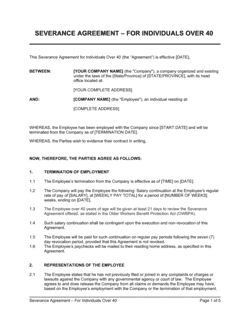
In plain language: For employees 40 and older in the US, discloses the specific rights and time periods required by federal law: 21 days to consider the agreement, 7 days to revoke after signing, and a statement that the employee is advised to consult an attorney.

Sample language
Employee acknowledges that: (a) this Agreement includes a waiver of rights under the ADEA; (b) Employee has been advised to consult an attorney before signing; (c) Employee has [21] days to consider this Agreement; and (d) Employee may revoke this Agreement within 7 days of signing by written notice to [HR CONTACT].

Common mistake: Omitting ADEA disclosures for employees aged 40 and over because the HR team assumed the employee was younger. ADEA non-compliance voids the age-discrimination waiver, exposing the company to the very claims the release was meant to eliminate.

Confidentiality of agreement terms

In plain language: Prohibits both parties from disclosing the existence or terms of the agreement to third parties, with standard carve-outs for attorneys, accountants, immediate family, and governmental authorities.

Sample language
Employee agrees to keep the terms of this Agreement strictly confidential and not to disclose them to any third party except Employee's spouse, attorney, or financial advisor, or as required by law, provided that any such permitted recipient agrees to maintain the same confidentiality.

Common mistake: Drafting a one-sided confidentiality clause that binds only the employee. Employers who later publicize the terms — even internally — can face claims that they breached the agreement and triggered the employee's right to sue on the underlying claims.

Non-disparagement

In plain language: Obligates the employee not to make negative, disparaging, or harmful statements about the company, its leadership, or its products — and often includes a reciprocal obligation from the employer.

Sample language
Employee agrees not to make any statement, oral or written, that disparages Company, its products, services, or current or former officers, directors, or employees. Company agrees that its officers and HR personnel will not make disparaging statements about Employee.

Common mistake: Failing to include a reciprocal employer-side obligation. Without it, a negative reference call from a manager can undermine the settlement and give the employee grounds to argue the agreement was breached in bad faith.

Return of company property

In plain language: Requires the employee to return all company property — devices, access credentials, documents, and confidential materials — by a specific date, and confirms that the employee has no outstanding personal property on company premises.

Sample language
By [DATE], Employee shall return all Company property in Employee's possession, including laptop serial no. [SERIAL], access badges, client files, and any copies of confidential information in any format. Employee confirms that no Company property remains on personal devices.

Common mistake: Not specifying a return deadline or listing the items to be returned. Vague property return obligations are routinely ignored and leave the employer unable to enforce them without a second legal action.

Surviving covenants and post-employment restrictions

In plain language: Confirms which obligations from the original employment contract survive separation and remain in force — typically confidentiality, non-solicitation, and any valid non-compete — and incorporates them by reference.

Sample language
Employee acknowledges that the confidentiality, non-solicitation, and intellectual property assignment obligations in Employee's Employment Agreement dated [DATE] remain in full force and effect following the Separation Date and are incorporated herein by reference.

Common mistake: Neglecting to reference surviving covenants entirely, which can create ambiguity about whether the employee believes prior restrictions were released as part of the severance deal.

Governing law, dispute resolution, and integration

In plain language: Specifies which jurisdiction's law governs the agreement, how disputes are resolved (arbitration or court), and includes an integration clause confirming this document supersedes all prior representations about the exit terms.

Sample language
This Agreement is governed by the laws of [STATE/PROVINCE/COUNTRY]. Any dispute shall be resolved by binding arbitration in [CITY] under [AAA/JAMS] rules, except claims for injunctive relief. This Agreement constitutes the entire agreement between the parties regarding Employee's separation and supersedes all prior negotiations and representations.

Common mistake: Selecting a governing law with no connection to the employee's actual work location. Several jurisdictions — including California — apply local law regardless of contractual choice-of-law provisions, invalidating non-competes and limiting release scope.

How to fill it out

  1. 1

    Enter the legal entity names and employment history

    Use the employer's full registered corporate name — not a brand or trade name — and the employee's legal name as it appears on payroll records. Record the job title, department, and exact start and separation dates.

    💡 Cross-check the employer's legal name against the original employment contract and payroll system to ensure all three documents are consistent.

  2. 2

    Calculate and document the severance amount

    Apply your company's severance formula (e.g., 2 weeks per year of service) to the employee's years of service and final base salary. State the gross total, the payment schedule, and confirm that standard payroll deductions apply.

    💡 Verify the calculated amount meets or exceeds the statutory minimum for the employee's work location before documenting it — the formula does not override the legal floor.

  3. 3

    Specify benefits continuation terms and COBRA details

    State the exact date employer-paid benefits end, which plans are covered, and reference the COBRA election notice the employee will receive separately. If you are paying COBRA premiums for a defined period, specify the number of months and the coverage plans.

    💡 Do not promise to maintain specific benefit levels — reference 'coverage under the current plan as in effect' to avoid liability if plan terms change before the continuation period ends.

  4. 4

    Draft the release of claims to the appropriate scope

    List the specific statutes being released that are relevant to the jurisdiction and the employee's protected class characteristics. Remove any attempt to waive NLRA rights, EEOC charge-filing rights, vested pension benefits, or future workers' compensation claims — these cannot legally be released.

    💡 A release drafted too broadly is more dangerous than one drafted too narrowly. Courts can void the entire agreement — not just the overbroad clause — if they find it impermissibly restricts non-waivable rights.

  5. 5

    Add ADEA and OWBPA disclosures if the employee is 40 or older

    Insert the mandatory 21-day review period, 7-day revocation window, and the statement advising the employee to consult an attorney. For group reductions in force, the review period extends to 45 days and requires specific information about the decisional unit.

    💡 Document the date you delivered the agreement to the employee — the 21-day clock starts on delivery, not on the date of the agreement.

  6. 6

    Confirm surviving post-employment obligations

    Reference the employee's original employment agreement by date and list the specific covenants that survive — confidentiality, non-solicitation, IP assignment. Attach the relevant sections as an exhibit if the covenants are detailed.

    💡 Never assume the employee remembers their post-employment restrictions. A written acknowledgment in the severance agreement reduces enforcement disputes significantly.

  7. 7

    Set the return-of-property deadline and asset list

    Specify every item to be returned — laptop serial number, mobile device, access badges, paper files, and remote-access credentials — and set a firm return date at or before the separation date.

    💡 Pair the return obligation with an IT off-boarding checklist signed on the last day. Physical acknowledgment of return is far easier to enforce than a contractual promise alone.

  8. 8

    Execute before or on the separation date

    Both parties must sign the agreement before or on the last day of employment. The employee's review period must be respected — do not pressure signature before the 21-day window expires for employees over 40.

    💡 Use a timestamped electronic signature platform to create an auditable record of when the agreement was delivered, reviewed, and signed by each party.

Frequently asked questions

What is a severance pay agreement?

A severance pay agreement is a legally binding contract between an employer and a departing employee that defines the compensation, benefits, and obligations associated with the end of the employment relationship. In exchange for the severance payment, the employee typically waives the right to bring legal claims against the employer arising from their employment or termination. It creates enforceable obligations on both parties and documents the complete terms of the exit.

Is severance pay required by law?

In the US, there is no federal law requiring private employers to pay severance — it is contractual or discretionary. However, in Canada, the UK, and most EU member states, statutory minimum termination pay or notice is required by law regardless of whether a formal severance agreement exists. Even in the US, an employer who has a written severance policy or who pays severance to similarly situated employees may be contractually obligated to pay it under implied contract theory.

What must a severance agreement include to be enforceable?

At minimum, an enforceable severance agreement must identify both parties, state the severance amount and payment schedule, include a valid release of claims supported by consideration, and be signed voluntarily. For US employees aged 40 and older, it must also include ADEA and OWBPA disclosures — including 21 days to review, 7 days to revoke, and a written recommendation to consult an attorney. Missing any of these elements can void the release or the entire agreement.

Can an employee negotiate a severance package?

Yes. Severance amounts, payment timing, benefits continuation periods, non-disparagement terms, and reference language are all typically negotiable. Employees with strong wrongful termination claims, long tenure, or specialized knowledge generally have the most leverage. Employers are not required to negotiate, but doing so often results in a faster, cleaner separation and reduces litigation risk. Any agreed changes should be documented in a written amendment or a restated agreement.

What claims does a severance agreement release?

A standard release covers all known and unknown employment-related claims — discrimination (Title VII, ADEA, ADA), harassment, retaliation, wage and hour disputes, breach of employment contract, and similar state-law claims. Certain rights cannot be released regardless of what the agreement says: EEOC charge-filing rights, NLRA Section 7 rights, vested pension or 401(k) benefits, and future workers' compensation claims. An agreement that attempts to waive non-waivable rights risks being voided in its entirety.

How much time does an employee have to review a severance agreement?

Under US law, employees aged 40 and older must receive at least 21 days to consider a severance agreement that waives ADEA claims, and 7 days to revoke after signing. For group layoffs, the review period extends to 45 days and requires additional disclosures about the decisional unit. There is no federal minimum review period for employees under 40, but best practice is to provide at least 5 business days. In the UK and Canada, courts evaluate whether the employee had meaningful opportunity to take independent legal advice.

Does a severance agreement need to be notarized?

Notarization is not required for a standard severance pay agreement to be enforceable in the US, Canada, the UK, or the EU. A witnessed or electronically signed agreement is generally sufficient. Some employers choose to have the agreement witnessed as an additional layer of evidence that the employee signed voluntarily, but this is a practical precaution rather than a legal requirement.

What happens if an employee violates a severance agreement?

If an employee breaches a material term — such as disclosing confidential settlement terms, making disparaging statements, or violating a surviving non-solicitation clause — the employer may seek damages, injunctive relief, or repayment of the severance under a clawback provision if one exists. However, the employer generally cannot unilaterally rescind the release of claims once the revocation period has expired. Courts assess each breach individually, so material breaches are more actionable than technical ones.

Can a severance agreement include a non-compete?

A severance agreement can reference or reaffirm a non-compete clause from the original employment contract, but courts will not enforce a new non-compete that was not part of the original employment agreement unless separate consideration beyond the statutory minimum severance is provided. Enforceability also depends heavily on jurisdiction — California bans most post-employment non-competes, and several EU countries require additional financial compensation for any restriction that limits future employment.

How this compares to alternatives

vs Mutual Separation Agreement

A mutual separation agreement documents a consensual parting where both parties agree to end the relationship — neither party is formally 'terminating' the other. A severance pay agreement is typically employer-initiated and places greater emphasis on the release of claims in exchange for a payment. When the separation is genuinely mutual, the mutual separation agreement is appropriate; when the employer is ending the relationship unilaterally, a severance pay agreement provides clearer legal protections.

vs Employee Dismissal Letter

A dismissal letter communicates the termination decision and its reasons but creates no binding obligations and provides no release of claims. A severance pay agreement is a bilateral contract signed by both parties that exchanges payment for legal protections. The dismissal letter triggers the separation; the severance pay agreement documents and closes it. Terminations for cause typically use a dismissal letter alone; terminations without cause benefit from both documents.

vs Employment Contract

An employment contract governs the beginning and duration of the working relationship — duties, compensation, and restrictive covenants. A severance pay agreement governs the end of that relationship — exit payments, release of claims, and post-employment obligations. The employment contract may contain a severance formula that the severance pay agreement then operationalizes. Both documents should be consistent with each other on surviving covenants and governing law.

vs Non-Disclosure Agreement

A standalone NDA creates confidentiality obligations before or during employment; it does not include a release of claims or severance payment. A severance pay agreement typically incorporates post-employment confidentiality obligations within the broader exit package. When a departing employee had access to particularly sensitive information, some employers execute both documents — the severance agreement for the release and the NDA for detailed confidentiality terms that survive the severance agreement's general provisions.

Industry-specific considerations

Technology / SaaS

IP assignment reaffirmation and access credential revocation are critical given that departing engineers may retain copies of source code or customer data without an explicit post-separation acknowledgment.

Financial Services

Regulatory licensing obligations, FINRA and FCA registration surrender requirements, and bonus clawback provisions tied to deferred compensation or unvested equity need explicit treatment in the agreement.

Healthcare

HIPAA confidentiality obligations survive separation and must be incorporated by reference; patient non-solicitation clauses are standard for clinical staff with direct patient relationships.

Professional Services

Client non-solicitation periods are the most contested clause in professional services separations, given that departing partners or senior advisors often have direct and portable client relationships.

Retail / Hospitality

High turnover and wage-and-hour exposure make clean releases particularly valuable; severance amounts are typically modest and the agreement must still comply with state wage-payment laws governing final paycheck timing.

Manufacturing

WARN Act compliance for plant closings or mass layoffs affecting 50 or more employees must be coordinated with individual severance agreements to avoid conflicting notice and payment obligations.

Jurisdictional notes

United States

There is no federal minimum severance requirement for private employers, but the ADEA and OWBPA impose mandatory disclosures, review periods, and revocation rights for employees aged 40 and older. WARN Act obligations apply to mass layoffs of 50 or more employees at a single site, requiring 60 days' advance notice or pay in lieu. State-level restrictions vary significantly — California limits release scope and bans most non-competes; New York requires specific wage-payment disclosures on final pay.

Canada

Each province's Employment Standards Act sets minimum termination notice and severance pay — Ontario requires up to 8 weeks' statutory notice plus up to 26 weeks' severance pay for qualifying employees, and courts may award significantly more under common law. Contractual severance that falls below statutory minimums is void to the extent of the shortfall. Quebec contracts must be available in French for provincially regulated employers, and the province's Civil Code governs contract interpretation differently from common law provinces.

United Kingdom

Statutory redundancy pay is calculated at 0.5 to 1.5 weeks' pay per year of service depending on age, subject to a weekly pay cap updated annually. Settlement agreements (formerly compromise agreements) must be in writing, signed by both parties, and the employee must have received independent legal advice from a named qualified advisor — without this advice, the agreement cannot validly waive statutory employment rights. ACAS Code of Practice applies to the dismissal process and can increase or decrease any tribunal award.

European Union

Statutory severance entitlements vary significantly by member state — France and Spain mandate severance based on length of service even for consensual separations, while Germany provides strong unfair dismissal protections that make clean releases difficult to obtain without meaningful compensation. Post-employment non-competes generally require financial compensation equivalent to 25–100% of salary to be enforceable. GDPR requires that any confidentiality provisions covering personal data references comply with data subject rights, which cannot be waived by contract.

Template vs lawyer — what fits your deal?

PathBest forCostTime
Use the templateStandard domestic separations for non-executive employees in a single US state or Canadian province where the severance amount is modest and no discrimination claim is anticipatedFree30–45 minutes
Template + legal reviewEmployees over 40 requiring ADEA compliance, cross-border separations, group layoffs, or situations where the employee has raised a discrimination or wage claim$400–$800 for a 1–2 hour employment attorney review2–5 business days
Custom draftedExecutive separations with equity, deferred compensation, or enhanced severance; mass layoffs with WARN Act obligations; or any separation where active litigation is threatened$2,000–$8,000+1–3 weeks

Glossary

Release of Claims
A contractual waiver in which the employee gives up the right to sue the employer for any employment-related legal claims in exchange for the severance payment.
ADEA (Age Discrimination in Employment Act)
A US federal law protecting employees 40 and older from age-based discrimination; it imposes specific disclosure, review period, and revocation rights on any severance agreement that waives ADEA claims.
OWBPA (Older Workers Benefit Protection Act)
A US law amending the ADEA that requires severance agreements to give employees over 40 at least 21 days to consider the agreement and 7 days to revoke after signing.
COBRA
A US federal law allowing employees to continue employer-sponsored health coverage after separation, typically at their own expense, for up to 18 months.
Non-Disparagement Clause
A mutual or one-sided obligation preventing one or both parties from making negative public statements about the other after separation.
Severance Formula
The method used to calculate the severance amount — commonly expressed as a number of weeks' pay per year of service, subject to a minimum and maximum.
Garden Leave
A notice period during which the departing employee is paid their full salary but released from active duties and barred from the workplace or systems.
Clawback Provision
A clause requiring the employee to repay some or all of the severance if they breach the agreement — for example, by violating confidentiality or non-disparagement terms.
Consideration
The legal requirement that both parties exchange something of value for a contract to be enforceable — in severance, the employer's payment is consideration for the employee's release of claims.
Integration Clause
A provision stating that the written agreement is the complete and final record of the parties' deal, superseding any prior verbal or written promises about the exit package.
Statutory Minimum Severance
The minimum termination pay or notice required by law in a given jurisdiction — contractual severance cannot fall below this floor, but may exceed it.

Part of your Business Operating System

This document is one of 3,000+ business & legal templates included in Business in a Box.

  • Fill-in-the-blanks — ready in minutes
  • 100% customizable Word document
  • Compatible with all office suites
  • Export to PDF and share electronically

Create your document in 3 simple steps.

From template to signed document — all inside one Business Operating System.
1
Download or open template

Access over 3,000+ business and legal templates for any business task, project or initiative.

2
Edit and fill in the blanks with AI

Customize your ready-made business document template and save it in the cloud.

3
Save, Share, Send, Sign

Share your files and folders with your team. Create a space of seamless collaboration.

Save time, save money, and create top-quality documents.

★★★★★

"Fantastic value! I'm not sure how I'd do without it. It's worth its weight in gold and paid back for itself many times."

Managing Director · Mall Farm
Robert Whalley
Managing Director, Mall Farm Proprietary Limited
★★★★★

"I have been using Business in a Box for years. It has been the most useful source of templates I have encountered. I recommend it to anyone."

Business Owner · 4+ years
Dr Michael John Freestone
Business Owner
★★★★★

"It has been a life saver so many times I have lost count. Business in a Box has saved me so much time and as you know, time is money."

Owner · Upstate Web
David G. Moore Jr.
Owner, Upstate Web

Run your business with a system — not scattered tools

Stop downloading documents. Start operating with clarity. Business in a Box gives you the Business Operating System used by over 250,000 companies worldwide to structure, run, and grow their business.

Start free · No credit card required