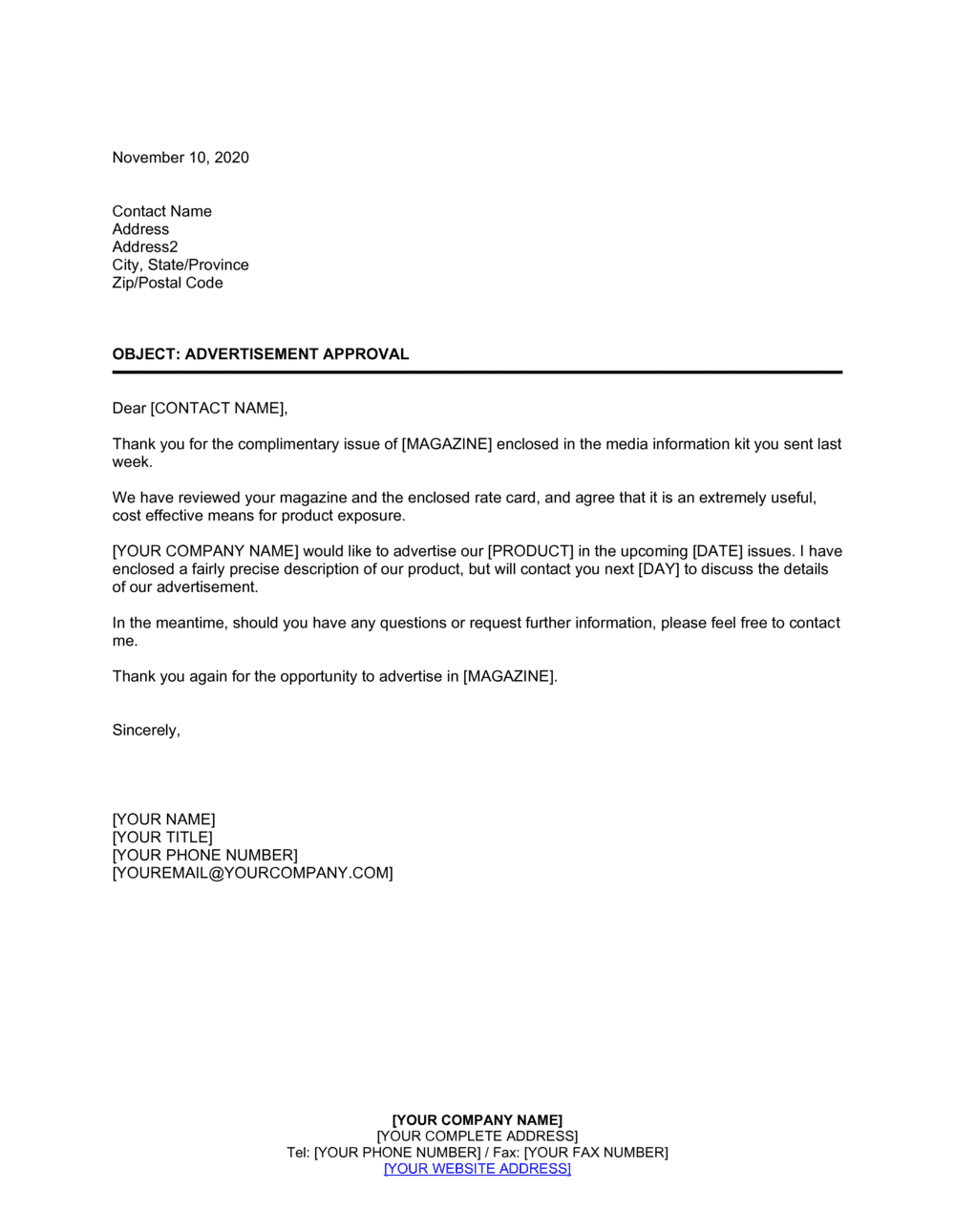
Advertisement Approval Template

Free Word download β€’ Edit online β€’ Save & share with Drive β€’ Export to PDF

1 pageβ€’20–30 min to fillβ€’Difficulty: Standardβ€’Signature requiredβ€’Legal review recommended
Learn more ↓
FreeAdvertisement Approval Template

At a glance

What it is
An Advertisement Approval is a binding legal document that authorizes a specific advertisement β€” print, digital, broadcast, or out-of-home β€” for publication or distribution after all required parties have reviewed and signed off on the content. This free Word download gives agencies, brands, and media buyers a structured form to document who approved what, when, and under what conditions, reducing post-publication disputes over content, rights, and regulatory compliance.
When you need it
Use it before any advertisement goes live β€” especially when a client, legal team, compliance officer, or rights holder must formally authorize the content. It is particularly important when the ad features third-party intellectual property, talent releases, regulated claims, or co-branded materials that require sign-off from more than one party.
What's inside
The document covers advertiser and approver identification, a detailed description of the approved advertisement, authorized media channels and territory, content restrictions and prohibited modifications, intellectual property and usage rights, regulatory compliance representations, liability allocation, and signatures with effective dates.

What is an Advertisement Approval?

An Advertisement Approval is a legally binding document that formally authorizes a specific advertisement β€” print, digital, broadcast, or out-of-home β€” for publication or distribution after all required parties have reviewed and signed off on the final creative. It identifies the advertiser and approving party, precisely describes the authorized asset, specifies the permitted media channels and territory, allocates intellectual property rights, requires the advertiser to represent that all claims are truthful and compliant with applicable law, and sets out the conditions under which approval may be revoked. Unlike an informal email sign-off or a verbal green light, a properly executed advertisement approval creates an enforceable record of who authorized what, under what conditions, and when.

Why You Need This Document

Running an advertisement without documented approval exposes every party in the chain β€” brand, agency, and media buyer β€” to disputes that are difficult and expensive to resolve after the ad has already run. If a claim in the ad is later challenged by a regulator or a competitor, the absence of a formal approval record makes it nearly impossible to demonstrate that the content was reviewed and substantiated before publication. If the creative is modified between approval and placement, there is no agreed baseline to measure the change against. If the agency and client disagree about what was authorized, email threads become competing evidence rather than a clear record. An Advertisement Approval Agreement solves all of these problems at once β€” it creates a single, versioned, signed document that defines exactly what ran, where, when, and on whose authority. This template gives agencies, brands, and compliance teams a structured starting point that covers every material term, so that the pre-launch review process produces a defensible record rather than a folder of conflicting messages.

Which variant fits your situation?

If your situation is…Use this template
Client approving creative work produced by an agency before any placementAdvertisement Approval
Obtaining model or talent consent to use their likeness in an adModel Release Form
Licensing third-party brand assets or logos for use in an advertisementTrademark License Agreement
Formally commissioning an agency to produce and place advertisingAdvertising Agency Agreement
Authorizing a third party to advertise on behalf of the brandCo-Marketing Agreement
Approving a specific social media post or sponsored content pieceInfluencer Marketing Agreement
Documenting content standards an advertiser must meet for a publicationAdvertising Policy Addendum

Common mistakes to avoid

❌ Approving a campaign concept instead of a final asset

Why it matters: Approving a brief or storyboard rather than the locked creative means any subsequent version β€” including the one that actually runs β€” was never formally authorized, voiding the protection the document is meant to provide.

Fix: Hold the approval process until the final, versioned asset is complete. Attach the exact file with a date and version number as Exhibit A before anyone signs.

❌ No expiration date on the approval

Why it matters: An undated approval can authorize an advertisement indefinitely β€” including after pricing, claims, or the advertiser's regulatory status have changed, creating liability for outdated or non-compliant content.

Fix: Always set a specific expiration date tied to the validity window of the ad's claims, pricing, and any applicable regulatory guidance.

❌ Placing all compliance liability on the agency

Why it matters: Regulators in the US, UK, EU, and Canada primarily hold the advertiser β€” not the agency β€” responsible for false or misleading claims. An indemnity clause that shifts this liability internally does not change the regulatory exposure.

Fix: Require the advertiser to sign the compliance representations clause personally, and ensure the indemnification clause covers regulatory fines and third-party consumer complaints as advertiser-side risks.

❌ Accepting email approval as a substitute for the signed agreement

Why it matters: Email sign-offs are easily disputed, may not bind the legal entity (only the individual), and create competing records when multiple stakeholders weigh in with conflicting feedback over a chain.

Fix: Treat email feedback as revision rounds only. Require a countersigned copy of the Advertisement Approval Agreement before any placement proceeds.

❌ Omitting a revocation or withdrawal clause

Why it matters: Without one, an approving party has no clear contractual mechanism to pull an advertisement that becomes problematic after publication β€” for example, following a regulatory guidance update or a reputational incident involving a spokesperson.

Fix: Include an explicit revocation clause with defined triggering events and a takedown timeline (typically 2–5 business days) so both parties know the process before a crisis requires it.

❌ Using blanket channel language without listing specific platforms

Why it matters: Approving 'all digital channels' can inadvertently authorize placements on platforms with incompatible audience demographics, content policies, or jurisdiction-specific advertising regulations the approving party would never have sanctioned.

Fix: List each authorized platform or channel by name in the agreement. Add a written-amendment requirement for any channel not on the original list.

The 10 key clauses, explained

Parties and authority

In plain language: Identifies the advertiser, the approving party, and any agency acting as intermediary, and confirms each signatory has authority to bind their organization.

Sample language
This Advertisement Approval Agreement ('Agreement') is entered into as of [DATE] by and between [ADVERTISER LEGAL NAME] ('Advertiser') and [APPROVING PARTY LEGAL NAME] ('Approving Party'). Each signatory represents that they have full authority to execute this Agreement on behalf of their respective organization.

Common mistake: Listing a job title rather than a legal entity as the approving party. If the individual leaves the company, the approval lacks a legally identifiable counterparty and disputes over authority arise.

Advertisement description and exhibit

In plain language: Precisely identifies the advertisement being approved β€” including title, version number, file format, and a copy or link attached as an exhibit β€” so there is no ambiguity about what was authorized.

Sample language
The advertisement described in Exhibit A ('Advertisement'), including the creative brief reference [BRIEF NUMBER], final script or visual dated [DATE], and file reference [FILE NAME / VERSION], is approved subject to the terms of this Agreement.

Common mistake: Approving 'the campaign' in general rather than a specific, versioned creative asset. Subsequent edits β€” even minor ones β€” then fall outside the formal approval, exposing both parties.

Authorized media channels and territory

In plain language: Lists the exact platforms, publications, or broadcast slots where the advertisement may run, and the geographic territory covered by the approval.

Sample language
The Advertisement is authorized for placement in the following channels: [CHANNEL LIST] within the territory of [COUNTRY / REGION]. Placement in any channel or territory not listed requires a written amendment signed by both parties.

Common mistake: Using broad language like 'all digital channels' without listing specific platforms. Platforms have materially different audience demographics and compliance obligations, and blanket approvals can authorize placements neither party intended.

Duration and expiration

In plain language: Sets the start date, end date, and any automatic renewal or extension provisions for the authorization.

Sample language
This approval is effective from [START DATE] and expires on [END DATE] unless earlier withdrawn pursuant to Section [X]. Continued use of the Advertisement after expiry without a written renewal constitutes unauthorized use.

Common mistake: Omitting an expiration date entirely. Approvals without a term can authorize an advertisement indefinitely, including after the advertiser's claims, pricing, or regulatory standing have changed.

Intellectual property and usage rights

In plain language: Specifies who owns the advertisement's underlying IP, what rights are granted for the approved use, and any restrictions on modification, sublicensing, or repurposing.

Sample language
All intellectual property in the Advertisement remains the property of [IP OWNER]. Approving Party is granted a limited, non-exclusive, non-transferable license to use the Advertisement in the authorized channels and territory for the term of this Agreement. No modification to the Advertisement is permitted without prior written consent of [IP OWNER].

Common mistake: Assuming the approving party automatically acquires rights to all ad content on sign-off. Without explicit IP terms, courts in some jurisdictions treat an approval as a license rather than an assignment β€” leaving the agency or creator with retained rights.

Regulatory compliance representations

In plain language: Requires the advertiser to represent and warrant that all claims in the advertisement are truthful, substantiated, and compliant with applicable advertising laws and regulations.

Sample language
Advertiser represents and warrants that: (a) all claims in the Advertisement are truthful, not misleading, and substantiated in accordance with applicable law; (b) the Advertisement complies with [FTC Act / ASA Code / CAD regulations / applicable EU Directives]; and (c) all required disclosures, disclaimers, and trigger words are included as required by applicable regulatory authority.

Common mistake: Placing compliance responsibility entirely on the agency rather than the advertiser. Regulators in most jurisdictions hold the advertiser β€” not the agency β€” primarily liable for false or misleading claims.

Indemnification and liability

In plain language: Allocates responsibility between the parties for losses arising from IP infringement, false claims, unauthorized use, or third-party complaints about the advertisement.

Sample language
Advertiser shall indemnify, defend, and hold harmless Approving Party from any claim, loss, or expense arising from: (a) inaccurate or unsubstantiated claims in the Advertisement; (b) infringement of third-party IP incorporated at Advertiser's direction; or (c) any unauthorized modification made by Advertiser after approval. Approving Party's liability for pre-approval errors shall not exceed [DOLLAR AMOUNT / PERCENTAGE OF FEES PAID].

Common mistake: Using mutual indemnification language without carving out each party's specific areas of responsibility. Symmetrical indemnities sound balanced but often leave both parties exposed on the claims most likely to arise β€” unsubstantiated ad copy and IP ownership.

Withdrawal and revocation of approval

In plain language: Defines the conditions under which the approving party can rescind authorization β€” such as a material change in the content, a regulatory development, or a brand crisis β€” and the required process for doing so.

Sample language
Approving Party may withdraw this approval by written notice to Advertiser if: (a) the Advertisement is materially altered from the approved version; (b) a regulatory authority issues guidance that renders the Advertisement non-compliant; or (c) continued use would cause material reputational harm. Advertiser shall cease use within [X] business days of receiving notice.

Common mistake: No revocation clause at all. Without one, an approving party has no clear contractual right to pull an ad that has become problematic after initial sign-off, forcing reliance on general law remedies that vary by jurisdiction.

Amendment and entire agreement

In plain language: States that any change to the approved advertisement or its terms requires a signed written amendment, and that this agreement supersedes all prior oral or written understandings about the advertisement.

Sample language
This Agreement may only be amended by a written instrument signed by authorized representatives of both parties. This Agreement constitutes the entire understanding between the parties regarding the Advertisement and supersedes all prior discussions, correspondence, and representations.

Common mistake: Treating email sign-off as a valid amendment. Without an explicit written-amendment requirement, courts in some jurisdictions accept email chains as binding modifications, creating conflicting records of what was actually approved.

Governing law and dispute resolution

In plain language: Specifies which jurisdiction's law governs the agreement and how disputes will be resolved β€” litigation, mediation, or arbitration.

Sample language
This Agreement shall be governed by the laws of [STATE / PROVINCE / COUNTRY]. Any dispute arising under this Agreement shall first be submitted to non-binding mediation in [CITY]. If unresolved within [30] days, the dispute shall be submitted to binding arbitration administered by [AAA / JAMS / equivalent body].

Common mistake: Selecting a governing law with no connection to where either party operates. Some advertising regulations β€” particularly FTC rules in the US and ASA codes in the UK β€” apply regardless of what governing law the contract specifies.

How to fill it out

  1. 1

    Identify all parties and confirm signatory authority

    Enter the full legal name of the advertiser, the approving party, and any intermediary agency. Confirm that each person signing has written authority to bind their organization β€” board resolution or delegation of authority if needed.

    πŸ’‘ For agencies acting on behalf of a brand, check whether the agency agreement already designates a specific person with approval authority before naming a new signatory here.

  2. 2

    Attach the final, versioned creative as Exhibit A

    Do not approve a campaign description β€” attach the exact file, script, or visual with a version number and date. For video or audio, include a link to the locked file with a checksum or file hash where practical.

    πŸ’‘ Name files with version numbers and dates in the filename itself (e.g., Ad_Brand_Campaign_v3_2026-05-02) so Exhibit A is unambiguous even years later.

  3. 3

    List authorized channels and territory explicitly

    Name every platform, publication, broadcast slot, or out-of-home location covered by this approval. State the geographic territory by country or region. Add a catch-all exclusion for all channels and territories not listed.

    πŸ’‘ If the campaign includes paid social, specify the platform name (Meta, TikTok, LinkedIn) rather than 'social media' β€” platform terms and audience rules differ materially.

  4. 4

    Set a specific start date and expiration date

    Enter the first publication date and a hard expiration date. For recurring campaigns, define the renewal process β€” automatic renewal with 30-day notice to terminate is common for annual campaigns.

    πŸ’‘ Tie the expiration date to the validity of any regulatory claims or pricing in the ad. If prices change quarterly, set a 90-day term rather than a 12-month one.

  5. 5

    Define IP ownership and modification rights

    State who owns the underlying creative IP and what rights the approving party receives. Specify whether the approving party may adapt the ad for local markets, translate it, or resize it for different placements β€” or whether all modifications require a new approval.

    πŸ’‘ If multiple parties contributed IP (e.g., licensed music, stock footage, a talent release), list each IP component and its owner in an IP schedule attached to the agreement.

  6. 6

    Complete the regulatory compliance section

    Have the advertiser's marketing or legal team confirm which regulatory frameworks apply to the ad β€” FTC guidelines, FDA claims rules, SEC performance disclosures, or equivalent. Check every claim in the ad against the applicable substantiation standard before signing.

    πŸ’‘ For health or financial products, attach the substantiation documents (clinical study, performance data) as a separate exhibit. If the substantiation is later challenged, you want it documented alongside the approval.

  7. 7

    Set the indemnification cap and mutual carve-outs

    Agree on a liability cap for each party β€” typically the fees paid under the underlying agency or media agreement. Carve out gross negligence and willful misconduct from any cap. Ensure the advertiser's indemnity covers claim accuracy and IP; the approving party's covers pre-approval errors or unauthorized platform placements.

    πŸ’‘ Ask your insurer whether the indemnification language in the agreement aligns with your advertising liability or errors-and-omissions coverage before signing.

  8. 8

    Execute before any media placement occurs

    Both parties must sign and date the agreement before the advertisement goes live. File the executed copy, the exhibit, and any attached schedules together in a single document set.

    πŸ’‘ Use an eSign platform that timestamps execution and emails a copy to each party automatically β€” this eliminates 'I never received the final version' disputes after the ad has run.

Frequently asked questions

What is an advertisement approval agreement?

An advertisement approval agreement is a legally binding document that formally authorizes a specific advertisement for publication or broadcast after all required parties have reviewed and signed off on the content. It identifies the parties, describes the approved creative asset, specifies the authorized channels and territory, allocates IP rights and compliance responsibility, and protects both the advertiser and approving party if disputes arise after the ad runs.

Who needs to sign an advertisement approval?

At minimum, an authorized representative of the advertiser and the approving party β€” typically the brand manager, legal officer, or client stakeholder with sign-off authority. When the advertisement features third-party IP, talent, or co-branded content, rights holders and talent representatives may also need to sign a separate release or addendum. Agencies typically coordinate execution but are not always parties to the approval itself.

Is an advertisement approval legally binding?

Yes, when properly executed by authorized signatories of both parties, an advertisement approval agreement is generally enforceable as a binding contract in most jurisdictions. It creates documented obligations on the advertiser regarding compliance representations, on the approving party regarding authorized channels, and on both parties regarding IP usage and indemnification. Consider having a lawyer review the agreement when significant spend, regulated claims, or third-party rights are involved.

What happens if the advertisement is changed after approval?

Any material change to the approved creative β€” including edits to claims, visuals, talent, or disclosures β€” should require a written amendment signed by both parties before the modified version runs. Without this, the modified advertisement is technically unauthorized, and the approving party's compliance representations no longer apply to it. The agreement should include an explicit prohibition on unauthorized modifications and a process for requesting amendments.

Do I need a separate approval for each media channel?

Not necessarily, but the approval agreement should list every authorized channel explicitly. If the same creative asset runs across multiple channels β€” print, digital, and broadcast β€” a single agreement can cover all of them provided each is named. If a significantly adapted version of the ad is used for a different channel (for example, a 15-second cut for social vs. a 30-second broadcast spot), a separate approval for the adapted version is advisable because the content is materially different.

How does an advertisement approval differ from a model release?

An advertisement approval authorizes the overall advertisement for publication and allocates compliance, IP, and liability between the advertiser and the approving party. A model release is a narrower document that specifically obtains consent from an individual whose image, voice, or likeness appears in the ad. Both documents are often needed: the model release addresses the talent's rights; the advertisement approval addresses the advertiser's authorization to run the finished creative.

What advertising regulations does the approval clause need to reference?

The applicable regulations depend on industry and jurisdiction. In the US, the FTC Act governs truth-in-advertising and endorsement disclosures; the FDA regulates health and drug claims; the SEC governs financial product performance advertising. In the UK, the ASA's CAP and BCAP Codes apply. In the EU, the Unfair Commercial Practices Directive and sector-specific directives (financial services, food labeling) are relevant. The compliance representations clause should cite the specific bodies and codes that apply to the advertiser's product and the channels used.

Can the approving party withdraw approval after the ad has run?

Yes, if the agreement includes a revocation clause β€” which it should. Common triggering events include a material alteration of the approved content, a regulatory change making the advertisement non-compliant, or a reputational incident involving a spokesperson. The agreement should specify a takedown timeline β€” typically 2–5 business days β€” and address what happens to media placements already committed or prepaid when revocation occurs.

Do I need a lawyer to complete an advertisement approval agreement?

For straightforward domestic campaigns with standard claims, a well-drafted template is generally sufficient. Legal review is worth considering when the ad makes health, financial, or comparative claims subject to regulatory scrutiny, when significant third-party IP is incorporated, when the campaign runs across multiple jurisdictions with different advertising laws, or when the media spend is large enough that the indemnification and liability terms warrant professional review.

How this compares to alternatives

vs Advertising Agency Agreement

An advertising agency agreement is the master contract that governs the entire relationship between a brand and its agency β€” scope of work, fees, IP ownership, and performance obligations. An advertisement approval is a transactional document within that relationship, authorizing a specific creative asset for a specific campaign. You typically need both: the agency agreement sets the framework; the approval executes each individual campaign.

vs Model Release Form

A model release obtains consent from an individual whose likeness, image, or voice appears in an advertisement. An advertisement approval authorizes the entire finished creative for publication and allocates compliance and IP responsibility between the advertiser and the approving party. When talent appears in an ad, both documents are generally required β€” the model release addresses the individual's rights; the approval addresses the campaign's authorization.

vs Co-Marketing Agreement

A co-marketing agreement governs the broader strategic arrangement between two brands that agree to market together β€” shared budgets, brand standards, and joint campaign obligations. An advertisement approval is narrower: it authorizes one specific co-branded advertisement and documents which party approved what. For joint campaigns, the co-marketing agreement provides the framework; individual approvals document each asset's sign-off.

vs Influencer Marketing Agreement

An influencer marketing agreement commissions a creator to produce and publish sponsored content, covering deliverables, payment, disclosure obligations, and content rights. An advertisement approval is used after content is produced to formally authorize a specific asset before it goes live β€” particularly relevant when brand compliance or legal review is required before publication of an influencer's deliverable.

Industry-specific considerations

Consumer Packaged Goods

Health, nutritional, and comparative claims require substantiation files to be attached to the approval; ingredient and labeling accuracy must be confirmed before any print or broadcast placement.

Financial Services

Performance claims, risk disclosures, and required regulatory language (SEC, FINRA, FCA) must be verified by compliance before sign-off; approval records serve as evidence of supervisory review.

Healthcare and Pharmaceuticals

FDA fair-balance requirements, off-label promotion restrictions, and mandatory side-effect disclosures make a documented approval trail essential for regulatory inspections.

Creative and Marketing Agencies

Agencies use advertisement approvals to create a clear record of client authorization, protecting themselves from post-campaign disputes over unauthorized content or misrepresented claims.

Jurisdictional notes

United States

The FTC Act prohibits unfair or deceptive advertising practices and requires substantiation for objective claims before an ad runs. The FTC's Endorsement Guides (updated 2023) impose disclosure requirements for paid endorsements and influencer content. Certain industries β€” pharmaceuticals (FDA), financial products (SEC/FINRA), and alcohol (TTB) β€” face additional overlay regulations that should be referenced explicitly in the compliance representations clause.

Canada

The Competition Act prohibits misleading advertising and requires adequate and proper testing before performance claims are made. Ad Standards Canada's Canadian Code of Advertising Standards applies across most consumer categories. Quebec's Consumer Protection Act imposes additional restrictions on advertising directed at children and requires French-language compliance in Quebec placements. Federal and provincial privacy laws (PIPEDA, Law 25) affect the use of consumer data in targeted digital advertising.

United Kingdom

The Advertising Standards Authority administers the CAP Code for non-broadcast advertising and the BCAP Code for broadcast advertising. All advertising must be legal, decent, honest, and truthful. The ASA has increased enforcement on environmental and sustainability claims (greenwashing) since 2023. Regulated sectors β€” financial promotions under FCA rules, health claims under Medicines Act β€” require sector-specific sign-off that should be documented in the approval.

European Union

The EU Unfair Commercial Practices Directive prohibits misleading and aggressive commercial practices across all member states. The Digital Services Act (applicable since 2024) imposes transparency obligations on targeted online advertising, including disclosure of why an ad was shown and prohibiting targeting based on sensitive personal data. Member state regulators enforce local advertising codes alongside EU-level rules, and greenwashing claims face heightened scrutiny under proposed Green Claims Directive rules.

Template vs lawyer β€” what fits your deal?

PathBest forCostTime
Use the templateStandard domestic ad campaigns with non-regulated claims, single channel, and a single approving partyFree15–30 minutes per approval
Template + legal reviewCampaigns with health, financial, or comparative claims, multi-channel placements, or third-party IP$200–$500 for a one-hour legal review1–2 days
Custom draftedMulti-jurisdiction campaigns, regulated industries (pharma, financial services), or campaigns with significant media spend and complex indemnification requirements$1,000–$3,500+1–2 weeks

Glossary

Advertiser
The company or individual whose product, service, or brand is being promoted in the advertisement.
Approving Party
The person or entity with authority to authorize the advertisement β€” typically a brand manager, legal officer, or client signatory.
Media Channel
The specific platform or medium through which an advertisement will be distributed, such as television, digital display, print, or out-of-home.
Creative Brief
A document specifying the strategic objectives, audience, tone, and deliverables for an advertisement, often attached as an exhibit to the approval.
Usage Rights
The specific permissions granted to use an advertisement β€” covering territory, duration, media channels, and any restrictions on modification.
Talent Release
Written consent from an individual who appears in an advertisement granting the advertiser the right to use their image, voice, or likeness.
Regulatory Claim
Any statement in an advertisement subject to oversight by a regulatory body β€” such as health claims under FTC or FDA rules, or financial performance claims under SEC or FCA guidelines.
Indemnification
A contractual obligation for one party to compensate the other for specified losses, damages, or legal costs arising from the indemnifying party's actions or representations.
Substantiation
The documented evidence an advertiser must hold before making an objective claim in an advertisement β€” required by the FTC and equivalent bodies in most jurisdictions.
Withdrawal Right
A clause allowing an approving party to revoke approval and require removal of the advertisement if specific conditions β€” such as a regulatory change or brand crisis β€” arise after initial sign-off.
Co-branded Advertisement
An advertisement that features the marks, trade dress, or endorsement of two or more distinct brands, requiring approval from each brand owner.

Part of your Business Operating System

This document is one of 3,000+ business & legal templates included in Business in a Box.

  • Fill-in-the-blanks β€” ready in minutes
  • 100% customizable Word document
  • Compatible with all office suites
  • Export to PDF and share electronically

Create your document in 3 simple steps.

From template to signed document β€” all inside one Business Operating System.
1
Download or open template

Access over 3,000+ business and legal templates for any business task, project or initiative.

2
Edit and fill in the blanks with AI

Customize your ready-made business document template and save it in the cloud.

3
Save, Share, Send, Sign

Share your files and folders with your team. Create a space of seamless collaboration.

Save time, save money, and create top-quality documents.

β˜…β˜…β˜…β˜…β˜…

"Fantastic value! I'm not sure how I'd do without it. It's worth its weight in gold and paid back for itself many times."

Managing Director Β· Mall Farm
Robert Whalley
Managing Director, Mall Farm Proprietary Limited
β˜…β˜…β˜…β˜…β˜…

"I have been using Business in a Box for years. It has been the most useful source of templates I have encountered. I recommend it to anyone."

Business Owner Β· 4+ years
Dr Michael John Freestone
Business Owner
β˜…β˜…β˜…β˜…β˜…

"It has been a life saver so many times I have lost count. Business in a Box has saved me so much time and as you know, time is money."

Owner Β· Upstate Web
David G. Moore Jr.
Owner, Upstate Web

Run your business with a system β€” not scattered tools

Stop downloading documents. Start operating with clarity. Business in a Box gives you the Business Operating System used by over 250,000 companies worldwide to structure, run, and grow their business.

Start freeΒ Β·Β No credit card required