Notice of Credit Limit Increase Template

Free Word download β€’ Edit online β€’ Save & share with Drive β€’ Export to PDF

1 pageβ€’15–20 min to fillβ€’Difficulty: Standard
Learn more ↓
FreeNotice of Credit Limit Increase Template

At a glance

What it is
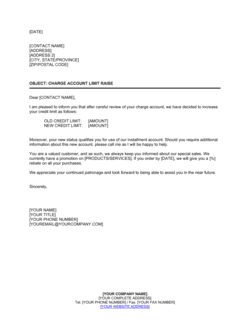
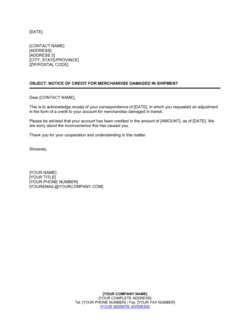
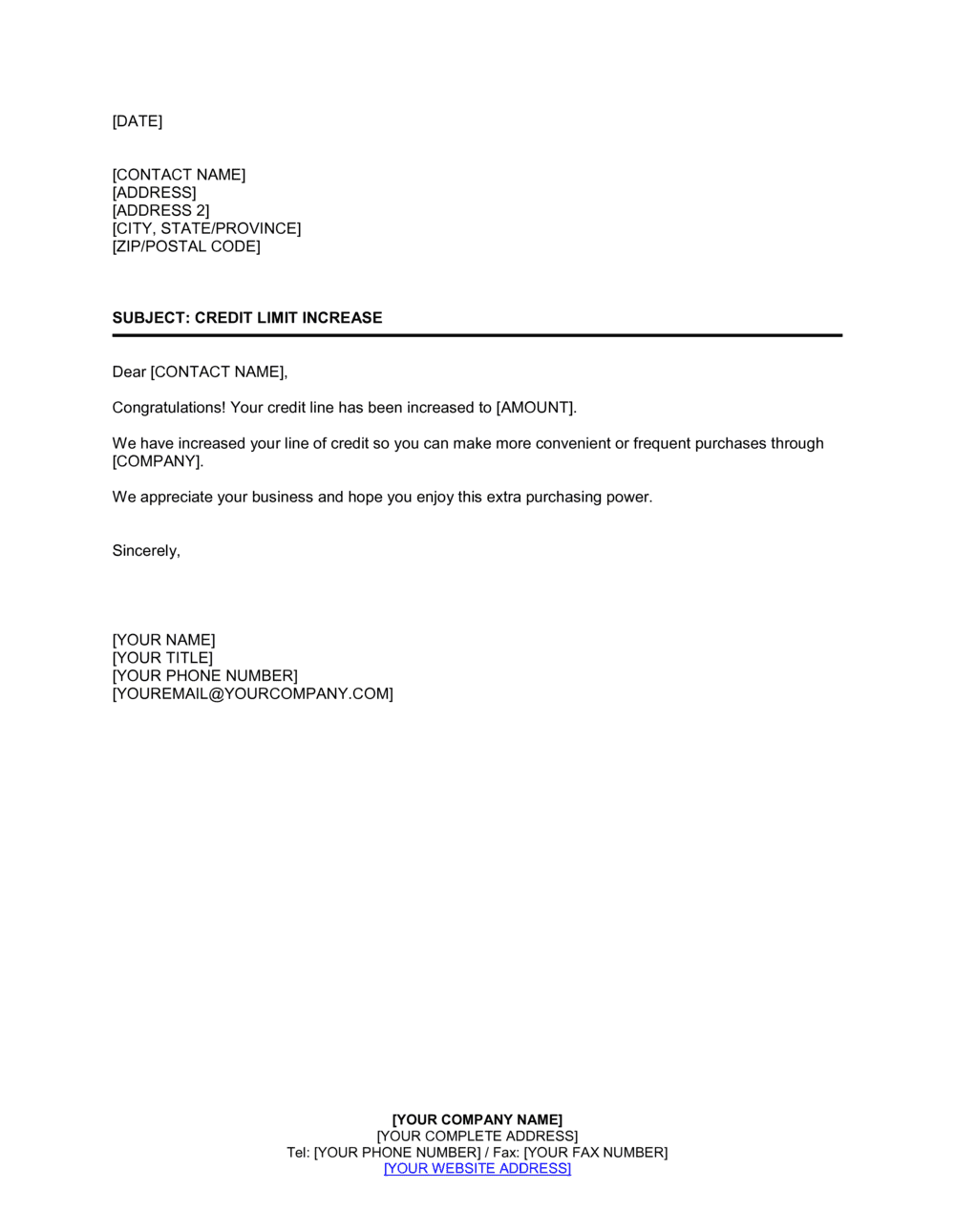
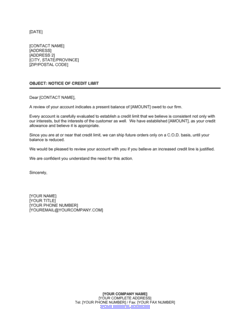
A Notice of Credit Limit Increase is a formal business letter a supplier, vendor, or financial institution sends to a customer or account holder to confirm that their approved credit limit has been raised. This free Word download lets you edit the key fields β€” current limit, new limit, effective date, and any revised terms β€” then export as PDF and send in minutes.
When you need it
Send it whenever you approve a higher credit line for an existing account, whether driven by a customer's payment history, a formal review cycle, or a strategic decision to extend more trade credit to key accounts.
What's inside
Sender and recipient details, the previous and revised credit limit figures, the effective date of the change, any updated payment terms or conditions attached to the new limit, and contact information for follow-up questions.

What is a Notice of Credit Limit Increase?

A Notice of Credit Limit Increase is a formal business letter issued by a supplier, vendor, or lender to an existing customer or account holder confirming that their approved credit line has been raised to a higher amount. It documents the previous limit, the revised limit, the effective date of the change, and any conditions or terms attached to the new arrangement. Unlike an informal email or phone call, a written notice creates a clear, dated record that both parties can file in their accounts and reference if questions arise later.

Why You Need This Document

Communicating a credit limit increase verbally or through an informal email leaves both parties without a reliable record of exactly what was approved, when it took effect, and what conditions apply. When a customer places a large order based on a misremembered figure, or assumes their payment terms also changed when only the limit did, disputes follow β€” and disputes cost time and damage relationships. A properly structured notice eliminates that ambiguity by stating the old limit, the new limit, and the effective date in a single document the customer's finance team can match to their account records. It also protects you: including a periodic review clause in the notice preserves your right to adjust the limit later without the customer claiming the increase was permanent and unconditional.

Which variant fits your situation?

If your situation is…Use this template
Increasing credit for an existing B2B trade accountNotice of Credit Limit Increase
Reducing a customer's credit limit due to missed paymentsNotice of Credit Limit Decrease
Placing a customer account on hold pending paymentCredit Hold Notice
Approving a new customer for a trade credit accountCredit Approval Letter
Declining a customer's request for more creditCredit Limit Decline Letter
Requesting payment on an overdue balance before reviewing creditPast Due Notice

Common mistakes to avoid

❌ No effective date stated

Why it matters: The customer cannot rely on the new limit until they know when it applies. Orders placed in the gap between receipt of the letter and an assumed start date risk rejection, damaging trust.

Fix: Always include a specific calendar date β€” 'effective June 1, 2026' β€” and confirm it matches your internal system before the letter goes out.
❌ Omitting the previous limit

Why it matters: Without the old figure, the customer cannot confirm the change matches what was discussed or requested, leading to unnecessary follow-up calls.

Fix: State both figures explicitly: 'increased from $[OLD] to $[NEW].' The comparison is the core information the customer needs.

❌ No review or adjustment clause

Why it matters: A letter that reads as a permanent, unconditional increase makes it harder to reduce the limit later without a dispute about unilateral changes to account terms.

Fix: Include a brief sentence noting the limit is subject to periodic review based on account activity and payment performance.

❌ Sending to the wrong contact

Why it matters: A credit limit notice sent to a sales contact or project manager instead of accounts payable may never reach the person managing purchasing limits, defeating the purpose of the notice.

Fix: Confirm the accounts payable contact and email address for each customer before sending. For large accounts, copy both the AP team and the relationship contact.

The 8 key clauses, explained

Sender and recipient details

In plain language: Identifies the business issuing the notice and the customer or account holder receiving it, including addresses and account reference numbers.

Sample language
[COMPANY NAME] | [ADDRESS] | [CITY, STATE, ZIP] | Account Reference: [ACCOUNT NUMBER] | To: [CUSTOMER LEGAL NAME] | [CUSTOMER ADDRESS]

Common mistake: Using a contact name rather than the customer's legal entity name. The notice then fails to clearly identify the account it applies to, creating ambiguity in the customer's own records.

Date and subject line

In plain language: States the date the letter is issued and a clear subject line identifying the letter as a credit limit change notice.

Sample language
Date: [DATE] | Subject: Notice of Credit Limit Increase β€” Account [ACCOUNT NUMBER]

Common mistake: Omitting the account number from the subject line. When a customer has multiple accounts or forwards the letter to their finance team, missing this reference causes delays in matching the notice to the correct account.

Opening statement of the increase

In plain language: States clearly and immediately that the customer's credit limit has been increased, with the previous and new figures side by side.

Sample language
We are pleased to inform you that your approved credit limit with [COMPANY NAME] has been increased from $[PREVIOUS LIMIT] to $[NEW LIMIT], effective [EFFECTIVE DATE].

Common mistake: Burying the new limit figure in the middle of a long paragraph. The customer should be able to identify both the old and new limit at a glance without reading the entire letter.

Reason or basis for the increase

In plain language: Briefly explains why the limit is being raised β€” typically good payment history, a completed annual review, or a mutual agreement to support growth.

Sample language
This adjustment reflects your consistent payment record over the past [X] months and our commitment to supporting your business growth.

Common mistake: Over-explaining internal credit scoring criteria. A one-sentence positive acknowledgment is sufficient; detailed methodology is unnecessary and can create unintended expectations about future increases.

Revised terms and conditions

In plain language: Confirms whether existing payment terms remain the same or have been updated alongside the limit increase.

Sample language
All other terms and conditions of your account remain unchanged, including payment terms of Net [30/60] days from invoice date.

Common mistake: Leaving this clause out entirely. If the customer assumes their terms have also changed when only the limit has, disputes over invoice due dates or late fees arise quickly.

Conditions or obligations attached to the new limit

In plain language: States any requirements the customer must maintain to keep the higher limit β€” such as continued on-time payment or a periodic review.

Sample language
This credit limit is subject to periodic review and may be adjusted based on account activity. To maintain this limit, your account must remain current with no balances exceeding [X] days past due.

Common mistake: Promising a permanent limit increase with no review language. Without this clause, reducing the limit later β€” even for legitimate reasons β€” can trigger a dispute about unilateral changes.

Effective date confirmation

In plain language: States the exact date from which the customer can place orders against the new, higher limit.

Sample language
Your updated credit limit of $[NEW LIMIT] is available for use effective [DATE]. Orders placed on or after this date will be processed against the revised limit.

Common mistake: Failing to state an explicit effective date. A customer who assumes the increase is immediate but receives an order rejection because the limit has not yet taken effect in the system will lose confidence in the process.

Contact information and closing

In plain language: Invites the customer to reach out with any questions and closes with a professional sign-off.

Sample language
If you have any questions regarding your account, please contact our credit department at [EMAIL] or [PHONE NUMBER]. We value your continued business and look forward to supporting your growth. Sincerely, [AUTHORIZED REPRESENTATIVE NAME], [TITLE], [COMPANY NAME]

Common mistake: Closing the letter without specifying who to contact. Directing the customer to a general company phone number rather than the credit department adds friction and delays resolution of any follow-up questions.

How to fill it out

  1. 1

    Enter sender and recipient information

    Fill in your company's full legal name and mailing address at the top of the letter. Enter the customer's legal entity name, billing address, and account reference number.

    πŸ’‘ Use the legal entity name that appears on the customer's account agreement β€” not a trade name β€” to ensure the notice is processed by the correct party.

  2. 2

    Set the date and subject line

    Enter today's date and add the account number to the subject line so the customer's finance team can file and match the notice without additional back-and-forth.

    πŸ’‘ If your system sends notices in batches, use the batch processing date rather than the day you drafted the template.

  3. 3

    State the previous and new credit limit

    Enter the exact dollar amounts for both the previous limit and the approved new limit in the opening paragraph. Place both figures on the same line so the change is immediately visible.

    πŸ’‘ Express the figures in the same currency your invoices use β€” if you invoice in USD, the limit should read in USD.

  4. 4

    Confirm the effective date

    Enter the specific calendar date from which the new limit applies. Confirm this date matches what has been updated in your accounts receivable or ERP system before sending.

    πŸ’‘ Send the notice at least 24–48 hours before the effective date so the customer can plan any pending orders accordingly.

  5. 5

    Update or confirm payment terms

    State whether payment terms remain unchanged or have been revised. If terms are changing β€” for example, from Net 60 to Net 30 β€” describe the new terms clearly in this section.

    πŸ’‘ Even if nothing has changed, explicitly stating 'all other terms remain unchanged' prevents the customer from assuming their due dates have shifted.

  6. 6

    Add conditions and review language

    Include a clause stating that the new limit is subject to periodic review and may be adjusted based on account performance. Specify the trigger β€” for example, any balance exceeding 30 days past due.

    πŸ’‘ Keep this clause brief and factual. Language that reads as threatening rather than informational can damage a positive customer relationship.

  7. 7

    Add contact details and send

    Enter the name, email, and direct phone number of the person or team handling credit inquiries. Export the completed letter as PDF and send to the customer's accounts payable contact.

    πŸ’‘ BCC your accounts receivable file or shared inbox when sending so the outbound notice is automatically archived alongside the customer's account record.

Frequently asked questions

What is a notice of credit limit increase?

A notice of credit limit increase is a formal letter a supplier, lender, or vendor sends to a customer confirming that their approved credit line has been raised to a higher amount. It records the previous limit, the new limit, the effective date, and any conditions attached β€” creating a clear written record for both parties' accounts.

When should a business send a credit limit increase notice?

Send one whenever you approve a higher credit line for an existing account, whether following an annual credit review, in response to a customer's formal request, or as a proactive decision to support a key account's growth. Sending the notice before the effective date β€” rather than after the fact β€” allows the customer to plan orders accordingly.

Does a credit limit increase notice need to be signed?

A signature is not required for the notice to be effective in most business contexts. The letter functions as a unilateral communication from the issuing party. However, including the name and title of an authorized representative adds credibility and gives the customer a named contact for follow-up questions.

What is the difference between a credit limit increase notice and a credit approval letter?

A credit approval letter is issued when a new customer is approved for a trade credit account for the first time, setting the initial limit and terms. A credit limit increase notice is sent to an existing account holder to confirm a revision to their already-approved limit. The approval letter opens the account; the increase notice adjusts it.

Should I state a reason for the credit limit increase?

A brief positive acknowledgment β€” such as referencing the customer's consistent payment history β€” is good practice and reinforces the relationship. You do not need to disclose internal credit scoring methodology or detailed financial analysis. One sentence is sufficient and appropriate.

Can a credit limit be reduced after this notice is sent?

Yes, provided the notice includes review and adjustment language stating the limit is subject to change based on account performance. Without that clause, reducing the limit later may trigger a dispute about unilateral modification of account terms. Always include a standard review clause even when the communication is positive.

How far in advance should the notice be sent?

Send the notice at least 24–48 hours before the effective date so the customer's purchasing and finance teams can update their records and plan any pending orders. For large accounts or institutional buyers with formal procurement processes, 5–7 business days' notice is preferable.

What format should the notice be sent in?

PDF is standard for formal business correspondence β€” it preserves formatting and is accepted by most accounts payable systems. Email delivery with the PDF attached is typical. For high-value accounts or where a paper trail is important, follow up with a printed copy sent by post.

How this compares to alternatives

vs Credit Approval Letter

A credit approval letter establishes a brand-new trade credit account for a customer β€” setting the initial limit, terms, and conditions from scratch. A notice of credit limit increase is sent to an existing account holder to confirm a change to their already-approved limit. Use the approval letter for new accounts and the increase notice for existing ones.

vs Past Due Notice

A past due notice is sent when a customer has not paid an outstanding invoice by its due date β€” it is a collections and recovery tool. A credit limit increase notice is a positive communication confirming expanded purchasing power. The two documents represent opposite ends of the account relationship spectrum.

vs Credit Hold Notice

A credit hold notice suspends a customer's ability to place new orders due to payment issues or exceeded limits β€” it restricts account activity. A credit limit increase notice expands it. If a customer's payment behavior deteriorates after an increase, a credit hold notice may follow.

vs Collection Letter

A collection letter demands payment on a significantly overdue balance and may reference legal action or third-party collection. A credit limit increase notice is a relationship-positive communication with no collection purpose. Using collection letter language in a limit increase notice, or vice versa, sends a confused signal that damages customer trust.

Industry-specific considerations

Wholesale and Distribution

High-volume buyers with seasonal order spikes often request limit increases before peak periods; the notice formalizes the approval and updates the account record.

Manufacturing

Suppliers extending trade credit to OEM customers or downstream fabricators use the notice to document revised limits tied to production contract values.

Financial Services

Banks and non-bank lenders issue credit limit increase notices to business borrowers when revolving facility limits are revised following a financial review.

Retail

Retailers with supplier accounts use the notice to confirm higher purchasing limits that support inventory expansion or new product category launches.

Template vs pro β€” what fits your needs?

PathBest forCostTime
Use the templateAny business issuing standard trade credit limit increases to existing customersFree5 minutes per notice
Template + professional reviewBusinesses adding custom conditions, revised payment terms, or legal review language to the notice$50–$150 (legal or credit advisor review)1–2 hours
Custom draftedFinancial institutions or regulated lenders with compliance requirements governing credit communications$300–$8001–3 days

Glossary

Credit Limit
The maximum outstanding balance a customer is permitted to carry on a trade or credit account at any one time.
Trade Credit
An arrangement where a supplier allows a buyer to receive goods or services and pay for them on agreed terms, typically Net 30 or Net 60, rather than upfront.
Effective Date
The specific calendar date on which the new credit limit takes effect and the customer may begin purchasing against it.
Net 30 / Net 60
Payment terms requiring the full invoice balance to be paid within 30 or 60 days of the invoice date.
Credit Review
A periodic assessment of a customer's payment history, financial standing, and account behavior used to decide whether to adjust their credit limit.
Accounts Receivable
Money owed to a business by its customers for goods or services already delivered but not yet paid for.
Credit Exposure
The total amount a supplier or lender has at risk at any moment β€” the sum of all outstanding invoices or balances across a customer's account.
Payment History
A record of how consistently and promptly a customer has paid invoices in the past, used as the primary indicator of creditworthiness in trade credit decisions.

Part of your Business Operating System

This document is one of 3,000+ business & legal templates included in Business in a Box.

  • Fill-in-the-blanks β€” ready in minutes
  • 100% customizable Word document
  • Compatible with all office suites
  • Export to PDF and share electronically

Create your document in 3 simple steps.

From template to signed document β€” all inside one Business Operating System.
1
Download or open template

Access over 3,000+ business and legal templates for any business task, project or initiative.

2
Edit and fill in the blanks with AI

Customize your ready-made business document template and save it in the cloud.

3
Save, Share, Send, Sign

Share your files and folders with your team. Create a space of seamless collaboration.

Save time, save money, and create top-quality documents.

β˜…β˜…β˜…β˜…β˜…

"Fantastic value! I'm not sure how I'd do without it. It's worth its weight in gold and paid back for itself many times."

Managing Director Β· Mall Farm
Robert Whalley
Managing Director, Mall Farm Proprietary Limited
β˜…β˜…β˜…β˜…β˜…

"I have been using Business in a Box for years. It has been the most useful source of templates I have encountered. I recommend it to anyone."

Business Owner Β· 4+ years
Dr Michael John Freestone
Business Owner
β˜…β˜…β˜…β˜…β˜…

"It has been a life saver so many times I have lost count. Business in a Box has saved me so much time and as you know, time is money."

Owner Β· Upstate Web
David G. Moore Jr.
Owner, Upstate Web

Run your business with a system β€” not scattered tools

Stop downloading documents. Start operating with clarity. Business in a Box gives you the Business Operating System used by over 250,000 companies worldwide to structure, run, and grow their business.

Start freeΒ Β·Β No credit card required