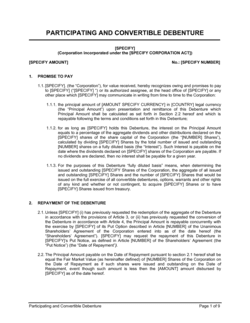
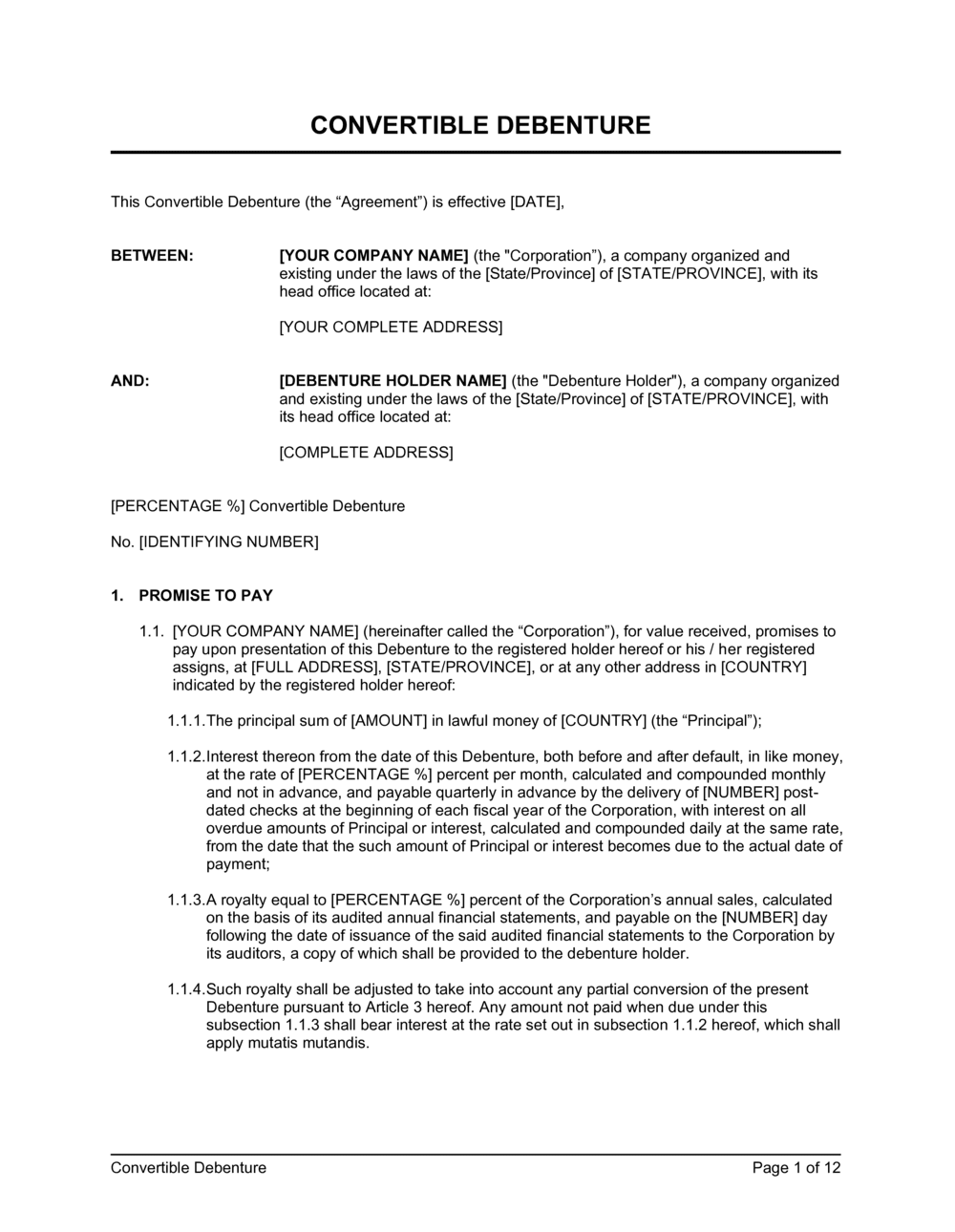
Convertible Debenture Template

Free Word download • Edit online • Save & share with Drive • Export to PDF

12 pages30–40 min to fillDifficulty: ComplexSignature requiredLegal review recommended
Learn more ↓
FreeConvertible Debenture Template

At a glance

What it is
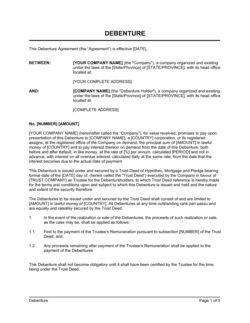
A Convertible Debenture is a legally binding debt instrument issued by a company to a lender that gives the lender the right — or in some cases the obligation — to convert the outstanding principal and accrued interest into equity shares at a defined conversion price or formula. This free Word download covers all core terms including principal amount, interest rate, maturity date, conversion mechanics, anti-dilution protection, and events of default, and can be edited online and exported as PDF.
When you need it
Use it when a company is raising bridge capital ahead of a priced equity round, when an investor wants downside protection as a creditor but upside participation as a shareholder, or when both parties want to defer valuation negotiations until a qualifying financing event.
What's inside
Principal amount and interest terms, maturity and repayment conditions, voluntary and mandatory conversion triggers, conversion price or discount rate, anti-dilution adjustments, representations and warranties, covenants, events of default, and governing law. A schedule of defined terms and a conversion notice form are included as attachments.

What is a Convertible Debenture?

A Convertible Debenture is a hybrid debt-equity instrument through which a company borrows money from an investor under terms that allow — or require — the outstanding principal and accrued interest to convert into equity shares at a future point, either at a predefined conversion price or at a price derived from a subsequent financing round. Until conversion occurs, the instrument functions as debt: the issuer owes the principal, interest accrues, and the holder ranks as a creditor ahead of shareholders. Upon a qualifying conversion event, the debt is extinguished and the holder receives shares, typically at a discount to the price paid by new investors or subject to a valuation cap that rewards the holder for investing early. Convertible debentures are widely used in bridge financing, mezzanine lending, and early-stage capital raises precisely because they defer the valuation negotiation — both parties agree today on the mechanics of how equity will be priced later, once the market has provided clearer data.

Why You Need This Document

Raising capital on informal or loosely documented terms is one of the most reliably expensive mistakes a company can make. Without a properly drafted convertible debenture, the economic terms of the conversion — the cap, the discount, the share class, the anti-dilution mechanics — exist only in emails and term sheets that courts treat as preliminary negotiations rather than binding obligations. Disputes over what the parties actually agreed to, particularly when a company's valuation has increased significantly by the time of conversion, frequently result in litigation that costs more than the original capital raised. A signed convertible debenture also establishes the holder's creditor status unambiguously, which matters in any insolvency or acquisition scenario where creditor claims are ranked and paid before equity. For issuers, the covenants and default provisions create a structured framework that prevents the relationship from deteriorating without a clear contractual path forward. This template gives you a market-standard starting point covering every material term — principal, interest, conversion, anti-dilution, and default — so that a 30-minute legal review, rather than a custom drafting engagement, is all that stands between you and a signed instrument.

Which variant fits your situation?

If your situation is…Use this template
Seed-stage startup deferring valuation to a future priced roundConvertible Note Agreement
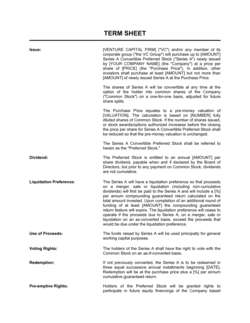
Investor requiring a valuation cap and discount rate onlySAFE Agreement
Lender requiring security over company assets as well as conversion rightsSecured Convertible Debenture
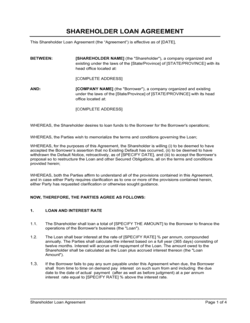
Existing shareholder providing bridge financing to a portfolio companyShareholder Loan Agreement
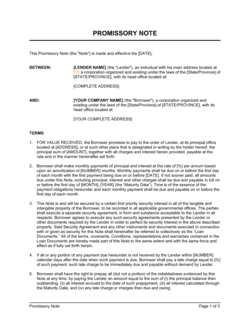
Company raising longer-term subordinated debt with no conversion featurePromissory Note
Public company issuing convertible debt to institutional investorsConvertible Bond Indenture
Bridge loan ahead of a specific acquisition rather than an equity roundBridge Loan Agreement

Common mistakes to avoid

❌ Using pre-money vs. post-money cap language inconsistently

Why it matters: A $5M cap on a pre-money basis and a $5M cap on a post-money basis produce different share counts — the difference can represent 10–20% of the holder's converted position depending on round size.

Fix: State explicitly in the Valuation Cap definition whether the cap refers to pre-money or post-money valuation, and confirm which share count (fully diluted, treasury method, or as-converted) is used as the denominator.

❌ Omitting a mandatory conversion provision

Why it matters: Without mandatory conversion on a qualifying financing, the debenture remains outstanding as debt after the round closes, creating a senior creditor whose existence complicates future financing and acquisition due diligence.

Fix: Include an automatic conversion clause triggered by any Qualifying Financing above a specified threshold, with no holder action required to effect conversion.

❌ Leaving the definition of 'Qualifying Financing' too vague or too low

Why it matters: A threshold that is too low — or undefined — can trigger conversion in an insider bridge round at an unfavorable price before the company has reached true price discovery.

Fix: Define Qualifying Financing as a bona fide equity financing led by a third-party investor with a minimum aggregate proceeds threshold of at least 2–3× the debenture principal.

❌ Selecting full-ratchet anti-dilution instead of weighted-average

Why it matters: Full-ratchet anti-dilution resets the conversion price to the lowest subsequent issuance price regardless of how few shares were issued at that price — devastating to founders and other shareholders in any down-round scenario.

Fix: Use broad-based weighted-average anti-dilution as the default. Reserve full-ratchet only for very small instruments to sophisticated institutional investors who specifically negotiate for it.

❌ Signing the debenture before funds are transferred

Why it matters: In most common-law jurisdictions, a debt instrument executed before consideration is received may be challenged for lack of consideration, particularly if the company later becomes insolvent and a trustee in bankruptcy reviews the instrument.

Fix: Coordinate execution and wire transfer on the same business day, or include a condition precedent stating the debenture is not effective until confirmed receipt of funds, documented by a closing certificate.

❌ No cure period for payment defaults

Why it matters: Immediate acceleration on a missed payment gives the holder a nuclear remedy for an inadvertent administrative error — wire delays, banking holidays, or a clerical oversight — and courts sometimes refuse to enforce it as unconscionable.

Fix: Include a 5-business-day cure period for payment defaults and a 30-day cure period for covenant breaches, with written notice required before the cure period begins.

The 10 key clauses, explained

Parties, Recitals, and Defined Terms

In plain language: Identifies the issuer (the company) and the holder (the lender), states the commercial purpose of the instrument, and defines all capitalized terms used throughout the document.

Sample language
This Convertible Debenture (the 'Debenture') is issued as of [DATE] by [COMPANY LEGAL NAME], a [STATE/PROVINCE] [ENTITY TYPE] ('Issuer'), to [HOLDER LEGAL NAME] ('Holder'). Capitalized terms not otherwise defined herein have the meanings set out in Schedule A.

Common mistake: Using informal shorthand names (e.g., 'the Company') without tying them to the exact registered legal entity name, which creates enforceability ambiguity if the issuer operates under a trade name.

Principal Amount and Issue Price

In plain language: States the face value of the debenture — how much the lender is advancing — and confirms the proceeds are received in full at closing.

Sample language
The Issuer hereby promises to pay to the order of the Holder the principal sum of $[AMOUNT] (the 'Principal Amount'), receipt of which is hereby acknowledged, together with interest as set out herein.

Common mistake: Failing to confirm receipt of proceeds within the instrument itself. If the debenture is signed before funds are actually transferred, the document may be unenforceable for lack of consideration until a closing certificate is executed.

Interest Rate and Accrual

In plain language: Sets the annual interest rate, the accrual method (simple or compound), and whether interest is paid in cash periodically or accrues and converts alongside principal.

Sample language
Interest shall accrue on the outstanding Principal Amount at the rate of [X]% per annum, calculated on a 365-day basis, from the Issue Date until conversion or repayment in full. Accrued Interest shall convert into shares alongside Principal upon any Conversion Event and shall not be payable in cash.

Common mistake: Leaving the accrual method unstated. Simple and compound interest produce meaningfully different amounts over a 12–24 month bridge term — courts will not infer a method, and the ambiguity benefits neither party.

Maturity and Repayment

In plain language: Defines the maturity date, the conditions under which the debenture is repaid in cash if it has not converted, and any right of the issuer to extend the term.

Sample language
Unless earlier converted or repaid, the outstanding Principal Amount and all Accrued Interest shall become due and payable on [DATE] (the 'Maturity Date'). The Issuer may extend the Maturity Date by [X] months upon [X] days' written notice to the Holder, provided no Event of Default has occurred.

Common mistake: Omitting a maturity extension provision. Without one, the debenture automatically becomes due in cash on the maturity date even if an equity round is imminent — forcing an inconvenient repayment or a rushed amendment.

Conversion Mechanics — Voluntary and Mandatory

In plain language: Sets out exactly how and when the debenture converts into shares: the triggers (voluntary holder election or mandatory on a qualifying financing), the conversion formula, and the share class issued.

Sample language
Upon the closing of a Qualifying Financing, the outstanding Principal Amount and Accrued Interest shall automatically convert into shares of the class issued in such Qualifying Financing at a price equal to the lesser of (a) the Qualifying Financing price per share multiplied by [1 minus the Discount Rate] and (b) the Valuation Cap divided by the Fully Diluted Share Count immediately prior to such closing.

Common mistake: Drafting conversion as exclusively voluntary at the holder's discretion with no mandatory conversion trigger. This can leave a debenture outstanding indefinitely after a successful financing round, creating a cap table overhang and complicating future investor diligence.

Valuation Cap and Discount Rate

In plain language: Defines the economic protection mechanisms: the maximum valuation at which the holder converts (cap) and/or the percentage discount to the next-round price the holder receives.

Sample language
For purposes of conversion, the Valuation Cap shall be $[AMOUNT] and the Discount Rate shall be [X]%. In the event both a Valuation Cap and a Discount Rate apply, the Holder shall receive the number of shares calculated using whichever formula produces the lower effective per-share price.

Common mistake: Setting a valuation cap but omitting language that specifies whether it applies to pre-money or post-money valuation. The two calculations produce different share counts, and the distinction can represent significant economic value.

Anti-Dilution and Adjustment Provisions

In plain language: Adjusts the conversion price downward if the company issues new shares at a price below the current conversion price, protecting the holder against down-round dilution.

Sample language
In the event the Issuer issues shares or securities convertible into shares at a price per share less than the then-applicable Conversion Price, the Conversion Price shall be adjusted on a [broad-based weighted-average / full-ratchet] basis as set out in Schedule B.

Common mistake: Selecting full-ratchet anti-dilution without recognizing its punitive impact on founders and other shareholders in a down round. Broad-based weighted-average anti-dilution is the market standard for most convertible instruments and is far less likely to destabilize the cap table.

Representations, Warranties, and Covenants

In plain language: The issuer represents material facts (valid incorporation, no undisclosed liabilities, authorized share capital) and makes ongoing covenants (maintain good standing, not incur senior debt without consent, provide financial statements).

Sample language
The Issuer represents and warrants as of the Issue Date that: (a) it is duly incorporated and in good standing under the laws of [JURISDICTION]; (b) the execution of this Debenture has been duly authorized; and (c) to the Issuer's knowledge, there is no pending litigation that would materially impair its ability to perform its obligations hereunder.

Common mistake: Limiting representations to the issue date without including a bring-down mechanism. Representations that are true at signing but false at conversion — due to undisclosed litigation or a material change — give the holder no contractual remedy unless a bring-down clause is included.

Events of Default and Remedies

In plain language: Lists the specific conditions that constitute a default — missed payment, insolvency filing, covenant breach, change of control — and the holder's remedies, including acceleration of the full outstanding amount.

Sample language
Each of the following constitutes an Event of Default: (a) failure to pay any amount due within [X] business days of the due date; (b) the Issuer making an assignment for the benefit of creditors or filing for bankruptcy protection; (c) any material breach of a covenant not cured within [30] days of written notice.

Common mistake: Drafting an exhaustive default list but omitting a cure period for non-payment events. Courts in several jurisdictions have refused to enforce immediate acceleration where the issuer had no opportunity to cure an inadvertent missed payment.

Governing Law, Jurisdiction, and Miscellaneous

In plain language: Specifies the applicable law, the courts or arbitration forum for disputes, and standard boilerplate provisions including amendment procedures, entire agreement, and severability.

Sample language
This Debenture shall be governed by and construed in accordance with the laws of [STATE/PROVINCE/COUNTRY], without regard to conflict-of-laws principles. Any dispute shall be submitted to the exclusive jurisdiction of the courts of [CITY/JURISDICTION]. This Debenture may be amended only by written instrument signed by both parties.

Common mistake: Choosing a governing jurisdiction that has no connection to where the issuer is incorporated or the holder resides. Courts in the chosen jurisdiction may decline to hear the case, or the chosen law may produce unexpected results on conversion mechanics or default remedies.

How to fill it out

  1. 1

    Enter the parties' full legal names and jurisdiction

    Use the issuer's exact registered corporate name and the holder's legal name or entity name. Confirm both against corporate registry filings before insertion.

    💡 If the holder is a fund or trust, name the general partner or trustee as the party and reference the fund in the recitals — this prevents execution authority disputes.

  2. 2

    Set the principal amount and confirm the issue date

    Enter the exact dollar amount being advanced. The issue date should be the date funds are actually transferred, not the date the document is drafted.

    💡 If closing occurs in tranches, use a schedule of advances rather than a single principal amount to avoid ambiguity about which funds are outstanding at conversion.

  3. 3

    Define the interest rate and accrual method

    Choose a rate (typically 4–8% for bridge debentures), specify simple or compound accrual, and confirm whether interest converts or is paid in cash at maturity.

    💡 Confirm the rate does not exceed the criminal interest rate ceiling in the governing jurisdiction — in Canada, 60% per annum is the Criminal Code ceiling; in some US states, usury limits apply to non-bank lenders.

  4. 4

    Set the maturity date and extension terms

    Choose a maturity date 12–24 months from issuance for most bridge instruments. Decide whether the issuer may extend unilaterally and for how long, and include the notice period.

    💡 A 6-month unilateral extension right is market standard for early-stage bridges — it prevents forced repayment when a round is close but not yet closed.

  5. 5

    Draft the conversion triggers and formula

    Define what constitutes a Qualifying Financing (minimum dollar threshold, e.g., $1M+), whether conversion is mandatory or voluntary at that trigger, and whether maturity triggers a conversion option or cash repayment.

    💡 Set the Qualifying Financing threshold high enough to exclude insider bridge rounds — otherwise the debenture converts prematurely at a low valuation before the real price-discovery round.

  6. 6

    Set the valuation cap and discount rate

    Enter the valuation cap as a pre-money figure and the discount rate as a whole percentage. Confirm the interaction clause specifies that the holder receives the more favorable calculation.

    💡 Market discount rates for seed-stage bridges typically run 15–20%. Caps should reflect a reasonable pre-money estimate of the company's Series A valuation — not an aspirational number.

  7. 7

    Complete representations, warranties, and covenants

    Review each representation for accuracy as of the issue date. Add or remove covenants based on the issuer's current obligations — for example, remove a 'no senior debt' covenant if senior bank debt already exists.

    💡 Have the issuer's CEO sign a closing certificate confirming the representations are true as of the closing date — this creates a contemporaneous record that limits 'I didn't know' defenses.

  8. 8

    Review events of default and cure periods, then execute

    Confirm each default event is defined precisely and that cure periods are commercially reasonable (typically 5 business days for payment, 30 days for covenant breach). Both parties sign; retain a fully executed copy.

    💡 Use an eSign platform to timestamp execution and store the executed instrument — a timestamped digital record is accepted as evidence in virtually all common-law jurisdictions.

Frequently asked questions

What is a convertible debenture?

A convertible debenture is a debt instrument that gives the holder the right — or in some structures the obligation — to convert the outstanding loan balance, including accrued interest, into equity shares of the issuing company. It functions as a loan until a conversion event occurs, at which point the debt is extinguished and the holder becomes a shareholder. It is commonly used in bridge financing, mezzanine lending, and early-stage capital raises where both parties want to defer valuation negotiations.

What is the difference between a convertible debenture and a convertible note?

The terms are often used interchangeably, but technically a debenture is an unsecured debt instrument backed only by the issuer's creditworthiness, while a note is a simpler promissory instrument. In practice, convertible debentures tend to include more detailed covenants, anti-dilution provisions, and conversion mechanics than a standard convertible note. For seed-stage startups, a convertible note is often sufficient; for growth-stage or institutional transactions, a full debenture structure is more appropriate.

When should a company use a convertible debenture instead of issuing equity directly?

A convertible debenture is preferred when both parties want to raise capital quickly without negotiating a company valuation, when the company expects a priced equity round in the near term and wants the current lender to participate at that round's price, or when the investor wants downside protection as a creditor but upside participation as a shareholder. It defers the valuation conversation to a point when the company has more traction and a cleaner price-discovery process.

What is a valuation cap in a convertible debenture?

A valuation cap sets the maximum company valuation at which the debenture converts into equity, regardless of the actual valuation at the qualifying financing round. If the company raises at a valuation above the cap, the holder converts as if the valuation were the cap — receiving more shares per dollar than new investors. This rewards early lenders for taking on more risk before the company's value was established.

Is a convertible debenture secured or unsecured?

A standard convertible debenture is unsecured, meaning the holder has no claim on specific company assets in the event of default — only a general creditor claim ranking behind secured lenders. A secured convertible debenture adds a security interest (a lien or charge) over specific or all company assets, giving the holder priority in insolvency. Secured structures require additional perfection steps — filing a UCC-1 in the US or a PPSA financing statement in Canada — to be enforceable against third parties.

What happens if the company does not raise a qualifying financing before the maturity date?

If no qualifying financing occurs before maturity, most debentures give the holder the choice to either demand repayment of the full principal and accrued interest in cash, or elect to convert at a pre-agreed default conversion price (often the valuation cap divided by the fully diluted share count). Some debentures allow the issuer to extend the maturity date unilaterally for a defined period. Without any such provision, the entire outstanding balance becomes immediately due and payable as of the maturity date.

Does a convertible debenture need to be registered with securities regulators?

In most jurisdictions, convertible debentures issued to a small number of accredited or sophisticated investors in a private placement are exempt from full prospectus or registration requirements. In the US, the most common exemptions are Regulation D Rule 506(b) and Rule 506(c). In Canada, accredited investor and minimum amount exemptions under National Instrument 45-106 typically apply. The conversion into equity at a later date is also treated as a separate securities issuance requiring its own exemption. Consider consulting a securities lawyer before issuance.

Can interest on a convertible debenture convert into equity rather than being paid in cash?

Yes — this is the market standard for early-stage convertible debentures. Accrued interest is added to the outstanding principal balance and converts into equity alongside principal at the conversion event. This avoids cash interest payments that would strain a pre-revenue company's liquidity and simplifies the conversion calculation. Some debentures give the holder the option to elect cash payment of interest at maturity instead of conversion, but this option is more common in institutional and growth-stage instruments.

What governing law should a convertible debenture use?

The governing law should correspond to the jurisdiction where the issuer is incorporated and where both parties have a genuine connection. US companies typically use Delaware or the state of incorporation; Canadian companies use their home province (Ontario, British Columbia, or Alberta are most common). Using a neutral jurisdiction like Delaware for a foreign-incorporated company is generally not recommended unless both parties have US counsel and US operations, as enforcement complications can arise.

How this compares to alternatives

vs Convertible Note

A convertible note is a simpler, shorter instrument commonly used in seed-stage transactions. It typically covers principal, interest, maturity, and basic conversion mechanics without detailed covenants, anti-dilution provisions, or representations. A convertible debenture is more comprehensive and appropriate for larger amounts, institutional investors, or growth-stage transactions where lenders require stronger contractual protections.

vs SAFE Agreement

A SAFE (Simple Agreement for Future Equity) is not a debt instrument — it carries no interest, no maturity date, and no repayment obligation. It converts into equity on a qualifying financing but does not give the holder creditor status. A convertible debenture creates an actual debt obligation with a maturity date and accrued interest, giving the holder priority over equity in a liquidation scenario. SAFEs are simpler; debentures provide more lender protection.

vs Shareholder Loan Agreement

A shareholder loan agreement is a straightforward inter-company or related-party loan without a conversion feature. It is repaid in cash on the agreed schedule and does not affect the cap table. A convertible debenture is specifically structured to convert into equity and is designed for third-party investors or strategic lenders who want future shareholding rights alongside debt protection.

vs Promissory Note

A promissory note is a simple, unconditional promise to repay a fixed sum with interest by a stated date. It carries no conversion rights, no anti-dilution provisions, and typically no covenants. A convertible debenture adds an entire conversion layer — cap, discount, trigger events, and equity mechanics — making it a hybrid instrument suited for investors who want both creditor protection and equity upside.

Industry-specific considerations

Technology / SaaS

Bridge financing ahead of a Series A, with conversion into preferred shares at a discount to the round price and a valuation cap reflecting pre-revenue MRR multiples.

Biotech / Life Sciences

Long maturity terms of 24–36 months to bridge clinical trial milestones, with milestone-based conversion triggers and regulatory approval as a qualifying event.

Real Estate Development

Mezzanine financing secured against development assets, converting into an equity interest in the project entity upon reaching a defined loan-to-value threshold.

Manufacturing

Equipment or expansion bridge financing with conversion rights tied to an EBITDA multiple rather than a priced equity round, reflecting the asset-heavy valuation basis.

Jurisdictional notes

United States

Convertible debentures issued to accredited investors in the US are typically exempt from SEC registration under Regulation D Rule 506(b) or Rule 506(c). The conversion into equity is treated as a separate securities issuance requiring its own Reg D filing within 15 days of first sale. State blue sky laws may impose additional notice or filing obligations. Usury laws vary by state and can limit permissible interest rates for non-bank lenders; confirm the applicable ceiling before setting the rate.

Canada

Canadian convertible debentures are most commonly issued under the accredited investor exemption or the minimum amount exemption under National Instrument 45-106. Both the initial issuance and the conversion into shares are separate distributions requiring their own exemptions and report of exempt distribution filings within 10 days. Quebec civil law applies different rules to debt instruments than common-law provinces; issuers with Quebec-resident holders should confirm the instrument is valid under the Civil Code. The Criminal Code interest ceiling of 60% per annum applies to all lenders.

United Kingdom

UK convertible debentures issued to high-net-worth individuals or sophisticated investors are typically structured as exempt offers under the Financial Services and Markets Act 2000 (Financial Promotion) Order 2005. The conversion into shares may require a prospectus exemption under the UK Prospectus Regulation unless the issuance is below the £8M threshold or limited to fewer than 150 non-qualified investors. Post-Brexit, EU prospectus passporting is no longer available for UK issuers.

European Union

EU convertible debentures issued to qualified investors are exempt from prospectus requirements under the EU Prospectus Regulation (Regulation 2017/1129) when the total consideration is below €8M over 12 months. GDPR obligations apply to the processing of investor personal data in connection with the debenture. Member state securities laws add local filing and notification requirements — France, Germany, and the Netherlands each maintain distinct private placement frameworks. Anti-dilution provisions involving adjustments to conversion price should be reviewed for compliance with applicable company law restrictions on share issuances in the relevant member state.

Template vs lawyer — what fits your deal?

PathBest forCostTime
Use the templateEarly-stage companies issuing a standard bridge debenture of under $250K to a single accredited investor in a familiar jurisdictionFree1–2 hours
Template + legal reviewBridge rounds of $250K–$2M, multiple holders, cross-border investors, or transactions requiring securities exemption confirmation$500–$2,0003–5 business days
Custom draftedInstitutional or mezzanine debentures above $2M, secured instruments, public company issuances, or multi-jurisdiction transactions$3,000–$15,000+2–4 weeks

Glossary

Debenture
An unsecured debt instrument backed by the general creditworthiness of the issuer rather than specific collateral.
Conversion Price
The per-share price at which outstanding principal and interest convert into equity — either fixed at issuance or calculated as a discount to a future financing round's price.
Valuation Cap
A ceiling on the company's valuation used to calculate the conversion price, protecting early lenders from excessive dilution when conversion occurs at a high valuation.
Discount Rate
A percentage reduction applied to the price per share in a qualifying financing round, giving the convertible holder shares at a lower effective price than new investors pay.
Qualifying Financing
A future equity financing round of a specified minimum size that triggers automatic or voluntary conversion of the debenture into shares of that round's class.
Maturity Date
The date by which the debenture must be repaid in cash or converted into equity if it has not already converted through a qualifying financing event.
Accrued Interest
Interest that has accumulated on the outstanding principal since the issue date, which typically converts alongside principal rather than being paid in cash.
Anti-Dilution Adjustment
A mechanism that adjusts the conversion price downward if the company later issues shares at a lower price, protecting the debenture holder's economic position.
Event of Default
A specified condition — such as missed payments, insolvency, or covenant breach — that gives the holder the right to demand immediate repayment of the full outstanding amount.
Subordination
A contractual ranking arrangement in which the debenture holder agrees that senior creditors must be paid first in the event of liquidation or insolvency.
Pre-Money Valuation
The agreed value of a company immediately before a new investment is made, used as the denominator when calculating the number of shares issued upon conversion.
Covenant
A contractual obligation — either positive (do this) or negative (do not do this) — that the issuing company must comply with throughout the term of the debenture.

Part of your Business Operating System

This document is one of 3,000+ business & legal templates included in Business in a Box.

  • Fill-in-the-blanks — ready in minutes
  • 100% customizable Word document
  • Compatible with all office suites
  • Export to PDF and share electronically

Create your document in 3 simple steps.

From template to signed document — all inside one Business Operating System.
1
Download or open template

Access over 3,000+ business and legal templates for any business task, project or initiative.

2
Edit and fill in the blanks with AI

Customize your ready-made business document template and save it in the cloud.

3
Save, Share, Send, Sign

Share your files and folders with your team. Create a space of seamless collaboration.

Save time, save money, and create top-quality documents.

★★★★★

"Fantastic value! I'm not sure how I'd do without it. It's worth its weight in gold and paid back for itself many times."

Managing Director · Mall Farm
Robert Whalley
Managing Director, Mall Farm Proprietary Limited
★★★★★

"I have been using Business in a Box for years. It has been the most useful source of templates I have encountered. I recommend it to anyone."

Business Owner · 4+ years
Dr Michael John Freestone
Business Owner
★★★★★

"It has been a life saver so many times I have lost count. Business in a Box has saved me so much time and as you know, time is money."

Owner · Upstate Web
David G. Moore Jr.
Owner, Upstate Web

Run your business with a system — not scattered tools

Stop downloading documents. Start operating with clarity. Business in a Box gives you the Business Operating System used by over 250,000 companies worldwide to structure, run, and grow their business.

Start free · No credit card required