Collateral Debenture Template

Free Word download • Edit online • Save & share with Drive • Export to PDF

3 pages25–30 min to fillDifficulty: ComplexSignature requiredLegal review recommended
Learn more ↓
FreeCollateral Debenture Template

At a glance

What it is
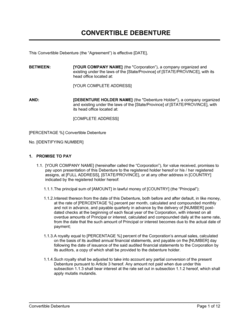
A Collateral Debenture is a formal legal instrument through which a borrowing company (the chargor) grants a lender (the chargee) a security interest over some or all of the company's assets as collateral for a loan or credit facility. This free Word download gives you a structured, lender-ready starting point covering fixed charges, floating charges, negative pledges, covenants, events of default, and enforcement rights — ready to edit online and export as PDF.
When you need it
Use it when a company is borrowing from a bank, private lender, or institutional investor and the lender requires security over company assets as a condition of advancing funds. It is also needed when refinancing existing secured debt or adding a new credit facility to an existing borrowing structure.
What's inside
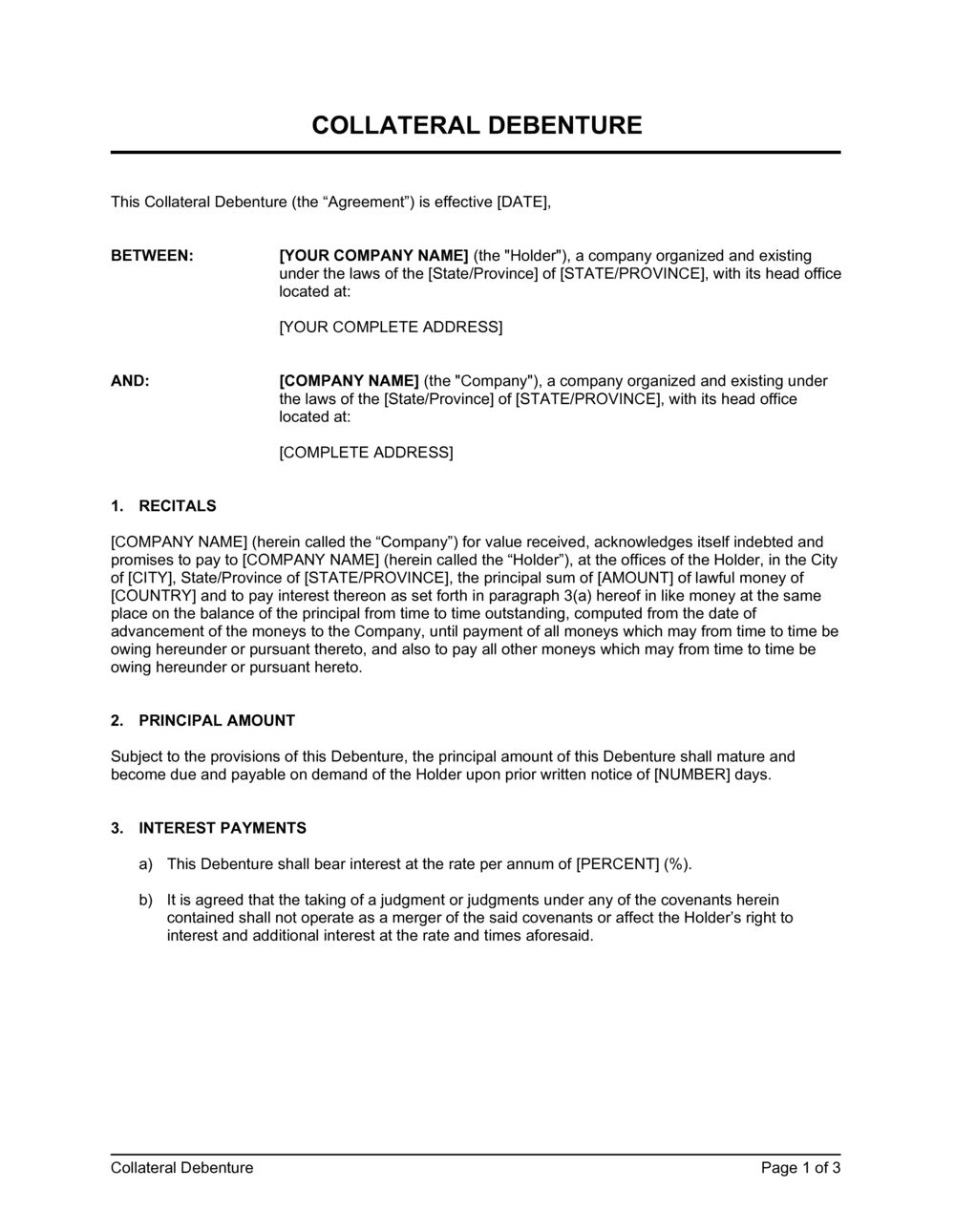
Parties and recitals, definitions, fixed and floating charge provisions, negative pledge, representations and warranties, positive and negative covenants, events of default, enforcement and receiver appointment rights, release conditions, and governing law and jurisdiction clauses.

What is a Collateral Debenture?

A Collateral Debenture is a formal legal instrument by which a company (the chargor) grants a lender or investor (the chargee) a security interest over some or all of its assets as collateral for a loan or credit facility. It typically creates two types of charge simultaneously: a fixed charge over specific, identifiable assets such as land, buildings, and intellectual property — which the company cannot sell or encumber without lender consent — and a floating charge over circulating assets such as stock, trade receivables, and cash, which the company can deal with freely in the ordinary course of business until a default event causes the charge to crystallise and attach to specific assets. A properly executed and registered debenture gives the lender priority over unsecured creditors if the borrower enters insolvency, and grants the right to appoint a receiver and enforce the security to recover the outstanding debt.

Why You Need This Document

Without a collateral debenture, a lender advancing funds to a company has no priority claim over company assets if the borrower defaults or becomes insolvent — it ranks alongside unsecured trade creditors and is unlikely to recover more than a fraction of the debt. For borrowers, an unregistered or incorrectly drafted debenture can be voided entirely by a liquidator, leaving the lender without recourse and making refinancing or further lending impossible. Specific consequences cascade quickly: a missed registration deadline of as little as 21 days (in the UK) renders the charge void without a court order; an incorrectly named chargor means security is registered against a non-existent entity; and a floating charge that omits future assets leaves newly acquired stock and receivables available to unsecured creditors at the worst possible moment. This template gives you a lender-ready debenture structure — with fixed and floating charges, a negative pledge, covenant framework, and enforcement waterfall — that can be reviewed and executed by counsel before the registration clock starts.

Which variant fits your situation?

If your situation is…Use this template
Securing a standard bank term loan against all company assetsCollateral Debenture (All Assets)
Securing a loan against a specific piece of real property onlyMortgage Deed / Deed of Trust
Securing a loan against receivables or invoices onlyAssignment of Receivables Agreement
Securing a personal guarantee from a director alongside company assetsPersonal Guarantee Agreement
Providing inter-company security within a group structureIntercompany Loan and Security Agreement
Securing an equipment finance facility against specific machineryEquipment Security Agreement
Granting a subordinated second-ranking charge behind a senior lenderSecond Ranking Debenture / Intercreditor Agreement

Common mistakes to avoid

❌ Failing to register the charge within the statutory deadline

Why it matters: A debenture that is not registered at Companies House (UK) within 21 days, or via a UCC-1 filing (US) promptly after signing, is void against a liquidator and unsecured creditors. The lender becomes unsecured at the moment of insolvency.

Fix: Build registration into the closing checklist as a day-one task. Assign a specific team member responsibility and set calendar reminders before the deed is even signed.

❌ Using a trading name instead of the registered legal name

Why it matters: A charge registered against 'Acme Solutions' when the company is registered as 'Acme Solutions Limited' can be challenged as unregistered, leaving the lender without enforceable security.

Fix: Pull the company's exact name from the official company register before drafting the debenture and copy it verbatim into the parties clause and registration documents.

❌ Omitting future assets from the floating charge

Why it matters: Without explicit language capturing after-acquired assets, stock purchased or receivables generated after the debenture date may fall outside the security. In insolvency, those assets are available to unsecured creditors.

Fix: Include standard 'present and future' language in the floating charge clause and confirm with counsel that it is effective in the governing jurisdiction.

❌ Leaving the Material Adverse Change event of default undefined

Why it matters: Courts consistently refuse to enforce broadly worded MAC defaults where the lender cannot point to a specific, objectively measurable deterioration. An undefined MAC clause gives the appearance of protection without the substance.

Fix: Define MAC by reference to specific financial metrics — a drop in EBITDA below [X]%, net assets below [Y], or a credit rating downgrade — so the trigger is unambiguous and enforceable.

❌ No carve-out for ordinary-course asset disposals

Why it matters: A debenture that prohibits all asset disposals without lender consent puts the chargor in technical default from day one — it cannot sell stock, collect receivables, or pay employees without breaching the dealing restrictions.

Fix: Include a standard carve-out permitting disposals of stock-in-trade and collection of receivables in the ordinary course of business at arm's length for full market value.

❌ Executing the debenture as a simple contract rather than a deed

Why it matters: In common-law jurisdictions, a legal mortgage or fixed charge over land must be created by deed. A debenture signed as an ordinary contract does not create a legal fixed charge over real property — only an equitable interest, which ranks lower in priority.

Fix: Ensure the debenture contains the word 'deed' on its face, is signed by two directors or a director and company secretary, and that each signature is witnessed by an independent adult who adds their name, address, and signature.

The 10 key clauses, explained

Parties, recitals, and definitions

In plain language: Identifies the chargor (borrower) and chargee (lender) by their full legal names, sets out the background to the lending arrangement, and defines every capitalised term used in the document.

Sample language
This Debenture is made on [DATE] between [CHARGOR LEGAL NAME], a company incorporated in [JURISDICTION] with registered number [NUMBER] ('Chargor'), and [CHARGEE LEGAL NAME] ('Chargee'). The Chargor has agreed to grant security in favour of the Chargee to secure the Secured Obligations defined herein.

Common mistake: Using a trading name rather than the exact registered legal name of the chargor. If the name on the debenture does not match the company register, the security may be unenforceable or invalidly registered.

Secured obligations

In plain language: Defines precisely what debts and liabilities the debenture secures — the principal loan amount, accrued interest, fees, costs, and any future advances under the same facility.

Sample language
This Debenture secures all present and future obligations of the Chargor to the Chargee, including (a) the principal sum of [AMOUNT], (b) interest at the rate of [RATE]% per annum, (c) all fees and costs under the Facility Agreement dated [DATE], and (d) any further advances made by the Chargee at its discretion.

Common mistake: Limiting the secured obligations to a specific loan amount without capturing future advances or associated costs — leaving the lender without security cover for facility amendments or enforcement expenses.

Fixed charge

In plain language: Creates a security interest over specific, identifiable assets of the chargor — typically land, buildings, plant, machinery, and intellectual property — that the chargor cannot deal with without lender consent.

Sample language
The Chargor charges by way of fixed charge in favour of the Chargee all its right, title, and interest in and to: (a) the Properties listed in Schedule 1; (b) all plant and machinery; (c) all intellectual property rights; and (d) all goodwill, as security for the Secured Obligations.

Common mistake: Omitting intellectual property from the fixed charge schedule. For technology companies, IP is often the most valuable asset — an unregistered or unspecified charge over it gives the lender no meaningful security.

Floating charge

In plain language: Creates a security interest over the chargor's circulating assets — stock, trade receivables, cash, and other assets not subject to the fixed charge — which the chargor can deal with in the ordinary course until the charge crystallises.

Sample language
The Chargor charges by way of floating charge all its assets and undertaking not otherwise subject to the Fixed Charge, including all stock-in-trade, book debts, receivables, cash, and other present and future assets, as security for the Secured Obligations.

Common mistake: Failing to specify that the floating charge covers future as well as present assets. Without this language, assets acquired after the debenture date may fall outside the security and be available to unsecured creditors.

Negative pledge and dealing restrictions

In plain language: Prohibits the chargor from creating any further security interests, selling or disposing of charged assets, or otherwise encumbering the collateral without the chargee's prior written consent.

Sample language
The Chargor undertakes that it shall not, without the prior written consent of the Chargee: (a) create or permit to subsist any Encumbrance over any Charged Asset; (b) dispose of or transfer any Charged Asset other than in the ordinary course of trading; or (c) grant any licence over any charged intellectual property on terms inconsistent with the security.

Common mistake: Omitting a carve-out for ordinary-course trading of stock and receivables. A blanket prohibition on dealing with all assets would prevent the chargor from running its business — courts may strike it down or the chargor may be in technical default from day one.

Representations and warranties

In plain language: Statements of fact made by the chargor at signing — confirming ownership of the charged assets, absence of prior encumbrances, corporate authority to grant the security, and accuracy of financial information provided.

Sample language
The Chargor represents and warrants that: (a) it is the sole legal and beneficial owner of the Charged Assets free from any prior Encumbrance; (b) it has full corporate authority to execute this Debenture; (c) no Event of Default has occurred or is continuing; and (d) all information provided to the Chargee is true, accurate, and not misleading.

Common mistake: No bring-down mechanism to repeat the representations at each drawdown. A single static warranty set gives the lender no protection if the chargor's circumstances deteriorate between signing and drawing funds.

Covenants

In plain language: Ongoing positive obligations (things the chargor must do — maintain insurance, file accounts, notify the lender of defaults) and negative obligations (things it must not do — incur additional debt, change business, pay dividends above agreed levels) for the life of the facility.

Sample language
The Chargor covenants that it shall: (a) maintain adequate insurance over all Charged Assets and produce evidence of cover on demand; (b) file all statutory returns on time; (c) notify the Chargee in writing within [5] Business Days of becoming aware of any Event of Default; and (d) not incur Financial Indebtedness exceeding [AMOUNT] without prior written consent.

Common mistake: Setting financial covenants — interest cover ratio, leverage ratio — without defining the calculation methodology. Ambiguous covenant definitions lead to disputes about whether a breach has occurred.

Events of default and acceleration

In plain language: Lists the specific triggers that allow the lender to declare all secured obligations immediately due and payable and to enforce the security — including non-payment, insolvency, breach of covenant, and misrepresentation.

Sample language
Each of the following constitutes an Event of Default: (a) failure to pay any amount due within [5] Business Days of its due date; (b) any representation proving materially incorrect; (c) breach of any covenant not remedied within [20] Business Days of written notice; (d) an Insolvency Event occurring in relation to the Chargor; or (e) a Material Adverse Change in the Chargor's financial condition.

Common mistake: Including a Material Adverse Change event of default without defining it. Undefined MAC clauses are routinely challenged in court — lenders typically lose unless they can demonstrate objectively verifiable deterioration.

Enforcement and receiver appointment

In plain language: Sets out the lender's rights after an event of default — including the right to appoint an administrative receiver or fixed charge receiver, take possession of assets, sell charged assets, and apply proceeds against the secured debt.

Sample language
At any time after the security becomes enforceable, the Chargee may: (a) appoint a Receiver of all or any part of the Charged Assets by writing signed by an authorised officer; (b) sell or otherwise dispose of any Charged Asset; and (c) apply all proceeds of enforcement in the order set out in Clause [X].

Common mistake: Omitting the order of application of enforcement proceeds. Without a waterfall clause, disputes arise between the lender, the receiver, and other creditors about how realised funds are distributed.

Release, discharge, and governing law

In plain language: States the conditions under which the lender will release the security once all secured obligations are repaid, and specifies the governing law and courts with jurisdiction over any disputes.

Sample language
Upon full and final repayment of the Secured Obligations, the Chargee shall at the Chargor's cost execute a discharge of this Debenture in a form suitable for registration. This Debenture is governed by the laws of [JURISDICTION] and the parties submit to the exclusive jurisdiction of the courts of [JURISDICTION].

Common mistake: No obligation on the lender to release within a defined timeframe after repayment. Without a release deadline, the chargor may be unable to provide a clean title certificate when selling assets or refinancing.

How to fill it out

  1. 1

    Enter the parties' full legal details

    Insert the chargor's exact registered company name, registered number, and registered office address. Do the same for the chargee. Cross-reference the company register in the relevant jurisdiction before execution.

    💡 A one-character discrepancy between the debenture and the company register can invalidate registration and leave the lender unsecured.

  2. 2

    Define the secured obligations precisely

    State the principal facility amount, interest rate, applicable facility agreement date, and whether future advances under the same facility are included in the security. Reference the facility agreement by date and parties.

    💡 Always include an 'all monies' or 'all obligations' sweep to capture costs of enforcement and any facility amendments — a defined-amount debenture leaves gaps.

  3. 3

    Identify and schedule the fixed charge assets

    List every specific asset subject to the fixed charge in Schedule 1 — property addresses, registered IP (with registration numbers), and specific plant items. For IP, include patents, trade marks, domain names, and software licences.

    💡 Register IP in the chargor's name before execution — a debenture over unregistered or third-party IP provides no enforceable security.

  4. 4

    Confirm the floating charge scope covers future assets

    Ensure the floating charge clause covers all present and future assets not included in the fixed charge. Include a specific reference to after-acquired property so assets purchased after signing are automatically caught.

    💡 In jurisdictions that require it (e.g., the UK), the debenture must be executed as a deed — a simple contract signature is insufficient to create a legal mortgage.

  5. 5

    Tailor the covenants to the facility terms

    Align financial covenants — leverage ratio, interest cover, minimum liquidity — with the thresholds agreed in the facility agreement. Define every ratio using the same calculation methodology as the facility agreement.

    💡 If financial covenants appear in both the facility agreement and the debenture, ensure the definitions are identical — inconsistencies create ambiguity about what constitutes a breach.

  6. 6

    Set the events of default with grace periods

    Include a grace period for payment defaults (typically 3–5 business days) and a cure period for covenant breaches (typically 15–30 days). Define Material Adverse Change with objective, measurable criteria rather than a general qualifier.

    💡 Remove or narrow MAC defaults where possible — lenders rarely succeed in enforcing them in court, but they create negotiation leverage that borrowers can use to challenge enforcement.

  7. 7

    Complete the execution block as a deed

    In most common-law jurisdictions, a debenture creating a legal charge must be executed as a deed — signed by two directors or a director and a company secretary, in the presence of an independent witness who adds their name, address, and signature.

    💡 Post-dating a deed is ineffective in most jurisdictions — use the actual date of execution and register promptly.

  8. 8

    Register the charge at the appropriate registry

    In the UK, register at Companies House within 21 days. In the US, file a UCC-1 financing statement in the debtor's state of organisation. In Canada, register under the applicable PPSA in the province. Late or missed registration means the charge is void against a liquidator and unsecured creditors.

    💡 Set a calendar reminder for the registration deadline the moment the deed is signed — registration failures are the single most common reason secured lenders lose priority.

Frequently asked questions

What is a collateral debenture?

A collateral debenture is a legal instrument through which a company grants a lender a security interest over its assets as collateral for a loan or credit facility. It typically creates both a fixed charge over specific assets such as land and intellectual property, and a floating charge over circulating assets such as stock and receivables. If the borrower defaults, the lender can enforce the security by appointing a receiver or selling the charged assets to recover the outstanding debt.

What is the difference between a fixed charge and a floating charge?

A fixed charge attaches immediately to a specific, identifiable asset — such as a building, a piece of machinery, or a registered trade mark — and prevents the chargor from selling or encumbering that asset without the lender's consent. A floating charge hovers over a changing pool of assets — typically stock, receivables, and cash — that the company can deal with freely in the ordinary course until the charge crystallises on a default event. Fixed charges rank higher in insolvency than floating charges, which is why lenders prefer to characterise as many assets as possible under the fixed charge.

Who needs a collateral debenture?

Any company borrowing from a bank, private lender, or institutional investor that requires security over company assets will need a collateral debenture. It is standard for term loans, revolving credit facilities, invoice finance arrangements, and venture debt transactions. Sole traders and partnerships cannot grant a debenture — only incorporated companies are able to create floating charges in most jurisdictions.

Does a collateral debenture need to be registered?

Yes. In the UK, a charge created by a company must be registered at Companies House within 21 days of creation, or it is void against a liquidator and unsecured creditors. In the US, a UCC-1 financing statement must be filed in the debtor's state of organisation to perfect the security interest. In Canada, registration under the applicable provincial Personal Property Security Act is required. Failure to register on time is the most common and most costly mistake in secured lending transactions.

What happens to a debenture if the company goes insolvent?

The debenture holder — as a secured creditor — has priority over unsecured creditors in a liquidation or administration. A qualifying floating charge holder can appoint an administrator, which gives them significant control over the insolvency process. However, certain preferential creditors (employees for unpaid wages, and in the UK HMRC for certain taxes) rank ahead of floating charge holders. Fixed charge holders generally rank first from the proceeds of the specific charged assets, subject to the costs of realisation.

What is a negative pledge clause in a debenture?

A negative pledge is a covenant by the borrower not to create any further security interests, liens, or encumbrances over the charged assets without the lender's prior written consent. It protects the lender's priority by preventing the chargor from granting competing security to another lender. Breach of a negative pledge is typically an event of default under the debenture and the underlying facility agreement.

Can a debenture secure future as well as current loans?

Yes, and most commercial debentures are drafted on an 'all monies' basis — securing all present and future obligations of the chargor to the chargee, including future advances, interest, fees, and enforcement costs. This avoids the need to execute a new debenture each time the facility is amended or increased. The scope of the secured obligations should be defined carefully in the debenture to avoid ambiguity about which debts are covered.

What is the difference between a debenture and a mortgage?

A mortgage is a security interest over a specific piece of real property, where legal title is transferred to the lender (or a charge is registered against title) until the loan is repaid. A debenture is a broader document that can create security over all of a company's assets — including real property, intellectual property, plant, and circulating assets — through both fixed and floating charges. In practice, a debenture over land functions similarly to a mortgage, but the debenture structure allows a single document to capture the entire asset base of the company.

Do I need a lawyer to prepare a collateral debenture?

For most commercial lending transactions, legal review is strongly recommended. A collateral debenture creates enforceable security interests that affect third parties, must be executed as a deed in common-law jurisdictions, and must be registered within strict statutory deadlines. A template provides the structural framework, but the fixed charge schedules, covenant thresholds, and event-of-default triggers should be reviewed by a qualified solicitor or attorney to ensure they are appropriate for the specific transaction and enforceable in the governing jurisdiction.

How this compares to alternatives

vs Personal Guarantee

A personal guarantee creates personal liability for a director or shareholder to repay the company's debt from their own assets if the company defaults. A collateral debenture secures the debt against the company's own assets. Lenders often require both — the debenture secures the company's asset base and the guarantee provides recourse to the individuals behind it. A debenture alone gives no recourse to personal assets; a guarantee alone gives no priority claim over company assets in insolvency.

vs Loan Agreement

A loan agreement sets out the terms of the lending — principal, interest rate, repayment schedule, and covenants — but does not itself create any security interest. A collateral debenture is the security document that backs the loan agreement by charging the borrower's assets. Both documents are typically executed simultaneously at closing; the debenture is worthless without an underlying loan obligation, and an unsecured loan agreement leaves the lender without priority in insolvency.

vs Mortgage Deed

A mortgage deed creates security over a single, specific piece of real property. A collateral debenture can cover an entire company's asset base — real property, IP, plant, receivables, and cash — through a single document using both fixed and floating charges. For loans secured purely against real estate, a standalone mortgage deed may suffice; for commercial lending against a trading business, a debenture is the appropriate instrument because it captures the full breadth of the company's assets.

vs Intercreditor Agreement

An intercreditor agreement governs the relationship between two or more lenders who each hold security over the same borrower's assets — setting out priority rankings, enforcement rights, and standstill obligations. A collateral debenture is the underlying security instrument each lender holds; the intercreditor agreement sits above it to regulate which lender acts first and how proceeds are split. Where there is only one lender, no intercreditor agreement is needed; where there are senior and junior lenders, both documents are required.

Industry-specific considerations

Banking and financial services

Standard all-assets debenture used for term loans and revolving credit facilities; registration against borrower and any guarantor companies is completed at closing.

Technology and SaaS

Fixed charge over registered IP, domain names, and software is critical — IP often represents the majority of asset value; lenders require specific schedules listing all registered and unregistered rights.

Manufacturing

Fixed charges over plant, machinery, and property alongside floating charges over raw materials, work-in-progress, and finished goods stock; asset valuations are commissioned at drawdown.

Real estate and property development

Debenture used alongside individual property charges; fixed charge over land holdings with floating charge over rental income streams and associated receivables.

Jurisdictional notes

United States

In the US, security interests over personal property are governed by Article 9 of the Uniform Commercial Code (UCC). To perfect a security interest, the lender must file a UCC-1 financing statement in the state where the debtor is organised. Security over real property requires a separate deed of trust or mortgage recorded at the county level. The term 'debenture' is less common in US practice — the equivalent instrument is typically called a Security Agreement combined with a UCC-1 filing.

Canada

Security over personal property in Canada is governed by the Personal Property Security Acts (PPSA) of each province, which closely follows the UCC Article 9 model. Security must be registered in the province where the debtor is located. Quebec operates under civil law and uses the hypothec rather than a common-law charge. Security over real property requires a separate mortgage or deed registered at the provincial land registry. Federal companies incorporated under the CBCA may also use a General Security Agreement (GSA).

United Kingdom

In the UK, a debenture creating a charge over a company's assets must be registered at Companies House within 21 days of creation under the Companies Act 2006. Failure to register renders the charge void against a liquidator and unsecured creditors. A qualifying floating charge holder has the right to appoint an administrator under the Insolvency Act 1986. The debenture must be executed as a deed — signed by two directors or a director and company secretary in the presence of a witness. Fixed charges over land must also be registered at HM Land Registry.

European Union

Security law varies significantly across EU member states and there is no pan-EU security instrument equivalent to a debenture. France uses the nantissement and hypothèque; Germany uses the Sicherungsübereignung and Grundschuld; the Netherlands uses the pandrecht. Cross-border lending into multiple EU jurisdictions typically requires local counsel in each country to ensure security is created, perfected, and enforceable under local law. The EU Financial Collateral Arrangements Directive harmonises rules for financial collateral (cash and securities) but does not cover general commercial asset security.

Template vs lawyer — what fits your deal?

PathBest forCostTime
Use the templateUnderstanding the structure of a debenture, preparing a first draft for legal review, or documenting a straightforward intra-group loan with securityFree1–2 hours to complete the template
Template + legal reviewSME bank loans, invoice finance facilities, or venture debt transactions where the lender requires standard all-assets security$500–$2,000 for solicitor or attorney review and registration3–7 days
Custom draftedComplex multi-lender facilities, cross-border security arrangements, regulated financial institutions, or transactions exceeding $5M$3,000–$15,000+ depending on transaction complexity2–6 weeks

Glossary

Debenture
A document that creates or acknowledges a debt and grants the lender a security interest over the borrower's assets as collateral.
Fixed Charge
A security interest attached to a specific, identified asset — such as land, buildings, or major equipment — that the borrower cannot sell or encumber without the lender's consent.
Floating Charge
A security interest that hovers over a class of assets that changes from day to day — such as stock, receivables, or cash — and only attaches to specific assets when it crystallises on a default or trigger event.
Crystallisation
The point at which a floating charge converts into a fixed charge and attaches to the specific assets in the class at that moment, typically triggered by an event of default or lender notice.
Chargor
The company or person granting the security interest — usually the borrower — who charges their assets in favour of the chargee.
Chargee
The lender or secured party in whose favour the charge is granted and who holds the security interest over the chargor's assets.
Negative Pledge
A covenant by the chargor not to create any further security interests, liens, or encumbrances over the charged assets without the chargee's prior written consent.
Administrative Receiver
A licensed insolvency practitioner appointed by a qualifying floating charge holder to take control of a company's assets and business for the purpose of repaying the secured debt.
Priority
The ranking order in which competing creditors are entitled to be paid from the proceeds of enforced security — typically determined by registration date and any intercreditor agreement.
Event of Default
A defined trigger — such as non-payment, insolvency, breach of covenant, or misrepresentation — that entitles the chargee to accelerate the debt and enforce the security.
Perfection
The steps required to make a security interest enforceable against third parties and prior-ranking creditors, such as registering at Companies House (UK) or filing a UCC-1 financing statement (US).
Release and Discharge
The formal process by which the chargee acknowledges that the secured obligations have been repaid and releases the security interest over the charged assets.

Part of your Business Operating System

This document is one of 3,000+ business & legal templates included in Business in a Box.

  • Fill-in-the-blanks — ready in minutes
  • 100% customizable Word document
  • Compatible with all office suites
  • Export to PDF and share electronically

Create your document in 3 simple steps.

From template to signed document — all inside one Business Operating System.
1
Download or open template

Access over 3,000+ business and legal templates for any business task, project or initiative.

2
Edit and fill in the blanks with AI

Customize your ready-made business document template and save it in the cloud.

3
Save, Share, Send, Sign

Share your files and folders with your team. Create a space of seamless collaboration.

Save time, save money, and create top-quality documents.

★★★★★

"Fantastic value! I'm not sure how I'd do without it. It's worth its weight in gold and paid back for itself many times."

Managing Director · Mall Farm
Robert Whalley
Managing Director, Mall Farm Proprietary Limited
★★★★★

"I have been using Business in a Box for years. It has been the most useful source of templates I have encountered. I recommend it to anyone."

Business Owner · 4+ years
Dr Michael John Freestone
Business Owner
★★★★★

"It has been a life saver so many times I have lost count. Business in a Box has saved me so much time and as you know, time is money."

Owner · Upstate Web
David G. Moore Jr.
Owner, Upstate Web

Run your business with a system — not scattered tools

Stop downloading documents. Start operating with clarity. Business in a Box gives you the Business Operating System used by over 250,000 companies worldwide to structure, run, and grow their business.

Start free · No credit card required