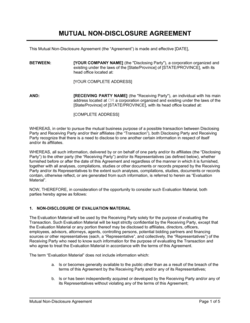
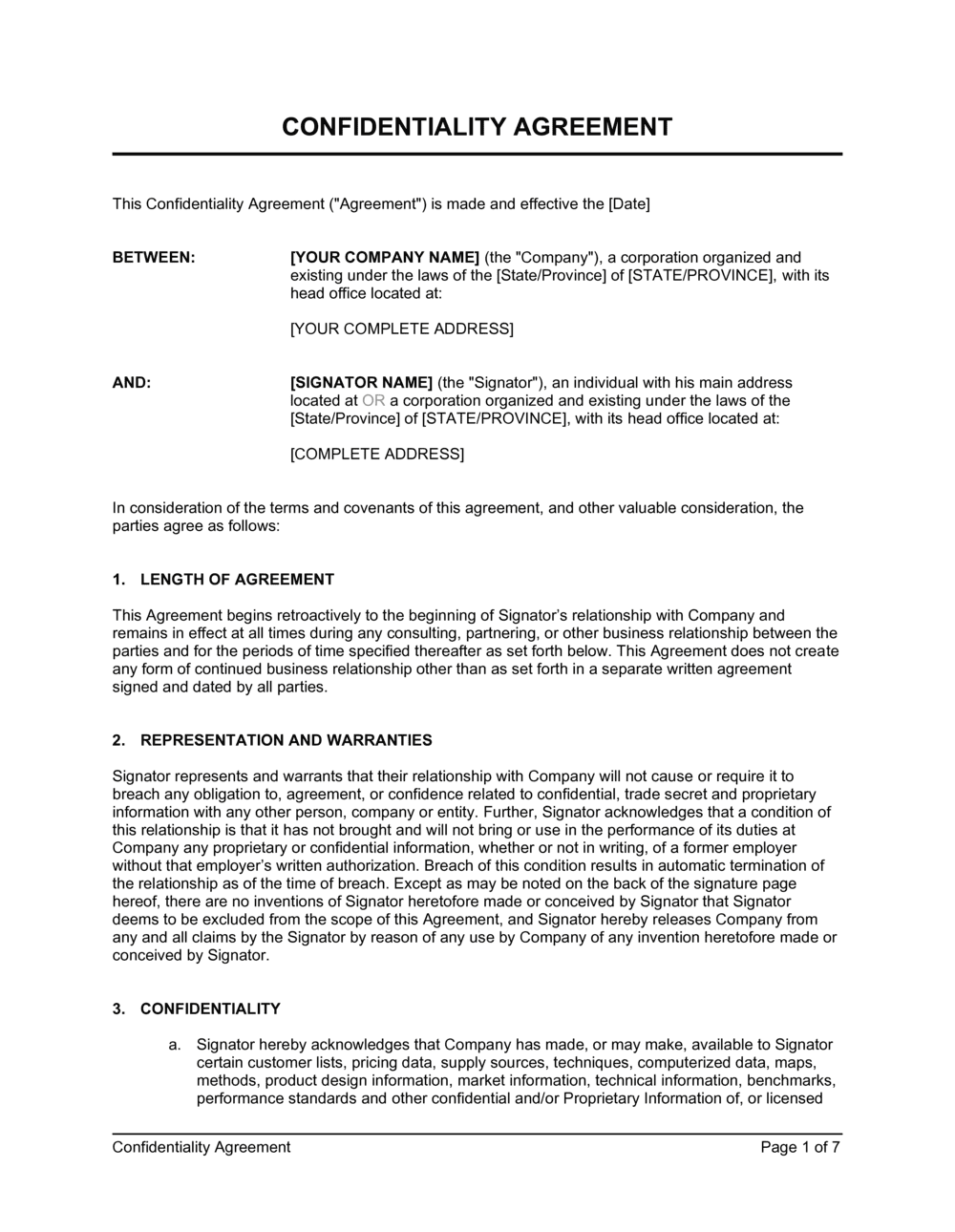
Confidentiality Agreement for Consultants, Contractors Template

Free Word download • Edit online • Save & share with Drive • Export to PDF

7 pages25–35 min to fillDifficulty: ComplexSignature requiredLegal review recommended
Learn more ↓
FreeConfidentiality Agreement for Consultants, Contractors Template

At a glance

What it is
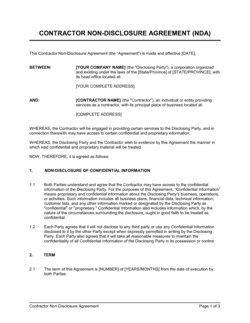
A Confidentiality Agreement for Consultants and Contractors is a legally binding contract that restricts an outside professional from disclosing or misusing sensitive business information they access during an engagement. This template is a free Word download you can edit online and export as PDF — covering trade secrets, proprietary data, client lists, and work-product ownership in a single enforceable document.
When you need it
Use it before any consultant, freelancer, or independent contractor begins work that gives them access to proprietary processes, unreleased products, financial data, customer information, or strategic plans. It should be signed prior to the engagement start date — never after work has begun.
What's inside
Definition of confidential information, permitted use restrictions, exclusions from coverage, IP and work-product assignment, non-solicitation obligations, term and survival clauses, remedies for breach, and governing law — everything needed to protect sensitive information shared with outside professionals.

What is a Confidentiality Agreement for Consultants and Contractors?

A Confidentiality Agreement for Consultants and Contractors is a legally binding contract that restricts an independent professional from disclosing or misusing any sensitive business information they access during an engagement. Unlike a standard employee NDA — which benefits from the implied duty of loyalty inherent in the employment relationship — this agreement is entirely self-contained, covering not only non-disclosure obligations but also IP and work-product assignment, subcontractor flow-down requirements, and non-solicitation restrictions that would otherwise have no legal basis. Because independent contractors own their work product by default under copyright law in most jurisdictions, the IP assignment clause is as critical as the confidentiality provisions themselves. The template is available as a free Word download, editable online, and exportable as PDF for immediate execution.

Why You Need This Document

Without a signed confidentiality agreement in place before a contractor begins work, your business faces three simultaneous exposures: the consultant is free to share your trade secrets, pricing strategies, and client data with competitors; work product they create — including code, designs, and reports — belongs to them, not to you; and there is nothing legally preventing them from calling your clients or hiring your employees the day after the engagement ends. These are not theoretical risks. IP ownership disputes between clients and freelancers are among the most common commercial disputes in the technology and creative industries, and trade-secret misappropriation by former contractors is a leading source of competitive intelligence loss. Executing this agreement before the contractor's first day closes all three gaps with a single document — and provides the documented basis for injunctive relief if a breach occurs.

Which variant fits your situation?

If your situation is…Use this template
Mutual exploration between two companies before a partnership or dealMutual Non-Disclosure Agreement
One-way disclosure to a single vendor or service providerNon-Disclosure Agreement (One-Way)
Full engagement terms plus confidentiality for an independent contractorIndependent Contractor Agreement
Executive consultant with access to board-level strategy and M&A dataExecutive Employment Agreement (with NDA rider)
Technology vendor or SaaS provider handling customer dataData Processing Agreement
Employee moving into a consulting role post-employmentPost-Employment Confidentiality Agreement
Investor or advisor receiving confidential business plan and financialsInvestor Non-Disclosure Agreement

Common mistakes to avoid

❌ Signing the agreement after the engagement starts

Why it matters: If the contractor has already accessed confidential information before signing, courts may find insufficient new consideration for the restrictive clauses — voiding IP assignment or non-solicitation terms.

Fix: Make execution of the confidentiality agreement a condition of onboarding, blocking system access and kickoff meetings until the signed agreement is on file.

❌ No obligation on the contractor to bind their subcontractors

Why it matters: A contractor who delegates work to an assistant or sub without equivalent confidentiality obligations creates a direct exposure gap — information flows out of the agreement's reach with no remedy.

Fix: Add an explicit clause requiring the contractor to impose equivalent confidentiality obligations on any subcontractors or team members who access company information, and to remain liable for their breaches.

❌ Omitting the IP assignment clause

Why it matters: Without explicit assignment language, work product created by an independent contractor — including code, designs, and written deliverables — belongs to the contractor by default under US and most common-law copyright frameworks.

Fix: Include a clause stating all deliverables are works made for hire or, where that doctrine does not apply, are irrevocably assigned to the company at creation.

❌ Survival period runs from the agreement date instead of the engagement end date

Why it matters: A 2-year survival clause running from the signing date can expire before an engagement has even concluded, leaving recently disclosed information unprotected.

Fix: Draft the survival clause to run from the later of the agreement date or the final date of the contractor's engagement — and set trade-secret protection to survive indefinitely.

❌ Blanket non-solicitation covering all company clients regardless of contractor contact

Why it matters: Courts apply a reasonableness standard to non-solicitation clauses — restricting a contractor from approaching clients they never interacted with is routinely struck down as overbroad.

Fix: Limit non-solicitation to clients and employees the contractor actually had contact with during the engagement, and set a duration proportionate to the contractor's seniority.

❌ No return or destruction certification requirement

Why it matters: Without a written certification obligation, there is no documented proof of compliance at the end of the engagement — creating an evidentiary gap if a breach surfaces months later.

Fix: Add a clause requiring the contractor to deliver a signed destruction certificate within 5 business days of engagement termination or on written request, confirming all confidential materials have been returned or deleted.

The 10 key clauses, explained

Parties and recitals

In plain language: Identifies the disclosing company and the contractor by their full legal names and establishes the context of the engagement.

Sample language
This Confidentiality Agreement is entered into as of [DATE] between [COMPANY LEGAL NAME], a [STATE/PROVINCE] [ENTITY TYPE] ('Company'), and [CONTRACTOR FULL NAME / ENTITY NAME] ('Contractor'), in connection with Contractor's engagement to provide [DESCRIPTION OF SERVICES].

Common mistake: Using a trade name or DBA instead of the contractor's registered legal entity name — creating an enforcement gap if the contract needs to be litigated.

Definition of confidential information

In plain language: Sets out exactly what information is covered, typically including a general category description plus specific examples, and whether information must be marked to qualify.

Sample language
'Confidential Information' means any non-public information disclosed by Company to Contractor, whether orally, in writing, or in any other form, including but not limited to trade secrets, financial data, customer lists, product specifications, and software code. Information need not be marked 'Confidential' to qualify.

Common mistake: Requiring that all confidential information be marked in writing. Oral disclosures and unmarked documents are common in consulting engagements — a marking requirement creates large coverage gaps.

Permitted use and purpose

In plain language: Restricts the contractor to using confidential information only for the defined engagement purpose and prohibits any other use, including benefiting a competitor.

Sample language
Contractor shall use Confidential Information solely for the purpose of performing services under the engagement letter dated [DATE] ('Permitted Purpose') and for no other purpose without prior written consent of the Company.

Common mistake: Defining the permitted purpose too broadly as 'any work for the Company.' This allows a contractor to use sensitive information from one project on an unrelated engagement months later.

Exclusions from confidentiality

In plain language: Lists the four standard categories of information that are not protected: already public, already known to the contractor, received independently from a third party, or required to be disclosed by law.

Sample language
The obligations in this Agreement do not apply to information that: (a) is or becomes publicly available without breach by Contractor; (b) was already known to Contractor before disclosure; (c) is received from a third party without restriction; or (d) is required to be disclosed by law, provided Contractor gives Company prompt written notice.

Common mistake: Omitting the required-by-law exclusion. Without it, a contractor compelled by court order to disclose information could technically be in breach.

Non-disclosure and non-use obligations

In plain language: States the core obligation: the contractor must not share confidential information with anyone and must not use it for any purpose outside the engagement.

Sample language
Contractor shall: (a) hold all Confidential Information in strict confidence; (b) not disclose Confidential Information to any third party without prior written consent; (c) not use Confidential Information for any purpose other than the Permitted Purpose; and (d) limit access to Confidential Information to those employees or subcontractors with a need to know who are bound by equivalent confidentiality obligations.

Common mistake: Not requiring the contractor to bind their own subcontractors and assistants. A contractor who passes confidential information to a sub without restriction creates direct exposure for the company.

Work-product and IP assignment

In plain language: Assigns ownership of all deliverables, inventions, and work product created during the engagement to the client company.

Sample language
All work product, deliverables, inventions, and developments created by Contractor in connection with this engagement are works made for hire or, to the extent they are not, are hereby irrevocably assigned to Company. Contractor waives all moral rights in such work product.

Common mistake: Omitting the IP assignment clause entirely, or including only a license instead of a full assignment — leaving the contractor as the legal owner of code, designs, or reports they created for the client.

Non-solicitation

In plain language: Prevents the contractor from poaching the company's employees or directly approaching the company's clients during and for a defined period after the engagement.

Sample language
During the engagement and for [12] months following its termination, Contractor shall not: (a) solicit or hire any employee of Company; or (b) solicit any client or customer of Company with whom Contractor had contact in connection with the engagement.

Common mistake: Setting the non-solicitation period at 24 months or longer for a routine short-term engagement. Courts weigh reasonableness against the contractor's seniority — an overly long restriction on a junior contractor is at risk of being struck down.

Term, termination, and survival

In plain language: Sets the duration of the agreement, the conditions under which it ends, and which obligations survive termination — typically confidentiality and IP assignment survive indefinitely or for a defined post-engagement period.

Sample language
This Agreement commences on the date first written above and continues until terminated by either party on [30] days' written notice. Sections [CONFIDENTIALITY], [IP ASSIGNMENT], and [NON-SOLICITATION] survive termination for a period of [3] years, except that obligations with respect to trade secrets survive indefinitely.

Common mistake: Setting a 1-year confidentiality survival period that runs from the agreement date rather than the engagement end date — information disclosed late in a multi-year engagement may be unprotected within months.

Return or destruction of materials

In plain language: Requires the contractor to return all confidential documents, data, and materials — or certify their destruction — upon request or at the end of the engagement.

Sample language
Upon termination of this Agreement or on Company's written request, Contractor shall promptly return or, at Company's election, destroy all tangible materials containing Confidential Information and provide written certification of destruction within [5] business days.

Common mistake: No destruction certification requirement. Without a written cert, the company has no way to verify compliance and no documentation if a dispute arises later.

Remedies and governing law

In plain language: States that breach may cause irreparable harm justifying injunctive relief without posting bond, names the governing jurisdiction, and identifies the forum for disputes.

Sample language
Contractor acknowledges that breach of this Agreement would cause irreparable harm for which monetary damages would be inadequate, and Company shall be entitled to seek injunctive relief without posting bond. This Agreement is governed by the laws of [STATE/PROVINCE/COUNTRY]. Any dispute shall be resolved in the courts of [JURISDICTION].

Common mistake: Choosing a governing law with no connection to where either party operates. Several jurisdictions — especially US states and EU member states — may apply local mandatory law regardless of the governing-law clause.

How to fill it out

  1. 1

    Identify the parties with full legal names

    Enter the company's registered legal entity name and the contractor's full legal name or registered business name. If the contractor operates through an LLC or corporation, use that entity — not the individual's personal name.

    💡 Cross-check the contractor's entity name against your state or provincial corporate registry before signing to confirm the entity is active and properly named.

  2. 2

    Define the engagement and permitted purpose

    Describe the specific services the contractor will perform — e.g., 'software development for the Company's mobile application' — and reference any accompanying statement of work. Narrow the permitted purpose to this specific engagement.

    💡 If you use a master contractor agreement with individual statements of work, add language tying this NDA to all current and future SOWs to avoid signing a new NDA each time.

  3. 3

    Customize the definition of confidential information

    Review the default definition and add any business-specific categories — patient data, source code, pricing algorithms, or proprietary formulas — that are central to your business and not captured in the standard language.

    💡 Remove the marking requirement if your team routinely shares information verbally or via email without labeling everything 'Confidential.'

  4. 4

    Set the non-solicitation duration and scope

    Choose a non-solicitation period proportionate to the contractor's seniority and access. For short-term project contractors, 6–12 months is standard. For senior consultants with direct client relationships, 12–24 months is defensible.

    💡 Limit the non-solicitation to customers the contractor actually worked with — a blanket restriction covering all company clients is harder to enforce and may be challenged.

  5. 5

    Confirm the IP assignment covers all deliverable types

    Review the work-product clause against the actual deliverables: code, designs, reports, training materials, data models. If the contractor will use pre-existing tools or frameworks they own, carve those out explicitly while assigning the new work product.

    💡 Ask the contractor to list any pre-existing IP they intend to incorporate before signing — discovering this after delivery creates costly renegotiation.

  6. 6

    Set the survival period correctly

    Tie the confidentiality survival period to the engagement end date, not the agreement signing date. Set trade-secret obligations to survive indefinitely and other confidentiality obligations for 3–5 years post-engagement.

    💡 For agreements covering HIPAA-regulated data or financial records, check applicable regulatory retention periods — your contractual survival clause should meet or exceed those minimums.

  7. 7

    Select governing law and dispute forum

    Choose the jurisdiction where your company is incorporated or where the contractor will primarily perform work. Confirm the chosen state or country will enforce the non-solicitation and IP clauses as written.

    💡 If the contractor is in California, remove or significantly narrow the non-solicitation and any non-compete language — California courts routinely void them under Business & Professions Code §16600.

  8. 8

    Sign before the engagement begins

    Both parties must execute the agreement before the contractor accesses any confidential information. Post-start signatures may undermine the consideration argument — the contractor has already received access to information and given nothing new in return.

    💡 Use a timestamped e-signature platform and store the fully executed copy in your secure document repository alongside the engagement letter or SOW.

Frequently asked questions

What is a confidentiality agreement for consultants and contractors?

A confidentiality agreement for consultants and contractors is a legally binding contract that restricts an outside professional from disclosing or misusing sensitive business information they access during an engagement. Unlike a standard employee NDA, it accounts for the contractor's independent status — covering work-product ownership, subcontractor obligations, and the absence of employment-law protections that would otherwise apply. It is typically signed before the engagement begins and survives the end of the working relationship for a defined period.

Is a confidentiality agreement for contractors different from a standard NDA?

Yes, in several important ways. A contractor NDA must address IP and work-product assignment explicitly — because contractors, unlike employees, own their work product by default under copyright law. It also needs to cover the contractor's own subcontractors and team members, who may access information without being party to the agreement. Standard NDAs between businesses focus on mutual information exchange and typically lack IP assignment and non-solicitation provisions.

Does a contractor NDA need to be signed before work starts?

Yes. The agreement should be executed before the contractor accesses any confidential information — ideally on or before the first day of the engagement. In common-law jurisdictions including the US, Canada, the UK, and Australia, a contract requires consideration from both parties. A contractor who has already started work and received access to information has given nothing new in exchange for later-signed restrictions, which can make IP assignment and non-solicitation clauses unenforceable.

Who owns work product created by a contractor — the client or the contractor?

By default under US and most common-law copyright frameworks, an independent contractor owns the work they create — even if the client paid for it. The "work made for hire" doctrine that automatically assigns employee output to employers does not apply to independent contractors except in nine narrowly defined categories. A written IP assignment clause in the confidentiality or contractor agreement is the only reliable way to transfer ownership to the client.

How long should a contractor confidentiality agreement last?

The agreement itself typically covers the duration of the engagement. The confidentiality obligations should survive for 2–5 years after the engagement ends, with trade-secret protections surviving indefinitely. Non-solicitation terms of 6–12 months post-engagement are standard for most contractor roles; up to 24 months may be defensible for senior consultants with direct access to key clients. Survival periods tied to the engagement end date — rather than the agreement signing date — provide the most reliable protection.

Are non-solicitation clauses in contractor agreements enforceable?

Enforceability depends on jurisdiction and scope. Courts in most US states, Canada, and the UK enforce non-solicitation clauses that are reasonable in duration, limited to clients the contractor actually worked with, and proportionate to the contractor's seniority. California is a notable exception — Business and Professions Code §16600 voids most post-engagement restrictions on independent contractors, including broad non-solicitation clauses. Always tailor the clause to the contractor's actual access and the governing jurisdiction.

What happens if a contractor breaches the confidentiality agreement?

The disclosing party can seek injunctive relief — a court order requiring the contractor to stop the disclosure immediately — without needing to quantify monetary damages. The agreement typically also entitles the company to seek damages for actual losses caused by the breach. Because proving the exact monetary harm from a confidentiality breach is difficult, including a liquidated damages clause or a specific acknowledgment that breach causes irreparable harm strengthens the company's remedial position.

Does this agreement cover GDPR or HIPAA compliance obligations?

A standard confidentiality agreement is not a substitute for a GDPR Data Processing Agreement (DPA) or a HIPAA Business Associate Agreement (BAA). If the contractor will process personal data of EU residents, a separate DPA is required under GDPR Article 28. If the contractor will handle protected health information, a BAA is a legal requirement under HIPAA. The confidentiality agreement can supplement these instruments but should not be treated as a replacement for them.

Do I need a lawyer to prepare a contractor confidentiality agreement?

For standard domestic engagements, a well-drafted template is typically sufficient. Consider engaging a lawyer when the contractor will access highly sensitive IP in a competitive market, when the engagement involves cross-border data transfers subject to GDPR, when the contractor is based in California or another jurisdiction with restrictive enforceability rules, or when the value of the information at risk justifies the additional cost. A 1-hour template review typically costs $200–$400 and is worthwhile for senior consultants or high-value IP engagements.

Should the confidentiality agreement be a standalone document or part of the contractor agreement?

Either approach works, but a standalone confidentiality agreement has a practical advantage: it can be executed immediately, before the full contractor agreement is negotiated and signed. This protects information shared during scope and pricing discussions, not just during active work. If you use a master services agreement with individual statements of work, the confidentiality agreement should reference all current and future SOWs rather than a single project to avoid gaps between engagements.

How this compares to alternatives

vs Mutual Non-Disclosure Agreement

A mutual NDA protects both parties equally when information flows in both directions — typical in partnership discussions or joint ventures. A contractor confidentiality agreement is one-directional: the client discloses, the contractor is restricted. It also adds IP assignment and non-solicitation provisions that a mutual NDA does not include. Use a mutual NDA for pre-deal exploration; use this agreement for any active contractor engagement.

vs Independent Contractor Agreement

An independent contractor agreement governs the full commercial relationship — scope, fees, deliverables, payment terms, and termination. A confidentiality agreement focuses exclusively on information protection and IP ownership. For a complete contractor engagement, you typically need both: the contractor agreement for the commercial terms and this document for the information-security obligations, either as a standalone or an integrated schedule.

vs Employee Non-Disclosure Agreement

An employee NDA relies on the employment relationship and the implied duties of loyalty and good faith to anchor its obligations. A contractor NDA must be entirely self-contained, explicitly covering IP assignment (not automatic for contractors), subcontractor flow-down, and the absence of employment-law protections. Using an employee NDA for a contractor engagement typically leaves significant legal gaps around work-product ownership.

vs Data Processing Agreement

A Data Processing Agreement (DPA) is required under GDPR whenever a contractor processes personal data of EU residents on behalf of a controller. It addresses data-subject rights, sub-processor restrictions, and cross-border transfer safeguards — obligations a confidentiality agreement does not cover. If the contractor handles EU personal data, both documents are needed: the DPA for regulatory compliance and the confidentiality agreement for broader business information protection.

Industry-specific considerations

Technology / SaaS

Source code, API architecture, and unreleased product roadmaps shared with freelance developers and QA contractors require explicit IP assignment and trade-secret protection extending well beyond the engagement.

Professional Services

Management consultants and accountants access client financial data, M&A targets, and strategic plans — making a robust definition of confidential information and a strong non-solicitation clause critical.

Healthcare / MedTech

Contractors handling protected health information must be covered by a HIPAA Business Associate Agreement in addition to this confidentiality agreement; the two instruments address overlapping but distinct obligations.

Creative and Marketing Agencies

Subcontractors and white-label partners create client deliverables — campaign strategies, brand assets, and copy — where ownership ambiguity is common without an explicit IP assignment and subcontractor flow-down clause.

Financial Services

Consultants reviewing trading algorithms, pricing models, or client portfolios access information with significant commercial value; confidentiality terms must cover both the information and the fact of the engagement itself.

Manufacturing

Process-improvement and supply-chain consultants see proprietary production methods and vendor relationships that qualify as trade secrets under the Defend Trade Secrets Act; indefinite protection on those specific categories is warranted.

Jurisdictional notes

United States

Federal trade-secret protection is provided by the Defend Trade Secrets Act (DTSA) of 2016, which allows federal civil claims for misappropriation. State law (typically the Uniform Trade Secrets Act, adopted in 48 states) applies in parallel. California is the critical exception: Business and Professions Code §16600 voids most non-solicitation and non-compete clauses for contractors, and Labor Code §2870 limits IP assignment for inventions developed entirely on the contractor's own time without company resources. Always tailor this agreement when the contractor is based in California.

Canada

Canada's federal and provincial privacy statutes — PIPEDA federally and PIPA in Alberta and BC — impose obligations on contractors who handle personal information, supplementing the contractual confidentiality framework. Non-solicitation clauses are enforceable if reasonable in scope and duration; courts apply a stricter reasonableness standard than in most US states. Quebec's Law 25 (Bill 64) adds GDPR-like data protection requirements that affect contractors processing Quebec residents' personal data, including mandatory data processing agreements.

United Kingdom

UK law implies a duty of confidence for genuinely confidential information even without a written agreement, but a signed contract remains the gold standard for enforcement. Post-Brexit, the UK GDPR (retained GDPR) governs data processing by contractors handling UK residents' personal data, requiring a data processing agreement separate from this NDA. Post-employment and post-engagement restraints — including non-solicitation — are enforceable only if they protect a legitimate business interest and go no further than reasonably necessary.

European Union

EU Trade Secrets Directive (2016/943) harmonizes minimum trade-secret protections across member states and requires that the owner take 'reasonable steps' to keep information secret — a signed contractor NDA is strong evidence of those steps. GDPR Article 28 mandates a separate Data Processing Agreement for any contractor processing personal data of EU residents; a confidentiality agreement alone does not satisfy this requirement. Non-solicitation and non-compete enforceability varies significantly by member state — Germany and France require financial compensation for post-engagement restrictions in many cases.

Template vs lawyer — what fits your deal?

PathBest forCostTime
Use the templateStandard domestic contractor engagements for small and medium businesses with no cross-border data transfersFree15–20 minutes
Template + legal reviewContractors in California, cross-border engagements, or access to high-value IP such as source code or trade formulas$200–$5001–2 days
Custom draftedSenior executive consultants, GDPR-regulated data environments, or heavily contested IP in competitive markets$800–$3,000+1–2 weeks

Glossary

Confidential Information
Any non-public data, knowledge, or material designated as sensitive by the disclosing party — including trade secrets, financial data, client lists, and proprietary processes.
Disclosing Party
The business or individual that shares sensitive information with the consultant or contractor under the terms of this agreement.
Receiving Party
The consultant or contractor who receives confidential information and is bound by the non-disclosure obligations in the agreement.
Trade Secret
Commercially valuable information — such as a formula, algorithm, or business method — that derives its value from not being publicly known and is subject to reasonable protective measures.
Work Product
Any deliverable, code, design, report, or other output created by the contractor during the engagement, which the agreement typically assigns to the client.
Non-Solicitation Clause
A restriction preventing the contractor from directly recruiting the client's employees or approaching the client's customers for their own benefit during or after the engagement.
Survival Clause
A provision stating that specified obligations — typically confidentiality and IP assignment — remain in effect after the agreement or engagement ends.
Residuals Clause
An optional provision allowing the receiving party to use general knowledge retained in unaided memory from the engagement, without violating the confidentiality obligation.
Injunctive Relief
A court order requiring a party to stop a specific action immediately — the standard remedy sought when confidential information is being disclosed or is at imminent risk of disclosure.
Permitted Purpose
The specific, defined scope of work for which the contractor is authorized to use the confidential information — any use outside this scope constitutes a breach.
Return or Destruction Obligation
A requirement that the contractor return all confidential materials or certify their destruction upon completion of the engagement or on request.

Part of your Business Operating System

This document is one of 3,000+ business & legal templates included in Business in a Box.

  • Fill-in-the-blanks — ready in minutes
  • 100% customizable Word document
  • Compatible with all office suites
  • Export to PDF and share electronically

Create your document in 3 simple steps.

From template to signed document — all inside one Business Operating System.
1
Download or open template

Access over 3,000+ business and legal templates for any business task, project or initiative.

2
Edit and fill in the blanks with AI

Customize your ready-made business document template and save it in the cloud.

3
Save, Share, Send, Sign

Share your files and folders with your team. Create a space of seamless collaboration.

Save time, save money, and create top-quality documents.

★★★★★

"Fantastic value! I'm not sure how I'd do without it. It's worth its weight in gold and paid back for itself many times."

Managing Director · Mall Farm
Robert Whalley
Managing Director, Mall Farm Proprietary Limited
★★★★★

"I have been using Business in a Box for years. It has been the most useful source of templates I have encountered. I recommend it to anyone."

Business Owner · 4+ years
Dr Michael John Freestone
Business Owner
★★★★★

"It has been a life saver so many times I have lost count. Business in a Box has saved me so much time and as you know, time is money."

Owner · Upstate Web
David G. Moore Jr.
Owner, Upstate Web

Run your business with a system — not scattered tools

Stop downloading documents. Start operating with clarity. Business in a Box gives you the Business Operating System used by over 250,000 companies worldwide to structure, run, and grow their business.

Free Forever Plan · No credit card required