1
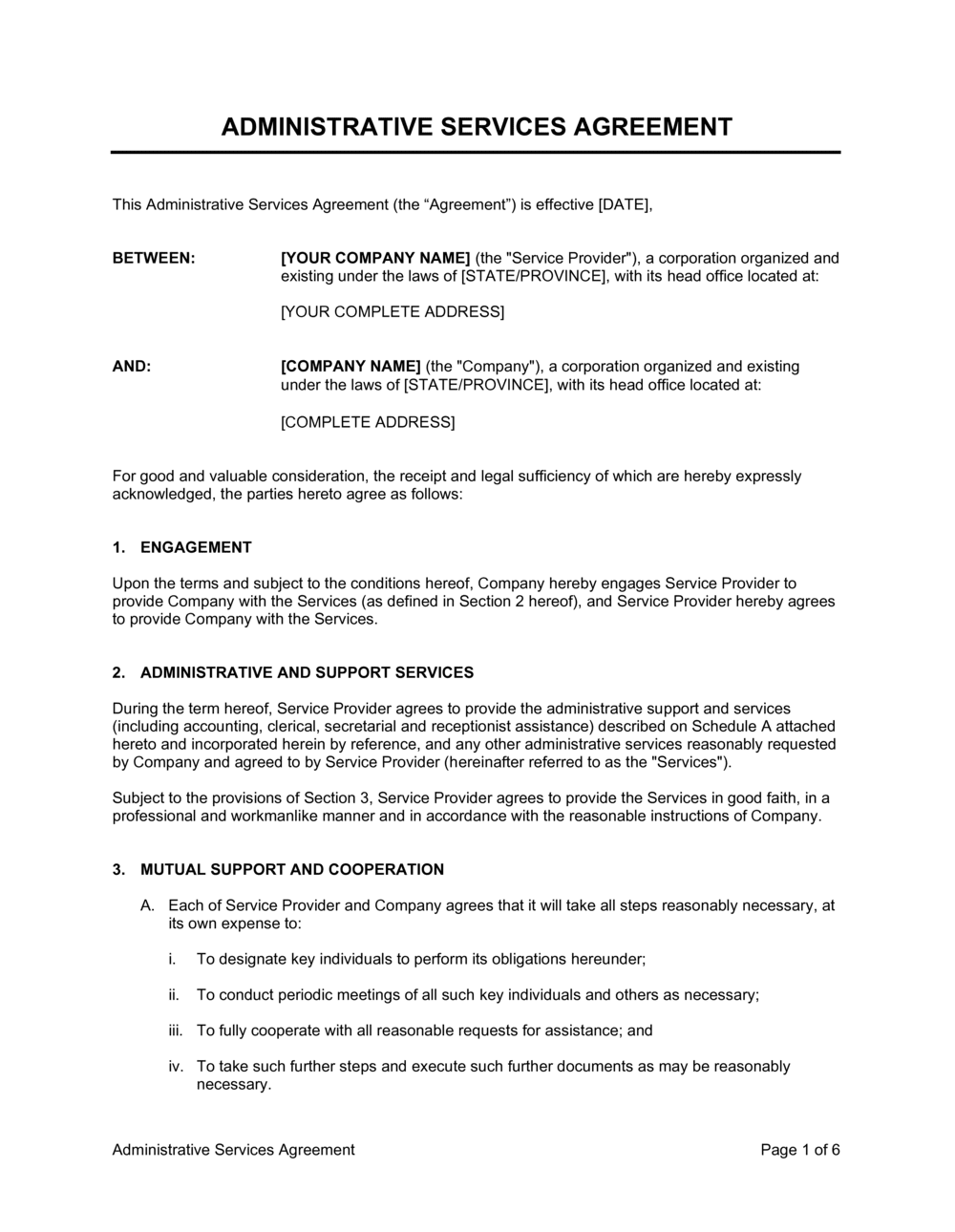
Identify both legal entities
Enter the full registered legal names of the service provider and the client — not trade names or DBAs. Confirm entity type (LLC, corporation, partnership) and state or province of formation for each.
💡 Cross-check your corporate registry filing before inserting entity names. A mismatched name in a contract can complicate enforcement.
2
Define the scope of services in Schedule A
List every administrative task the provider will perform with enough specificity that a third party could determine whether each task was completed. Avoid broad categories like 'accounting support' — specify 'monthly bank reconciliation, accounts payable processing, and payroll journal entry posting.'
💡 Have the provider draft Schedule A first, then have the client redline it. Differences in that negotiation reveal assumptions that need to be resolved before signing.
3
Set performance standards in Schedule B
Attach a Schedule B with measurable benchmarks — turnaround times, error tolerances, reporting deadlines. Link each standard to a specific service in Schedule A.
💡 If a standard cannot be measured objectively, it cannot be enforced. 'Timely' means nothing; '48 hours from receipt of source documents' does.
4
Complete the fee and payment section
Enter the fee amount, fee type (retainer, hourly, per-transaction), invoice frequency, payment due date, and the late-fee rate. Confirm whether fees are inclusive or exclusive of applicable taxes such as VAT or HST.
💡 State the currency explicitly, especially for cross-border arrangements where USD and CAD, or GBP and EUR, are easily confused.
5
Tailor the confidentiality and data provisions
Define 'Confidential Information' specifically — include financial records, employee data, client lists, and any personally identifiable information the provider will access. Add a data breach notification timeline and any sector-specific compliance obligations (HIPAA, GDPR, PIPEDA).
💡 If the provider will process personal data of EU residents, attach a Data Processing Agreement as an exhibit to comply with GDPR Article 28.
6
Set the term, notice period, and transition window
Choose an initial term (12 months is standard), set the automatic renewal period, and confirm the notice period for non-renewal or termination. Add a transition assistance period of at least 60–90 days for complex administrative arrangements.
💡 The notice period should be long enough for the client to competitively procure a replacement provider. Thirty days is often too short for specialized administrative functions.
7
Confirm the liability cap and indemnification scope
Set the aggregate liability cap — typically total fees paid in the preceding 12 months — and confirm which categories of loss are excluded from the cap (fraud, willful misconduct, data-breach penalties).
💡 For arrangements involving payroll or tax filing, consider a higher cap or a separate carve-out for regulatory penalties caused by provider error, as fines can easily exceed 12 months of fees.
8
Execute before services begin
Both authorized signatories must sign before the first day of service delivery. Confirm each signatory has authority to bind their entity — board authorization may be required for entities governed by formal bylaws.
💡 Use a timestamped e-signature platform to create an auditable execution record. Store the fully-executed agreement alongside the Schedules as a single PDF.