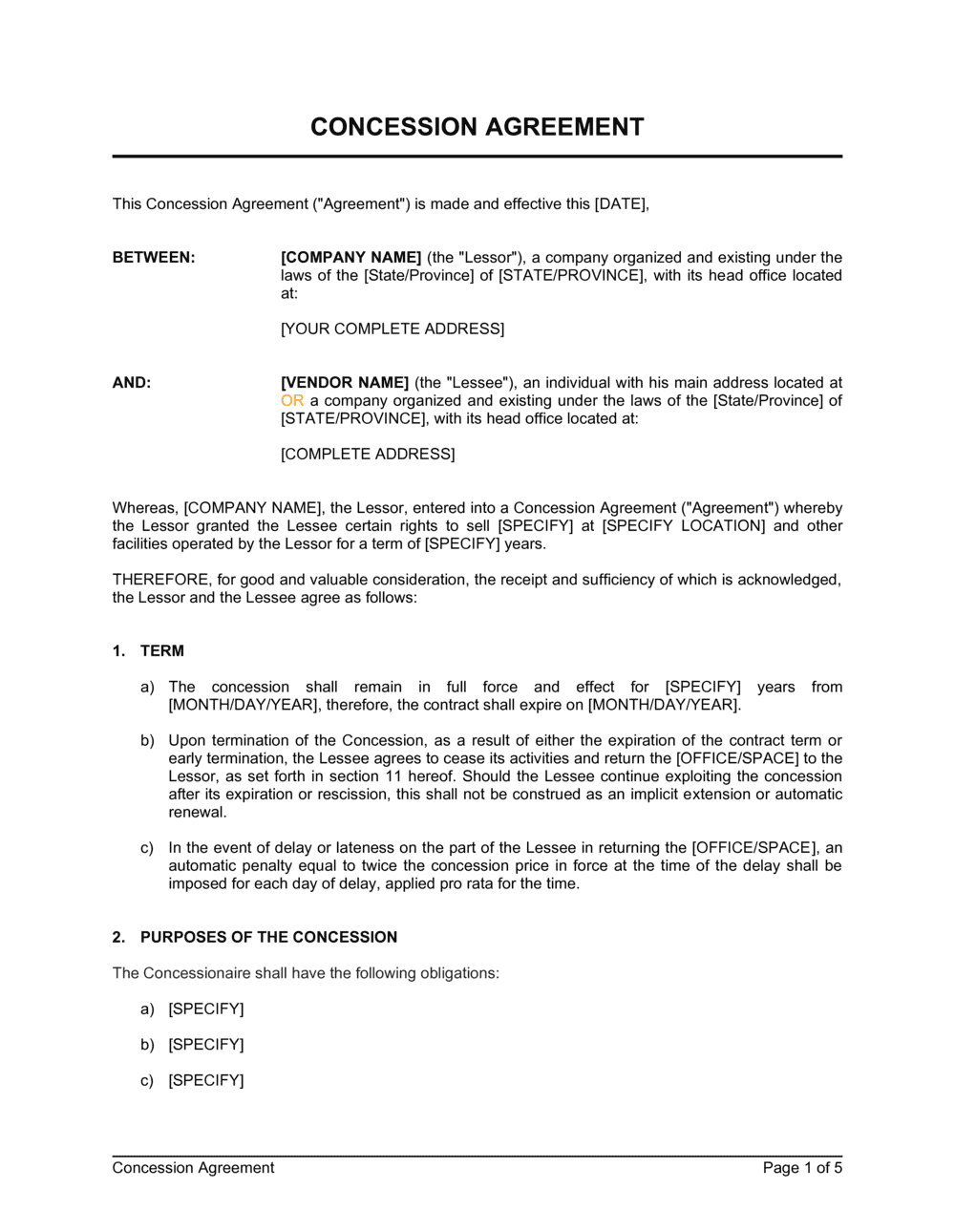
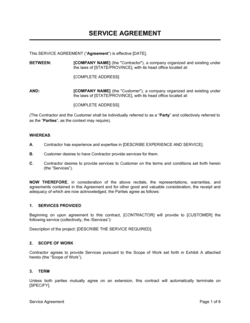
Concession Agreement Template

Free Word download β€’ Edit online β€’ Save & share with Drive β€’ Export to PDF

5 pagesβ€’25–35 min to fillβ€’Difficulty: Complexβ€’Signature requiredβ€’Legal review recommended
Learn more ↓
FreeConcession Agreement Template

At a glance

What it is
A Concession Agreement is a legally binding contract between a property owner or authority (the grantor) and a third-party operator (the concessionaire) that grants the right to conduct a specific commercial activity β€” such as selling food, operating a kiosk, or running a service facility β€” within a defined space or infrastructure for a set term. This free Word download covers fees, territory, exclusivity, operational standards, insurance, and termination in a single structured document you can edit online and export as PDF.
When you need it
Use it when you are granting or receiving the right to operate a commercial activity within a venue, public facility, airport, stadium, park, or private property where the property owner retains overall control. It is also required any time a government or public authority licenses infrastructure operations to a private company.
What's inside
Parties and grant of rights, concession territory and permitted use, term and renewal options, fees and revenue share, operational standards and compliance, insurance and indemnification, IP and branding, and termination and handback provisions.

What is a Concession Agreement?

A Concession Agreement is a legally binding contract between a property owner or authority (the grantor) and a third-party commercial operator (the concessionaire) that grants the right to conduct a defined business activity β€” selling food and beverages, operating a retail kiosk, running a parking facility, or managing infrastructure β€” within a specific physical space or public asset for an agreed term. Unlike a lease, which transfers possession to the tenant, a concession agreement allows the grantor to retain control over the property and impose ongoing operational, performance, and compliance obligations on the operator. The agreement establishes the territory, the permitted use, the fee structure (including any revenue share and minimum annual guarantee), insurance requirements, exclusivity terms, and the conditions under which the agreement may be terminated or renewed.

Why You Need This Document

Operating a concession without a written agreement exposes both parties to significant and entirely avoidable risk. For grantors, an undocumented concession leaves no enforceable basis to collect fees, enforce hygiene or brand standards, remove an underperforming operator, or recover reinstatement costs when the operator exits. For concessionaires, operating without a signed agreement provides no protection against sudden termination, loss of territory to a competitor, or disputed revenue calculations. A properly structured concession agreement defines the scope of rights before either party invests time or capital, documents the condition of the space at commencement, and provides a clear mechanism for resolving disputes without resorting to litigation. This template gives grantors and concessionaires a professionally drafted starting point that covers every material term β€” cutting drafting time from weeks to hours while reducing the most common sources of post-execution conflict.

Which variant fits your situation?

If your situation is…Use this template
Operating a food or beverage stand at a stadium or event venueFood Concession Agreement
Running a retail kiosk or cart inside a shopping mall or airportKiosk License Agreement
Granting long-term infrastructure operating rights under a public-private partnershipPublic-Private Partnership Agreement
Licensing branded merchandise or product sales at an eventVendor Agreement
Renting a defined space within a property for a short-term pop-upSpace Rental Agreement
Granting franchise rights to operate under a brand in a territoryFranchise Agreement
Allowing a contractor to operate equipment or services on a construction siteService Agreement

Common mistakes to avoid

❌ Vague permitted-use definition

Why it matters: A loosely drafted permitted-use clause allows the concessionaire to expand into product lines or services the grantor never intended, undercutting other operators or violating exclusivity agreements with third parties.

Fix: List the specific products, services, and brands the concessionaire is authorized to sell. Add a clause requiring written consent for any expansion outside that list.

❌ No handback condition schedule

Why it matters: Without a documented baseline condition at commencement, the grantor cannot prove what reinstatement work was required by the concessionaire at exit β€” disputes routinely escalate to formal proceedings.

Fix: Conduct a photographic condition survey before the start date, attach it as a schedule, and have both parties sign the acknowledgment page.

❌ Automatic renewal with no performance threshold

Why it matters: A concessionaire that consistently misses revenue targets can trigger automatic renewal simply by not sending an opt-out notice, locking the grantor into another term with an underperforming operator.

Fix: Tie renewal eligibility to objective criteria β€” revenue above the MAG, no unremedied breach in the prior 12 months β€” and state these as conditions precedent to the renewal right.

❌ Undefined gross revenue calculation

Why it matters: If the revenue share clause does not specify whether tips, sales tax, delivery-platform commissions, and returns are included or excluded, both parties will calculate fees differently and disputes are certain.

Fix: Add a Gross Revenue definition in the definitions section that explicitly includes or excludes each revenue category relevant to the concessionaire's business model.

❌ No step-in rights clause

Why it matters: Without step-in rights, the grantor's only remedy for a failing or abandoned concession is full termination β€” which leaves the space dark during the notice period and any subsequent legal proceedings.

Fix: Include a step-in rights clause allowing the grantor to remedy operational failures or appoint a substitute operator at the concessionaire's cost following a defined cure period.

❌ Governing law inconsistent with the concession's physical location

Why it matters: Local health, licensing, zoning, and labor laws apply to the concession operations regardless of what the contract says β€” a governing law clause that points elsewhere does not displace mandatory local regulation.

Fix: Choose the governing law of the jurisdiction where the concession physically operates, and add a compliance clause confirming both parties' obligation to follow all applicable local laws.

The 10 key clauses, explained

Grant of concession rights

In plain language: Establishes the core right the grantor gives the concessionaire β€” the specific commercial activity, the territory it covers, and whether the right is exclusive.

Sample language
[GRANTOR NAME] hereby grants to [CONCESSIONAIRE NAME] the exclusive/non-exclusive right to operate [DESCRIPTION OF ACTIVITY] within the Concession Territory described in Schedule A, for the Term set out in Clause [X].

Common mistake: Describing the permitted activity too broadly. If the clause allows 'food and beverage services' without specifying category or product type, the concessionaire may expand into products the grantor never intended, creating conflicts with other vendors or brand standards.

Concession territory and permitted use

In plain language: Defines precisely where the concessionaire may operate and what activities are permitted β€” any use outside this definition is a breach.

Sample language
The Concession Territory is the area identified as [LOCATION / UNIT NUMBER] in the attached floor plan (Schedule A). The Permitted Use is limited to [SPECIFIC ACTIVITY]. No other use is permitted without the prior written consent of the Grantor.

Common mistake: Attaching a vague or outdated floor plan. If the physical boundary of the territory is ambiguous, disputes about prime selling areas β€” entrance zones, high-footfall corridors β€” are almost certain.

Term, renewal, and options

In plain language: Sets the start and end date of the concession, any renewal options, and the notice period the concessionaire must give to exercise renewal.

Sample language
The initial Term commences on [START DATE] and expires on [END DATE]. The Concessionaire shall have [X] renewal option(s) of [Y] year(s) each, exercisable by written notice no later than [Z] days prior to the expiry of the then-current Term.

Common mistake: Setting automatic renewal without a minimum performance threshold. A concessionaire who consistently underperforms can lock in another term simply by not opting out, limiting the grantor's ability to re-tender the concession.

Fees, revenue share, and minimum annual guarantee

In plain language: States the concession fee structure β€” fixed rent, percentage of gross revenue, minimum annual guarantee, or a combination β€” and the payment schedule.

Sample language
The Concessionaire shall pay the Grantor: (a) a Minimum Annual Guarantee of $[AMOUNT], payable in equal monthly installments on the [DAY] of each month; plus (b) [X]% of Gross Revenue in excess of $[THRESHOLD], payable within [30] days of each calendar quarter end.

Common mistake: Failing to define 'Gross Revenue' precisely. If the clause does not specify whether revenue includes tips, sales tax, or third-party delivery fees, the parties will calculate the revenue share differently and disputes will follow.

Operational standards and compliance

In plain language: Requires the concessionaire to operate to defined quality, hygiene, staffing, and branding standards β€” and to comply with all applicable laws and the grantor's own venue rules.

Sample language
The Concessionaire shall operate the Concession in compliance with all applicable laws and regulations and in accordance with the Grantor's Operating Standards, as updated from time to time and provided in writing to the Concessionaire.

Common mistake: Giving the grantor unlimited unilateral authority to change operating standards with no notice requirement. Courts have found that significant unilateral changes to operating requirements can constitute a variation of contract, exposing the grantor to claims.

Insurance and indemnification

In plain language: Requires the concessionaire to maintain specified insurance coverage and indemnifies the grantor against third-party claims arising from the concessionaire's operations.

Sample language
The Concessionaire shall maintain, at its own expense, general commercial liability insurance of no less than $[AMOUNT] per occurrence. The Concessionaire shall indemnify and hold harmless the Grantor from any claims, damages, or liabilities arising out of the Concessionaire's operations within the Concession Territory.

Common mistake: Setting insurance minimums once at contract execution and never indexing them to inflation or venue scale. A $1M liability policy that was adequate at signing may be materially insufficient five years into a 10-year term.

Intellectual property and branding

In plain language: Governs the use of the grantor's trademarks, logos, and venue branding by the concessionaire β€” and vice versa β€” and sets approval rights for marketing materials.

Sample language
Any use by the Concessionaire of the Grantor's name, logo, or trademarks requires the prior written approval of the Grantor. All approved use shall comply with the Grantor's Brand Guidelines attached as Schedule [B]. No rights in any Grantor IP are transferred by this Agreement.

Common mistake: Omitting an IP clause entirely when the concessionaire will prominently display the venue's name or branding in their own marketing. Without a license, the concessionaire's use of grantor IP is technically unauthorized.

Step-in rights and performance remedies

In plain language: Gives the grantor the right to take operational control, appoint a replacement operator, or remedy defaults at the concessionaire's cost if performance falls below defined thresholds.

Sample language
If the Concessionaire fails to remedy a material breach within [30] days of written notice, the Grantor may, without further notice, step in and operate the Concession directly or appoint a third party to do so, with all costs recoverable from the Concessionaire.

Common mistake: No step-in rights clause at all. Without it, the grantor's only remedy for a failing concessionaire is termination β€” which leaves the concession space generating zero revenue during the dispute and notice period.

Termination and consequences

In plain language: States the grounds for early termination by either party, the required notice period, and what happens to assets, fit-out, and deposits on exit.

Sample language
Either party may terminate this Agreement for material breach on [30] days' written notice if the breach remains unremedied. Upon termination or expiry, the Concessionaire shall vacate the Concession Territory and return it in the condition specified in Schedule [C] within [X] days.

Common mistake: No handback condition schedule. Without a documented baseline condition (photos, inventory lists, fit-out specifications), disputes about reinstatement costs at exit are almost inevitable β€” and expensive to resolve.

Governing law and dispute resolution

In plain language: Specifies the jurisdiction whose law governs the contract and the mechanism for resolving disputes β€” arbitration, mediation, or litigation.

Sample language
This Agreement is governed by the laws of [STATE / PROVINCE / COUNTRY]. Any dispute arising under this Agreement shall be referred first to mediation, and if unresolved within [30] days, to binding arbitration under the rules of [ARBITRATION BODY] in [CITY].

Common mistake: Selecting a governing law that differs from the jurisdiction where the concession physically operates. Local land-use, health, and licensing regulations apply regardless of contractual choice of law, creating a gap between the contract framework and the operative legal reality.

How to fill it out

  1. 1

    Identify the parties with full legal names

    Enter the registered legal name of the grantor (property owner, authority, or company) and the concessionaire. Include entity type, jurisdiction of incorporation, and principal address for both.

    πŸ’‘ If the concessionaire is an individual operating as a sole proprietor, state their full legal name and trading name to avoid ambiguity about which entity is bound.

  2. 2

    Define the concession territory with a floor plan

    Describe the territory in precise physical terms and attach a labeled floor plan or site map as Schedule A. Include the unit number, square footage, and any shared or adjacent areas.

    πŸ’‘ Mark access routes and storage areas on the floor plan β€” disputes about who controls adjacent corridors or back-of-house space are among the most common concession conflicts.

  3. 3

    Specify permitted use and exclusivity scope

    List the exact commercial activities the concessionaire may perform. If exclusivity is granted, define its scope β€” product category, geographic zone within the venue, or both.

    πŸ’‘ Narrow the exclusivity to what the grantor genuinely intends to protect. Broad exclusivity limits the grantor's flexibility to attract complementary vendors.

  4. 4

    Set the term, renewal options, and notice periods

    Enter the precise start and end dates. For each renewal option, state the duration and the deadline by which the concessionaire must exercise it in writing.

    πŸ’‘ Tie renewal options to a minimum performance threshold β€” for example, revenue above the MAG in the prior year β€” to prevent underperforming operators from auto-renewing.

  5. 5

    Complete the fee structure and payment schedule

    Define the MAG, the revenue share percentage, the revenue base (gross or net), and the payment due date. Attach a sample revenue report template as a schedule if the agreement uses a percentage fee.

    πŸ’‘ Define 'Gross Revenue' in the definitions section with enough specificity to address tip income, sales tax, and third-party platform fees before they become a dispute.

  6. 6

    Attach or reference operational standards

    Either embed the required operating, hygiene, and branding standards directly in a schedule or reference an existing venue operations manual β€” and confirm the concessionaire has received a copy.

    πŸ’‘ Reserve the right to update operating standards with reasonable written notice (typically 30 days) rather than locking in standards that may need to evolve.

  7. 7

    Set insurance minimums and indemnification terms

    State the required coverage types and per-occurrence limits. Include the grantor as an additional insured on the concessionaire's policy and require certificates of insurance before the commencement date.

    πŸ’‘ Index insurance minimums to CPI or set a review trigger β€” for example, every three years or on renewal β€” to keep coverage adequate over a long term.

  8. 8

    Document handback conditions before signing

    Conduct and photograph a pre-commencement condition survey of the concession space. Attach the report as Schedule C and have both parties acknowledge it. This becomes the benchmark for exit reinstatement.

    πŸ’‘ A detailed handback condition schedule routinely eliminates five-figure exit disputes β€” it is worth the 30 minutes it takes to complete before day one.

Frequently asked questions

What is a concession agreement?

A concession agreement is a legally binding contract in which a property owner or public authority (the grantor) grants a third-party operator (the concessionaire) the right to conduct a specific commercial activity within a defined space or infrastructure for a set term. Common examples include food and beverage operations at stadiums, retail kiosks in airports, and private operators managing toll roads or port facilities. The agreement governs the territory, permitted use, fees, operational standards, insurance, and termination conditions.

What is the difference between a concession agreement and a lease?

A lease grants the tenant exclusive possession of a defined space β€” the tenant controls how the space is used within broad legal limits. A concession agreement grants operational rights within a space the grantor continues to control, subject to defined permitted uses and ongoing performance standards. Concessionaires typically do not have the same proprietary rights as tenants, and grantors retain step-in and operational oversight rights that landlords under a lease do not have. The distinction matters for local property law, taxation, and the scope of the operator's rights on exit.

What is a minimum annual guarantee in a concession agreement?

A Minimum Annual Guarantee (MAG) is a fixed payment the concessionaire must make to the grantor each year regardless of actual revenue generated. It protects the grantor from receiving no income in a low-revenue year while still giving the concessionaire upside through a revenue-share structure above the MAG threshold. Setting the MAG at a realistic but not punitive level is critical β€” a MAG set too high relative to achievable revenue makes the concession commercially unviable and drives early termination.

Does a concession agreement need to be signed by both parties?

Yes. A concession agreement is a bilateral contract and requires execution by both the grantor and the concessionaire to be enforceable. For corporate entities, the signatory must have authority to bind the organization β€” typically a director, officer, or authorized signatory. In public-sector or government concessions, additional formalities such as board approval or public tender requirements may apply before the agreement can be executed.

How long does a concession agreement typically last?

Term length varies significantly by context. Food and retail venue concessions commonly run 1–5 years with renewal options. Airport and transit authority concessions typically run 5–10 years to justify the operator's capital investment in fit-out. Large infrastructure concessions β€” toll roads, ports, utilities β€” can run 20–99 years under public-private partnership structures. The appropriate term depends on the level of capital investment the concessionaire is required to make at commencement.

What insurance does a concessionaire typically need?

At minimum, a concessionaire typically needs commercial general liability insurance (commonly $1M–$5M per occurrence depending on venue scale and jurisdiction), product liability coverage if food or goods are sold, and workers' compensation for any employees. The grantor should be named as an additional insured on the policy. For higher-value or public-sector concessions, a performance bond may also be required to guarantee fulfillment of contractual obligations.

Can a concession agreement include an exclusivity clause?

Yes. Exclusivity clauses are common and prevent the grantor from awarding the same or materially similar concession rights to a competitor within the same venue or territory. The scope of exclusivity should be defined precisely by product category, geographic zone, or both. Overly broad exclusivity provisions can limit the grantor's flexibility to attract complementary operators and may raise competition-law concerns in public or regulated concession environments.

What happens at the end of a concession agreement?

On expiry or termination, the concessionaire must vacate the concession space and return it in the condition specified in the handback provisions β€” typically the pre-commencement baseline documented in a condition schedule. Any equipment, fixtures, or fit-out installed by the concessionaire may need to be removed or, if agreed, transferred to the grantor. Failure to meet handback conditions exposes the concessionaire to reinstatement cost claims, which is why a documented pre-commencement condition survey is essential.

Do I need a lawyer to draft a concession agreement?

For straightforward venue or event concessions with a short term and simple fee structure, a high-quality template reviewed by a lawyer for jurisdiction-specific compliance is usually sufficient. Engage a lawyer directly for infrastructure or public-sector concessions, long-term agreements with significant capital investment, agreements involving government authorities with tender requirements, or any concession in a heavily regulated industry such as aviation, healthcare, or food service at scale. A template review typically costs $400–$800 and is worthwhile for any agreement running longer than two years.

How this compares to alternatives

vs Lease Agreement

A lease grants the tenant exclusive possession of a defined space with broad use rights and limited ongoing grantor control. A concession agreement grants operational rights within a space the grantor continues to manage, subject to permitted use, performance standards, and step-in rights. Concessionaires are not tenants in the legal sense, which affects their rights on exit, their ability to sublicense, and the grantor's remedies for underperformance.

vs Vendor Agreement

A vendor agreement governs the supply of goods or services between a buyer and seller β€” it does not grant the right to operate within a defined space. A concession agreement grants territorial operational rights with ongoing performance and fee obligations to the property owner. Use a vendor agreement for one-time or recurring supply relationships; use a concession agreement when the operator will occupy and run a defined commercial space.

vs Franchise Agreement

A franchise agreement grants the franchisee the right to operate under a franchisor's brand and business system in a territory, with detailed training, royalty, and quality standards. A concession agreement grants operational rights within a specific physical space owned by the grantor, regardless of brand. Franchise agreements are brand-driven; concession agreements are property-driven. Some concessions are franchised operations, requiring both documents.

vs License Agreement

A license agreement grants permission to use intellectual property or a defined right without conferring possession of physical space. A concession agreement grants the right to operate commercially within a specific physical territory, usually with ongoing fee, performance, and compliance obligations. Where a concession also involves the use of the grantor's trademarks or brand, a separate IP license or an IP clause within the concession agreement is needed.

Industry-specific considerations

Hospitality and venues

Stadium, arena, and hotel concessions focus on revenue-share tiers tied to event attendance, exclusivity for food and beverage categories, and strict brand and hygiene standards aligned to the venue's guest experience.

Transportation and infrastructure

Airport, port, and transit authority concessions involve long terms (5–20 years), significant concessionaire capital investment in fit-out, performance benchmarks tied to passenger volumes, and step-in rights to protect continuous service.

Government and public sector

Municipal park, recreation, and public facility concessions require compliance with public procurement rules, open tender processes, and performance bonds β€” and may be subject to freedom-of-information disclosure requirements.

Retail and food service

Shopping mall kiosks, food courts, and pop-up concessions emphasize permitted product categories, brand standards, trading hours, and revenue-share structures calibrated to foot traffic data and lease comparables.

Jurisdictional notes

United States

Concession agreements on federal lands (national parks, airports receiving federal funds) are subject to federal regulations and may require compliance with the Federal Acquisition Regulation or agency-specific rules. State and local health, zoning, and business licensing requirements apply to the concession operations regardless of the governing law clause. Non-compete and exclusivity provisions are subject to state-level enforceability rules, particularly in California.

Canada

Public-sector concessions in Canada are subject to provincial procurement rules and, in some cases, obligations under the Agreement on Internal Trade. Municipal concessions in Quebec may require French-language compliance in signage and consumer-facing materials. Revenue-share structures must account for GST/HST treatment of concession fees, which can vary depending on whether the fee is characterized as rent or a service payment.

United Kingdom

UK concession agreements involving public authorities are regulated under the Concession Contracts Regulations 2016, which impose procurement transparency and award criteria requirements for concessions above statutory thresholds. The distinction between a concession and a lease is governed by property law principles β€” a document labelled a concession may still be a tenancy if it grants exclusive possession, triggering Landlord and Tenant Act protections the grantor may not have intended.

European Union

EU Directive 2014/23/EU on the award of concession contracts applies to public-sector and utility concessions above defined thresholds, requiring open procurement procedures and non-discriminatory award criteria. GDPR applies to any personal data collected or processed through the concession operations. Member state property law governs the physical occupation aspects of the agreement, and characterization as a concession versus a lease varies by national legal system.

Template vs lawyer β€” what fits your deal?

PathBest forCostTime
Use the templateShort-term venue concessions (1–3 years), food and retail operators at events or small facilities, straightforward fee structuresFree30–60 minutes
Template + legal reviewMid-term concessions (3–10 years), airport or transit authority operators, public-sector grantors, or agreements involving significant fit-out investment$400–$800 for a lawyer review2–5 days
Custom draftedLong-term infrastructure concessions (10+ years), PPP structures, government tender requirements, or regulated industries such as aviation and food service at scale$3,000–$15,000+3–8 weeks

Glossary

Grantor
The property owner, authority, or entity that awards the concession rights to the concessionaire.
Concessionaire
The operator or business that receives the right to conduct a defined commercial activity within the grantor's property or infrastructure.
Concession Territory
The specific physical area, space, or zone within which the concessionaire is authorized to operate.
Revenue Share
A percentage of the concessionaire's gross or net revenue paid to the grantor as part of the concession fee structure.
Minimum Annual Guarantee (MAG)
A fixed minimum payment the concessionaire must pay the grantor each year regardless of actual revenue generated.
Exclusivity
A clause preventing the grantor from awarding the same or similar concession rights to a competing operator within the territory or venue.
Handback Provisions
Terms specifying the condition in which the concessionaire must return the concession space, equipment, and assets to the grantor at the end of the term.
Permitted Use
The specific commercial activities the concessionaire is authorized to conduct β€” any activity outside this definition requires written consent from the grantor.
Step-In Rights
A grantor's contractual right to take operational control of the concession if the concessionaire materially defaults or fails to meet performance standards.
Force Majeure
A clause excusing a party from performance obligations when prevented by events outside their control β€” such as natural disasters, pandemics, or government-mandated closures.
Performance Bond
A financial guarantee, typically from a bank or surety, that the concessionaire will fulfill its contractual obligations β€” used in higher-value or public-sector concessions.

Part of your Business Operating System

This document is one of 3,000+ business & legal templates included in Business in a Box.

  • Fill-in-the-blanks β€” ready in minutes
  • 100% customizable Word document
  • Compatible with all office suites
  • Export to PDF and share electronically

Create your document in 3 simple steps.

From template to signed document β€” all inside one Business Operating System.
1
Download or open template

Access over 3,000+ business and legal templates for any business task, project or initiative.

2
Edit and fill in the blanks with AI

Customize your ready-made business document template and save it in the cloud.

3
Save, Share, Send, Sign

Share your files and folders with your team. Create a space of seamless collaboration.

Save time, save money, and create top-quality documents.

β˜…β˜…β˜…β˜…β˜…

"Fantastic value! I'm not sure how I'd do without it. It's worth its weight in gold and paid back for itself many times."

Managing Director Β· Mall Farm
Robert Whalley
Managing Director, Mall Farm Proprietary Limited
β˜…β˜…β˜…β˜…β˜…

"I have been using Business in a Box for years. It has been the most useful source of templates I have encountered. I recommend it to anyone."

Business Owner Β· 4+ years
Dr Michael John Freestone
Business Owner
β˜…β˜…β˜…β˜…β˜…

"It has been a life saver so many times I have lost count. Business in a Box has saved me so much time and as you know, time is money."

Owner Β· Upstate Web
David G. Moore Jr.
Owner, Upstate Web

Run your business with a system β€” not scattered tools

Stop downloading documents. Start operating with clarity. Business in a Box gives you the Business Operating System used by over 250,000 companies worldwide to structure, run, and grow their business.

Free Forever PlanΒ Β·Β No credit card required