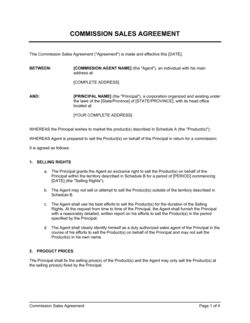
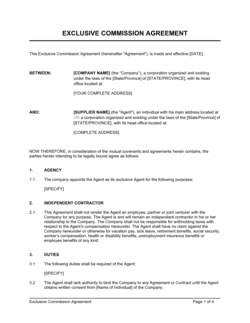
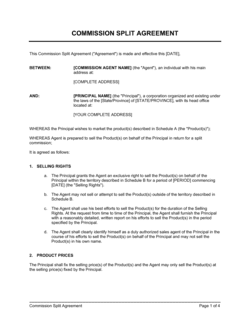
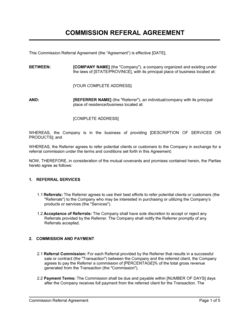
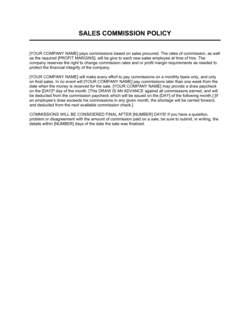
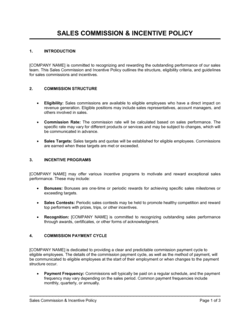
Commission Payment Agreement Template

Free Word download • Edit online • Save & share with Drive • Export to PDF

Learn more ↓
FreeCommission Payment Agreement Template

At a glance

What it is
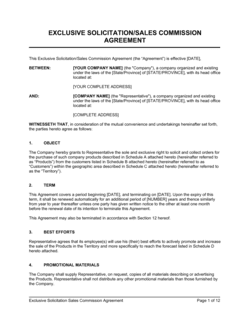
A Commission Payment Agreement is a legally binding contract between a company and an individual or entity — such as a sales representative, independent agent, or broker — that defines the exact terms under which commission-based compensation will be earned and paid. This free Word download covers commission rate structure, qualifying sales, payment triggers, clawback conditions, and termination in a single enforceable document.
When you need it
Use it whenever you engage a salesperson, referral partner, real estate agent, or any commission-earning party whose compensation depends on closed deals, transactions, or introductions rather than a fixed salary. It is equally necessary when restructuring an existing commission plan to avoid disputes about past verbal or informal arrangements.
What's inside
Parties and engagement type, commission rate and calculation method, qualifying events and eligible transactions, payment schedule and currency, clawback and chargeback provisions, non-solicitation and confidentiality obligations, term and termination clauses, and governing law.

What is a Commission Payment Agreement?

A Commission Payment Agreement is a legally binding contract between a company and a commission-earning party — typically a sales representative, broker, referral partner, or independent agent — that defines exactly how compensation is calculated, triggered, and paid in exchange for generating sales or introductions. It establishes the commission rate and base, identifies which transactions qualify, sets the payment schedule, and specifies what happens to earned and pending commissions when the relationship ends. Unlike a general independent contractor agreement, this document focuses specifically on the financial mechanics of performance-based compensation, leaving no material term to inference or verbal understanding.

Why You Need This Document

Without a written commission payment agreement, every commission dispute defaults to a he-said-she-said contest decided by whichever jurisdiction's courts or labor agencies have authority — and in most of them, the defaults favor the representative. A representative who closes a deal one day before you terminate them may claim commissions on the entire downstream pipeline. A customer who cancels two months after close may leave you having paid a full commission on revenue you never collected, with no contractual basis for recovery. More than a dozen US states, every Canadian province, and the entire EU impose statutory commission protections that apply even when there is no written agreement — but those protections work against you when the terms are undefined. A signed commission payment agreement, executed before the representative makes their first call, fixes the rate, the base, the clawback window, and the tail period so every payment and every dispute is resolved by reference to the document rather than by a labor board's default rules.

Which variant fits your situation?

If your situation is…Use this template
Engaging a full-time employee whose pay includes a commission componentEmployment Contract with Commission
Paying a referral fee to a third party for a warm introductionReferral Fee Agreement
Engaging an independent contractor to sell on your behalfIndependent Contractor Agreement
Appointing an exclusive sales agent for a territory or product lineSales Agency Agreement
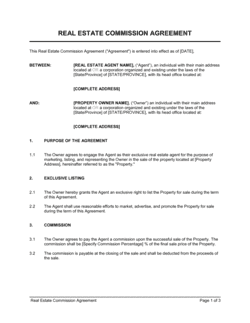
Structuring a real estate agent commission split with a brokerageReal Estate Commission Agreement
Setting commission terms for an affiliate or online referral partnerAffiliate Agreement
Documenting a one-time broker fee for a specific closed transactionFinder's Fee Agreement

Common mistakes to avoid

❌ Defining commission on 'revenue' without specifying gross or net

Why it matters: Whether the commission base includes shipping, taxes, discounts, and returns can mean a 15–30% difference in the actual payout per deal — a gap that compounds quickly across a full sales pipeline.

Fix: Define 'commission base' as a standalone term in the definitions section, listing every deduction explicitly so both parties calculate from the same number.

❌ Granting territorial exclusivity without a minimum quota

Why it matters: An exclusive representative who underperforms blocks the company from selling in that territory or to those accounts with no contractual remedy short of termination.

Fix: Attach a quota schedule with a cure period — if the representative misses target for two consecutive quarters, exclusivity converts to non-exclusive automatically.

❌ No tail period clause

Why it matters: A representative who spent six months developing a deal that closes two weeks after termination has a strong claim to that commission — and courts in several jurisdictions will imply a reasonable tail period if the contract is silent.

Fix: Include an explicit tail period of 60–90 days, conditioned on the representative submitting a written pipeline report at the time of termination.

❌ Using an at-will contractor label while controlling how the work is done

Why it matters: Directing when, where, and how a commission-only representative works is a hallmark of employment in most jurisdictions. Misclassification triggers retroactive payroll taxes, benefits liability, and employment law protection claims.

Fix: Limit the agreement to results — closed deals, revenue generated — without specifying daily schedules, required scripts, or mandatory office attendance.

❌ No clawback clause for cancelled or refunded transactions

Why it matters: Without a clawback, the company pays commission on revenue it never collects, and the representative faces no incentive to qualify customers carefully for financial health or fit.

Fix: Add a clawback window aligned with your standard refund or cancellation policy — 60 to 120 days from payment — with a clear recovery mechanism.

❌ Auto-renewal with no termination notice reminder

Why it matters: Commission agreements that renew automatically for successive annual terms can lock the company into an outdated commission structure for years if no one tracks the notice deadline.

Fix: Set a calendar reminder 60 days before the renewal date each year, and include a mutual non-renewal right with a 30-day notice period.

The 10 key clauses, explained

Parties and relationship type

In plain language: Identifies the company and the commission-earning party by their full legal names and clarifies whether the relationship is employment, independent contractor, or agent.

Sample language
This Commission Payment Agreement is entered into as of [DATE] between [COMPANY LEGAL NAME], a [STATE/COUNTRY] [ENTITY TYPE] ('Company'), and [REPRESENTATIVE FULL NAME / ENTITY NAME] ('Representative'). The parties agree that Representative is an independent contractor and not an employee of the Company.

Common mistake: Labeling someone an independent contractor in the agreement while exercising day-to-day control over how they work. Courts look past contract labels — misclassification triggers payroll tax liability, benefit obligations, and employment law protections.

Scope of appointment and territory

In plain language: Defines which products or services the representative is authorized to sell, the geographic or account territory they cover, and whether the appointment is exclusive or non-exclusive.

Sample language
Company appoints Representative on a [exclusive / non-exclusive] basis to solicit orders for [PRODUCTS / SERVICES] within the territory of [GEOGRAPHIC AREA / NAMED ACCOUNTS] ('Territory'). Representative shall not solicit sales outside the Territory without prior written consent.

Common mistake: Granting exclusivity without a minimum performance requirement. An exclusive representative who misses quota blocks the company from selling in that territory with no remedy.

Commission rate and calculation method

In plain language: States the exact percentage or flat fee earned per qualifying transaction, defines the commission base (gross revenue, net revenue, or gross profit), and specifies any tiered or accelerator structure.

Sample language
Company shall pay Representative a commission of [X]% of the Net Revenue received from each Qualifying Transaction. 'Net Revenue' means gross invoice amount less returns, allowances, and applicable taxes. Commission accelerates to [Y]% on cumulative Net Revenue exceeding $[THRESHOLD] in a calendar quarter.

Common mistake: Defining commission on 'revenue' without specifying whether it is gross or net. A dispute over whether shipping, taxes, or discounts are deducted can represent thousands of dollars per deal.

Qualifying transactions and exclusions

In plain language: Lists which deals, customers, and transaction types are eligible for commission, and explicitly carves out house accounts, government bids, or transactions the company originated directly.

Sample language
A 'Qualifying Transaction' means a sale to a new customer introduced by Representative and closed during the Term. The following transactions are excluded: (a) sales to accounts listed in Schedule A ('House Accounts'); (b) government or public-sector contracts; (c) renewals of existing agreements not actively renegotiated by Representative.

Common mistake: Leaving house accounts undefined or unlisted. If the company can retroactively designate any account as a house account after Representative has worked it, the clause becomes a mechanism to avoid paying legitimate commissions.

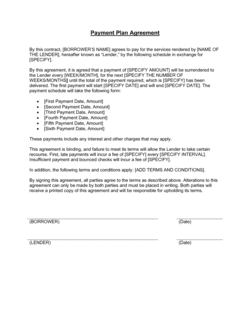
Payment schedule and currency

In plain language: Sets the payment frequency (monthly, quarterly), the date by which each payment must be made, the currency, and the documentation — such as a commission statement — that accompanies each payment.

Sample language
Commissions earned on Qualifying Transactions for which Company has received payment shall be calculated and paid within [30] days after the end of each calendar month, accompanied by a written commission statement. All payments shall be made in [USD / CAD / GBP / EUR].

Common mistake: Tying the payment trigger to invoice date rather than cash receipt date, then failing to add a backstop. If the customer never pays, the rep may still argue the commission was earned on invoice.

Clawback and chargeback provisions

In plain language: Grants the company the right to recover or offset commissions already paid if a customer cancels within a defined window, defaults on payment, or a transaction is reversed, and states how recovery is effected.

Sample language
If a customer cancels a Qualifying Transaction or defaults on payment within [90] days of the commission payment date, Company may deduct the corresponding commission from Representative's next scheduled payment. If no future payment is due, Representative shall repay the clawed-back amount within [30] days of written notice.

Common mistake: No clawback period at all. Without one, the company bears the full credit risk on every deal while the representative has no incentive to qualify customers for financial health.

Term, renewal, and termination

In plain language: States the initial contract term, automatic renewal conditions, notice required to terminate, and whether termination affects commissions on deals already in the pipeline.

Sample language
This Agreement commences on [START DATE] and continues for [12] months, renewing automatically for successive [12]-month terms unless either party provides [30] days' written notice of non-renewal. Either party may terminate for cause immediately upon written notice. Termination does not affect commissions on Qualifying Transactions closed before the termination date.

Common mistake: Auto-renewal clauses with no cap on renewal periods and no notice reminder mechanism. Companies have been held to commission structures they considered abandoned years earlier because neither party sent a termination notice.

Tail period for post-termination commissions

In plain language: Defines whether — and for how long — the representative is entitled to commissions on deals they sourced before termination that close after the agreement ends.

Sample language
For [90] days following termination of this Agreement ('Tail Period'), Representative shall be entitled to commissions at the rates set out in Section [X] on Qualifying Transactions sourced by Representative prior to termination and closed by Company during the Tail Period, as evidenced by Representative's written pipeline report submitted within [10] days of termination.

Common mistake: No tail period clause at all. A representative who invested months developing a deal that closes one week after termination has a strong moral and sometimes legal claim. Documenting the tail period in advance prevents expensive disputes.

Confidentiality and non-solicitation

In plain language: Prohibits the representative from disclosing the company's pricing, customer lists, and sales data, and restricts post-termination solicitation of the company's clients and employees.

Sample language
Representative shall not disclose Confidential Information to any third party during or after the Term. For [12] months following termination, Representative shall not solicit any customer or prospect listed in Schedule B, or recruit any employee or contractor of the Company.

Common mistake: Combining confidentiality and non-solicitation in a single overbroad clause without defining 'Confidential Information.' Courts may void the entire clause as too vague, leaving the company with no protection on either front.

Governing law and dispute resolution

In plain language: Specifies which jurisdiction's law governs the agreement and how disputes are resolved — litigation, arbitration, or mediation — and where proceedings take place.

Sample language
This Agreement shall be governed by the laws of [STATE / PROVINCE / COUNTRY]. Any dispute arising under this Agreement shall be submitted to binding arbitration administered by [AAA / JAMS / ADR BODY] in [CITY], except that either party may seek injunctive relief in a court of competent jurisdiction.

Common mistake: Choosing a governing law that has no connection to where the representative operates. Several US states and EU member countries apply local commission protection statutes regardless of the governing law clause — and these protections cannot be contracted away.

How to fill it out

  1. 1

    Identify the parties and their legal relationship

    Enter the full registered legal name of the company and the representative's full legal name or entity name. Clearly state whether the representative is an independent contractor or employee, and confirm the classification is consistent with how work is actually performed.

    💡 Run a worker-classification checklist for the jurisdiction before finalizing the relationship type — the label in the contract does not override economic reality.

  2. 2

    Define the territory and scope of appointment

    Specify the exact geographic area, named accounts, or product lines the representative is authorized to sell. Decide whether the appointment is exclusive or non-exclusive, and if exclusive, include a minimum sales quota that activates or maintains exclusivity.

    💡 Attach a Schedule A listing all house accounts and pre-existing customers excluded from the representative's territory to prevent future disputes.

  3. 3

    Set the commission rate, base, and any tiers

    Enter the exact percentage and define the commission base — gross revenue, net revenue, or gross profit — with a clear definition of each deduction. If using a tiered structure, state the thresholds and accelerator rates explicitly.

    💡 State the commission base definition in a standalone defined term so it cannot be interpreted differently from year to year as pricing models change.

  4. 4

    List qualifying transactions and exclusions

    Describe what constitutes a qualifying sale — new customer, specific product category, minimum deal size — and enumerate all exclusions such as house accounts, government contracts, and direct-sourced deals.

    💡 If your business has a significant government or enterprise pipeline, list those accounts by name in a schedule rather than by category — it removes ambiguity.

  5. 5

    Set the payment schedule and documentation requirements

    Choose a payment frequency (monthly is most common), set the payment date relative to period-end, specify the currency, and require a written commission statement accompanying each payment.

    💡 Require the representative to flag disputed line items within 30 days of receiving the commission statement — a formal dispute window prevents years-old claims from surfacing.

  6. 6

    Draft the clawback and chargeback terms

    Set a clawback window — typically 60 to 120 days from payment — for cancelled or defaulted transactions. Specify whether recovery is by deduction from future payments or direct repayment, and whether the clawback applies to all terminations or only fraud and misconduct.

    💡 A 90-day clawback window aligned with your refund or cancellation policy keeps the mechanic fair and defensible.

  7. 7

    Define the tail period

    Specify how long after termination the representative can earn commissions on pipeline deals they sourced. Require the representative to submit a written pipeline report within a fixed window of termination as the basis for tail-period claims.

    💡 A 60–90 day tail period with a documented pipeline requirement strikes the right balance — long enough to be fair, short enough to be manageable.

  8. 8

    Execute before the representative begins selling

    Both parties must sign the agreement before the representative contacts any prospect on the company's behalf. Post-start signatures raise fresh-consideration issues and may void restrictive covenants.

    💡 Use electronic signature with timestamping so you have a dated, authenticated execution record if a commission dispute goes to arbitration.

Frequently asked questions

What is a commission payment agreement?

A commission payment agreement is a binding contract between a company and a sales representative, agent, or broker that specifies exactly how commission-based compensation is earned, calculated, and paid. It defines the qualifying events that trigger a commission, the rate and base used to calculate it, the payment schedule, and what happens to commissions when the agreement ends. Without one, commission disputes are resolved by courts applying jurisdiction-specific defaults — which often favor the representative.

Is a commission agreement legally binding?

Yes — a commission payment agreement is generally enforceable as a binding contract when it contains an offer, acceptance, and consideration (the commission itself), is signed by both parties, and does not violate applicable law. Many US states, Canadian provinces, and EU member countries have specific commission protection statutes that impose minimum requirements regardless of what the contract says. Consider having legal counsel review the agreement for the jurisdiction where the representative operates.

What should a commission payment agreement include?

At minimum: identification of both parties and their legal relationship (employee vs. independent contractor), the territory or scope of appointment, commission rate and the base it is calculated on, qualifying transaction definitions and exclusions, payment schedule and currency, clawback or chargeback provisions, a tail period for post-termination pipeline deals, confidentiality and non-solicitation terms, and governing law. Missing any of these creates gaps that courts fill with defaults usually more favorable to the representative.

What is the difference between a commission agreement and an independent contractor agreement?

An independent contractor agreement governs the broader working relationship — scope of services, IP ownership, confidentiality, and termination — without necessarily specifying commission-based pay. A commission payment agreement focuses specifically on how compensation is earned and paid. For a commission-only sales representative, you typically need both documents, or a single agreement that covers all the relevant terms comprehensively.

What is a clawback clause in a commission agreement?

A clawback clause allows the company to recover commissions already paid if the underlying transaction is later cancelled, refunded, or the customer defaults within a defined window — typically 60 to 120 days. It aligns the representative's incentive with customer quality, not just deal volume. Without one, the company bears the full credit risk while the representative has no financial stake in whether the deal actually sticks.

What is a tail period in a commission agreement?

A tail period is a defined window after termination — typically 60 to 90 days — during which the representative remains entitled to commissions on deals they sourced before the agreement ended but that close afterward. It is a fairness provision that prevents the company from terminating a representative just before a large deal closes to avoid paying the commission. Requiring a written pipeline report at termination defines exactly which deals are eligible.

Can a commission agreement be used for both employees and contractors?

The commission payment terms can be similar, but the legal framing must differ. For employees, commission terms are typically embedded in or attached to an employment contract, and minimum wage, overtime, and employment standards obligations apply. For independent contractors, the commission agreement stands alone, but misclassification risk is high if the company controls how the work is performed. Use the correct template variant for each relationship type.

What happens to unpaid commissions when a commission agreement is terminated?

In most jurisdictions, commissions that were fully earned before termination — meaning the qualifying event occurred and any conditions were met — must be paid regardless of termination. Several US states (California, Illinois, and New York among them) have specific statutes requiring payment of earned commissions at termination and imposing penalties for non-payment. A well-drafted tail period clause in the agreement clarifies pipeline deal treatment and reduces the scope of disputes at termination.

Do I need a lawyer to draft a commission payment agreement?

For straightforward domestic arrangements with a single sales representative, a high-quality template is typically sufficient. Engage a lawyer when the representative earns commissions across multiple US states or internationally, when commission amounts are large enough to motivate litigation, when the role involves sensitive competitive information requiring enforceable non-competes, or when the employment versus contractor classification is genuinely complex. A targeted review typically costs $300–$700 and is worthwhile for high-volume or high-value commission relationships.

How this compares to alternatives

vs Independent Contractor Agreement

An independent contractor agreement governs the broader working relationship — scope of services, deliverables, IP ownership, and confidentiality — without specifying commission-based pay in detail. A commission payment agreement focuses specifically on how earnings are calculated, triggered, and paid. For a commission-only sales rep, you typically need both documents or a single agreement covering all terms.

vs Sales Representative Agreement

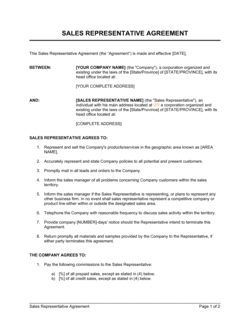
A sales representative agreement appoints a representative to a territory or product line and governs the conduct of the sales relationship — exclusivity, marketing obligations, reporting, and compliance. A commission payment agreement focuses narrowly on the financial mechanics of compensation. The two are complementary; larger engagements typically use both.

vs Referral Fee Agreement

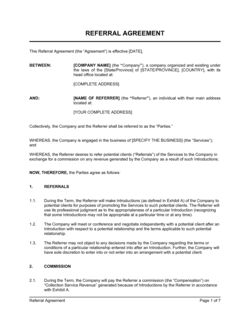
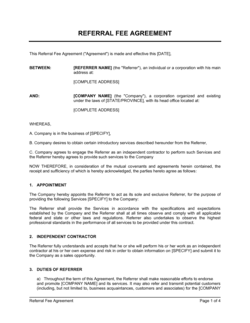
A referral fee agreement covers a one-time or per-introduction flat fee or percentage paid to a third party for a warm lead or introduction. It does not create an ongoing sales appointment, territory, or residual commission structure. Use a referral fee agreement for passive introducer relationships; use a commission payment agreement for active selling arrangements.

vs Finder's Fee Agreement

A finder's fee agreement documents a single-transaction fee paid to a party who identifies a specific deal — an acquisition target, a key customer, or a financing source — without an ongoing sales role. A commission payment agreement governs a continuing relationship with recurring qualifying transactions, rate tiers, clawbacks, and a tail period. Use a finder's fee agreement for one-off deal introductions.

Industry-specific considerations

Technology / SaaS

Residual commissions on recurring MRR, clawback aligned to churn window, accelerators tied to ARR quota, and spiff structures for upsells and expansions.

Real estate

Co-broker splits, referral fee percentages on closed transactions, holdback for escrow completion, and state-mandated written commission disclosure requirements.

Financial services

Regulatory licensing prerequisites for commission-earning agents, trailing commissions on assets under management, and compliance with FINRA or FCA rules on fee disclosure.

Staffing and recruitment

Placement fee as a percentage of first-year salary, guarantee and replacement periods that trigger chargebacks, and split-fee arrangements between internal and external recruiters.

Manufacturing and wholesale

Territory-based exclusive appointments with minimum order commitments, commission on net shipments rather than invoices, and multi-tier channel partner rates.

Professional services

Referral commissions paid to introducing advisors or consultants, milestone-linked payments tied to project kickoff or invoice collection, and non-solicitation of referred clients.

Jurisdictional notes

United States

More than a dozen US states have specific sales commission protection statutes. California, Illinois, and New York require that commission agreements with employees be in writing and that earned commissions be paid at termination. California additionally restricts non-solicitation clauses and bans most post-employment non-competes. Independent contractor classification is scrutinized under both the ABC test (California, New Jersey) and the IRS common-law test — the contract label alone does not determine status.

Canada

Provincial employment standards legislation in Ontario, British Columbia, and Quebec imposes minimum protections for commission-earning employees regardless of contract terms, including payment of earned commissions on termination. At-will employment does not exist in Canada — even commission-only agents engage under implied notice obligations. Quebec contracts must be in French for provincially-regulated employers. Non-solicitation clauses are enforceable only if reasonable in scope and duration.

United Kingdom

The Commercial Agents (Council Directive) Regulations 1993 grant self-employed commercial agents significant protections — including mandatory compensation or indemnity on termination — that cannot be excluded by contract. Commission agreement drafters must assess whether the representative qualifies as a 'commercial agent' under the Regulations before excluding these rights. Workers misclassified as self-employed may also claim 'worker' status and access to holiday pay, which can include a commission component.

European Union

The EU Commercial Agents Directive (86/653/EEC), implemented in all member states, requires written commission agreements on request and grants agents the right to an indemnity or compensation on termination — a right that cannot be waived in advance in most member states. Several countries (Germany, France, and Spain) impose additional requirements, including minimum notice periods scaled to agent tenure. Post-termination non-competes generally require financial compensation to the agent, typically 50–100% of average commission for the restriction period.

Template vs lawyer — what fits your deal?

PathBest forCostTime
Use the templateSingle domestic sales representative or referral partner with a straightforward flat commission rateFree30 minutes
Template + legal reviewMulti-state or international representatives, tiered or residual commission structures, or roles with non-compete requirements$300–$7002–4 days
Custom draftedExecutive-level sales leaders with equity-linked commissions, regulated industries (financial services, real estate), or large commission exposure requiring bespoke clawback and arbitration terms$1,500–$5,000+1–3 weeks

Glossary

Commission Rate
The percentage of a sale price, deal value, or gross margin that the agent or representative earns upon meeting a qualifying trigger.
Commission Base
The dollar amount to which the commission rate is applied — typically gross revenue, net revenue, gross profit, or contract value.
Qualifying Event
The specific action or milestone — such as a signed contract, cash receipt, or deal close — that triggers the right to earn a commission.
Clawback
A contractual right allowing the company to recover previously paid commissions if a customer cancels, defaults, or a deal is reversed within a defined period.
Draw Against Commission
An advance payment to a sales rep drawn against future commissions earned, which must be repaid if commissions do not cover the advance.
Residual Commission
Ongoing commission payments earned each period that a previously closed account continues to generate revenue — common in SaaS and insurance sales.
Chargeback
A deduction from future commission payments to recover amounts already paid on transactions that were later cancelled, refunded, or downgraded.
Tail Period
A defined window after contract termination during which the representative remains entitled to commissions on deals they sourced or introduced before termination.
Tiered Commission
A structure that increases the commission rate as the representative's cumulative sales volume crosses defined thresholds within a period.
Non-Solicitation Clause
A post-termination restriction preventing the former representative from soliciting the company's customers or employees for a defined period.
Quota
A minimum sales target that must be met for the full commission rate to apply or for accelerator rates to activate.

Part of your Business Operating System

This document is one of 3,000+ business & legal templates included in Business in a Box.

  • Fill-in-the-blanks — ready in minutes
  • 100% customizable Word document
  • Compatible with all office suites
  • Export to PDF and share electronically

Create your document in 3 simple steps.

From template to signed document — all inside one Business Operating System.
1
Download or open template

Access over 3,000+ business and legal templates for any business task, project or initiative.

2
Edit and fill in the blanks with AI

Customize your ready-made business document template and save it in the cloud.

3
Save, Share, Send, Sign

Share your files and folders with your team. Create a space of seamless collaboration.

Save time, save money, and create top-quality documents.

★★★★★

"Fantastic value! I'm not sure how I'd do without it. It's worth its weight in gold and paid back for itself many times."

Managing Director · Mall Farm
Robert Whalley
Managing Director, Mall Farm Proprietary Limited
★★★★★

"I have been using Business in a Box for years. It has been the most useful source of templates I have encountered. I recommend it to anyone."

Business Owner · 4+ years
Dr Michael John Freestone
Business Owner
★★★★★

"It has been a life saver so many times I have lost count. Business in a Box has saved me so much time and as you know, time is money."

Owner · Upstate Web
David G. Moore Jr.
Owner, Upstate Web

Run your business with a system — not scattered tools

Stop downloading documents. Start operating with clarity. Business in a Box gives you the Business Operating System used by over 250,000 companies worldwide to structure, run, and grow their business.

Free Forever Plan · No credit card required