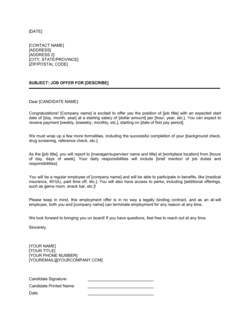
Compensation and Benefits Manager Job Description Template

Free Word download • Edit online • Save & share with Drive • Export to PDF

2 pages20–30 min to fillDifficulty: StandardSignature requiredLegal review recommended
Learn more ↓
FreeCompensation and Benefits Manager Job Description Template

At a glance

What it is
A Compensation and Benefits Manager Job Description is a formal document that defines the scope, duties, qualifications, reporting structure, and performance expectations for a professional who designs and administers an organization's pay structures, incentive programs, and employee benefits plans. This free Word download gives you a structured, editable starting point you can tailor to your organization's size and industry, then export as PDF for job postings, offer letters, or employment file documentation.
When you need it
Use it when creating a new compensation and benefits role, backfilling a vacancy, or auditing an existing job description against current regulatory requirements and market benchmarks. It is also needed when attaching formal scope-of-role documentation to an employment contract or offer letter.
What's inside
Role summary and reporting line, core duties covering job evaluation, salary benchmarking, benefits administration, and compliance, required and preferred qualifications, key performance indicators, travel and physical requirements, and an acknowledgment signature block.

What is a Compensation and Benefits Manager Job Description?

A Compensation and Benefits Manager Job Description is a formal document that defines the duties, qualifications, reporting structure, compliance obligations, and performance expectations for the professional responsible for designing and administering an organization's pay programs and employee benefits plans. It functions both as an internal scope-of-role document — attached to an employment contract or offer letter — and as a public-facing job posting that signals to candidates the depth and regulatory complexity of the position. A well-drafted job description also creates the documentary foundation needed to support an FLSA administrative exemption classification, defend pay-band placement, and conduct meaningful performance reviews.

Why You Need This Document

Without a written, signed job description, organizations face compounding exposure across three areas simultaneously. First, an undocumented or vague description of duties weakens the FLSA administrative exemption defense for a role that is almost certainly classified as exempt — one successful misclassification claim can trigger back overtime pay, penalties, and class-action risk. Second, compensation and benefits managers carry significant regulatory responsibility — ERISA filings, ACA reporting, pay-equity analyses, and open-enrollment compliance — and if those obligations are not formally assigned in writing, ownership gaps emerge exactly when a regulatory deadline or audit arrives. Third, the absence of documented performance standards makes it nearly impossible to manage underperformance or support a for-cause termination in a role with this much financial and legal exposure. This template gives you a structured, jurisdiction-aware starting point that covers duty scope, qualification thresholds, measurable KPIs, and a signed acknowledgment block — turning a generic posting into an operational and legal asset from day one.

Which variant fits your situation?

If your situation is…Use this template
Hiring a senior leader overseeing the full total-rewards functionTotal Rewards Director Job Description
Creating an entry-level analyst role to support the compensation functionCompensation Analyst Job Description
Defining a standalone benefits administrator with no compensation scopeBenefits Administrator Job Description
Posting a generalist HR role that includes some compensation dutiesHR Manager Job Description
Attaching the job description to a formal employment agreementEmployment Contract
Documenting a contract or consulting engagement for a compensation consultantIndependent Contractor Agreement
Onboarding the hired candidate once the role is filledEmployee Onboarding Checklist

Common mistakes to avoid

❌ Writing duties too broadly to support FLSA exemption

Why it matters: The FLSA administrative exemption requires that the primary duty involve office work directly related to management or general business operations with the exercise of discretion and independent judgment. Vague duties like 'supports HR programs' may not meet the test, exposing the company to overtime claims.

Fix: Describe specific decision-making authority — e.g., 'makes final recommendations on pay-band adjustments up to $[X]' — to document that the role meets the discretion and independent judgment standard.

❌ Omitting jurisdiction-specific compliance obligations

Why it matters: A job description that lists only federal US compliance duties for a company with employees in California, New York, Ontario, or the UK leaves a documented gap in role ownership for state, provincial, and local reporting requirements.

Fix: Audit every jurisdiction where the company employs people and add the applicable statutes — pay-transparency, pay-equity, pension enrollment, and gender pay-gap reporting — to the compliance clause.

❌ No acknowledgment signature block

Why it matters: Without a signed acknowledgment, the company cannot prove the employee received and understood their duties, which complicates performance management, disciplinary action, and FLSA exemption defense.

Fix: Add a signature block to every job description and obtain signed copies before or on the employee's first day. File originals in the personnel record.

❌ Using implied employment-contract language in the description

Why it matters: Phrases like 'this role will always include' or 'duties are permanently assigned' have been read by courts in some jurisdictions as creating an implied contract of indefinite employment or fixed scope, restricting the employer's ability to modify the role.

Fix: Include an explicit disclaimer: 'This job description does not constitute a contract of employment and may be modified at the Company's discretion to reflect changing business needs.'

❌ Setting qualifications that cannot be defended as job-related

Why it matters: Requiring a specific degree or years of experience beyond what the role genuinely demands can create disparate-impact liability under Title VII and equivalent laws if the requirements disproportionately screen out protected groups.

Fix: Tie each qualification threshold to a documented business necessity. If a four-year degree is preferred but not operationally required, list it as preferred — not required.

❌ Failing to distinguish between compensation and benefits scope

Why it matters: When one clause blends both functions without specificity, organizations struggle to reclassify the role, split it into two positions, or accurately benchmark it against market data — leading to pay inequity for the role itself.

Fix: Use separate duty clauses for compensation design and benefits administration so the scope of each function is clear and can be updated independently.

The 10 key clauses, explained

Role Summary and Reporting Structure

In plain language: Defines the purpose of the position in two to four sentences, states the department it sits within, and identifies the direct supervisor by title.

Sample language
The Compensation and Benefits Manager reports to the [VP OF HUMAN RESOURCES / CHRO] and is responsible for designing, implementing, and administering [COMPANY NAME]'s total-rewards programs for approximately [NUMBER] employees across [NUMBER] locations.

Common mistake: Listing the hiring manager's name instead of the title in the reporting line. Names become outdated immediately after an org change, creating a document that must be amended every time leadership turns over.

Core Duties — Compensation Design and Administration

In plain language: Enumerates the primary compensation responsibilities: job evaluation, pay-band design, salary benchmarking, merit-cycle administration, and incentive-plan modeling.

Sample language
Conduct annual salary benchmarking using [SURVEY SOURCES] and recommend adjustments to pay bands to maintain [PERCENTILE] market positioning. Administer the annual merit increase cycle for [NUMBER] employees, ensuring compliance with budget parameters of [X]%.

Common mistake: Writing duties at such a high level — 'manages compensation programs' — that the description cannot be used for performance evaluation or FLSA exemption analysis.

Core Duties — Benefits Design and Administration

In plain language: Covers the benefits-specific responsibilities: plan design, open enrollment, vendor management, cost analysis, and compliance reporting.

Sample language
Manage relationships with benefits brokers and carriers including [VENDOR NAMES / TYPES]. Lead annual open-enrollment process for [HEALTH / DENTAL / VISION / 401(K)] plans, coordinating employee communications and system updates in [HRIS PLATFORM].

Common mistake: Combining compensation and benefits duties into a single vague bullet. When the role becomes purely one or the other, a combined clause makes reclassification or scope adjustment much harder.

Compliance and Regulatory Obligations

In plain language: Specifies the laws and reporting obligations the role owner is responsible for monitoring and meeting, including ERISA, ACA, FLSA, and state or provincial equivalents.

Sample language
Ensure compensation and benefits programs comply with applicable federal and state law, including FLSA, ERISA, ACA, COBRA, and [STATE]-specific leave and pay-equity statutes. Prepare and file required regulatory reports including Form 5500, ACA 1094/1095, and [OTHER REPORTS].

Common mistake: Omitting jurisdiction-specific compliance obligations when the company operates in multiple states or countries. A generic federal-only compliance clause exposes the company to unmanaged state and local risk.

Data Analysis and Reporting

In plain language: Describes the analytical responsibilities: modeling compensation scenarios, producing regular pay-equity analyses, and generating metrics reports for HR leadership and the board.

Sample language
Develop and maintain compensation and benefits analytics dashboards in [HRIS / BI TOOL], delivering monthly reports on compa-ratios, benefits cost per employee, and incentive payout variance to [CHRO / CFO / COMPENSATION COMMITTEE].

Common mistake: Leaving data and reporting duties out entirely. Without this clause, ownership of pay-equity reporting and compensation disclosures — increasingly required by regulation — is unassigned.

HRIS and Systems Management

In plain language: States the role's responsibility for configuring, maintaining, and auditing compensation and benefits data within the organization's HR information system.

Sample language
Maintain compensation and benefits configuration in [HRIS PLATFORM — e.g., Workday, ADP, SAP SuccessFactors], including pay-grade tables, benefit-plan setup, and eligibility rules. Audit system data quarterly to ensure accuracy.

Common mistake: Not specifying which HRIS platform is in scope. When the role changes hands, a new hire has no documented system responsibility, leading to configuration drift and audit failures.

Required Qualifications

In plain language: Lists the minimum education, experience, certifications, and technical skills a candidate must have to perform the role — used for screening, FLSA exemption support, and pay-band placement.

Sample language
Bachelor's degree in Human Resources, Business Administration, Finance, or a related field. Minimum [5] years of progressive compensation and benefits experience, including [2] years in a management or lead role. Proficiency in [EXCEL / HRIS PLATFORM]. [CCP or CEBS certification preferred / required].

Common mistake: Setting qualification thresholds so high that the role inadvertently screens out protected classes without a demonstrated business necessity — creating disparate-impact exposure under Title VII and equivalent laws.

Performance Standards and KPIs

In plain language: Identifies the measurable outcomes — benchmarking cycle completion dates, open-enrollment error rates, benefits cost targets — against which the role holder will be evaluated.

Sample language
Annual benchmarking analysis completed by [MONTH] each year. Open-enrollment error rate below [X]%. Benefits cost per employee maintained within [X]% of prior-year budget. Pay-equity gap remediated to within [X]% unexplained variance by [DATE].

Common mistake: Including no measurable KPIs at all. A job description without performance standards cannot support a performance-improvement plan or a for-cause termination if the role is underperforming.

Physical Requirements and Work Conditions

In plain language: Describes the physical demands and work environment — sedentary, hybrid, travel percentage — required to perform the role, which is necessary for ADA compliance in the US and equivalent laws elsewhere.

Sample language
This position is primarily sedentary, requiring the ability to sit for extended periods and operate standard office equipment. Travel required up to [X]% annually for benefits broker meetings and multi-site HR initiatives. Hybrid schedule: [X] days on-site per week at [LOCATION].

Common mistake: Skipping physical requirements entirely for office-based roles. Under the ADA and equivalent laws, the absence of documented physical requirements can complicate reasonable-accommodation determinations.

Acknowledgment and Signature Block

In plain language: A signature line where both the employee and a company representative confirm the employee has received, read, and understood the job description — creating a record of mutual acknowledgment.

Sample language
I acknowledge that I have received, read, and understood this job description. I understand that this document does not constitute a contract of employment and that duties may be modified by [COMPANY NAME] at its sole discretion. Employee Signature: _______________ Date: _______________ Manager Signature: _______________ Date: _______________

Common mistake: Including language that reads as a guarantee of continued employment. Phrases like 'this role will be maintained' or 'duties are fixed' can be read as an implied employment contract in some jurisdictions.

How to fill it out

  1. 1

    Enter the company name, department, and reporting line

    Replace all [COMPANY NAME] placeholders with your registered legal entity name. Confirm the department (typically HR or People Operations) and the title — not name — of the direct supervisor.

    💡 Use the supervisor's job title, not their name. Titles remain accurate through personnel changes; names become stale the moment someone is promoted or leaves.

  2. 2

    Define the compensation scope for this specific role

    Specify whether the role covers only base pay, or also short-term incentives, equity, and long-term incentive plans. Enter the approximate employee headcount and number of locations the manager will support.

    💡 Narrowing scope to what the role actually owns — rather than listing every possible compensation task — makes the document usable for FLSA exemption analysis and performance management.

  3. 3

    List the benefits programs in scope

    Name the specific plans the manager will administer: health, dental, vision, life, disability, FSA, HSA, 401(k) or pension, and any supplemental or voluntary programs. Include the HRIS and broker or carrier names.

    💡 If the organization uses a benefits broker, name the broker relationship as an explicit duty. Broker management is a significant workload that surprises new hires if undocumented.

  4. 4

    Complete the compliance obligations section

    Review which federal, state or provincial, and local laws apply to your workforce. Add any jurisdiction-specific statutes — California pay-transparency law, Ontario pay-equity legislation, UK gender pay-gap reporting — to the compliance clause.

    💡 Run the compliance list past your employment counsel before publishing. A clause that omits a required reporting obligation creates documented proof that the duty was never assigned.

  5. 5

    Set the required qualifications and certifications

    Enter minimum years of experience, degree requirements, and any required or preferred certifications such as CCP (Certified Compensation Professional) or CEBS (Certified Employee Benefit Specialist). Confirm these thresholds are tied to genuine business requirements.

    💡 Distinguish clearly between 'required' and 'preferred' qualifications. Treating preferred items as screening criteria in practice — while listing them as preferred on paper — creates disparate-impact risk.

  6. 6

    Define measurable KPIs for the role

    Enter at least three to five specific, measurable performance standards: benchmarking cycle deadline, open-enrollment error rate threshold, benefits cost-per-employee target, and pay-equity gap tolerance.

    💡 KPIs written into the job description at hire become the baseline for the first performance review. Vague KPIs make that conversation difficult and can complicate performance-management documentation.

  7. 7

    Complete the physical requirements and work-schedule fields

    State whether the role is sedentary, hybrid, or on-site, the travel percentage, and any physical requirements needed for ADA documentation. Enter the primary work location.

    💡 For hybrid roles, specify the minimum on-site days per week rather than leaving it to 'as needed.' Ambiguity in schedule expectations is a leading cause of new-hire dissatisfaction within the first 90 days.

  8. 8

    Obtain signatures before or on the first day

    Have both the employee and the hiring manager sign the acknowledgment block before or on the employee's start date. File the signed copy in the employee's personnel record and store a digital copy in your HRIS.

    💡 Send the job description with the offer letter so the candidate reviews it before accepting — not after. Post-start signature without fresh consideration can weaken enforceability in some jurisdictions.

Frequently asked questions

What does a compensation and benefits manager do?

A compensation and benefits manager designs, administers, and audits an organization's pay structures, incentive programs, and employee benefits plans. Core responsibilities include annual salary benchmarking, pay-band maintenance, open-enrollment management, benefits vendor oversight, compliance reporting under ERISA and the ACA, and pay-equity analysis. The role typically reports to a VP of HR or CHRO and serves as the internal subject-matter expert on total-rewards strategy.

Why does a job description need a signature block?

A signed job description creates a documented record that the employee received, reviewed, and understood their duties and performance expectations before or at the start of employment. This record is material in three situations: supporting an FLSA administrative exemption classification, defending a performance-improvement plan or termination, and demonstrating that compliance duties were formally assigned. Without it, the company has no proof the employee was ever aware of their scope.

Is a job description legally binding?

A job description is generally not a contract of employment on its own, but it carries legal weight. Courts have used job description language to assess FLSA exemption status, ADA reasonable-accommodation obligations, and whether an employer had legitimate performance expectations. Including an explicit disclaimer — that the document does not constitute an employment contract and may be modified — is standard practice to limit implied-contract risk.

What certifications should a compensation and benefits manager have?

The Certified Compensation Professional (CCP) designation from WorldatWork is the most widely recognized credential for compensation practitioners. The Certified Employee Benefit Specialist (CEBS) from the International Foundation of Employee Benefit Plans covers the benefits side. For generalist total-rewards roles, either or both are commonly listed as preferred. SHRM-CP or SHRM-SCP credentials are relevant but more broadly HR-focused.

What is the difference between a compensation manager and a total rewards manager?

A compensation manager typically focuses on base pay, merit cycles, job evaluation, and incentive programs. A total rewards manager covers the full spectrum — compensation, benefits, recognition, well-being, and career-development programs — and usually operates at a higher organizational level with a broader strategic mandate. In smaller organizations, the two functions are combined into a single role; in larger enterprises, they may be separate departments.

How do FLSA exemption requirements affect how this job description is written?

To qualify for the FLSA administrative exemption — which most compensation and benefits manager roles rely on — the job description must document that the primary duty involves office or non-manual work directly related to management or general business operations, and that the role exercises discretion and independent judgment on significant matters. Vague duty statements that merely list tasks without capturing decision-making authority weaken the exemption defense. Specific language about recommending pay-band changes, approving vendor contracts, or making final benefits-design decisions strengthens it.

What laws should a compensation and benefits manager be responsible for monitoring?

In the US: FLSA (overtime and minimum wage), ERISA (retirement and health plan standards), ACA (employer mandate and reporting), COBRA (continuation coverage), HIPAA (health information privacy), and state-specific pay-transparency and pay-equity laws. In Canada: provincial Employment Standards Acts, the Pay Equity Act in Ontario and Quebec, and pension legislation. In the UK: the Equality Act 2010, gender pay-gap reporting regulations, and The Pensions Act. The specific list depends on the employer's jurisdictions and should be reviewed by employment counsel.

How often should a compensation and benefits manager job description be updated?

Review the job description annually, aligned to the compensation benchmarking and performance-review cycle. Update immediately when the role's scope changes materially — a new HRIS implementation, a significant headcount change, or entry into a new jurisdiction with different compliance requirements. An outdated job description that no longer reflects actual duties is a liability in both FLSA exemption defense and performance-management documentation.

Do I need a lawyer to finalize a job description?

For most standard domestic hires, a high-quality template is sufficient. Engage employment counsel when the role has FLSA exemption risk, when the company operates in multiple jurisdictions with distinct compliance obligations, when the job description will be attached to an executive employment agreement with significant severance exposure, or when the qualifications section needs a disparate-impact review. A 30-to-60-minute attorney review typically costs $150–$400 and is worthwhile for any senior HR role with significant regulatory responsibility.

How this compares to alternatives

vs HR Manager Job Description

An HR manager job description covers generalist responsibilities — recruitment, employee relations, performance management, and policy administration — with compensation and benefits as a secondary function. A compensation and benefits manager job description defines a specialist role focused exclusively on total-rewards strategy, pay-band management, and benefits compliance. Organizations with 150 or more employees typically split these functions; smaller organizations combine them under a generalist HR manager.

vs Employment Contract

An employment contract is the binding legal agreement governing the entire employment relationship — salary, IP assignment, non-compete, termination, and severance. A job description defines duties and qualifications and is typically attached as a schedule to the contract. The job description describes the role; the contract governs the relationship. Both are needed for senior hires, and the job description should always be incorporated by reference into the contract rather than duplicated.

vs Independent Contractor Agreement

An independent contractor agreement engages a self-employed compensation consultant on a project basis with no benefits entitlements, no FLSA obligations, and no employer tax withholding. A compensation and benefits manager job description defines a W-2 employee role with full employment obligations. Using a job description format for a contractor engagement — or misclassifying a manager as a contractor — triggers significant tax, benefit, and FLSA liability.

vs Job Offer Letter

A job offer letter summarizes the role, start date, compensation, and key conditions to secure candidate acceptance. It is not a comprehensive scope document. A job description provides the detailed duty and qualification framework that underpins the offer, supports FLSA classification, and governs performance management after hire. The two documents work together — the offer letter references the job description, which is delivered alongside it.

Industry-specific considerations

Technology / SaaS

Equity compensation plan administration, stock option vesting schedules, and global mobility benefits for distributed engineering teams are typically added to the core scope.

Healthcare

HIPAA-compliant benefits administration, credentialing pay differentials, and shift-differential and on-call compensation structures require explicit duty clauses beyond the standard template.

Financial Services

Incentive compensation clawback provisions, deferred compensation plan compliance under IRC 409A, and regulatory caps on bonus structures for certain licensed roles must be documented.

Manufacturing

Shift-differential pay structures, union-agreement benefit plan coordination, and multi-site open-enrollment logistics require specific operational duties beyond a single-location scope.

Retail / Hospitality

Tip credit rules, variable-schedule compensation, and high-volume seasonal open enrollment across hourly workforces create compliance and administrative duties distinct from a corporate environment.

Professional Services

Partner and non-partner compensation tier administration, billable-rate alignment with compensation bands, and professional development benefit budgets are commonly added to the scope.

Jurisdictional notes

United States

The job description must support the FLSA administrative exemption by documenting that the primary duty involves discretion and independent judgment on significant matters — vague duties risk misclassification and overtime liability. California, Colorado, New York, and Washington require pay ranges to be disclosed in job postings; omitting a salary range in those states creates a compliance violation before the hire is even made. State-specific pay-equity laws in California, Illinois, and Massachusetts may also require the role to conduct and document annual pay-equity analyses.

Canada

Ontario's Pay Equity Act imposes proactive pay-equity obligations on employers with 10 or more employees — the job description should explicitly assign pay-equity plan maintenance as a duty for Ontario-based roles. Quebec requires workplace documents to be in French for provincially regulated employers. British Columbia and Alberta have specific Employment Standards Act provisions affecting benefits administration duties. Common-law notice obligations in Canada mean scope changes documented in the job description can trigger constructive-dismissal claims if made unilaterally.

United Kingdom

Employers with 250 or more employees must publish annual gender pay-gap reports under the Equality Act 2010 — this duty should be explicitly assigned to the compensation and benefits manager. The Pensions Act 2008 auto-enrollment obligations must appear as a compliance duty for UK-based roles. Job descriptions used alongside employment contracts must align with the written statement of particulars required under the Employment Rights Act 1996. Non-specific duty descriptions can complicate redundancy selection processes if the role is later restructured.

European Union

The EU Pay Transparency Directive (2023/970), applicable from June 2026, requires employers to provide pay information in job postings and conduct pay-equity assessments — creating new compliance duties that should be reflected in the job description for organizations operating in EU member states. GDPR imposes strict requirements on how employee compensation and benefits data is processed and stored, making data-governance duties a necessary addition to the role's scope. Member state implementations vary: Germany's Entgelttransparenzgesetz and France's index égalité impose specific reporting timelines that should be enumerated in the compliance clause.

Template vs lawyer — what fits your deal?

PathBest forCostTime
Use the templateHR teams creating or updating a standard domestic compensation and benefits manager roleFree30–60 minutes
Template + legal reviewOrganizations operating in multiple US states, Canada, or the UK with jurisdiction-specific compliance obligations$150–$400 for a 30–60 minute employment counsel review1–3 days
Custom draftedExecutive total-rewards roles with equity, clawback, or cross-border scope, or heavily regulated industries requiring bespoke compliance clauses$500–$1,500+1–2 weeks

Glossary

Job Evaluation
A systematic process for assessing the relative value of roles within an organization to establish an internally equitable pay structure.
Pay Band
A defined salary range — minimum, midpoint, and maximum — assigned to a job level or grade based on market data and internal equity analysis.
Total Rewards
The complete package of compensation, benefits, recognition, work-life programs, and career development an employer offers to attract and retain employees.
FLSA Classification
The determination under the US Fair Labor Standards Act of whether a position is exempt or non-exempt from overtime pay requirements based on duties and salary level.
Benchmarking
The process of comparing an organization's pay and benefits practices against external market data to assess competitiveness.
Compa-Ratio
An employee's actual salary divided by the midpoint of their pay band, used to measure where individual pay falls relative to the market median.
ERISA
The Employee Retirement Income Security Act — a US federal law that sets minimum standards for retirement and health benefit plans offered by private employers.
Job Architecture
The framework that organizes all roles into levels, families, and grades with consistent criteria, enabling fair pay and career-path decisions across an organization.
Incentive Compensation
Variable pay tied to individual, team, or company performance targets — including bonuses, commissions, and long-term incentive plans.
Benefits Administration
The day-to-day management of employee benefit programs — health, dental, vision, retirement, and leave — including vendor relationships, enrollment, and compliance reporting.
Pay Equity Analysis
A statistical review of compensation data to identify and remediate unexplained pay differences across gender, race, or other protected characteristics.

Part of your Business Operating System

This document is one of 3,000+ business & legal templates included in Business in a Box.

  • Fill-in-the-blanks — ready in minutes
  • 100% customizable Word document
  • Compatible with all office suites
  • Export to PDF and share electronically

Create your document in 3 simple steps.

From template to signed document — all inside one Business Operating System.
1
Download or open template

Access over 3,000+ business and legal templates for any business task, project or initiative.

2
Edit and fill in the blanks with AI

Customize your ready-made business document template and save it in the cloud.

3
Save, Share, Send, Sign

Share your files and folders with your team. Create a space of seamless collaboration.

Save time, save money, and create top-quality documents.

★★★★★

"Fantastic value! I'm not sure how I'd do without it. It's worth its weight in gold and paid back for itself many times."

Managing Director · Mall Farm
Robert Whalley
Managing Director, Mall Farm Proprietary Limited
★★★★★

"I have been using Business in a Box for years. It has been the most useful source of templates I have encountered. I recommend it to anyone."

Business Owner · 4+ years
Dr Michael John Freestone
Business Owner
★★★★★

"It has been a life saver so many times I have lost count. Business in a Box has saved me so much time and as you know, time is money."

Owner · Upstate Web
David G. Moore Jr.
Owner, Upstate Web

Run your business with a system — not scattered tools

Stop downloading documents. Start operating with clarity. Business in a Box gives you the Business Operating System used by over 250,000 companies worldwide to structure, run, and grow their business.

Free Forever Plan · No credit card required