RACI Matrix Template

Free download • Use as a template • Print or share

1 page20–30 min to useDifficulty: StandardSignature requiredLegal review recommended
Learn more ↓
FreeRACI Matrix Template

At a glance

What it is
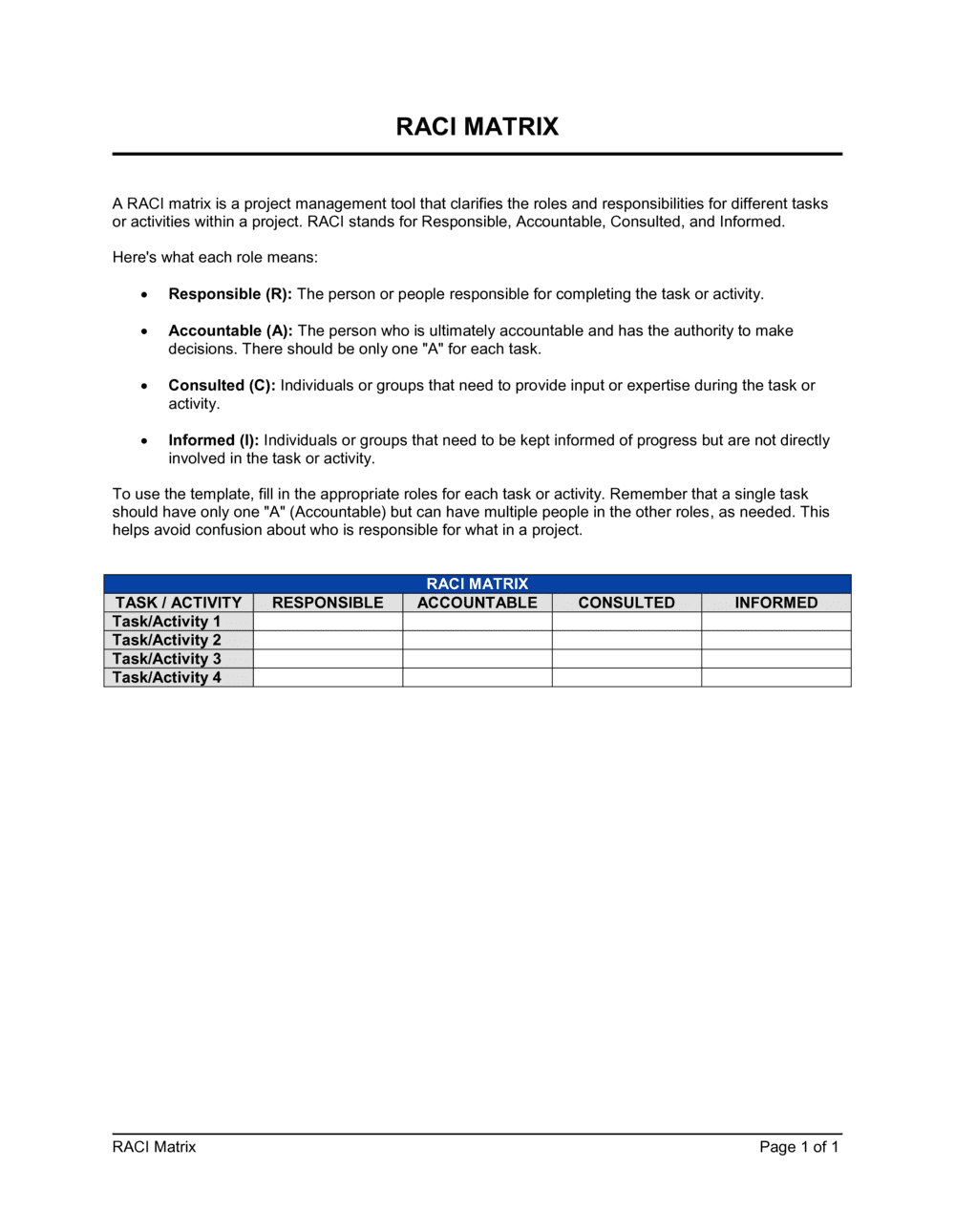
A RACI Matrix is a structured responsibility-assignment document that maps every task, decision, or deliverable in a project or process to one of four role designations: Responsible, Accountable, Consulted, and Informed. This free Word download gives you a ready-to-edit grid you can tailor to any team size or project scope, then export as PDF and circulate for sign-off before work begins.
When you need it
Use it at the start of any project, process redesign, or organizational change where two or more people share responsibility for outcomes and ambiguity about decision authority creates risk. It is especially critical before cross-functional initiatives, system implementations, or regulatory compliance programs where accountability gaps have legal or financial consequences.
What's inside
A header section identifying the project and stakeholders, a task-and-role grid assigning R, A, C, or I designations to every activity, a definitions block explaining each designation, an escalation and decision-authority clause, and a sign-off block where all accountable parties formally acknowledge their responsibilities.

What is a RACI Matrix?

A RACI Matrix is a structured responsibility-assignment document that maps every task, decision, and deliverable in a project or business process to one of four role designations: Responsible (the person who does the work), Accountable (the single person who owns the outcome and has final decision authority), Consulted (those whose input is required before completion), and Informed (those kept up to date without direct involvement). It provides a visual, auditable record of who does what, who decides, and who needs to know — eliminating the ambiguity that causes missed deadlines, duplicated effort, and accountability disputes in cross-functional teams. Unlike a project plan, which defines sequence and timing, the RACI Matrix defines governance: the human accountability structure beneath every deliverable.

Why You Need This Document

Without a documented RACI Matrix, projects consistently fail in the same predictable ways: two people both assume ownership of a critical task and neither does it, decision bottlenecks form because no one knows who can actually approve an output, and post-project disputes over who was responsible for a failure have no written record to resolve them. In regulated industries — healthcare, financial services, construction — an undocumented accountability structure is not just an operational problem; it is a compliance gap that auditors cite and regulators act on. The cost of an unsigned, informal approach compounds quickly: a single missed deliverable tied to an unclear owner can delay a project by weeks and trigger contractual penalties under a statement of work or service agreement. This template gives you a signed, versioned accountability record that is defensible in governance reviews, enforceable in contract disputes, and practical enough to run a team with on day one.

Which variant fits your situation?

If your situation is…Use this template
Assigning project task ownership across a multi-department teamRACI Matrix (Project-Level)
Mapping ongoing process responsibilities rather than a one-time projectProcess Responsibility Matrix
Documenting high-level executive decision rights and governanceDACI Decision Framework
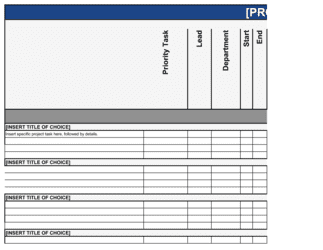
Tracking task status alongside role assignmentsProject Action Plan
Defining roles for a specific software or IT deploymentIT Project RACI Matrix
Structuring board-level and C-suite accountability for governanceCorporate Governance Policy
Assigning compliance and audit responsibilities by regulationCompliance Responsibility Matrix

Common mistakes to avoid

❌ Assigning multiple Accountable parties to a single task

Why it matters: Shared accountability is functionally no accountability. When a deadline is missed or a deliverable is substandard, every A points to the other, and the project manager has no clear owner to hold responsible.

Fix: Enforce a strict one-A-per-row rule during the drafting session. If consensus is impossible, escalate to the project sponsor before the matrix is signed.

❌ Overloading roles with both A and R on every task

Why it matters: When the Accountable person is also the sole Responsible party across dozens of tasks, the matrix maps a bottleneck rather than a team. That individual becomes a single point of failure.

Fix: Separate execution from accountability. The A approves and owns the outcome; R parties do the work. Distribute R designations across the team proportionate to capacity.

❌ Creating the matrix after work has already begun

Why it matters: Retroactive RACI assignments are rarely accepted by team members who have already been operating under informal agreements. Role disputes that predate the document undermine its authority.

Fix: Complete and sign the RACI Matrix before the project kickoff meeting. Include it as a prerequisite in your project charter or statement of work.

❌ Omitting a sign-off block and treating the matrix as informational

Why it matters: Without formal acknowledgment, accountable parties dispute their designations when problems arise, citing no formal agreement. The document becomes a reference artifact rather than an enforceable governance tool.

Fix: Include a dated signature line for every A-designated party and collect signatures before the project start date. File the signed copy in the project record.

❌ Failing to update the matrix when scope changes

Why it matters: A RACI that reflects the original scope but not the current scope creates phantom accountability — roles assigned to tasks that no longer exist, and active tasks with no owner.

Fix: Establish a formal change-control step that triggers a RACI review whenever scope, budget, or team composition changes materially. Version and re-sign the updated matrix.

❌ Using the matrix to document too many Consulted parties

Why it matters: Excess C designations create approval bottlenecks and diffuse responsibility. When 12 people are listed as Consulted on a decision, no individual feels genuine ownership of the input.

Fix: Limit C to roles whose input will materially affect the output. Anyone who simply needs to be aware of the outcome belongs in the I column.

The 10 key clauses, explained

Project and scope identification

In plain language: Names the project, process, or initiative the matrix governs, states the version date, and identifies the document owner responsible for keeping it current.

Sample language
Project: [PROJECT NAME] | Scope: [BRIEF SCOPE DESCRIPTION] | Version: [X.X] | Date: [DATE] | Document Owner: [NAME / ROLE]

Common mistake: Omitting the version date and document owner. When the matrix is revised mid-project, teams reference an outdated version and accountability gaps re-emerge.

Stakeholder and role registry

In plain language: Lists every individual, role, or team column that appears in the matrix with their full name, title, and department so there is no ambiguity about who holds each designation.

Sample language
[COLUMN HEADER]: [FULL NAME], [TITLE], [DEPARTMENT] — e.g., 'PM: Jane Smith, Senior Project Manager, Operations'

Common mistake: Using job titles instead of individual names for the Accountable column. Titles change with reorganizations, leaving no identifiable person responsible after a reorg.

Task and deliverable inventory

In plain language: Enumerates every task, decision, or deliverable the matrix covers in row form, grouped by phase or workstream so the grid is navigable.

Sample language
Phase 1 — Discovery: 1.1 Requirements gathering | 1.2 Stakeholder interviews | 1.3 Requirements sign-off document | Phase 2 — Design: 2.1 Architecture diagram...

Common mistake: Grouping too many tasks under a single row to keep the matrix short. Overly broad rows hide accountability gaps and make the document unenforceable as a governance tool.

RACI designation grid

In plain language: The core table assigning R, A, C, or I to each combination of task and role, with the rule that every task has exactly one A and at least one R.

Sample language
Task | [ROLE 1] | [ROLE 2] | [ROLE 3] — Requirements sign-off | C | A | R

Common mistake: Assigning multiple Accountable (A) designations to a single task. Shared accountability is functionally no accountability — when a deadline is missed, everyone points to the other A.

Decision authority and approval thresholds

In plain language: States which roles can approve decisions unilaterally, which require consultation before acting, and at what cost, scope, or risk threshold escalation to the next level is triggered.

Sample language
The Accountable role for [TASK TYPE] may approve decisions within [SCOPE / BUDGET LIMIT] without escalation. Decisions exceeding [THRESHOLD] require sign-off from [ESCALATION ROLE].

Common mistake: Leaving decision thresholds undefined. Without explicit limits, every mid-project decision generates a separate escalation discussion, defeating the purpose of the matrix.

Escalation and conflict resolution procedure

In plain language: Defines the step-by-step process for resolving disputes when two parties disagree on role boundaries, timelines, or deliverable ownership.

Sample language
If a role boundary conflict arises, the affected parties shall first attempt resolution within [X] business days. If unresolved, the matter escalates to [ESCALATION ROLE] who issues a binding written decision within [X] business days.

Common mistake: Omitting a conflict resolution clause entirely. Without it, role disputes escalate informally to senior leadership at the worst possible moment — mid-deadline.

Communication and reporting obligations

In plain language: Specifies the frequency, format, and audience for status updates flowing from Responsible parties to Informed and Consulted stakeholders.

Sample language
The Responsible party for [TASK / PHASE] shall provide a written status update to all Informed stakeholders every [FREQUENCY] via [CHANNEL], flagging any items that are at risk of missing the agreed deadline.

Common mistake: Defining Informed stakeholders but specifying no reporting cadence. Informed parties receive no updates and either disengage or start sending ad hoc requests that disrupt the team.

Amendment and version control procedure

In plain language: Governs how the matrix may be changed, who must approve amendments, and how prior versions are archived so the change history is traceable.

Sample language
Any amendment to this matrix requires written approval from the document owner and all Accountable parties. Amended versions are numbered sequentially (v1.0, v1.1) and prior versions archived at [LOCATION].

Common mistake: Allowing informal verbal changes to RACI designations without updating the document. Verbal role reassignments leave the written matrix out of sync with actual practice and create accountability disputes at project close.

Sign-off and acknowledgment block

In plain language: A formal signature section where each Accountable party confirms they have read the matrix, understood their designated responsibilities, and agree to fulfill them.

Sample language
By signing below, I, [NAME], in my capacity as [ROLE], acknowledge and accept the responsibilities designated to my role in this RACI Matrix as of [DATE]. Signature: _______________ Date: _______________

Common mistake: Treating the sign-off as optional or collecting only the project sponsor's signature. Unsigned accountable parties routinely dispute their obligations later, citing lack of formal agreement.

Governing policy and integration references

In plain language: Identifies any parent policy, project charter, statement of work, or contract this matrix operates under, ensuring RACI designations are read in context of broader obligations.

Sample language
This RACI Matrix operates under and is subject to the [PROJECT CHARTER / MASTER SERVICE AGREEMENT / POLICY NAME] dated [DATE]. In case of conflict, [DOCUMENT NAME] shall prevail.

Common mistake: Creating a RACI Matrix that contradicts the project charter or SOW on decision authority. The conflict surfaces at the worst time — during a dispute — and neither document can be enforced cleanly.

How to fill it out

  1. 1

    Define the project scope and task inventory

    List every task, decision point, and deliverable the project requires, grouped by phase or workstream. Use the project's work breakdown structure as the input if one exists.

    💡 Aim for task rows granular enough that one person can own each row — if a row contains both 'design' and 'develop,' split it.

  2. 2

    Identify all stakeholder roles

    Create one column for each person or role involved in the project. Use individual names in the Accountable column and role titles elsewhere. Limit columns to genuine participants — an oversized RACI is as useless as none.

    💡 A matrix with more than eight to ten role columns becomes unreadable. If you have more stakeholders, group them by function and assign a representative.

  3. 3

    Assign exactly one A per task

    Go row by row and assign the single person who owns the outcome of each task. This person approves the output and answers for it if something goes wrong. Never assign A to a committee.

    💡 If you find yourself wanting to assign A to two people, the task is probably two tasks — split the row.

  4. 4

    Assign R, C, and I designations for each task

    Mark R for everyone doing the hands-on work, C for those whose input is required before completion, and I for those who need to be kept informed but are not doing the work. Every task must have at least one R.

    💡 Limit C designations to genuinely essential inputs. Overconsulting creates bottlenecks; if someone only needs the final output, they are an I, not a C.

  5. 5

    Set decision thresholds and escalation paths

    For each Accountable role, document the scope, budget, or risk limits within which they can decide unilaterally, and name the escalation contact for decisions above those limits.

    💡 Express thresholds in numbers — '$10,000 budget variance' or '5-day schedule slip' — not vague language like 'significant changes.'

  6. 6

    Define communication cadence for Informed stakeholders

    Specify how often and in what format Responsible parties update Informed stakeholders — weekly email, dashboard, or stand-up meeting. Assign a specific role to own the update.

    💡 A reporting cadence agreed upfront stops ad hoc status-check requests that interrupt the team mid-sprint.

  7. 7

    Collect signatures from all Accountable parties

    Circulate the completed matrix to every person holding an A designation and obtain a dated signature before the project officially begins. Keep a countersigned copy on file.

    💡 Send the signature request with a two-business-day response deadline. Unsigned matrices routinely stay unsigned indefinitely once the project starts.

  8. 8

    Archive the signed version and set a review date

    Save the signed v1.0 matrix in the project repository, communicate it to all stakeholders, and schedule a review checkpoint at the midpoint of the project or whenever a major scope change occurs.

    💡 Treat scope changes as a trigger to update the RACI before work resumes — not after problems appear.

Frequently asked questions

What is a RACI Matrix?

A RACI Matrix is a responsibility-assignment chart that maps every task or decision in a project to one of four roles: Responsible (does the work), Accountable (owns the outcome), Consulted (provides required input), and Informed (kept up to date). It eliminates ambiguity about who makes decisions and who is answerable when something goes wrong, making it one of the most widely used project governance tools in business operations.

What does RACI stand for?

RACI stands for Responsible, Accountable, Consulted, and Informed. Each letter represents a distinct type of engagement with a task or decision. Responsible parties execute the work. The single Accountable party owns the outcome and has final approval authority. Consulted parties provide input before the task is completed. Informed parties receive updates but are not directly involved in execution or approval.

When should a RACI Matrix be created?

Create a RACI Matrix before a project kickoff, at the start of a new business process, or whenever a cross-functional team forms and role boundaries are unclear. It is especially important before regulatory compliance programs, system implementations, and organizational restructures where accountability gaps carry legal or financial consequences. Building it retroactively, after work has started, is significantly less effective.

Can a task have more than one Accountable party?

No. The core rule of the RACI model is exactly one Accountable party per task. Assigning A to two people creates shared accountability, which in practice means neither person feels sole ownership. If a task genuinely requires two decision-makers, it should be split into two distinct tasks, each with its own single A designation.

What is the difference between Responsible and Accountable in a RACI Matrix?

Responsible refers to the person or people who perform the hands-on work to complete a task. Accountable refers to the single person who owns the outcome — they approve the deliverable, answer for missed deadlines, and make the final call on disputes. A person can hold both R and A on the same task, but the A cannot be shared across multiple people.

How is a RACI Matrix different from a project plan?

A project plan defines what tasks need to be done, in what sequence, and by what date. A RACI Matrix defines who is responsible and accountable for each task and who needs to be consulted or informed. The two documents complement each other: the project plan provides the timeline and the RACI provides the accountability structure. Together they form the foundation of project governance.

Does a RACI Matrix need to be signed?

A signed RACI Matrix carries significantly more authority as a governance document than an unsigned one. When Accountable parties formally sign and date the matrix before the project begins, they acknowledge their responsibilities in a way that is difficult to dispute later. For projects with legal, regulatory, or financial accountability implications, signatures from all A-designated parties are strongly recommended.

What are common RACI Matrix variants?

Common variants include RASCI (adding a Support designation), DACI (Driver, Approver, Contributor, Informed — used in product management), RAPID (a McKinsey-developed model focused on decision roles), and CAIRO (adding Omitted to explicitly exclude certain roles). Each variant suits a different organizational context, but the standard four-letter RACI model is the most widely recognized and requires the least orientation time for new team members.

How often should a RACI Matrix be updated?

Review and update the matrix whenever the project scope changes materially, a team member joins or leaves, or the organizational structure shifts. At minimum, schedule a formal review at each project phase gate. A RACI that reflects the original project scope but not current reality creates phantom accountability — roles assigned to obsolete tasks and live tasks with no documented owner.

How this compares to alternatives

vs Project Action Plan

A project action plan defines what tasks need to be completed, by when, and tracks their status. A RACI Matrix defines who owns each task and what their decision authority is. The action plan answers the scheduling question; the RACI answers the accountability question. Most well-run projects use both simultaneously.

vs Organizational Chart

An organizational chart maps reporting lines and hierarchical structure. A RACI Matrix maps task-level accountability for a specific project or process, which frequently crosses those reporting lines. The org chart tells you who manages whom; the RACI tells you who is accountable for what deliverable — these often differ significantly in matrix organizations.

vs Job Description

A job description defines the standing duties, qualifications, and reporting structure of a permanent role. A RACI Matrix assigns accountability for specific tasks within a defined project or process. Job descriptions are static documents about roles; RACI matrices are dynamic governance tools about work. A job description does not substitute for task-level accountability on a cross-functional project.

vs Project Charter

A project charter authorizes the project, defines objectives, scope, budget, and executive sponsor. A RACI Matrix operates beneath the charter, translating scope into specific task-level accountability. The charter establishes what the project is and why it exists; the RACI establishes who is responsible and accountable for making it happen. Both should be completed before kickoff.

Industry-specific considerations

Technology / SaaS

Sprint-level task ownership, product release approvals, and cross-squad accountability for platform reliability and security incidents.

Healthcare

Regulatory compliance task ownership, HIPAA audit accountability, and clinical workflow responsibility mapping to reduce patient safety gaps.

Financial Services

SOX control ownership, regulatory reporting accountability, and audit-trail documentation of who approved each compliance activity.

Construction and Engineering

Subcontractor task assignments, safety inspection accountability, permit approval chains, and milestone sign-off authorities across general contractor and owner relationships.

Professional Services

Client deliverable ownership across engagement teams, partner-level accountability for quality review, and billing milestone approval authority.

Manufacturing

Production phase accountability, quality control sign-off authority, supplier coordination responsibility, and regulatory inspection ownership.

Jurisdictional notes

United States

In the US, a signed RACI Matrix embedded in or referenced by a master service agreement or statement of work can carry contractual weight, particularly for multi-party IT or construction projects. Sarbanes-Oxley and HIPAA compliance programs commonly use RACI-style matrices to document internal control ownership — an unsigned or outdated matrix can be cited as a control deficiency during an audit.

Canada

Canadian project governance practice broadly follows PMI and PRINCE2 standards, both of which endorse RACI-style accountability documentation. In federally regulated industries such as banking and telecommunications, documented role accountability is expected during OSFI or CRTC regulatory reviews. Quebec organizations operating under French-language requirements should ensure the matrix is drafted or translated in French when used in provincially regulated contexts.

United Kingdom

RACI matrices are standard deliverables under PRINCE2, the UK's predominant project management methodology, where they are typically required as part of the project initiation documentation. In regulated sectors overseen by the FCA or NHS procurement frameworks, documented accountability matrices are reviewed as evidence of sound governance and may be requested during regulatory inquiries or contract audits.

European Union

Under the GDPR, organizations are required to document who holds accountability for data processing activities — a RACI Matrix is an accepted method for demonstrating this accountability to supervisory authorities. EU public procurement projects funded under structural funds or Horizon Europe grants typically require formal responsibility assignment documentation as part of project governance deliverables. Requirements vary by member state and funding body.

Template vs lawyer — what fits your deal?

PathBest forCostTime
Use the templateProject managers and operations leads building a RACI for internal cross-functional projects with standard governance needsFree2–4 hours
Template + legal reviewProjects with contractual accountability implications, regulatory compliance ownership, or third-party vendor responsibility mapping$200–$500 for a governance or legal advisor review1–3 days
Custom draftedEnterprise-wide process governance, regulated-industry compliance programs, or multi-party contractual projects where the RACI forms part of a binding agreement$1,000–$3,000+1–2 weeks

Glossary

Responsible (R)
The person or role that performs the actual work to complete a task — there can be more than one Responsible party per task.
Accountable (A)
The single person who owns the outcome of a task and has final decision-making authority — there must be exactly one Accountable per task.
Consulted (C)
A person or role whose input is required before the task is completed, typically through a two-way communication loop.
Informed (I)
A person or role kept up to date on task progress or decisions but not directly involved in execution or approval.
Decision Authority
The explicitly documented right of a specific role to make a binding decision on a task or deliverable without further escalation.
Escalation Path
A defined chain of contacts and conditions that govern when a task or decision must be elevated to a higher authority.
Stakeholder Matrix
A broader mapping of all individuals or groups with an interest in a project, often used alongside a RACI to define communication plans.
Work Breakdown Structure (WBS)
A hierarchical decomposition of all work required to complete a project, often used as the input task list for building a RACI Matrix.
Sign-Off Block
The section of a RACI Matrix where accountable parties formally acknowledge their designated responsibilities with a dated signature.
DACI
A variant of the RACI model using Driver, Approver, Contributor, and Informed designations — common in product management and executive decision governance.
Cross-Functional Team
A team composed of members from different departments or disciplines who collaborate on a shared project or process.

Part of your Business Operating System

This document is one of 3,000+ business & legal templates included in Business in a Box.

  • Fill-in-the-blanks — ready in minutes
  • 100% customizable Word document
  • Compatible with all office suites
  • Export to PDF and share electronically

Create your document in 3 simple steps.

From template to signed document — all inside one Business Operating System.
1
Download or open template

Access over 3,000+ business and legal templates for any business task, project or initiative.

2
Edit and fill in the blanks with AI

Customize your ready-made business document template and save it in the cloud.

3
Save, Share, Send, Sign

Share your files and folders with your team. Create a space of seamless collaboration.

Save time, save money, and create top-quality documents.

★★★★★

"Fantastic value! I'm not sure how I'd do without it. It's worth its weight in gold and paid back for itself many times."

Managing Director · Mall Farm
Robert Whalley
Managing Director, Mall Farm Proprietary Limited
★★★★★

"I have been using Business in a Box for years. It has been the most useful source of templates I have encountered. I recommend it to anyone."

Business Owner · 4+ years
Dr Michael John Freestone
Business Owner
★★★★★

"It has been a life saver so many times I have lost count. Business in a Box has saved me so much time and as you know, time is money."

Owner · Upstate Web
David G. Moore Jr.
Owner, Upstate Web

Run your business with a system — not scattered tools

Stop downloading documents. Start operating with clarity. Business in a Box gives you the Business Operating System used by over 250,000 companies worldwide to structure, run, and grow their business.

Free Forever Plan · No credit card required