24h Cancellation Policy Template

Free Word download β€’ Edit online β€’ Save & share with Drive β€’ Export to PDF

2 pagesβ€’20–30 min to fillβ€’Difficulty: Standard
Learn more ↓
Free24h Cancellation Policy Template

At a glance

What it is
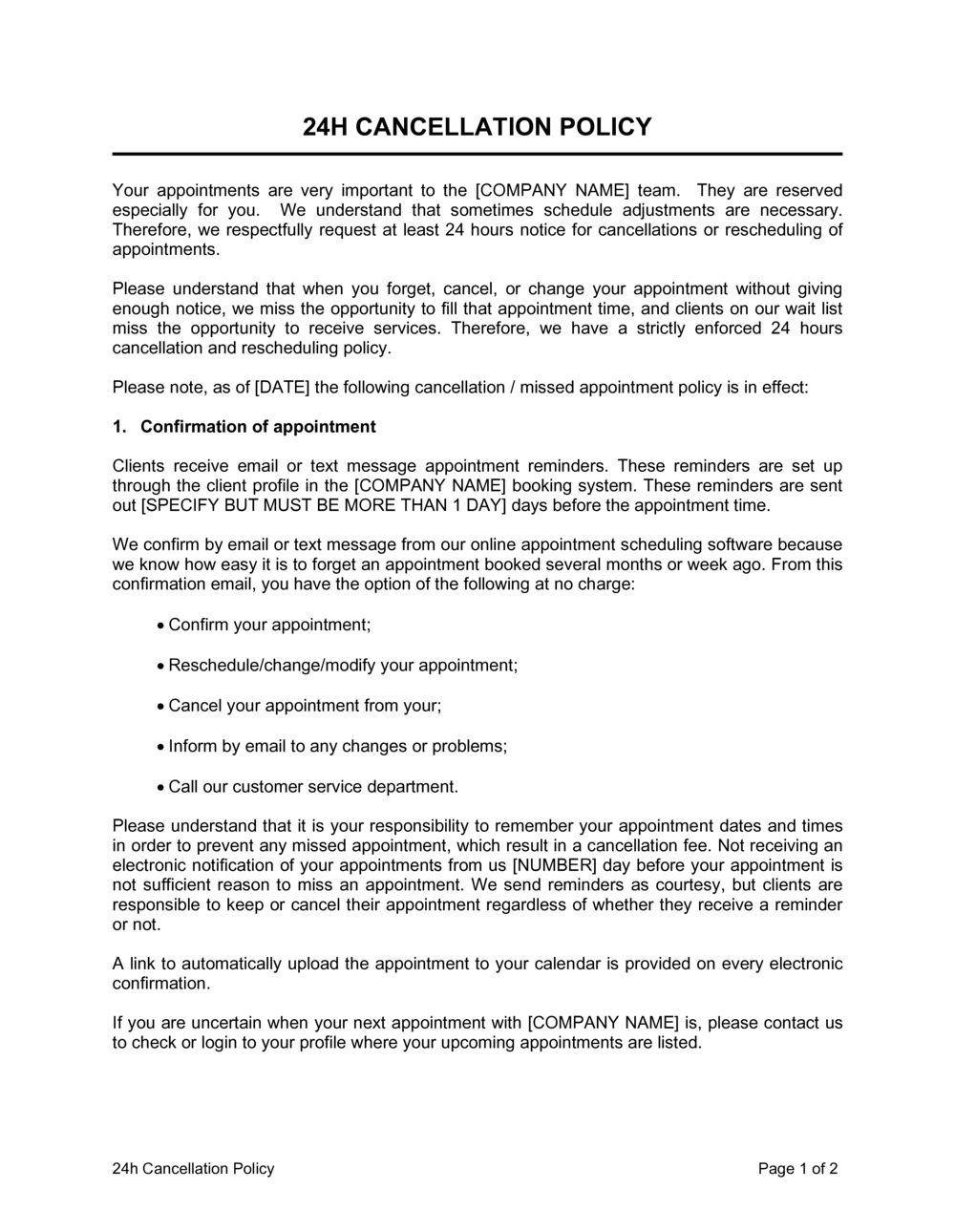
A 24-Hour Cancellation Policy is a written operational document that sets out the rules governing appointment and booking cancellations made with less than 24 hours' notice. This free Word download gives you a ready-to-edit policy you can customize with your fee structure, refund terms, and exceptions, then publish on your website, booking platform, or client intake forms.
When you need it
Use it whenever your business books time-based appointments or services and needs a clear, enforceable standard for late cancellations and no-shows. It is especially critical once missed appointments begin to represent measurable lost revenue.
What's inside
Policy scope and effective date, cancellation notice requirements, late cancellation fee schedule, no-show rules, refund and deposit terms, exceptions and waiver conditions, client acknowledgment, and contact and enforcement procedures.

What is a 24-Hour Cancellation Policy?

A 24-Hour Cancellation Policy is a written operational document that establishes the rules governing appointment cancellations, rescheduling requests, and no-shows made within 24 hours of the scheduled service time. It defines the minimum notice period clients must provide, the fees charged for late cancellations and missed appointments, the conditions under which those fees may be waived, and how the policy is accepted and enforced at the point of booking. For any business that sells time β€” consultations, sessions, treatments, lessons, or appointments β€” this document is the operational foundation that converts unrecoverable time into recoverable revenue.

Why You Need This Document

Without a written cancellation policy, every late cancellation is a judgment call, and judgment calls invite arguments. Clients who were never given a written policy successfully dispute charges with their bank, and providers who enforce fees inconsistently face resentment from clients who paid while others did not. The practical cost is significant: a single no-show on a $150 appointment, repeated twice a week, represents over $15,000 in lost annual revenue for a solo provider. Beyond revenue recovery, a clearly communicated policy changes client behavior before a cancellation happens β€” most clients with a written policy acknowledgment in their inbox simply reschedule rather than cancel late. This template gives you a policy that is specific enough to enforce, flexible enough to allow documented exceptions, and structured for the digital booking workflows most service businesses already use.

Which variant fits your situation?

If your situation is…Use this template
Medical or therapy practice with regulated cancellation rulesMedical Appointment Cancellation Policy
Subscription or recurring service with multi-appointment packagesService Cancellation Policy
Event venue or studio with large-group bookingsEvent Cancellation Policy
Online or remote coaching with no physical overheadVirtual Appointment Cancellation Policy
Hospitality or accommodation booking with multi-day staysHotel Cancellation Policy
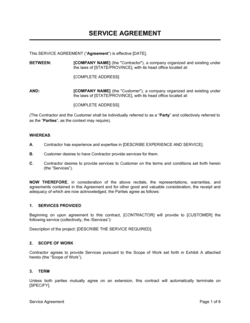
Service business needing a full client-facing intake agreementService Agreement
Deposit-based booking requiring a separate refund documentRefund Policy

Common mistakes to avoid

❌ Ambiguous cancellation window definition

Why it matters: If '24 hours' is not tied to a specific time or calculation method, clients argue the window had not yet closed at the time they cancelled, making the fee impossible to enforce consistently.

Fix: Define the window as a specific clock time the day before the appointment β€” e.g., 'by 5:00 PM the calendar day prior' β€” and state this in bold in the policy.

❌ No record of client acceptance

Why it matters: Without documented acknowledgment, clients dispute fees by claiming they were never informed of the policy, and payment processors frequently side with the cardholder in chargebacks.

Fix: Require a checkbox, signed form, or email reply confirming acceptance before completing any booking, and retain a timestamped copy for each client.

❌ Charging the same fee for no-shows as for late cancellations

Why it matters: A no-show causes greater harm than a late cancellation β€” there is no chance to rebook the slot β€” yet charging the same fee signals that no-shows carry no additional consequence.

Fix: Set the no-show fee at 100% of the service price and note in the policy that repeat no-shows trigger a prepayment requirement.

❌ Exceptions clause that is too broad to enforce

Why it matters: Phrases like 'at our discretion for any reasonable reason' invite every client to invent a justification, eroding the policy's deterrent effect and creating inconsistent enforcement.

Fix: List two or three specific, verifiable exceptions β€” documented emergency, government-issued advisory, or a one-time courtesy waiver β€” and require supporting documentation for the first two.

❌ Not addressing rescheduling separately from cancellation

Why it matters: Clients learn quickly that 'rescheduling' is treated differently from cancelling and will use it repeatedly to hold time slots without ever confirming attendance.

Fix: State explicitly that rescheduling within the 24-hour window is treated as a late cancellation and the same fee applies.

❌ Failing to specify consequences for non-payment of the fee

Why it matters: Without a stated consequence β€” booking suspension, referral to collections β€” clients who dispute or ignore a cancellation fee face no meaningful deterrent.

Fix: Add a single sentence: 'Unpaid cancellation fees will result in the suspension of future booking privileges until the balance is settled.'

The 10 key sections, explained

Policy scope and effective date

24-hour notice requirement

Late cancellation fee schedule

No-show policy

Deposit and prepayment terms

Rescheduling rules

Exceptions and waiver conditions

Client acknowledgment and acceptance

Payment collection and enforcement

Policy updates and communication

How to fill it out

  1. 1

    Insert your business name, services, and effective date

    Replace all [BUSINESS NAME], [SERVICE TYPES], and [DATE] placeholders in the scope section. Confirm the effective date is on or after the date you plan to communicate the policy to existing clients.

    πŸ’‘ If you serve multiple service lines with different pricing, list them explicitly in the scope section so the policy cannot be disputed as not applying to a specific booking type.

  2. 2

    Define the exact cancellation window and contact method

    Specify whether '24 hours' means 24 hours before the appointment time or by a fixed time (e.g., 5 PM) the prior day. State the accepted cancellation contact method β€” phone, email, or booking app β€” and confirm calls or messages after hours are not counted until the next business day.

    πŸ’‘ Tying the window to a specific clock time (e.g., '5:00 PM the day prior') is easier to enforce than a rolling 24-hour calculation.

  3. 3

    Set the late cancellation fee amount

    Enter a flat fee or percentage that reflects the average cost of a missed appointment β€” typically 50–100% of the service price. Consider setting a minimum dollar floor if you offer variable-price services.

    πŸ’‘ A fee equal to 50% of the service price is generally accepted by clients; 100% is appropriate for long or high-cost appointments that are difficult to rebook on short notice.

  4. 4

    Specify the no-show charge separately

    Set the no-show fee at 100% of the service price and note any consequence for repeat no-shows, such as a prepayment requirement for future bookings.

    πŸ’‘ Distinguishing no-shows from late cancellations signals you take both seriously and gives you a graduated enforcement ladder.

  5. 5

    Confirm deposit and prepayment terms

    If you collect a booking deposit, state the amount, whether it is refundable, and exactly how it interacts with the cancellation fee β€” forfeited, applied toward the fee, or both.

    πŸ’‘ Using the word 'non-refundable' explicitly in the deposit section, rather than just in the cancellation clause, prevents ambiguity in disputes.

  6. 6

    Draft your exceptions list carefully

    Limit exceptions to two or three objectively verifiable circumstances β€” documented medical emergency, government-issued weather warning, or a first-time waiver β€” and require supporting documentation for all but the first-time waiver.

    πŸ’‘ A first-time waiver clause increases goodwill with new clients while still protecting your policy from habitual late cancellations.

  7. 7

    Add the client acknowledgment and payment collection details

    Confirm how clients will accept the policy β€” booking platform checkbox, signed intake form, or email confirmation β€” and state the payment method that will be charged for fees.

    πŸ’‘ Save a screenshot or PDF of each client's acceptance along with the booking confirmation to create an audit trail before any dispute arises.

  8. 8

    Publish and communicate the policy before it takes effect

    Post the completed policy on your website, booking platform, and any client intake paperwork. Send existing clients notice at least 7–14 days before the effective date.

    πŸ’‘ Clients who received the policy in writing before they booked are far less likely to dispute a fee β€” and far easier to collect from if they do.

Frequently asked questions

What is a 24-hour cancellation policy?

A 24-hour cancellation policy is a written rule that requires clients to cancel or reschedule appointments at least 24 hours in advance to avoid a fee. It protects service-based businesses from lost revenue caused by last-minute cancellations and no-shows that leave time slots unfilled and unrecoverable. The policy typically specifies the exact notice window, the fee amount, no-show rules, and any permitted exceptions.

Can I legally charge a cancellation fee?

In most jurisdictions, yes β€” provided the client was informed of the fee before booking and agreed to it in writing or through a booking confirmation. A cancellation fee is generally enforceable as a contractual term when properly disclosed and accepted. Consider reviewing your policy with a local advisor if you operate in a regulated industry such as healthcare or financial services, where additional consumer protection rules may apply.

What is a reasonable cancellation fee amount?

For most service businesses, a fee between 50% and 100% of the booked service price is standard. A 50% fee is appropriate for shorter appointments where partial rebooking is possible; 100% is justified for long sessions, premium services, or high-demand time slots that cannot realistically be filled with less than 24 hours' notice. No-shows typically warrant a 100% charge regardless of session length.

How should I communicate the cancellation policy to clients?

Publish the policy on your website, include it in your booking confirmation email, and require a checkbox or signed acknowledgment before completing any reservation. For new clients, send the policy as part of their intake paperwork. The goal is documented acceptance before the appointment β€” not at the time of a dispute.

What is the difference between a late cancellation and a no-show?

A late cancellation is when a client notifies you of their intent to cancel after the policy window has closed β€” giving you some warning, however brief. A no-show is when the client fails to appear with no notice at all. No-shows are typically treated more severely because the provider has no opportunity to attempt to rebook the slot and has often already prepared for the appointment.

Should I require a deposit to enforce the cancellation policy?

A booking deposit is the most effective enforcement mechanism because the fee is already collected before any cancellation occurs. It eliminates the collection step and significantly reduces no-show rates. A non-refundable deposit of 25–50% of the service price, clearly described in the policy, is standard for high-demand or premium appointment types. For lower-cost services, a card-on-file arrangement achieves a similar deterrent effect without requiring upfront payment.

What exceptions should I include in a cancellation policy?

Limit exceptions to two or three objectively verifiable circumstances: a documented medical emergency, a government-issued severe weather advisory, and optionally a one-time courtesy waiver for new clients. Broad exceptions undermine the entire policy. Requiring documentation for emergency waivers β€” a doctor's note or weather advisory screenshot β€” creates a verifiable standard and discourages fabricated claims.

How do I handle a client who disputes a cancellation fee with their bank?

The strongest defense against a chargeback is a paper trail: a timestamped booking confirmation that includes or links to the cancellation policy, a record of the client's acceptance, and documentation that the cancellation occurred inside the window. When you receive a chargeback notice, respond with these three documents plus a copy of the signed or acknowledged policy. Most payment processors will side with the merchant when the policy was clearly disclosed prior to the transaction.

Do I need a separate cancellation policy for each service I offer?

Not necessarily β€” one policy that clearly scopes all covered services is easier to communicate and enforce than multiple overlapping documents. However, if your services differ significantly in price or session length, you may want to include a tiered fee schedule within a single policy document rather than maintaining separate policies for each service line.

How this compares to alternatives

vs Service Agreement

A service agreement is a comprehensive contract covering the full scope of a client engagement β€” deliverables, payment terms, IP, liability, and termination. A 24-hour cancellation policy is a focused operational document that governs only the rules for cancelling or rescheduling appointments. For most service businesses, the cancellation policy is embedded within or attached to the service agreement, but it can also stand alone for businesses that book through platforms or intake forms.

vs Refund Policy

A refund policy defines when and how a client is entitled to a return of money already paid. A cancellation policy defines what fee is charged when a client fails to give adequate notice before an appointment. The two documents interact β€” particularly around deposits β€” but they govern different transactions and should be maintained separately for clarity.

vs Appointment Confirmation Letter

An appointment confirmation letter acknowledges the date, time, and location of a scheduled appointment and may include a reminder of the cancellation policy. It is a communication document, not a policy document. The cancellation policy is the authoritative source of terms; the confirmation letter references it and creates a record of delivery to the client.

vs Terms and Conditions

Terms and conditions are a broad governing document covering all aspects of the relationship between a business and its customers β€” acceptable use, liability, dispute resolution, and general policies. A 24-hour cancellation policy is a single operational policy that would typically be incorporated by reference within a broader terms and conditions document. For appointment-based businesses, a standalone cancellation policy is easier to present and enforce at the point of booking.

Industry-specific considerations

Health and Wellness

Medical and therapy practices often collect a card on file at intake to facilitate automatic fee collection, and some regulated providers must comply with state or provincial billing guidelines that affect how cancellation fees are structured.

Beauty and Personal Care

Salons and spas frequently combine a booking deposit with a 24-hour cancellation fee to protect stylists and therapists whose income depends directly on filled appointment slots.

Fitness and Coaching

Personal trainers and coaches typically apply the cancellation policy to individual sessions within a prepaid package, requiring clients to agree that missed sessions within the window are deducted at full value.

Education and Tutoring

Private tutors and instructors often include the cancellation policy in a broader service agreement signed before the first lesson, with package-based clients subject to session forfeiture rather than a separate cash fee.

Template vs pro β€” what fits your needs?

PathBest forCostTime
Use the templateSolo service providers and small businesses that book individual appointments and need a ready-to-post policyFree15–30 minutes
Template + professional reviewMulti-provider practices, regulated industries (healthcare, financial services), or businesses with high-value appointments where fee disputes are likely$150–$400 for a legal or business advisor review1–3 days
Custom draftedFranchise networks, large clinics, or businesses needing jurisdiction-specific consumer protection compliance built into the policy$500–$1,500+1–2 weeks

Glossary

Cancellation Window
The minimum amount of advance notice a client must provide to cancel without incurring a fee β€” in this policy, 24 hours before the scheduled appointment.
Late Cancellation
Any cancellation made after the cancellation window has closed, typically triggering a partial or full fee.
No-Show
A client who fails to appear for a scheduled appointment without any prior notice of cancellation.
Cancellation Fee
A charge applied when a client cancels within the restricted window, expressed as a flat dollar amount or a percentage of the service price.
Booking Deposit
An upfront payment collected at the time of scheduling, often forfeited or applied toward the cancellation fee in the event of a late cancellation or no-show.
Waiver
A documented exception granted by the service provider that excuses a late cancellation fee, typically for emergencies or first-time offenses.
Rescheduling
Moving an appointment to a new date and time rather than cancelling outright β€” policies may treat rescheduling differently from cancellation.
Client Acknowledgment
A signature, checkbox, or confirmed acceptance by the client indicating they have read and agree to the cancellation policy before booking.
Retention on File
The practice of storing a client's payment method to facilitate automatic collection of cancellation fees when triggered.
Force Majeure
An unforeseeable event β€” severe weather, natural disaster, or public emergency β€” that may justify waiving cancellation fees as a documented exception.

Part of your Business Operating System

This document is one of 3,000+ business & legal templates included in Business in a Box.

  • Fill-in-the-blanks β€” ready in minutes
  • 100% customizable Word document
  • Compatible with all office suites
  • Export to PDF and share electronically

Create your document in 3 simple steps.

From template to signed document β€” all inside one Business Operating System.
1
Download or open template

Access over 3,000+ business and legal templates for any business task, project or initiative.

2
Edit and fill in the blanks with AI

Customize your ready-made business document template and save it in the cloud.

3
Save, Share, Send, Sign

Share your files and folders with your team. Create a space of seamless collaboration.

Save time, save money, and create top-quality documents.

β˜…β˜…β˜…β˜…β˜…

"Fantastic value! I'm not sure how I'd do without it. It's worth its weight in gold and paid back for itself many times."

Managing Director Β· Mall Farm
Robert Whalley
Managing Director, Mall Farm Proprietary Limited
β˜…β˜…β˜…β˜…β˜…

"I have been using Business in a Box for years. It has been the most useful source of templates I have encountered. I recommend it to anyone."

Business Owner Β· 4+ years
Dr Michael John Freestone
Business Owner
β˜…β˜…β˜…β˜…β˜…

"It has been a life saver so many times I have lost count. Business in a Box has saved me so much time and as you know, time is money."

Owner Β· Upstate Web
David G. Moore Jr.
Owner, Upstate Web

Run your business with a system β€” not scattered tools

Stop downloading documents. Start operating with clarity. Business in a Box gives you the Business Operating System used by over 250,000 companies worldwide to structure, run, and grow their business.

Start freeΒ Β·Β No credit card required