Call Center Agent_Outbound_Customer Service & Collection Job Description Template

Free Word download • Edit online • Save & share with Drive • Export to PDF

2 pages20–30 min to fillDifficulty: StandardSignature requiredLegal review recommended
Learn more ↓
FreeCall Center Agent_Outbound_Customer Service & Collection Job Description Template

At a glance

What it is
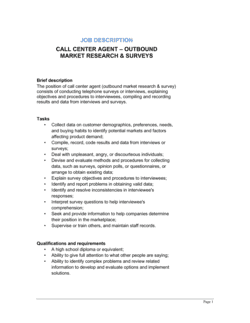
A Call Center Agent Outbound Customer Service & Collection Job Description is a binding employment document that defines the role, responsibilities, performance standards, and compliance obligations for agents who make outbound calls for customer service follow-up or debt collection purposes. This free Word download can be edited online and exported as PDF, giving HR teams a compliant, ready-to-sign document they can tailor to their contact center environment in under 30 minutes.
When you need it
Use it when hiring or onboarding agents who will make outbound calls for account follow-up, payment collection, customer retention, or post-sale service — especially in regulated industries where written role definitions and compliance obligations must be documented before the first shift.
What's inside
Role summary and reporting structure, core outbound calling duties, KPI and performance targets, regulatory compliance obligations (FDCPA, TCPA, GDPR), compensation and commission structure, data privacy requirements, disciplinary standards, and termination conditions.

What is a Call Center Agent Outbound Customer Service & Collection Job Description?

A Call Center Agent Outbound Customer Service & Collection Job Description is a formal employment document that defines the specific duties, performance standards, regulatory compliance obligations, and compensation terms for agents who make outbound telephone calls on behalf of a business — whether for debt recovery, post-sale service follow-up, or account retention. Unlike a generic job posting, this document is designed to be signed by both the employer and the agent before the first shift, creating a written, enforceable record of the agent's acknowledged obligations under the FDCPA, TCPA, and applicable state laws. It bridges the gap between an employment contract and a compliance policy by embedding regulatory requirements directly into the role definition.

Why You Need This Document

Outbound call center roles — particularly those involving debt collection — carry some of the highest per-violation regulatory risk of any entry-level position. A single agent using prohibited language, calling outside permitted hours, or failing to deliver the Mini-Miranda disclosure can trigger an FDCPA claim worth $1,000 per violation plus attorney's fees, with the employer vicariously liable for every call. Without a signed job description documenting the agent's specific, acknowledged compliance obligations, the employer cannot demonstrate the good-faith compliance program the FDCPA requires as an affirmative defense. Operationally, missing KPI targets and vague duty descriptions make underperformance disputes nearly impossible to resolve cleanly, and absent data-return clauses leave the business exposed when agents depart with consumer account data. This template gives HR teams and contact center operators a compliant, jurisdiction-aware starting point that closes all of these gaps before the first outbound call is ever dialed.

Which variant fits your situation?

If your situation is…Use this template
Hiring agents focused exclusively on inbound customer supportCall Center Agent Inbound Customer Service Job Description
Hiring a team lead or supervisor overseeing outbound agentsCall Center Supervisor Job Description
Hiring outbound agents primarily for cold sales prospectingOutbound Sales Representative Job Description
Engaging a collections specialist as an independent contractorIndependent Contractor Agreement
Documenting the full employment relationship beyond the job descriptionEmployment Contract
Defining performance standards in a separate standalone documentEmployee Performance Review Template
Onboarding a remote outbound agent working from homeRemote Work Employment Agreement

Common mistakes to avoid

❌ Not obtaining a signed acknowledgment

Why it matters: An unsigned job description is an informational document, not an enforceable agreement. In FDCPA enforcement proceedings, regulators and plaintiffs' attorneys will challenge whether the agent was ever formally bound to the documented compliance standards.

Fix: Include a signature block and obtain signatures from both the agent and an authorized company representative before the agent makes a single outbound call.

❌ Citing only federal law and omitting state-level analogues

Why it matters: State laws such as California's Rosenthal Fair Debt Collection Practices Act and New York's Debt Collection Procedures Law impose obligations that differ from — and sometimes exceed — the FDCPA, and apply to first-party collectors the federal statute does not cover.

Fix: List every applicable federal and state statute by name in the compliance clause and have legal counsel confirm the list covers all states into which the agent will be dialing.

❌ Vague or absent KPI targets

Why it matters: Without numeric performance standards, managing out a consistently underperforming agent becomes a subjective judgment call that exposes the employer to wrongful termination or discrimination claims.

Fix: Set specific, measurable targets — minimum calls per shift, recovery percentage, quality score — and document the review cadence and consequence framework in the same clause.

❌ Omitting a post-employment data return obligation

Why it matters: Former agents who retain consumer account data after separation create FDCPA, GLBA, and — for European consumers — GDPR liability for the employer, even if the data was never misused.

Fix: Include an explicit clause requiring immediate return or deletion of all consumer data and system credential deactivation upon separation, with a signed acknowledgment.

The 10 key clauses, explained

Role summary and reporting structure

In plain language: States the job title, the agent's primary purpose, who they report to, and where the role sits within the contact center hierarchy.

Sample language
The Outbound Customer Service & Collection Agent reports to the [COLLECTIONS SUPERVISOR / CALL CENTER MANAGER] and is responsible for contacting existing customers and account holders via telephone to resolve outstanding balances, provide post-sale support, and execute retention campaigns on behalf of [COMPANY NAME].

Common mistake: Omitting the reporting line entirely. Without a named supervisory structure, performance management and disciplinary escalation have no defined chain of authority, complicating termination if needed.

Core outbound calling duties

In plain language: Itemizes the agent's day-to-day responsibilities — making calls, following scripts, logging outcomes, and escalating complex accounts.

Sample language
Agent shall: (a) make a minimum of [X] outbound calls per shift using the Company's approved dialing system; (b) follow approved scripts and disclosure language on every call; (c) accurately log all call outcomes in [CRM SYSTEM] within [5] minutes of call completion; (d) escalate accounts flagged for dispute or legal action to [SUPERVISOR / LEGAL TEAM] without further contact attempts.

Common mistake: Listing duties without specifying the minimum call volume or system to be used. Vague duties make it impossible to establish whether an agent is underperforming or non-compliant.

Regulatory compliance obligations

In plain language: Specifies which laws govern the agent's calling conduct and places the obligation to comply squarely on the agent as a documented employment condition.

Sample language
Agent shall comply with all applicable laws governing outbound calling, including without limitation the FDCPA, TCPA, applicable state mini-TCPA statutes, and the FTC's Telemarketing Sales Rule. Agent shall not contact any consumer: (a) before 8:00 a.m. or after 9:00 p.m. local time; (b) listed on the Company's internal DNC list; or (c) who has provided a written cease-and-desist notice.

Common mistake: Referencing only federal law and omitting state-level restrictions. States like California (Rosenthal Act), New York, and Florida impose additional restrictions beyond FDCPA that apply to first-party collectors not covered by the federal statute.

Script and disclosure requirements

In plain language: Requires the agent to use only Company-approved scripts, deliver all mandatory disclosures (e.g., Mini-Miranda), and refrain from using prohibited language or misrepresentation.

Sample language
On every collection call, Agent shall deliver the Mini-Miranda disclosure at the outset: 'This is [AGENT NAME] calling from [COMPANY NAME]. This is an attempt to collect a debt, and any information obtained will be used for that purpose.' Deviation from approved scripts requires prior written authorization from [SUPERVISOR NAME / TITLE].

Common mistake: Treating script compliance as a training issue rather than a contractual obligation. Without a signed acknowledgment of script requirements, the employer cannot hold the agent accountable for unauthorized statements that trigger FDCPA violations.

Performance targets and KPIs

In plain language: Sets measurable, objective performance standards the agent is expected to meet — call volume, right party contact rate, collections recovery rate, and quality scores.

Sample language
Agent is expected to maintain: (a) minimum [X] right party contacts per shift; (b) collections recovery rate of [X]% of assigned portfolio value per month; (c) average handle time not to exceed [X] minutes; (d) call quality score of [X]% or above on monthly monitored calls.

Common mistake: Setting KPIs without specifying the review cadence or consequence of underperformance. KPIs with no defined review process are unenforceable and create inconsistent discipline across the team.

Data privacy and call recording obligations

In plain language: Requires the agent to handle consumer data according to applicable privacy law, obtain required recording consents, and refrain from accessing or sharing account data outside of authorized purposes.

Sample language
Agent shall handle all consumer account data in accordance with [COMPANY NAME]'s Privacy Policy and applicable law, including GLBA, applicable state privacy statutes, and GDPR where applicable. Agent shall obtain and document required call recording consent in jurisdictions requiring two-party consent before recording any call.

Common mistake: Failing to list the specific states where two-party consent is required (California, Florida, Illinois, Washington, and others). A blanket 'comply with privacy law' clause does not put the agent on sufficient notice of specific recording obligations.

Compensation, commission, and incentive structure

In plain language: States the agent's base pay, any variable commission tied to collections recovery, shift differentials, and the conditions under which commissions are earned and paid.

Sample language
Agent shall receive a base hourly wage of $[X.XX] per hour. Agent is eligible for a monthly collections commission of [X]% of gross dollars recovered on assigned accounts in excess of [$BASE TARGET], payable on the [15th] of the month following the qualifying period. Commission is earned only on amounts actually received by [COMPANY NAME].

Common mistake: Omitting the 'actually received' condition on commission. If commission is deemed earned on the promise to pay rather than payment receipt, the employer may owe commission on accounts that subsequently default again.

Prohibited conduct and disciplinary standards

In plain language: Lists specific behaviors that constitute misconduct — harassment, threats, misrepresentation, unauthorized DNC removal — and the disciplinary consequences, up to and including immediate termination.

Sample language
The following conduct is grounds for immediate termination without notice or severance: (a) threatening, abusing, or using obscene language with a consumer; (b) misrepresenting the legal status of a debt or the consequences of non-payment; (c) removing a consumer from the DNC list without authorization; (d) accessing consumer account data outside of assigned duties.

Common mistake: Using a generic 'gross misconduct' clause without listing call-center-specific prohibited behaviors. In FDCPA enforcement actions, employers with documented, specific conduct standards fare significantly better in demonstrating a good-faith compliance program.

Termination, notice, and post-employment obligations

In plain language: States the notice period required from either party, conditions for immediate termination for cause, and any post-employment restrictions on soliciting the employer's clients or disclosing consumer data.

Sample language
Either party may terminate this Agreement with [X] days' written notice. [COMPANY NAME] may terminate immediately for Cause as defined in Section [X]. Upon separation, Agent shall immediately return all Company property, cease access to all systems, and shall not retain, copy, or disclose any consumer account data obtained during employment.

Common mistake: No post-employment data return clause. Former call center agents with access to consumer account data who retain it after separation create significant FDCPA, GLBA, and GDPR exposure for the employer.

Governing law and acknowledgment

In plain language: Specifies the jurisdiction whose law governs the agreement and includes a signed acknowledgment that the agent has read, understood, and agrees to all terms.

Sample language
This Job Description and any associated employment terms shall be governed by the laws of [STATE / PROVINCE / COUNTRY]. By signing below, Agent acknowledges receipt of this document, confirms they have read and understood all obligations herein, and agrees to comply with all terms as a condition of employment. Agent Name: _________________ Date: _________

Common mistake: Treating the job description as an informational document rather than obtaining a signature. An unsigned job description cannot be introduced as evidence of the agent's acknowledged compliance obligations in an FDCPA enforcement proceeding or employment dispute.

How to fill it out

  1. 1

    Enter company name, location, and the agent's reporting line

    Fill in your registered company name, the contact center location or remote-work designation, and the title of the direct supervisor. Confirm the supervisor title matches your org chart.

    💡 Use the same legal entity name that appears on payroll — mismatches between the job description entity and the paying entity create confusion in wage-and-hour disputes.

  2. 2

    Define the scope of outbound calling activity

    Specify whether the role covers collections only, customer service follow-up only, or both. For collections roles, note whether the agent handles first-party (company-owned receivables) or third-party (purchased or assigned) debt — this determines which regulations apply.

    💡 First-party collectors in most US states are not covered by the FDCPA but may be covered by state analogues. Confirm which statute applies before finalizing the compliance clause.

  3. 3

    Set measurable KPIs and review frequency

    Enter specific numeric targets for call volume, right party contact rate, recovery rate, and quality score. Add the review cadence — weekly, monthly, or quarterly — and the consequence table for missing targets.

    💡 Tie KPIs to the metrics your dialer platform actually tracks so there is no dispute about data source at review time.

  4. 4

    Complete the regulatory compliance clause for your jurisdiction

    List every applicable statute — federal FDCPA and TCPA, state mini-TCPA laws, and any industry-specific rules (e.g., HIPAA for medical debt). Add the specific calling-hours restriction for the states where your agents will be dialing.

    💡 Several states, including California and New York, require compliance disclosures that go beyond the federal minimums — have legal counsel confirm the list before finalizing.

  5. 5

    Fill in the compensation and commission structure

    Enter the base hourly or salary rate, the commission percentage, the base recovery target above which commission applies, and the payment date. Confirm the structure complies with the FLSA minimum wage floor when commission is the primary variable component.

    💡 In California, commission plans must be in a separate signed commission agreement under Labor Code §2751 — attach it as an exhibit rather than embedding full terms in the job description.

  6. 6

    List prohibited conduct specific to your call type

    Customize the prohibited conduct clause with behaviors relevant to your specific campaigns — medical debt, credit card, utilities, or retail. Add any campaign-specific restrictions provided by your client if you are a BPO.

    💡 If you operate under a client's FDCPA license, include a clause requiring the agent to comply with the client's written compliance program as well as your own.

  7. 7

    Set the termination notice period for your jurisdiction

    Enter the notice period in days — typically 2 weeks for at-will US employment — and confirm statutory minimums for Canadian provinces, the UK, or EU countries where the agent is located.

    💡 In Ontario and British Columbia, termination without cause requires written notice or pay in lieu that meets Employment Standards Act minimums regardless of what the document states.

  8. 8

    Obtain signatures before the first shift

    Both the agent and an authorized company representative must sign and date the document before the agent's first day of calling. Retain the original in the agent's personnel file and provide the agent with a copy.

    💡 Use Business in a Box eSign to timestamp signatures and create a tamper-evident audit trail — critical if the document is later referenced in an FDCPA enforcement action.

Frequently asked questions

What is a call center agent outbound job description?

A call center agent outbound job description is a formal employment document that defines the duties, performance standards, compliance obligations, and compensation terms for agents who make outbound telephone calls — for customer service follow-up, debt collection, or account retention. When signed by both parties, it creates documented, enforceable obligations that protect both the employer and the employee and support the employer's regulatory compliance program.

Does an outbound collections agent job description need to reference the FDCPA?

For third-party debt collectors in the United States, yes — referencing the FDCPA and its key prohibitions in the job description puts agents on formal notice of their compliance obligations. It also supports the employer's good-faith compliance defense in enforcement actions. First-party collectors are not covered by the FDCPA in most US states but may be covered by state analogues such as California's Rosenthal Act, which should be cited where applicable.

What is the difference between a job description and an employment contract for a call center agent?

A job description defines role-specific duties, KPIs, and compliance obligations. An employment contract is a broader legal agreement covering salary, benefits, IP, confidentiality, non-compete, and termination terms. For outbound call center agents, a signed job description documents compliance obligations in a form that can be introduced as evidence in regulatory proceedings, while the employment contract governs the broader financial and legal relationship. Both documents are typically used together.

Can I use the same job description for outbound customer service and collections agents?

Only if the roles are genuinely combined. Customer service follow-up calls and debt collection calls are subject to different regulatory frameworks — TCPA applies to both, but FDCPA applies specifically to collection activity. If agents handle both call types in a single shift, the job description must address both regulatory regimes. Separate documents are cleaner for compliance audits and easier to maintain when regulations change.

What calling hours must the job description restrict agents to?

The FDCPA prohibits contacting consumers before 8:00 a.m. or after 9:00 p.m. in the consumer's local time zone. The TCPA imposes the same window for calls to mobile numbers using an ATDS. Several states impose stricter hours — California restricts calls to 8:00 a.m.–9:00 p.m., while New York restricts collection calls to 8:00 a.m.–9:00 p.m. local time. The job description should specify the most restrictive applicable hours for the states your agents dial into.

Does a call center job description need to address call recording consent?

Yes, particularly for outbound calls crossing state lines. The United States operates on a patchwork of one-party and two-party (all-party) consent states. California, Florida, Illinois, Washington, and several others require all parties to consent to recording. The job description should require agents to obtain and document consent in two-party states and follow the Company's approved disclosure script before recording begins.

Is this job description legally required before hiring an outbound agent?

No federal law mandates a written job description before hire, but a signed, specific job description is a best practice that supports FDCPA compliance programs, provides clear grounds for performance management, and reduces wrongful termination and wage-and-hour exposure. Many state regulators and court decisions treat documented, signed compliance obligations as evidence of a good-faith compliance program.

What happens if an outbound agent violates the FDCPA?

Individual agents can be personally liable under the FDCPA for statutory damages up to $1,000 per violation, plus actual damages and attorney's fees. The employer is also vicariously liable for agent violations. A signed job description that documents the agent's acknowledged compliance obligations supports the employer's bona fide error defense — one of the few FDCPA affirmative defenses — but only if the employer can show meaningful procedures were in place and the agent violated them despite training.

Should commissions for debt collection agents be in the job description or a separate agreement?

Both approaches are used, but California requires a separate signed commission agreement under Labor Code §2751. For multi-state employers, best practice is to reference the commission structure in the job description and attach a detailed commission plan as a signed exhibit. This separates the compliance-sensitive role definition from the financial terms, making each document easier to update independently.

How this compares to alternatives

vs Inbound Call Center Agent Job Description

An inbound job description covers agents who receive incoming calls from customers — no proactive dialing, no FDCPA obligations, and no DNC compliance requirements. An outbound job description must address TCPA dialing restrictions, FDCPA prohibitions, calling-hour limits, and Mini-Miranda disclosures that simply do not apply to inbound-only roles. Using an inbound template for outbound agents leaves critical compliance clauses missing.

vs Employment Contract

An employment contract governs the full legal relationship — salary, benefits, IP, non-compete, and termination. A job description defines role-specific duties, KPIs, and compliance obligations. Both are typically used together for call center agents: the employment contract sets the legal framework, while the signed job description documents the agent's specific acknowledged obligations under the FDCPA and TCPA.

vs Independent Contractor Agreement

An independent contractor agreement engages a self-employed individual with no employee entitlements. Classifying outbound collection agents as contractors rather than employees is high-risk — the degree of behavioral control exercised over call scripts, dialing systems, and compliance protocols typically meets the IRS and DOL tests for employee status. Misclassification creates back-tax liability and voids the contractor agreement's FDCPA compliance protections.

vs Employee Performance Review Template

A performance review template documents how an agent is evaluated against their KPIs after the fact. A job description establishes those KPIs upfront as binding conditions of employment. The job description must exist — and be signed — before a performance review can have a contractual basis for disciplinary action or termination.

Industry-specific considerations

Financial Services & Banking

Credit card, personal loan, and mortgage collections governed by FDCPA, GLBA, and OCC supervisory guidance; agents require documented training on dispute and validation procedures.

Healthcare

Medical debt collection intersects FDCPA with HIPAA — job descriptions must address PHI handling restrictions and the No Surprises Act billing disclosure requirements.

Telecommunications & Utilities

High-volume outbound for past-due accounts; TCPA autodialer restrictions are particularly acute given the mobile-heavy customer base and predictive dialing systems used.

Retail & E-commerce

Post-purchase service follow-up and charge-back recovery calls require agents to handle both customer satisfaction and collections in a single call type, requiring dual compliance protocols.

Jurisdictional notes

United States

The FDCPA (15 U.S.C. § 1692) governs third-party collectors; first-party collectors are covered by state analogues in California (Rosenthal Act), New York, and others. The TCPA restricts autodialed and prerecorded calls to mobile numbers without prior express written consent. At-will employment applies in 49 states, but commission clawback provisions and two-party recording consent laws vary significantly — California, Florida, Illinois, and Washington require all-party consent to record calls.

Canada

Each province regulates debt collection independently; Ontario's Collection and Debt Settlement Services Act and British Columbia's Business Practices and Consumer Protection Act impose calling-hour restrictions, mandatory registration for collection agencies, and prohibited contact rules that parallel but are distinct from the FDCPA. CASL governs electronic commercial messages. Employment terms must meet provincial Employment Standards Act minimums for notice and termination pay.

United Kingdom

The Financial Conduct Authority (FCA) regulates consumer credit and debt collection under CONC (Consumer Credit sourcebook) rules, which impose conduct standards on outbound collection calls. PECR (Privacy and Electronic Communications Regulations) restricts unsolicited calls and requires TPS (Telephone Preference Service) list screening. Employers must provide written employment particulars on or before day one under the Employment Rights Act 1996.

European Union

GDPR imposes strict conditions on processing consumer data for debt collection purposes, including lawful basis documentation and data minimization. The ePrivacy Directive restricts unsolicited calls to individuals without prior consent. Debt collection regulation varies by member state — Germany's Rechtsdienstleistungsgesetz and France's Code de la consommation impose national frameworks. Employment contracts must meet the EU Transparent and Predictable Working Conditions Directive, requiring written terms within 7 days of hire.

Template vs lawyer — what fits your deal?

PathBest forCostTime
Use the templateSmall contact centers and BPOs hiring domestic agents in straightforward single-state operationsFree30 minutes
Template + legal reviewMulti-state outbound campaigns, medical debt collections, or first-party collectors navigating state-law analogues$300–$700 (employment or collections compliance attorney review)2–5 days
Custom draftedLarge BPOs, third-party debt purchasers, cross-border outbound programs, or operations under CFPB consent order$1,500–$4,000+1–3 weeks

Glossary

FDCPA
The Fair Debt Collection Practices Act — a US federal law that restricts the methods, times, and language debt collectors may use when contacting consumers.
TCPA
The Telephone Consumer Protection Act — a US federal law that limits automated calls, prerecorded messages, and text messages to mobile numbers without prior express consent.
Predictive Dialer
An automated outbound calling system that dials multiple numbers simultaneously and connects answered calls to available agents, maximizing talk time but raising TCPA compliance concerns.
Abandonment Rate
The percentage of outbound calls answered by a consumer but disconnected before reaching a live agent — regulated by the FTC to no more than 3% of answered calls per campaign.
Right Party Contact (RPC)
A successful outbound call that reaches the intended account holder or debtor, as opposed to a third party, voicemail, or wrong number.
Mini-Miranda Warning
A required FDCPA disclosure collectors must deliver at the start of each call: 'This is an attempt to collect a debt, and any information obtained will be used for that purpose.'
Do Not Call (DNC) Registry
A US national list maintained by the FTC of consumers who have opted out of unsolicited telemarketing calls; scrubbing call lists against it before dialing is a legal requirement.
Dunning
The process of systematically contacting customers with overdue accounts through escalating communication attempts — letters, calls, emails — to recover outstanding balances.
Wrap Time
The time an agent spends completing administrative tasks — logging notes, updating records — immediately after ending a call, before becoming available for the next.
Call Recording Consent
Legal authorization obtained from a caller or called party permitting a conversation to be recorded; requirements for one-party versus two-party consent vary by US state, Canadian province, and country.
Charge-Off
An accounting entry a creditor makes when a debt is deemed unlikely to be collected, typically after 180 days of non-payment; charged-off accounts are often transferred to third-party collectors.

Part of your Business Operating System

This document is one of 3,000+ business & legal templates included in Business in a Box.

  • Fill-in-the-blanks — ready in minutes
  • 100% customizable Word document
  • Compatible with all office suites
  • Export to PDF and share electronically

Create your document in 3 simple steps.

From template to signed document — all inside one Business Operating System.
1
Download or open template

Access over 3,000+ business and legal templates for any business task, project or initiative.

2
Edit and fill in the blanks with AI

Customize your ready-made business document template and save it in the cloud.

3
Save, Share, Send, Sign

Share your files and folders with your team. Create a space of seamless collaboration.

Save time, save money, and create top-quality documents.

★★★★★

"Fantastic value! I'm not sure how I'd do without it. It's worth its weight in gold and paid back for itself many times."

Managing Director · Mall Farm
Robert Whalley
Managing Director, Mall Farm Proprietary Limited
★★★★★

"I have been using Business in a Box for years. It has been the most useful source of templates I have encountered. I recommend it to anyone."

Business Owner · 4+ years
Dr Michael John Freestone
Business Owner
★★★★★

"It has been a life saver so many times I have lost count. Business in a Box has saved me so much time and as you know, time is money."

Owner · Upstate Web
David G. Moore Jr.
Owner, Upstate Web

Run your business with a system — not scattered tools

Stop downloading documents. Start operating with clarity. Business in a Box gives you the Business Operating System used by over 250,000 companies worldwide to structure, run, and grow their business.

Free Forever Plan · No credit card required