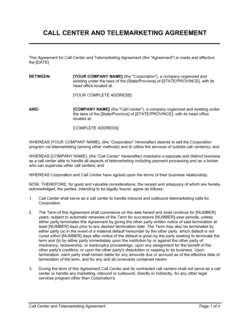
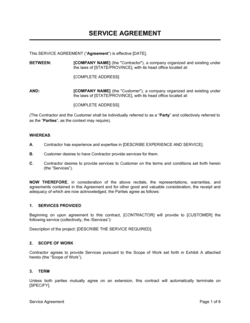
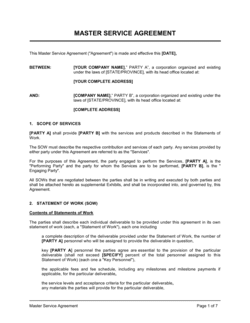
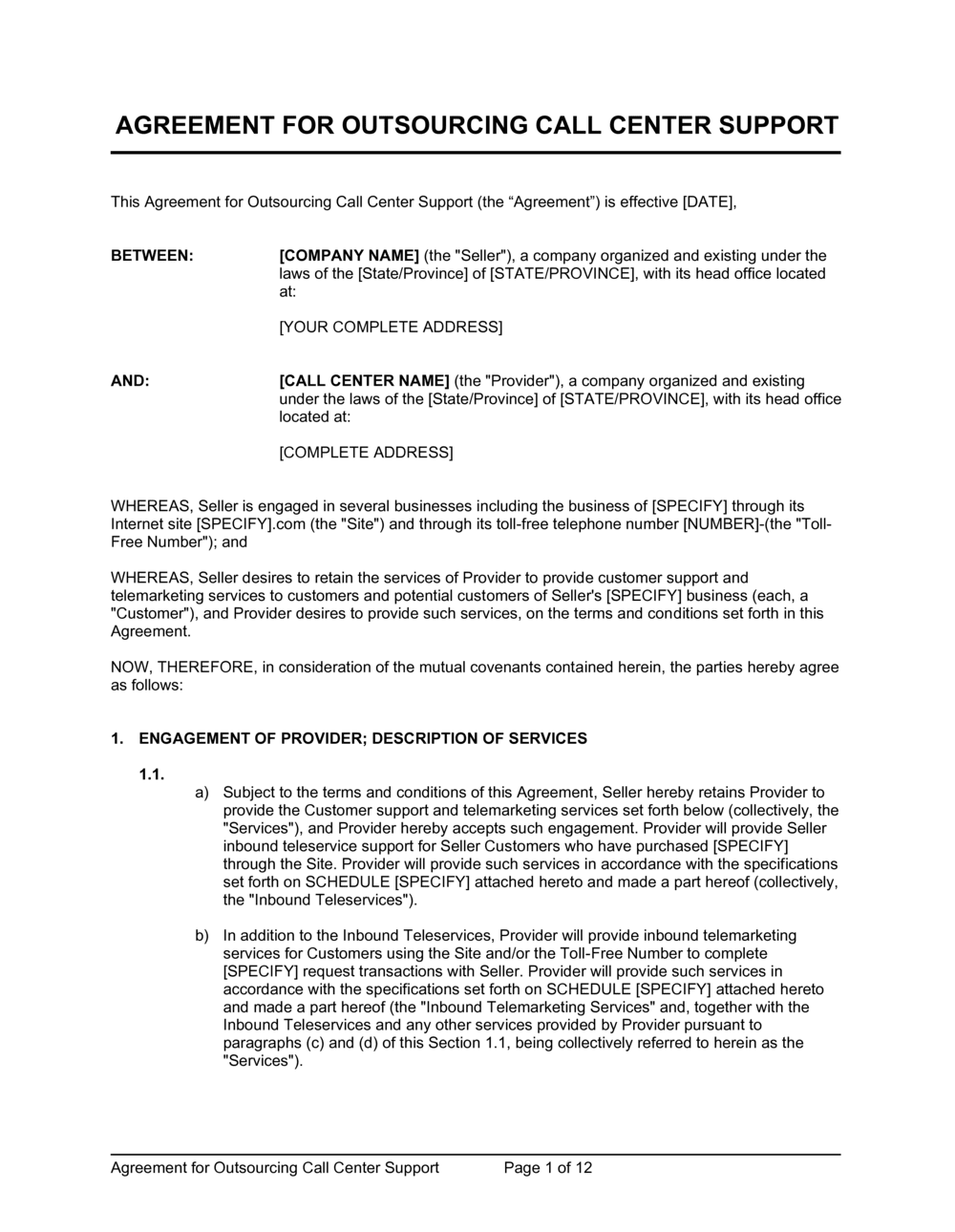
Agreement for Outsourcing Call Center Support Template

Free Word download • Edit online • Save & share with Drive • Export to PDF

12 pages30–40 min to fillDifficulty: ComplexSignature requiredLegal review recommended
Learn more ↓
FreeAgreement for Outsourcing Call Center Support Template

At a glance

What it is
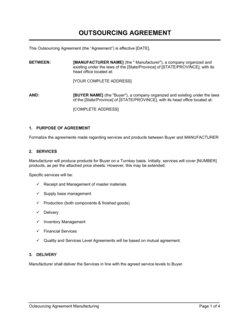
An Agreement for Outsourcing Call Center Support is a legally binding contract between a client company and a third-party call center provider that governs the full scope of outsourced customer support services. This free Word download covers SLAs, staffing requirements, data privacy obligations, confidentiality, IP ownership, fees, and termination in a single document you can edit online and export as PDF before execution.
When you need it
Use it before handing off any inbound, outbound, or blended customer support function to an external provider — whether for a pilot program, a seasonal surge, or a permanent operational transfer. It is equally necessary when the provider will handle sensitive customer data, process payments, or represent your brand to end customers.
What's inside
Scope of services, service level agreements with measurable KPIs, staffing and training obligations, data security and privacy requirements, fees and invoicing terms, confidentiality, IP assignment, liability caps, and termination rights including transition assistance upon exit.

What is an Agreement for Outsourcing Call Center Support?

An Agreement for Outsourcing Call Center Support is a legally binding contract between a client company and a third-party call center or business process outsourcing (BPO) provider that governs every material dimension of the outsourced customer support relationship. It defines the services to be performed, the performance standards the provider must meet, the fees and remedies for underperformance, how customer data must be protected, who owns call recordings and work product, and how either party may exit the arrangement. Unlike a generic services agreement, this document is purpose-built for the operational complexity of call center outsourcing — with SLA mechanisms, staffing obligations, and data privacy provisions that a standard vendor contract does not address.

Why You Need This Document

Handing customer interactions to a third party without a comprehensive written agreement exposes your business on multiple fronts simultaneously. Without defined SLAs and service credits, a provider who consistently misses answer-time or resolution targets faces no financial consequence and no contractual basis for termination. Without explicit data security provisions, a breach affecting your customers' personal information can trigger regulatory fines under GDPR, CCPA, or HIPAA — with your business bearing full liability for a failure that occurred in the provider's infrastructure. Without call recording ownership language, recordings that are critical for dispute resolution or quality assurance become the provider's property the moment the relationship ends. And without a transition assistance clause, switching providers can take months longer than necessary because the outgoing vendor has no obligation to cooperate. This template closes all four gaps with enforceable provisions that protect your customers, your data, your brand, and your operational continuity from the first contact to the last.

Which variant fits your situation?

If your situation is…Use this template
Outsourcing inbound customer service calls onlyAgreement for Outsourcing Call Center Support
Engaging a provider for outbound sales or telemarketingTelemarketing Services Agreement
Broad business process outsourcing beyond call center functionsBusiness Process Outsourcing Agreement
Hiring an independent contractor agent rather than a full providerIndependent Contractor Agreement
Adding a data processing addendum to an existing services agreementData Processing Agreement
Short-term or seasonal surge support with a fixed end dateFixed-Term Service Agreement
Outsourcing IT help desk instead of customer-facing supportIT Services Agreement

Common mistakes to avoid

❌ Embedding scope in the contract body instead of a SOW

Why it matters: Changing a single service channel or volume commitment requires a full contract amendment rather than a simple SOW revision, creating administrative drag and legal cost for routine operational adjustments.

Fix: Move all service specifics to Schedule A (Statement of Work) and include a change-order clause allowing the SOW to be updated by mutual written agreement without amending the master agreement.

❌ SLAs without defined measurement methods

Why it matters: When the client and provider use different reporting tools or different definitions of 'abandoned call,' every underperformance period becomes a dispute rather than a credit calculation.

Fix: Specify the exact system of record for each metric (e.g., the provider's ACD platform report), the sampling period, and who is responsible for generating and distributing the monthly performance report.

❌ No data breach notification deadline

Why it matters: GDPR requires notification to supervisory authorities within 72 hours of a breach. If the provider discovers a breach and has no contractual obligation to notify you promptly, you may miss that window and face regulatory fines.

Fix: Set a 24- to 48-hour notification obligation in the contract — shorter than the regulatory deadline so you have time to assess and file before the clock runs out.

❌ Applying the liability cap to data security incidents

Why it matters: A data breach affecting customer personal data can trigger regulatory fines, class-action settlements, and remediation costs that exceed a year's contract fees many times over — meaning the cap provides no real protection.

Fix: Explicitly carve data security breaches, confidentiality breaches, and IP indemnification obligations out of the aggregate liability cap so those categories carry separate or uncapped exposure.

❌ No transition assistance obligation

Why it matters: A provider who receives a termination notice has no financial or reputational incentive to cooperate with handover without a contractual obligation — data export can be delayed, knowledge transfer refused, and staffing pulled before a successor is ready.

Fix: Include a transition assistance clause requiring the provider to cooperate for up to 90 days post-termination notice, specifying data export format, knowledge transfer sessions, and staffing continuity — and include it as a survival obligation.

❌ Omitting call recording and transcript ownership

Why it matters: Call recordings are operationally valuable for QA and legally significant in disputes. Without explicit ownership language, providers treat them as their own operational data and may withhold or delete them on exit.

Fix: State explicitly that all call recordings, transcripts, and interaction data generated under the agreement are the sole property of the client, and require the provider to deliver a complete export within 30 days of termination.

The 10 key clauses, explained

Parties, recitals, and definitions

In plain language: Identifies the client and the provider by their full legal entity names, states the commercial purpose of the agreement, and defines all capitalized terms used throughout.

Sample language
This Agreement for Outsourcing Call Center Support ('Agreement') is entered into as of [EFFECTIVE DATE] by and between [CLIENT LEGAL NAME], a [STATE/COUNTRY] [ENTITY TYPE] ('Client'), and [PROVIDER LEGAL NAME], a [STATE/COUNTRY] [ENTITY TYPE] ('Provider').

Common mistake: Using a trading name instead of the registered legal entity for either party — this can void specific clauses or make enforcement against the correct legal entity difficult.

Scope of services and Statement of Work

In plain language: Specifies exactly which call center functions are outsourced — inbound, outbound, email, chat, or blended — the supported channels, languages, hours of operation, and contact volumes anticipated.

Sample language
Provider shall perform the services described in Schedule A (Statement of Work), including inbound customer support via [CHANNELS] in [LANGUAGE(S)], available [HOURS] across [COVERAGE DAYS], handling an estimated [VOLUME] contacts per month.

Common mistake: Defining scope in the body of the agreement instead of a separate SOW. Embedding scope makes it operationally hard to update as volumes or channels change without a full contract amendment.

Service level agreements and KPIs

In plain language: Sets measurable performance targets — average speed to answer, first-call resolution rate, customer satisfaction score, and abandonment rate — along with the measurement method and reporting cadence.

Sample language
Provider shall maintain the following minimum SLAs: (a) Average Speed to Answer: [X] seconds for [Y]% of calls; (b) First-Call Resolution: [Z]% or above; (c) Customer Satisfaction Score: [X]/5.0 or above; (d) Abandonment Rate: no greater than [X]%.

Common mistake: Setting SLA targets without specifying the measurement method or data source — disputes over whether a threshold was met are nearly impossible to resolve without agreed measurement rules.

Staffing, training, and quality assurance

In plain language: States the provider's obligations to maintain adequate staffing levels, train agents on the client's products and brand standards, and conduct ongoing quality monitoring including call recording and scoring.

Sample language
Provider shall maintain a minimum of [X] full-time-equivalent agents dedicated to Client's account, complete Client's onboarding training program within [X] days of hire, and conduct quality audits on a minimum of [X]% of calls per month using Client's approved scoring rubric.

Common mistake: Leaving staffing ratios undefined and relying on the provider's discretion. Understaffing is the single most common cause of SLA breaches, and without a contractual minimum, the client has no remedy.

Fees, invoicing, and service credits

In plain language: Defines the fee structure (per-minute, per-call, per-agent, or flat monthly), invoicing frequency, payment terms, late-payment penalties, and the formula for service credits when SLAs are missed.

Sample language
Client shall pay Provider a monthly fee of $[AMOUNT] based on [FEE BASIS], invoiced on the [X]th of each month, due Net [30] days. For each month in which Provider fails to meet any SLA, Client shall receive a service credit equal to [X]% of that month's fees per breached metric, up to a maximum of [Y]% of monthly fees.

Common mistake: Capping service credits at a token percentage — such as 2% of monthly fees — that provides no real financial incentive for the provider to fix persistent performance issues.

Data security, privacy, and compliance

In plain language: Requires the provider to implement and maintain specified security controls, restricts how customer personal data may be used, mandates breach notification within a defined timeframe, and incorporates applicable regulatory compliance obligations.

Sample language
Provider shall maintain information security controls no less rigorous than [ISO 27001 / SOC 2 Type II] standards. Provider shall notify Client of any confirmed or suspected data breach within [48] hours of discovery. Provider shall process Client's customer data solely as instructed by Client and shall not use such data for any purpose other than performing the Services.

Common mistake: Omitting a breach notification timeframe or setting one longer than 72 hours — which conflicts with GDPR's mandatory 72-hour supervisory authority notification window and exposes the client to regulatory fines.

Confidentiality and intellectual property

In plain language: Prohibits the provider from disclosing or using the client's confidential business information, customer data, and brand assets, and confirms that all work product, scripts, and materials created for the client belong to the client.

Sample language
All scripts, training materials, knowledge base content, and other work product created by Provider specifically for Client under this Agreement shall be the sole property of Client and are hereby assigned to Client. Provider shall treat all Client Confidential Information with no less care than it uses for its own confidential information, and in no event less than reasonable care.

Common mistake: Failing to specify who owns call recordings and interaction transcripts. Providers routinely retain these as operational assets unless the contract explicitly assigns them to the client.

Term, termination, and transition assistance

In plain language: Sets the initial contract term, renewal mechanics, the notice period required for either party to terminate, conditions permitting immediate termination for cause, and the provider's obligations to assist with handover to a successor vendor.

Sample language
This Agreement shall commence on [START DATE] and continue for an initial term of [X] months, renewing automatically for successive [X]-month periods unless either party provides [90] days' written notice of non-renewal. Upon termination, Provider shall provide up to [X] months of Transition Assistance, including data export in [FORMAT], knowledge transfer sessions, and staffing continuity, at no additional charge.

Common mistake: No transition assistance clause. Without it, a provider facing termination has no contractual obligation to cooperate with handover, leaving the client operationally stranded — sometimes for months.

Liability cap and indemnification

In plain language: Limits each party's maximum aggregate liability to a defined ceiling — typically 12 months of fees paid — and allocates responsibility for specific categories of loss, including data breaches, third-party IP claims, and regulatory fines.

Sample language
Each party's total aggregate liability under this Agreement shall not exceed the fees paid by Client to Provider in the [12] months immediately preceding the event giving rise to the claim. This cap shall not apply to breaches of confidentiality, data security obligations, or either party's indemnification obligations.

Common mistake: Applying the liability cap to data breach losses. A data breach affecting tens of thousands of customers can generate regulatory fines and class-action costs that dwarf a year's contract value — carving breach exposure out of the cap is essential.

Governing law and dispute resolution

In plain language: Specifies which jurisdiction's law governs the contract, how disputes are escalated before litigation (escalation ladder, mediation), and whether unresolved disputes go to arbitration or court.

Sample language
This Agreement is governed by the laws of [STATE / PROVINCE / COUNTRY]. The parties shall attempt in good faith to resolve disputes through executive escalation within [30] days of written notice. Unresolved disputes shall be submitted to binding arbitration administered by [AAA / JAMS / ICC] in [CITY / JURISDICTION].

Common mistake: Choosing a governing law with no real connection to either party's operations. Courts in many jurisdictions will apply local consumer protection or data privacy law regardless of what the contract states.

How to fill it out

  1. 1

    Identify both legal entities and insert the effective date

    Enter the full registered legal names of both the client company and the provider. Confirm entity type (LLC, corporation, Ltd.) and the state or country of formation for each. Set the effective date as the date both parties will sign.

    💡 Cross-check the provider's registered legal name against their business registration certificate before execution — brand names and legal names frequently differ in the BPO industry.

  2. 2

    Draft and attach the Statement of Work as Schedule A

    Define the specific services, supported channels (phone, email, chat, social), languages, hours of coverage, estimated monthly contact volumes, and any geographic restrictions. The SOW should stand alone as an operational document the provider's team uses daily.

    💡 Include a volume range — not just a single figure — to establish what triggers renegotiation. For example, 'between 5,000 and 15,000 contacts per month; volumes above 15,000 require a written change order.'

  3. 3

    Set measurable SLA targets and measurement rules

    Specify numeric thresholds for each KPI — average speed to answer in seconds, FCR percentage, CSAT score, abandonment rate — and state the measurement tool, reporting cadence, and who provides the data.

    💡 Require the provider to deliver a monthly performance report by the 5th business day of the following month. Delayed reporting obscures performance issues and delays service credit claims.

  4. 4

    Define the fee structure and service credit formula

    Enter the fee basis (per-agent FTE, per-minute, per-call, or monthly flat), the invoicing schedule, payment terms, and the exact service credit percentage and cap formula. Confirm that credits apply per breached metric, not per month overall.

    💡 Set the service credit cap at 20–30% of monthly fees rather than the industry-common 5–10%. A meaningful credit is the primary financial incentive for performance recovery.

  5. 5

    Complete the data security and privacy obligations

    Specify the security standard the provider must meet (ISO 27001, SOC 2 Type II, PCI DSS if payments are involved) and the breach notification window. If EU, UK, or California residents' data is involved, attach a Data Processing Addendum.

    💡 Ask the provider for their most recent SOC 2 Type II audit report before signing — a refusal to produce it is a material red flag.

  6. 6

    Negotiate the liability cap and carve-outs

    Set the aggregate liability cap as a multiple of annual fees paid. Explicitly carve out confidentiality breaches, data security incidents, and IP indemnification from the cap so those categories carry uncapped exposure.

    💡 Verify that the provider carries sufficient cyber liability insurance — $1M minimum for most engagements, $5M+ for healthcare or financial services — and require the client to be named as an additional insured.

  7. 7

    Set the term, notice periods, and transition assistance terms

    Choose an initial term (12 or 24 months is most common), automatic renewal periods, and the notice window required to exit (90 days is standard). Define transition assistance duration, deliverables, and whether it is included in fees or billed at cost.

    💡 Negotiate transition assistance before signing, not after notice is given. Providers who know they are being replaced have little incentive to cooperate without a contractual obligation already in place.

  8. 8

    Execute before the provider begins any work

    Both authorized signatories must sign before the provider accesses any customer data, begins training, or handles a single contact. Post-start execution creates fresh consideration problems and leaves early data handling legally ungoverned.

    💡 Use a timestamped eSignature platform and store the fully executed agreement in a location accessible to both your legal team and the operational team managing the relationship.

Frequently asked questions

What is a call center outsourcing agreement?

A call center outsourcing agreement is a legally binding contract between a client company and a third-party provider that governs the outsourcing of customer support functions — inbound calls, outbound calls, email, live chat, or a combination. It defines the scope of services, performance standards, data handling obligations, fees, and the conditions under which either party may exit the relationship. Without it, both parties are exposed to significant operational and legal risk.

What should a call center outsourcing agreement include?

At minimum: full legal names of both parties, a Statement of Work defining services and volumes, SLAs with measurable KPIs, staffing and training obligations, data security and privacy requirements, fee structure and service credits, confidentiality, IP and recording ownership, liability cap and indemnification, termination notice periods, transition assistance, and governing law. Missing any of these creates gaps that are costly to resolve once a dispute arises.

What SLAs should I include in a call center outsourcing contract?

Standard SLA metrics include average speed to answer (target 20–30 seconds for 80% of calls), first-call resolution rate (60–75% is typical), customer satisfaction score, abandonment rate (under 5%), and agent utilization rate. Each metric should have a numeric threshold, a measurement method, a reporting cadence, and a service credit formula triggered when the threshold is not met. Avoid SLAs without all four components — they are decorative rather than enforceable.

Who owns the call recordings made by the outsourced provider?

Ownership depends entirely on what the contract says. Many providers treat recordings as their own operational data by default. To ensure the client retains ownership, the agreement must explicitly assign all recordings, transcripts, and interaction data to the client and require a full data export within a defined period upon termination. Without this language, recovering your recordings after a contentious exit can require litigation.

What data privacy obligations should the contract address?

The contract should require the provider to maintain a specified security standard (ISO 27001 or SOC 2 Type II), limit data use strictly to performing the services, notify the client of any breach within 24–48 hours, and comply with applicable privacy laws. If the provider will handle data from EU or UK residents, a Data Processing Addendum compliant with GDPR is legally required. For California residents, CCPA service provider provisions must be incorporated.

What is a reasonable liability cap for a call center outsourcing contract?

A cap of 12 months of fees paid in the preceding year is the most common starting point. However, data security breaches, confidentiality violations, and IP indemnification should be carved out of the cap — these categories can generate losses that far exceed annual contract value. Require the provider to maintain cyber liability insurance with limits proportionate to the data they handle (at minimum $1M for general support, $5M for healthcare or financial services).

How much notice should I require before terminating the contract?

Ninety days is the industry standard for termination without cause in call center outsourcing agreements. This gives both parties time to wind down or transition without operational disruption. For cause termination — such as a material data breach or persistent SLA failure — an immediate or 30-day notice right is more appropriate. Always pair termination notice with a transition assistance obligation covering the notice period.

Do I need a lawyer to draft a call center outsourcing agreement?

For straightforward domestic arrangements with a small provider and limited data exposure, a high-quality template is a strong starting point. Engage a lawyer when the provider will handle sensitive personal data (health records, payment card data), when the engagement is cross-border, when annual contract value exceeds $250K, or when the client operates in a regulated industry such as healthcare or financial services. A template review typically costs $500–$1,500 and is well worth it for multi-year or high-volume engagements.

What happens if the provider misses SLA targets consistently?

If the contract includes a service credit clause, the client receives a percentage reduction on the next invoice for each breach. Beyond credits, most well-drafted agreements also give the client a right to terminate for cause if SLA failures persist for two or three consecutive months — providing a meaningful exit right without the burden of proving damages. Without both mechanisms, the client is financially exposed to poor performance with no practical remedy short of litigation.

How this compares to alternatives

vs General Services Agreement

A general services agreement covers the broad exchange of services for fees but lacks the operational specificity needed for call center outsourcing. It does not address SLAs, AHT, FCR, agent staffing ratios, call recording ownership, or surge pricing. A call center outsourcing agreement includes all of these as core components, not optional addenda. Use the general services agreement for simpler vendor relationships where output is project-based rather than volume-driven.

vs Independent Contractor Agreement

An independent contractor agreement engages an individual for specific deliverables without employment entitlements. It is not appropriate for outsourcing to a call center provider with its own workforce. Misclassifying a BPO provider relationship as a contractor engagement creates gaps in data security obligations, liability allocation, and SLA enforceability. Use a call center outsourcing agreement whenever the counterparty is an entity operating a staffed call center, not an individual.

vs Non-Disclosure Agreement

An NDA addresses confidentiality alone — it does not govern services, SLAs, fees, data security controls, or termination rights. Many outsourcing relationships begin with an NDA during due diligence, followed by the full outsourcing agreement at execution. The call center outsourcing agreement includes a confidentiality clause that supersedes any prior standalone NDA between the parties, so both documents are rarely needed simultaneously.

vs Master Service Agreement

A Master Service Agreement sets the overarching commercial terms for a vendor relationship — liability, confidentiality, IP, governing law — and is designed to govern multiple Statements of Work over time. A call center outsourcing agreement combines the master terms and the first SOW in a single document, which is simpler for single-engagement arrangements. For enterprises managing multiple BPO vendors or multiple service lines with one provider, an MSA plus separate SOWs offers more flexibility.

Industry-specific considerations

E-commerce and retail

High seasonal volume spikes require contractual surge staffing provisions and volume-based pricing tiers that adjust automatically above and below defined thresholds.

Healthcare

Providers handling patient scheduling, intake, or billing must be contractually bound to HIPAA Business Associate obligations, with BAA provisions either embedded or attached as an exhibit.

Financial services

PCI DSS compliance is mandatory for any provider handling payment card data; FINRA or FCA record-keeping obligations require defined call recording retention periods and access rights.

SaaS and technology

Tier-1 support outsourcing requires detailed escalation path definitions, access to internal knowledge bases, and integration with the client's ticketing platform — all governed by separate technical exhibits.

Telecommunications

Providers supporting telecom clients must comply with TCPA regulations for outbound calls and maintain state-by-state do-not-call compliance documentation as part of their contractual obligations.

Insurance

Agents handling first-notice-of-loss or policy inquiries may require state licensing; the agreement must confirm the provider's obligation to ensure agent credentials are current and disclosed to the client.

Jurisdictional notes

United States

US call center outsourcing contracts must account for TCPA compliance for any outbound calling, state-by-state do-not-call registry obligations, and CCPA data handling provisions for California residents. At-will employment norms mean provider staffing commitments carry less legal weight than in other jurisdictions — rely on minimum FTE clauses rather than staffing continuity assumptions. If the provider handles payment card data, PCI DSS compliance obligations must be explicitly contracted.

Canada

Canada's Anti-Spam Legislation (CASL) imposes strict requirements on outbound electronic communications, and PIPEDA (federally) or provincial privacy statutes govern personal data handling. Quebec's Law 25 requires enhanced data governance obligations for providers processing Quebec residents' data and mandates a Privacy Impact Assessment for cross-border data transfers. French-language requirements may apply to contracts and service delivery for Quebec-based operations.

United Kingdom

Post-Brexit, UK GDPR and the Data Protection Act 2018 require a Data Processing Agreement compliant with UK adequacy standards for any provider handling UK residents' personal data. The ICO expects breach notification within 72 hours. Ofcom regulations govern outbound calling practices, including call abandonment rate limits (no more than 3% of live outbound calls in any 24-hour period). Contracts should reference the FCA's outsourcing requirements for regulated financial services firms.

European Union

GDPR mandates a Data Processing Agreement (Article 28) for any provider processing EU residents' personal data, requiring documented instructions, sub-processor approval rights, audit rights, and breach notification within 72 hours to the controller. Cross-border data transfers outside the EEA require Standard Contractual Clauses or an adequacy decision. EBA and EIOPA outsourcing guidelines impose additional obligations for financial services and insurance firms, including concentration risk assessment and exit strategy documentation.

Template vs lawyer — what fits your deal?

PathBest forCostTime
Use the templateDomestic outsourcing arrangements with established providers for non-sensitive support functions, annual contract value under $150KFree1–3 hours to complete
Template + legal reviewCross-border engagements, providers handling personal data, regulated industries, or contracts with annual value of $150K–$500K$500–$1,5003–7 days
Custom draftedLarge-scale BPO engagements, healthcare or financial services clients, multi-jurisdiction data flows, or contracts exceeding $500K annually$2,000–$8,000+2–6 weeks

Glossary

Service Level Agreement (SLA)
A contractual commitment specifying minimum performance standards — such as average speed to answer, first-call resolution rate, and abandonment rate — that the provider must meet.
Average Handle Time (AHT)
The average duration of a single customer interaction from the moment the agent answers to the end of any post-call work, used as a KPI in SLAs.
First-Call Resolution (FCR)
The percentage of customer contacts resolved in a single interaction without requiring a callback or escalation — a primary quality metric for call centers.
Business Process Outsourcing (BPO)
The practice of contracting one or more business functions — including customer support — to an external provider rather than handling them in-house.
Statement of Work (SOW)
A schedule or exhibit attached to the master agreement that defines the specific services, volume commitments, locations, staffing levels, and deliverables for a given engagement.
Data Processing Addendum (DPA)
A supplemental agreement governing how the provider may collect, store, process, and delete personal data on behalf of the client, required under GDPR, CCPA, and similar regulations.
Service Credit
A financial remedy — typically a percentage reduction in the next invoice — owed by the provider to the client when SLA performance falls below the contracted threshold.
Transition Assistance
Obligations requiring the outgoing provider to cooperate with handover to a successor vendor, including data export, knowledge transfer, and staffing continuity for a defined period.
Force Majeure
A clause excusing a party's non-performance when caused by events outside reasonable control — such as natural disasters, pandemics, or government orders — for a defined period.
Indemnification
A contractual obligation requiring one party to compensate the other for losses, claims, or damages arising from a defined category of fault or breach.
Liability Cap
A contractual ceiling — often expressed as a multiple of fees paid in the preceding 12 months — limiting the maximum amount either party can recover in damages.
Change Order
A written amendment to the Statement of Work that formally modifies scope, volume, pricing, or timelines, requiring signatures from both parties before taking effect.

Part of your Business Operating System

This document is one of 3,000+ business & legal templates included in Business in a Box.

  • Fill-in-the-blanks — ready in minutes
  • 100% customizable Word document
  • Compatible with all office suites
  • Export to PDF and share electronically

Create your document in 3 simple steps.

From template to signed document — all inside one Business Operating System.
1
Download or open template

Access over 3,000+ business and legal templates for any business task, project or initiative.

2
Edit and fill in the blanks with AI

Customize your ready-made business document template and save it in the cloud.

3
Save, Share, Send, Sign

Share your files and folders with your team. Create a space of seamless collaboration.

Save time, save money, and create top-quality documents.

★★★★★

"Fantastic value! I'm not sure how I'd do without it. It's worth its weight in gold and paid back for itself many times."

Managing Director · Mall Farm
Robert Whalley
Managing Director, Mall Farm Proprietary Limited
★★★★★

"I have been using Business in a Box for years. It has been the most useful source of templates I have encountered. I recommend it to anyone."

Business Owner · 4+ years
Dr Michael John Freestone
Business Owner
★★★★★

"It has been a life saver so many times I have lost count. Business in a Box has saved me so much time and as you know, time is money."

Owner · Upstate Web
David G. Moore Jr.
Owner, Upstate Web

Run your business with a system — not scattered tools

Stop downloading documents. Start operating with clarity. Business in a Box gives you the Business Operating System used by over 250,000 companies worldwide to structure, run, and grow their business.

Free Forever Plan · No credit card required