1
Enter the position details and reporting line
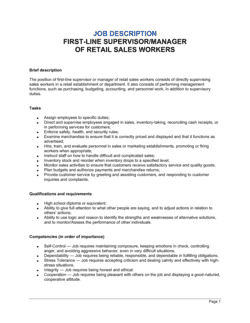
Fill in the official job title as it appears in your HR system, the department name, the direct manager's title, and the number of agents the supervisor will oversee. Confirm the title matches your payroll records before publishing the posting.
💡 Use the title that will appear on the employee's paystub and employment agreement — inconsistencies between documents create problems during termination or unemployment claims.
2
Write a focused role summary
Draft a 2–4 sentence paragraph describing the core purpose of the role, the team it leads, and the primary outcome the supervisor is accountable for. Avoid generic language — reference your specific environment (inbound, outbound, BPO, in-house).
💡 A strong role summary doubles as the opening paragraph of the job posting. Write it as though you are explaining the role to a strong internal candidate who has never heard of it.
3
List core duties in priority order
Start with the three to five most critical daily responsibilities — typically call monitoring, agent coaching, queue management, and escalation handling — before adding secondary tasks. Keep the total list to 8–12 items.
💡 End the duties list with 'Other duties as reasonably assigned by [MANAGER TITLE]' to preserve flexibility without undermining the document's specificity.
4
Set specific, measurable KPIs
Enter your actual performance targets for AHT, FCR, CSAT, QA score, and schedule adherence. Use your current team's rolling 90-day averages as the baseline and set the target 5–10% above that baseline.
💡 If you are hiring for a new call center with no historical data, use industry benchmarks — FCR ≥ 70%, CSAT ≥ 4.0/5, and AHT ≤ 6 minutes are widely accepted starting points.
5
Define required and preferred qualifications separately
Place mandatory requirements in one section and preferred qualifications in a clearly labeled separate section. Review required qualifications to ensure each one is genuinely necessary and not a proxy for protected characteristics.
💡 If the role does not involve written reports or compliance documentation, remove bachelor's degree as a requirement — courts have found mandatory degree requirements for non-degree-dependent roles to have disparate impact.
6
Document the schedule and work location
State the standard shift hours, any rotating or weekend coverage requirements, and whether the role is on-site, remote, or hybrid. For remote roles, specify whether the employee must be in a specific state, province, or country.
💡 For hybrid arrangements, specify the minimum number of on-site days per week in writing — 'flexible' without a minimum creates scheduling disputes within 90 days.
7
Add the compensation band and FLSA classification
Enter the salary range rather than a fixed figure, confirm whether the role is FLSA-exempt or non-exempt, and reference the benefits plan by category rather than plan specifics.
💡 Supervisors who spend more than 50% of their time performing the same tasks as the agents they manage may not qualify for the FLSA executive exemption — confirm classification with HR or employment counsel before publishing.
8
Obtain signatures before or on the first day
Have the employee sign the acknowledgment block before or on their start date. File the signed copy in the personnel record and provide the employee with a copy.
💡 In common-law jurisdictions, a job description signed after the start date without new consideration may not be enforceable as a contractual document — execute it alongside or before the employment agreement.