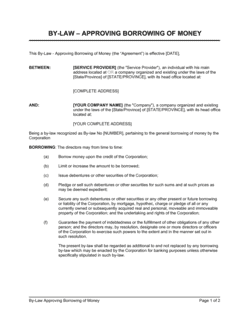
By-Law Banking Template

Free Word download • Edit online • Save & share with Drive • Export to PDF

2 pages20–30 min to fillDifficulty: StandardSignature requiredLegal review recommended
Learn more ↓
FreeBy-Law Banking Template

At a glance

What it is
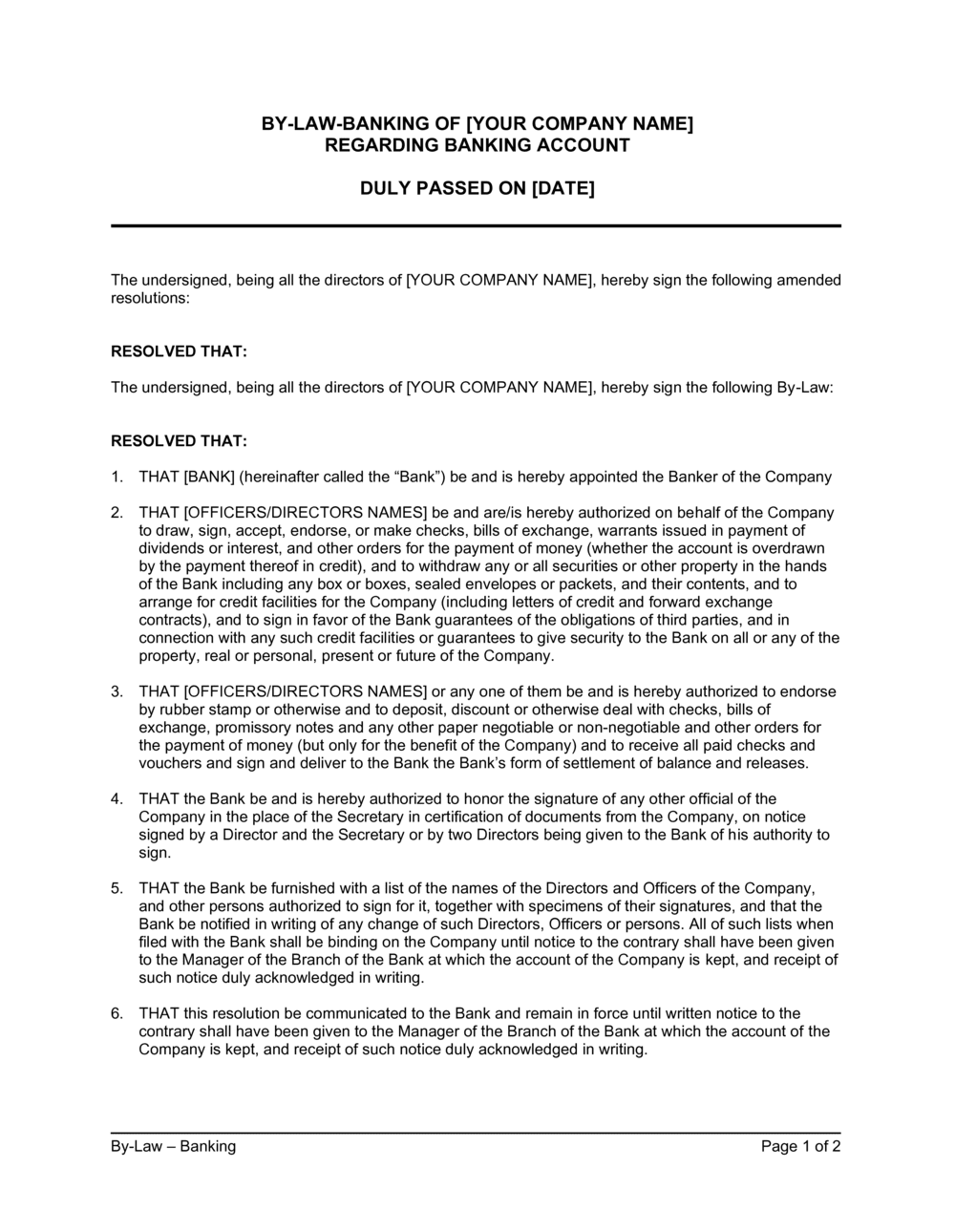
A Banking Bylaw is a formal corporate document that establishes and governs an organization's relationship with its financial institution — defining who is authorized to open accounts, sign cheques, execute wire transfers, obtain credit facilities, and bind the corporation to banking agreements. This free Word download gives you a structured, board-approved template you can edit online and present directly to your bank or credit union.
When you need it
Use it when incorporating a new business and opening a corporate bank account, when adding or removing authorized signatories, or when a financial institution requires a formal resolution confirming the corporation's banking authority before processing a credit application or account change.
What's inside
Identification of the corporation and its governing body, designation of authorized officers and signatories, scope of banking powers (including borrowing limits and account types), signature requirements for transactions of varying dollar thresholds, and certification by the corporate secretary.

What is a Banking Bylaw?

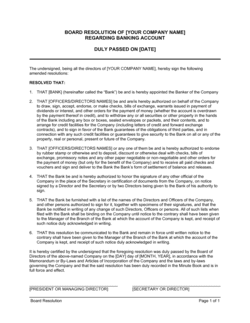
A Banking Bylaw (also called a banking resolution) is a formal corporate document adopted by a company's board of directors that establishes its relationship with a financial institution and defines the scope of financial authority delegated to officers and signing personnel. It specifies who may open and close accounts, sign cheques, authorize wire transfers, endorse deposits, and commit the corporation to credit agreements — and under what conditions dual signatures are required. Without a properly certified banking bylaw on file, most banks and credit unions will not open a corporate account, process a credit application, or recognize a change in authorized signatories.

Why You Need This Document

Operating without a current, board-certified banking bylaw creates immediate and compounding risk. Banks refuse to act on instructions from individuals whose authority cannot be verified, which means a payroll run, a supplier payment, or a loan drawdown can be blocked the moment a signatory leaves the organization. An outdated bylaw naming a departed officer remains technically in effect until formally revoked — giving that person continued legal authority over the account in the bank's records. For credit applications, lenders require documented borrowing authority before committing funds; a missing or unsigned bylaw delays closing and can cause deal terms to lapse. This template provides a complete, bank-ready structure that closes all four gaps — account authority, signatory control, electronic transfer power, and borrowing limits — in a single certified document your corporate secretary can present on the same day the board passes it.

Which variant fits your situation?

If your situation is…Use this template
Opening a first corporate bank account at incorporationBy Law Banking (Standard)
Authorizing a specific borrowing or credit facility onlyBanking Resolution — Borrowing Authority
Adding or removing a signatory on an existing accountBanking Resolution — Change of Signatories
Establishing signing authority for a nonprofit organizationNonprofit Banking Resolution
Authorizing online banking and electronic transfers specificallyElectronic Banking Authorization Resolution
Setting multi-signatory controls for large-dollar transactionsDual-Signatory Banking Bylaw
Documenting banking authority for a partnership rather than a corporationPartnership Banking Resolution

Common mistakes to avoid

❌ Using officer names instead of officer titles

Why it matters: When a named individual leaves the organization, the bylaw becomes stale and the bank will freeze transaction authority until an amended resolution is filed — potentially blocking payroll or supplier payments.

Fix: Always designate authority by title (e.g., 'the CEO') rather than by personal name, and update the bylaw only when the titled role itself changes or is eliminated.

❌ Omitting electronic transfer authority

Why it matters: Standard bylaw templates drafted before online banking became routine often cover cheques only, leaving no legal basis for EFT or wire transactions — banks will flag this when a corporation attempts to set up online payment workflows.

Fix: Add a dedicated clause authorizing electronic funds transfers and wire payments with explicit per-transaction and daily limits that match the bank's platform controls.

❌ No revocation of prior banking resolutions

Why it matters: Without an explicit revocation clause, an older resolution naming a departed officer remains technically in effect, creating a conflicting authorization record that banks and auditors will flag.

Fix: Include a revocation clause in every updated bylaw that explicitly cancels all prior banking resolutions by date, and deliver the new bylaw to the bank in writing.

❌ Unlimited borrowing authority

Why it matters: Granting an officer uncapped authority to borrow exposes the corporation to unilateral debt commitments beyond board-approved limits, which can trigger covenant breaches on existing credit facilities or surprise the board with undisclosed liabilities.

Fix: Set a specific dollar cap on borrowing authority and require a new board resolution — or shareholder approval depending on the amount — for any credit facility exceeding that cap.

❌ Corporate secretary and authorized signatory are the same person

Why it matters: Having the same individual both certify the bylaw and receive the authority it grants undermines the independence of the certification — some banks and auditors will refuse to accept it.

Fix: Appoint a separate corporate secretary to execute the certification block, or have an independent director sign the certification if no separate secretary has been named.

❌ Failing to deposit the bylaw in the minute book before presenting to the bank

Why it matters: A bylaw presented to the bank without a corresponding minute-book entry has no formal corporate record supporting it, creating a governance gap that can become material during a financing, acquisition, or audit.

Fix: Record the adopting board resolution in the minute book first, then provide the bank with a certified copy that references the meeting date and resolution number.

The 10 key clauses, explained

Corporation identification

In plain language: States the full legal name of the corporation, its jurisdiction of incorporation, and the date the bylaw was adopted.

Sample language
RESOLVED that [CORPORATION LEGAL NAME], a corporation incorporated under the laws of [JURISDICTION], hereby adopts the following banking bylaw effective [DATE].

Common mistake: Using a trade name or operating name instead of the exact registered legal name — banks match this against incorporation documents and will reject a bylaw with a name mismatch.

Designation of financial institution

In plain language: Names the bank or credit union with which the corporation is establishing or confirming its banking relationship, including the branch address.

Sample language
The Corporation is authorized to bank with [FINANCIAL INSTITUTION NAME], [BRANCH ADDRESS] ('the Bank'), and such other financial institutions as the board may from time to time designate.

Common mistake: Failing to include an 'and such other institutions' catch-all — this forces a new bylaw every time the corporation opens a secondary account elsewhere.

Account opening authority

In plain language: Authorizes named officers to open, maintain, and close bank accounts, including chequing, savings, and investment accounts.

Sample language
Any one of the following officers is authorized to open, operate, and close accounts with the Bank on behalf of the Corporation: [OFFICER TITLE 1], [OFFICER TITLE 2], [OFFICER TITLE 3].

Common mistake: Listing individuals by name rather than officer title — when a named person leaves, the bylaw becomes invalid and must be amended before the bank will recognize the replacement.

Cheque signing authority

In plain language: Defines who may sign cheques and whether any transaction requires one or two signatures, with a dollar threshold separating single- and dual-signatory requirements.

Sample language
Cheques, drafts, or orders for the payment of money drawn on the Corporation's accounts shall be signed by any [ONE / TWO] of the authorized signing officers. Payments exceeding $[THRESHOLD AMOUNT] require two signatures.

Common mistake: Setting the dual-signature threshold too high — a $50,000 threshold that requires two signatures offers no practical protection against mid-range fraud or unauthorized payments.

Electronic and wire transfer authority

In plain language: Extends signing authority to electronic funds transfers, wire payments, and online banking transactions, specifying any per-transaction or daily limits.

Sample language
Authorized signing officers are hereby empowered to initiate electronic funds transfers and wire transfers on behalf of the Corporation, subject to a per-transaction limit of $[AMOUNT] unless a second authorized officer provides written confirmation.

Common mistake: Omitting electronic transfer authority entirely — many older bylaw templates predate internet banking, leaving a gap that banks flag when a corporation attempts to authorize EFT or online payment platforms.

Borrowing and credit facility authority

In plain language: Authorizes designated officers to negotiate and execute credit agreements, lines of credit, term loans, and related security documents up to a board-approved limit.

Sample language
The [CEO / CFO / PRESIDENT] is authorized to negotiate and execute, on behalf of the Corporation, credit agreements, lines of credit, and term loans with the Bank up to an aggregate principal amount of $[CREDIT LIMIT], and to grant such security as the Bank may require.

Common mistake: No dollar cap on borrowing authority — leaving the amount unlimited exposes the corporation to an officer unilaterally committing the business to debt beyond what the board has approved.

Deposit and endorsement authority

In plain language: Authorizes designated officers to deposit funds into corporate accounts and endorse cheques and other instruments received by the corporation.

Sample language
Any officer or employee designated by the [CEO / CFO] is authorized to endorse cheques, drafts, and other instruments payable to the Corporation for deposit to its accounts at the Bank.

Common mistake: Restricting deposit authority to signing officers only — this creates operational bottlenecks when a bookkeeper or accounts-receivable clerk needs to make routine deposits.

Revocation of prior authority

In plain language: Explicitly revokes any previously granted banking authority so there is no ambiguity about which resolution governs the current banking relationship.

Sample language
All prior banking resolutions, authorizations, and arrangements between the Corporation and the Bank are hereby revoked and replaced in their entirety by this By-Law, effective [DATE].

Common mistake: Omitting a revocation clause — banks have refused to honor updated signatories because an earlier resolution naming a departed employee was never formally cancelled.

Certification by corporate secretary

In plain language: A certification signed by the corporate secretary confirming that the bylaw was duly adopted by the board, that it is in full force, and that the named officers hold the stated positions.

Sample language
I, [CORPORATE SECRETARY NAME], Corporate Secretary of [CORPORATION LEGAL NAME], hereby certify that the foregoing is a true copy of a resolution duly passed at a meeting of the Board of Directors held on [DATE], at which a quorum was present, and that the resolution is in full force and effect as of the date hereof.

Common mistake: Having an authorized signatory also certify the bylaw — the certifying officer should be the corporate secretary, not one of the persons being granted authority, to preserve the independence of the certification.

Amendment and ongoing authority

In plain language: Confirms that the board retains authority to amend the bylaw at any time by resolution, and that the Bank may rely on a certified copy as conclusive evidence of the corporation's current authority.

Sample language
The Bank is hereby authorized to rely on a certified copy of this By-Law as conclusive evidence of the Corporation's banking authority until written notice of amendment or revocation is delivered to the Bank by the Corporate Secretary.

Common mistake: No amendment clause — without it, the bank may require an entirely new bylaw rather than a short amending resolution each time a signatory changes, creating unnecessary administrative burden.

How to fill it out

  1. 1

    Enter the corporation's full legal name and jurisdiction

    Copy the exact name from the certificate of incorporation or articles. Confirm the jurisdiction — federal, state, or provincial — and enter the effective date of the bylaw.

    💡 Cross-reference the corporation's most recent annual return filing to confirm the legal name hasn't changed since incorporation.

  2. 2

    Name the financial institution and branch

    Enter the full legal name of the bank or credit union and the specific branch address where accounts will be held. Add the catch-all phrase authorizing future institutions.

    💡 Call the bank's business banking department before completing this section — some institutions require their own prescribed bylaw form alongside yours.

  3. 3

    Designate authorized officers by title

    List each authorized signing officer by their corporate title — CEO, CFO, President, Treasurer — rather than by personal name. Confirm each title matches the officer's appointment resolution in the minute book.

    💡 If your corporation has only one or two officers, consider naming a backup signatory such as a director to avoid account lockout if a primary officer is unavailable.

  4. 4

    Set the dual-signature threshold

    Choose a dollar amount above which two signatures are required on cheques and transfers. A threshold of 5–10% of monthly operating expenses is a common internal control benchmark.

    💡 Align this threshold with your external auditor's or accountant's internal control recommendations — misalignment can be flagged in financial statement notes.

  5. 5

    Define electronic and wire transfer limits

    Enter per-transaction and daily limits for EFT and wire transfers. Coordinate these limits with your bank's online banking platform to ensure the bylaw's limits are reflected in the system.

    💡 Many banking platforms allow you to hardcode per-user transfer limits — set these at or below the bylaw's limits to enforce the controls technically, not just on paper.

  6. 6

    Insert the borrowing authority cap

    Enter the maximum aggregate credit the designated officer may commit the corporation to without additional board approval. This figure should be consistent with the board's approved operating budget.

    💡 Review your current and projected credit needs before setting this cap — setting it too low forces a bylaw amendment before closing a routine credit facility.

  7. 7

    Pass the bylaw at a board meeting and record it in the minute book

    The bylaw must be formally adopted by a quorum of the board of directors. Record the meeting date, attendees, and the resolution in the minute book before presenting the document to the bank.

    💡 If directors are remote, a written resolution signed by all directors (in lieu of a meeting) is accepted in most jurisdictions — confirm this with the corporation's legal counsel.

  8. 8

    Have the corporate secretary certify and deliver to the bank

    The corporate secretary signs the certification block, attaches a certified copy to the bank's account-opening package, and retains the original in the minute book.

    💡 Ask the bank's business banking officer to stamp and date a copy as received — this creates a clear record of when the new authority took effect.

Frequently asked questions

What is a banking bylaw?

A banking bylaw is a formal corporate document adopted by the board of directors that governs the corporation's relationship with its financial institution. It designates who is authorized to open and operate accounts, sign cheques, execute electronic transfers, and borrow money on the corporation's behalf. Most banks require a certified copy of the banking bylaw before opening a corporate account or processing a credit application.

Is a banking bylaw the same as a banking resolution?

In practice, the terms are often used interchangeably, but they have a technical distinction. A bylaw is a standing governance rule adopted as part of the corporation's permanent governance framework. A resolution is a one-time board decision that authorizes a specific action. Many corporations adopt a banking bylaw at incorporation and then update it through subsequent amending resolutions whenever signatories or account terms change.

When does a corporation need a banking bylaw?

A banking bylaw is required when opening a corporate bank account, adding or removing authorized signatories, applying for a business credit facility, or changing the scope of banking authority — for example, adding electronic transfer or wire payment powers. Banks will not process these changes without a certified corporate resolution or bylaw on file.

Who needs to sign a banking bylaw?

The banking bylaw must be passed by a quorum of the board of directors and certified by the corporate secretary. The authorized signatories named in the bylaw do not need to sign the bylaw itself — their authority flows from the board resolution. The corporate secretary's certification block confirms the resolution was duly passed and is in full force.

Can a sole director corporation use a banking bylaw?

Yes. A sole director corporation passes the resolution by written consent rather than at a formal meeting, which is permitted in most jurisdictions for single-director companies. The director signs as both the board and, if no separate secretary is appointed, as corporate secretary. Some banks accept this structure; others may require a second director signature for certain credit facilities — confirm with your specific institution.

How often should a banking bylaw be updated?

Update it whenever an authorized signatory is added, removed, or changes title, when borrowing limits need to be revised, when a new bank or account type is added, or when internal controls require a change to signing thresholds. Keeping the bylaw current eliminates the risk of transaction delays when banking personnel change or when the bank conducts a periodic account review.

Does a banking bylaw need to be notarized?

Notarization is not typically required for a banking bylaw in Canada, the United States, the United Kingdom, or the European Union. Banks accept a certified copy signed by the corporate secretary as sufficient. However, some international banking arrangements or foreign correspondent banks may require notarization or apostille certification — confirm with the receiving institution before execution.

What happens if a corporation's banking bylaw is out of date?

An outdated bylaw can block routine transactions. If a signatory named in the bylaw has left and no replacement has been formally authorized, the bank may freeze cheque signing or transfer authority until an updated certified resolution is filed. For corporations with active payroll or vendor payment cycles, this can create immediate operational disruption. Pass an amending resolution promptly whenever personnel changes affect designated signatories.

Can the bank require its own form in addition to this template?

Yes. Most major banks have their own prescribed banking resolution or account agreement forms that must be completed alongside — or instead of — a corporate-generated bylaw. This template establishes the corporation's internal governance record, which is required regardless. Bring a certified copy of this bylaw to the bank along with any forms the institution provides, and confirm whether both are needed before the account is activated.

How this compares to alternatives

vs General corporate bylaw

A general corporate bylaw covers the full governance framework of a corporation — director elections, meeting procedures, officer roles, and voting rights. A banking bylaw is a narrowly scoped document that deals exclusively with financial institution authority. Banks do not accept a general bylaw as a substitute for a banking resolution; both documents serve distinct purposes.

vs Board resolution

A board resolution is a one-time decision passed to authorize a specific action. A banking bylaw is a standing governance document that governs all banking activities on an ongoing basis. For routine signatory updates, a short amending resolution referencing the existing bylaw is sufficient; for establishing a new banking relationship, the full bylaw is required.

vs Signing authority policy

A signing authority policy is an internal operational document that sets out spending limits and approval workflows for management. It is not presented to banks and is not a formal corporate record. A banking bylaw is a legally operative document filed with the financial institution; the two documents should be consistent with each other but serve entirely different audiences.

vs Operating agreement (LLC)

An LLC operating agreement governs the relationship among members and managers of a limited liability company, including financial decision-making authority. Some banks accept relevant sections of an operating agreement as evidence of banking authority for an LLC. A banking bylaw is the equivalent instrument for corporations and provides a standalone, purpose-built record that is more readily accepted by financial institutions than an extracted operating agreement clause.

Industry-specific considerations

Technology and SaaS

Frequently updated to add new signing officers during rapid executive hiring, and expanded to authorize electronic payment platforms and multi-currency accounts for international SaaS billing.

Professional Services

Law firms and accounting practices require trust account provisions and dual-signatory controls on client funds accounts, alongside standard operating account authority.

Nonprofit Organizations

Nonprofit bylaws typically require board-level approval for any borrowing and mandate dual signing authority on all disbursements above a low threshold to satisfy grant-compliance and audit requirements.

Construction and Real Estate

Project-specific accounts and bonding requirements mean construction firms regularly file amending resolutions to authorize new accounts for each major contract, with credit facility caps tied to project budgets.

Jurisdictional notes

United States

Corporate banking authority is governed by state corporation statutes, which vary in how they define officer authority and bylaw adoption requirements. Most states require a quorum of the board to adopt or amend bylaws unless the articles delegate this power to officers. Some banks operating under federal charters (OCC-regulated national banks) have standardized resolution forms that must accompany the corporate bylaw. California and Delaware have specific statutory provisions governing officer signing authority that should be reflected in the bylaw's language.

Canada

Under the Canada Business Corporations Act and provincial equivalents, bylaws take effect immediately upon adoption by the board but must be ratified by shareholders at the next annual meeting. Banks chartered under the Bank Act typically have their own prescribed resolution forms that must be completed alongside the corporate bylaw. Quebec civil law corporations (constituted under the QBCA) use a slightly different governance framework, and French-language versions of the bylaw may be required for provincially regulated Quebec entities.

United Kingdom

UK companies are governed by the Companies Act 2006, and banking authority is typically established through a board resolution rather than a standalone bylaw instrument. UK banks generally require a certified extract of the relevant board resolution and a copy of the company's articles of association confirming the directors' authority to delegate financial powers. The company secretary's certification plays a central role in authenticating the authority of signing officers, particularly for sole-director private limited companies where Companies House filings are scrutinized.

European Union

Banking authority documentation requirements vary significantly across EU member states. German GmbHs require notarized documents for certain banking powers, while French SAS entities use a Président-signed certification. The EU's Anti-Money Laundering directives (AMLD5 and AMLD6) require banks to verify beneficial ownership and the chain of authority in corporate banking documents, making a clear and complete bylaw critical for account opening compliance. GDPR considerations apply when the bylaw lists personal officer details that may be shared with correspondent banks.

Template vs lawyer — what fits your deal?

PathBest forCostTime
Use the templateStandard domestic corporations opening a first bank account or updating signatories with no credit facility involvedFree20–30 minutes
Template + legal reviewCorporations adding a credit facility, dual-signatory controls, or trust account provisions$150–$400 (corporate lawyer or notary review)1–2 days
Custom draftedMulti-jurisdictional corporations, heavily regulated industries (financial services, healthcare), or complex borrowing structures requiring board and shareholder approval$500–$2,000+3–7 business days

Glossary

Banking Bylaw
A formal corporate document adopted by the board of directors that establishes the organization's banking authority, designates authorized signatories, and sets the scope of permitted financial transactions.
Authorized Signatory
An individual named in the banking bylaw who has board-approved authority to sign cheques, authorize transfers, and execute banking documents on behalf of the corporation.
Board Resolution
A formal decision passed by a corporation's board of directors, recorded in writing, that authorizes a specific action — such as opening a bank account or appointing a signing officer.
Signing Officer
An officer of the corporation — typically the CEO, CFO, or treasurer — designated to execute financial instruments and banking documents within defined limits.
Borrowing Powers
The authority granted to designated officers to obtain credit, draw on lines of credit, issue promissory notes, or otherwise incur debt on behalf of the corporation within limits set by the bylaw.
Quorum
The minimum number of directors or officers required to be present for a board meeting to validly pass a resolution, as defined in the corporation's constating documents.
Constating Documents
The foundational legal documents of a corporation — articles of incorporation, certificate of incorporation, or charter — that establish its existence and basic governance rules.
Dual Signing Authority
A control requirement in which two authorized signatories must both sign for a transaction to be valid, typically applied to cheques or transfers above a specified dollar threshold.
Corporate Seal
An embossed or printed stamp bearing the corporation's name and jurisdiction, sometimes required alongside a signature to formally authenticate corporate documents.
Certified Copy
A copy of a corporate resolution or bylaw signed by the corporate secretary attesting that it is a true and complete reproduction of the original as recorded in the minute book.
Minute Book
The official corporate record containing resolutions, meeting minutes, bylaws, and other governance documents required to be maintained under corporate law.

Part of your Business Operating System

This document is one of 3,000+ business & legal templates included in Business in a Box.

  • Fill-in-the-blanks — ready in minutes
  • 100% customizable Word document
  • Compatible with all office suites
  • Export to PDF and share electronically

Create your document in 3 simple steps.

From template to signed document — all inside one Business Operating System.
1
Download or open template

Access over 3,000+ business and legal templates for any business task, project or initiative.

2
Edit and fill in the blanks with AI

Customize your ready-made business document template and save it in the cloud.

3
Save, Share, Send, Sign

Share your files and folders with your team. Create a space of seamless collaboration.

Save time, save money, and create top-quality documents.

★★★★★

"Fantastic value! I'm not sure how I'd do without it. It's worth its weight in gold and paid back for itself many times."

Managing Director · Mall Farm
Robert Whalley
Managing Director, Mall Farm Proprietary Limited
★★★★★

"I have been using Business in a Box for years. It has been the most useful source of templates I have encountered. I recommend it to anyone."

Business Owner · 4+ years
Dr Michael John Freestone
Business Owner
★★★★★

"It has been a life saver so many times I have lost count. Business in a Box has saved me so much time and as you know, time is money."

Owner · Upstate Web
David G. Moore Jr.
Owner, Upstate Web

Run your business with a system — not scattered tools

Stop downloading documents. Start operating with clarity. Business in a Box gives you the Business Operating System used by over 250,000 companies worldwide to structure, run, and grow their business.

Start free · No credit card required