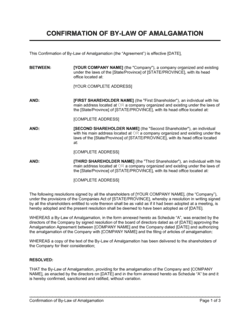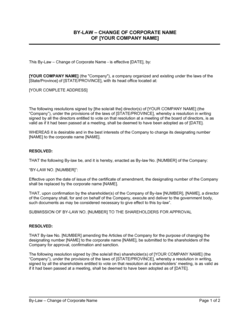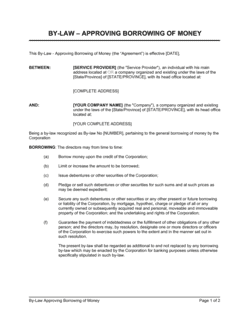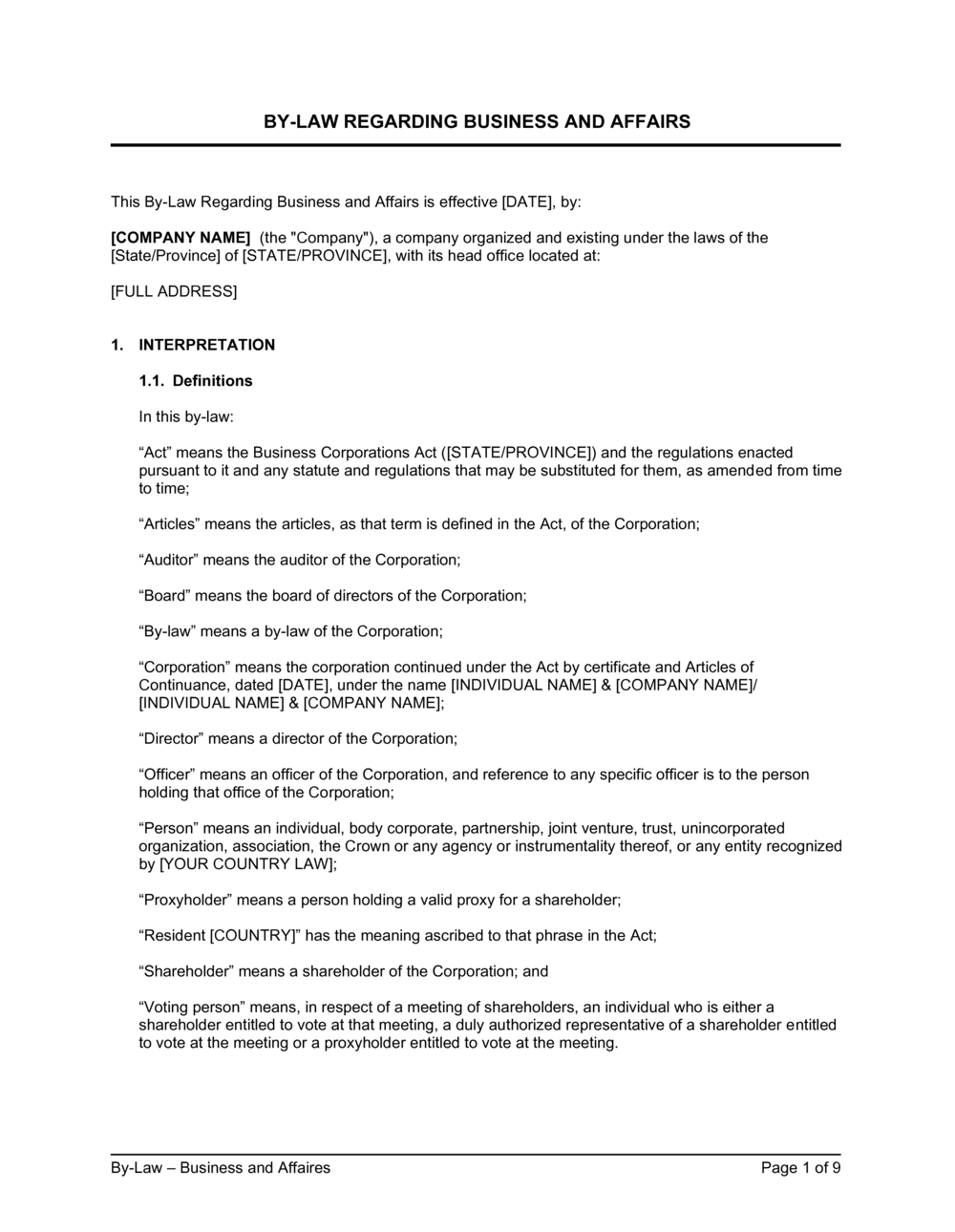
By-Law Business and Affairs Template

Free Word download • Edit online • Save & share with Drive • Export to PDF

9 pages30–40 min to fillDifficulty: ComplexSignature requiredLegal review recommended
Learn more ↓
FreeBy-Law Business and Affairs Template

At a glance

What it is
A By Law Business and Affairs document is the internal governing rulebook of a corporation, defining how the company is managed, how directors and officers are appointed and removed, how meetings are called and conducted, and how decisions are made and recorded. This free Word download gives you a professionally structured, fully editable by-law template you can customize for your corporation and export as PDF for adoption at your organizational meeting.
When you need it
Use it when incorporating a new business, restructuring corporate governance, onboarding new directors or investors, or replacing outdated by-laws that no longer reflect how the company actually operates. Banks, lenders, and investors routinely request a certified copy of by-laws before extending credit or closing a transaction.
What's inside
Registered office and records provisions, shareholder meeting procedures, director and officer roles and authorities, voting and quorum requirements, indemnification provisions, financial controls, amendment procedures, and conflict-of-interest rules.

What is a By Law Business and Affairs?

A By Law Business and Affairs document is the binding internal governance rulebook of a corporation — the foundational legal text that defines how the company is managed, how its directors and officers are appointed and removed, how meetings of the board and shareholders are called and conducted, and how formal decisions are made, recorded, and challenged. Unlike the articles of incorporation, which are filed publicly with the government to create the corporation, by-laws are an internal document adopted by the board and ratified by shareholders to govern the day-to-day mechanics of corporate life. This free Word template covers every standard provision — from registered office and quorum rules to signing authority, indemnification, and conflict-of-interest procedures — in a format that is ready for adoption at your organizational meeting.

Why You Need This Document

Operating a corporation without formally adopted by-laws creates immediate and compounding problems. Banks will refuse to open a corporate account without a certified by-law extract; lenders and investors require governance documents as a standard condition of any financing transaction. More practically, without by-laws there is no agreed framework for resolving disputes about who has authority to sign a contract, how a director can be removed, or what constitutes a valid board decision — questions that are straightforward when governed by clear written rules and deeply disruptive when they are not. Every day a corporation operates without by-laws, it accumulates governance gaps that surface at the worst possible moment: a co-founder dispute, an acquisition due diligence process, or a regulatory audit. This template gives you a professionally structured, jurisdiction-aware starting point that closes those gaps in under an hour for a standard small private corporation.

Which variant fits your situation?

If your situation is…Use this template
Incorporating a for-profit corporation with a standard board structureBy Law Business and Affairs
Forming a nonprofit or charitable corporationNonprofit Corporate By-Laws
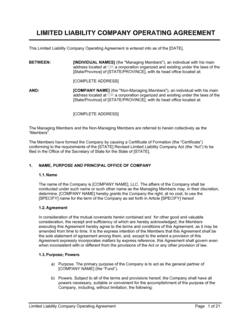
Establishing rules for a limited liability companyLLC Operating Agreement
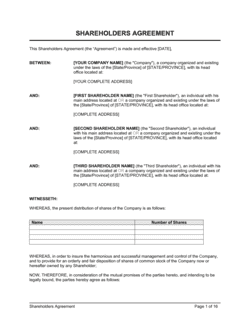
Defining shareholder rights and transfer restrictionsShareholders Agreement
Recording decisions made at the organizational meetingMinutes of Organizational Meeting
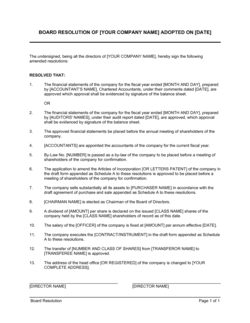
Documenting a board resolution to amend existing by-lawsBoard Resolution
Outlining director duties and indemnification separatelyDirector Indemnification Agreement

Common mistakes to avoid

❌ Adopting by-laws after the first banking or financing transaction

Why it matters: Banks and lenders require a certified copy of by-laws to open accounts and process loan documents. Operating without adopted by-laws delays these transactions and signals governance gaps to counterparties.

Fix: Adopt by-laws at the organizational meeting before any banking relationship is established, and keep a certified extract readily available for third-party requests.

❌ Using a generic template that conflicts with the applicable corporate statute

Why it matters: A by-law provision that contradicts a mandatory requirement of the governing corporate statute — such as minimum notice periods or residency requirements for directors — is void, leaving the corporation without a governing rule on that point.

Fix: Cross-reference every material provision against the specific corporate statute in your jurisdiction (e.g., CBCA, OBCA, DGCL, or Companies Act) before adoption.

❌ Omitting a written-resolution-in-lieu-of-meeting provision

Why it matters: Without this clause, every board decision technically requires a formal meeting with proper notice — a procedural burden that causes small corporations to act informally, creating gaps in the corporate record.

Fix: Include a provision allowing all directors to pass resolutions in writing without a meeting, signed by all directors, which is as valid as a resolution passed at a duly convened meeting.

❌ Setting unrestricted single-signatory banking authority

Why it matters: Allowing any one officer to sign cheques and authorize transfers of any amount is the most common governance weakness cited in corporate fraud cases involving small and mid-size businesses.

Fix: Require dual signatures for payments above a defined threshold — typically $10,000 to $25,000 — and hardcode this into both the by-laws and the banking resolution.

❌ Never updating by-laws after a financing round or ownership change

Why it matters: Investor shareholders often receive special rights — veto rights, board appointment rights, information rights — that must be reflected in the governing documents. Out-of-date by-laws can conflict with shareholder agreement terms, creating enforceability disputes.

Fix: Review and amend by-laws whenever a new shareholder class is created, a new director is appointed under a shareholder agreement, or a material governance change is agreed with investors.

❌ Failing to ratify by-laws at the first shareholder meeting

Why it matters: In jurisdictions such as Canada under the CBCA, by-laws adopted by the board are interim only until confirmed by shareholders. Unratified by-laws create uncertainty about whether board decisions made under them are legally valid.

Fix: Add shareholder ratification of the by-laws as a standing agenda item at the first annual meeting and record the confirming resolution in the minute book.

The 10 key clauses, explained

Registered office and corporate records

In plain language: Establishes where the corporation's official address is located and where statutory records — including the minute book, share register, and financial statements — must be kept.

Sample language
The registered office of [CORPORATION NAME] shall be located at [ADDRESS], [CITY], [PROVINCE/STATE]. The Corporation shall maintain at its registered office the records required by [APPLICABLE CORPORATE STATUTE].

Common mistake: Using a personal home address as the registered office without updating it when the business moves — service of legal process at an outdated address can result in a default judgment going unnoticed.

Shareholder meetings — notice and procedures

In plain language: Specifies how annual and special shareholder meetings are called, the required notice period, who may call them, and how they may be held (in person, by telephone, or electronically).

Sample language
The annual meeting of shareholders shall be held within [X] months of the Corporation's fiscal year end on a date and at a place fixed by the directors. Notice shall be given not less than [10] and not more than [50] days before the meeting.

Common mistake: Setting a notice period shorter than the statutory minimum — many jurisdictions mandate at least 21 days for public companies and 10 days for private companies; a shorter contractual period is void.

Quorum and voting at shareholder meetings

In plain language: Defines the minimum shareholder attendance required to constitute a valid meeting and the voting thresholds for ordinary and special resolutions.

Sample language
A quorum for the transaction of business at any meeting of shareholders shall be [X] shareholders representing not less than [X]% of the voting shares. Each shareholder shall have one vote per share held of record.

Common mistake: Setting quorum too low — a quorum of one shareholder, even if legally permissible, enables a single party to make binding decisions without meaningful corporate oversight.

Board of directors — composition and election

In plain language: States the minimum and maximum number of directors, how they are elected by shareholders, their term of office, and the conditions under which a director's seat becomes vacant.

Sample language
The board shall consist of a minimum of [1] and a maximum of [X] directors. Directors shall be elected at each annual meeting of shareholders to hold office until the next annual meeting or until their successors are elected.

Common mistake: Omitting a vacancy-filling mechanism — if a director resigns and no process exists to fill the seat, the board may fall below quorum and be unable to act until a shareholder meeting is called.

Directors' meetings — notice, quorum, and resolutions

In plain language: Governs how board meetings are convened, the notice required, what constitutes a quorum of directors, and how written resolutions in lieu of meetings are passed.

Sample language
Meetings of the board may be held at any time and place. Notice shall be given to each director not less than [X] days before the meeting. A quorum shall be a majority of the directors then in office. A resolution in writing signed by all directors is as valid as a resolution passed at a duly called meeting.

Common mistake: Requiring unanimous written consent for all board resolutions — this gives any single director an effective veto over routine decisions and can paralyze operations when directors disagree.

Officers — appointment, authority, and removal

In plain language: Identifies the corporate officers (CEO, President, Secretary, Treasurer, etc.), how they are appointed and removed by the board, and the scope of their authority to act on the corporation's behalf.

Sample language
The board shall appoint a President, a Secretary, and a Treasurer, and may appoint such other officers as the board considers appropriate. Officers shall hold office at the pleasure of the board and may be removed at any time by a resolution of the board.

Common mistake: Defining officer authority too narrowly in the by-laws — if the by-laws require board approval for contracts above $1,000 but the CEO routinely signs larger contracts, every such contract is technically unauthorized.

Signing authority and banking

In plain language: Identifies which officers may sign contracts, cheques, promissory notes, and other financial instruments on the corporation's behalf and whether countersignature is required above certain dollar thresholds.

Sample language
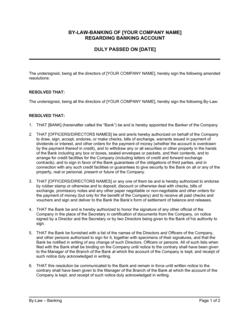
Contracts, deeds, and instruments may be signed on behalf of the Corporation by the [TITLE] and/or the [TITLE]. Cheques and other banking instruments in excess of $[AMOUNT] shall require the signatures of any two of the following officers: [LIST OF OFFICERS].

Common mistake: Not requiring dual signing authority for payments above a material threshold — single-signatory authority on bank accounts is a common internal fraud vector in small and mid-size corporations.

Indemnification of directors and officers

In plain language: Commits the corporation to defend and reimburse directors and officers against personal liability for claims arising from actions they took in their official capacity, within the limits set by law.

Sample language
Subject to applicable law, the Corporation shall indemnify each director and officer against all costs, charges, and expenses reasonably incurred in respect of any civil, criminal, or administrative proceeding in which the individual is involved by reason of being a director or officer, provided the individual acted honestly and in good faith.

Common mistake: Including an absolute indemnity with no carve-out for fraud, willful misconduct, or bad faith — courts will void an indemnity that purports to shield directors from liability for dishonest acts, and the clause may be read as unenforceable in its entirety.

Conflict of interest and related-party transactions

In plain language: Requires directors and officers to disclose any personal interest in a transaction the corporation is considering and to abstain from voting on matters where a conflict exists.

Sample language
A director who has a material interest in any proposed contract or transaction with the Corporation shall disclose such interest to the board in writing as soon as practicable, and shall not vote on any resolution to approve such contract or transaction.

Common mistake: Omitting this clause entirely — without a conflict-of-interest provision, self-dealing transactions are harder to challenge and can expose the corporation to derivative litigation from minority shareholders.

Amendment of by-laws

In plain language: States the procedure by which the corporation's by-laws may be changed — typically requiring a board resolution followed by shareholder ratification at the next meeting.

Sample language
The board may, by resolution, make, amend, or repeal any by-law of the Corporation. Any such by-law, amendment, or repeal shall be submitted to the next meeting of shareholders, and the shareholders may by ordinary resolution confirm, reject, or amend the by-law.

Common mistake: Requiring a supermajority (e.g., two-thirds) for all amendments without distinguishing between routine administrative changes and fundamental governance changes — this can make correcting a drafting error as procedurally burdensome as restructuring the entire board.

How to fill it out

  1. 1

    Insert the corporation's legal name and registered office

    Replace every instance of [CORPORATION NAME] with the exact legal name as it appears on the certificate of incorporation. Enter the full registered office address, including the street address, city, and province or state.

    💡 The registered office address in the by-laws must match the address on file with the corporate registry — a mismatch creates a discrepancy that surfaces during due diligence.

  2. 2

    Set the board composition limits

    Decide on the minimum and maximum number of directors appropriate for your corporation's size and ownership structure. For most small private corporations, a minimum of 1 and a maximum of 5 is sufficient.

    💡 Keep the maximum high enough to accommodate future investor board seats — venture investors frequently require a board seat as a condition of investment.

  3. 3

    Define notice periods for meetings

    Enter the number of days' notice required for shareholder and director meetings. Confirm these meet or exceed the minimums under the applicable corporate statute in your jurisdiction.

    💡 For a private corporation, 10 days for shareholder meetings and 48 hours for director meetings is a common practical standard that stays above most statutory floors.

  4. 4

    Specify quorum requirements

    Set the quorum for both shareholder and board meetings. A majority of directors is standard for board meetings; for shareholders, 2 shareholders or holders of 10% of voting shares is typical for a small private company.

    💡 If you have a sole director and sole shareholder, quorum provisions are largely procedural — but they become critical the moment a second director or investor is added.

  5. 5

    Appoint officers and define their authority

    List the officers your corporation will have at formation (typically President, Secretary, and Treasurer) and specify the dollar threshold above which contracts require board approval rather than officer sign-off.

    💡 A $25,000 officer signing authority is common for early-stage companies — it covers most operating contracts without requiring a board resolution for every vendor agreement.

  6. 6

    Configure signing authority and banking provisions

    Identify which officers may sign cheques and financial instruments, and set a dual-signature threshold for large payments. Enter the dollar amount above which two signatories are required.

    💡 Set the dual-signature threshold at a level that requires oversight for significant expenditures but does not create operational bottlenecks — $10,000 to $25,000 is a practical range for most small corporations.

  7. 7

    Adopt the by-laws at the organizational meeting

    The initial by-laws must be formally adopted by the board of directors at the corporation's first organizational meeting or by written resolution in lieu of meeting, signed by all directors.

    💡 Keep a certified copy of the adopted by-laws in the corporate minute book immediately after execution — banks and lenders will request a certified extract before opening accounts or extending credit.

  8. 8

    Submit to shareholders for ratification

    After board adoption, present the by-laws to shareholders at the first annual meeting for confirmation. Record the shareholder ratification resolution in the minute book.

    💡 In many jurisdictions, by-laws adopted by the board are effective immediately but become permanent only upon shareholder ratification — failure to obtain ratification can leave governance in a legally uncertain state.

Frequently asked questions

What are corporate by-laws?

Corporate by-laws are the internal governing rules of a corporation that establish how the company is managed on a day-to-day basis. They cover the roles and powers of directors and officers, how meetings are called and conducted, what constitutes a quorum, how decisions are recorded, and how the by-laws themselves can be amended. By-laws are subordinate to the articles of incorporation and the applicable corporate statute — they cannot override either.

Are corporate by-laws legally required?

In most jurisdictions, corporations are required by statute to have by-laws or an equivalent governing document. Under the Canada Business Corporations Act and most provincial equivalents, corporations must adopt by-laws at their organizational meeting. In the US, Delaware and most states require initial by-laws to be adopted by the incorporators or the initial board. Operating without by-laws exposes the corporation to governance disputes and creates complications with banks and counterparties who require certified governance documents.

What is the difference between articles of incorporation and by-laws?

Articles of incorporation are the foundational public document filed with the government that creates the corporation — they define the corporation's name, share structure, and any restrictions on business activity. By-laws are the internal operational rules adopted by the corporation after formation. The articles take precedence; by-laws fill in the procedural detail the articles do not address. Amending articles typically requires shareholder approval and a government filing; amending by-laws is usually a board and shareholder matter handled internally.

Who adopts corporate by-laws?

Initial by-laws are typically adopted by the board of directors at the corporation's first organizational meeting. In most jurisdictions, the directors then submit the by-laws to shareholders for ratification at the first annual meeting. After adoption, by-law amendments follow the same two-step process: board resolution followed by shareholder confirmation. Some jurisdictions permit shareholders to amend by-laws directly without board action.

Can a corporation operate without by-laws?

Technically, a corporation can operate without formally adopted by-laws, but doing so creates significant practical problems. Banks will not open corporate accounts without a certified copy of by-laws. Investors and lenders require them as part of due diligence. Without by-laws, disputes over meeting procedures, officer authority, and signing rights default to the bare statutory rules, which are often poorly suited to the specific needs of the business.

What is the difference between by-laws and a shareholders agreement?

By-laws govern the internal operations of the corporation and apply to all shareholders equally. A shareholders agreement is a private contract among specific shareholders that can grant additional rights — pre-emptive rights, drag-along and tag-along rights, board appointment rights, and transfer restrictions — that go beyond what by-laws can provide. By-laws are publicly accessible in some jurisdictions; shareholders agreements are private. Where the two conflict, the shareholders agreement typically governs among the parties to it, but the by-laws govern the corporation itself.

How often should by-laws be updated?

By-laws should be reviewed and updated whenever the corporation undergoes a material governance change — a new financing round, a change in board composition, the addition of a new class of shares, or a significant change in the scale of operations. At minimum, a full review every three to five years is good governance practice. Many corporations discover that their by-laws were adopted at incorporation and never amended, even as the business grew and governance needs changed substantially.

Do by-laws need to be signed?

By-laws are typically adopted by a board resolution or organizational meeting resolution that is signed and entered into the corporate minute book. The by-laws themselves are attached as a schedule to that resolution. In some jurisdictions and for some corporate structures, the shareholders' confirming resolution also requires signatures. The signed resolution adopting the by-laws, together with the by-laws themselves, constitutes the enforceable governance document.

Do I need a lawyer to draft corporate by-laws?

For a straightforward small private corporation with a simple share structure, a high-quality template reviewed against the applicable corporate statute is generally sufficient for initial adoption. Engage a corporate lawyer when the corporation has multiple classes of shares, external investors with negotiated rights, cross-border governance considerations, or when the by-laws need to align precisely with a shareholders agreement. A one to two hour lawyer review typically costs $400–$800 and is worthwhile before any financing transaction or ownership dispute arises.

How this compares to alternatives

vs Shareholders Agreement

By-laws are internal corporate rules that apply to all shareholders and govern meeting procedures, officer authority, and board composition. A shareholders agreement is a private contract among specific shareholders granting additional rights — transfer restrictions, pre-emptive rights, drag-along provisions — that bind only the parties who sign it. Most corporations need both: by-laws for governance, a shareholders agreement for investor and co-founder protections.

vs LLC Operating Agreement

An LLC operating agreement serves the same governance function for a limited liability company that by-laws serve for a corporation — it defines management authority, profit distributions, member rights, and dissolution procedures. The key structural difference is that LLCs have members and managers rather than shareholders and directors. Corporations require by-laws; LLCs require an operating agreement.

vs Articles of Incorporation

Articles of incorporation are the foundational government-filed document that creates the corporation — they define its name, share classes, and any restrictions on business activity. By-laws are the internal operational rules that follow from incorporation. The articles take legal precedence, but by-laws govern the day-to-day mechanics the articles leave unaddressed. Both documents are required; neither can substitute for the other.

vs Board Resolution

A board resolution is a specific decision made by the directors on a single matter — approving a contract, appointing an officer, or authorizing a bank account. By-laws are the standing governance framework that authorizes the board to pass such resolutions in the first place. Resolutions must be consistent with the by-laws to be valid; if no by-laws exist, the board has no defined authority to act.

Industry-specific considerations

Technology / SaaS

Investor board seat provisions, information rights for preferred shareholders, and written-consent procedures that accommodate distributed founding teams operating across multiple time zones.

Professional Services

Partner-level officer designations, conflict-of-interest rules covering client engagements, and signing authority thresholds that align with engagement letter values.

Financial Services

Regulatory compliance obligations incorporated by reference, fit-and-proper director requirements, and enhanced indemnification provisions required by D&O insurers.

Healthcare

Credentialing and licensing prerequisites for director eligibility, HIPAA-related confidentiality obligations referenced in officer duties, and conflict-of-interest rules covering referral relationships.

Manufacturing

Capital expenditure thresholds for officer signing authority, dual-signature banking controls for high-value purchase orders, and environmental compliance incorporated into officer duties.

Retail / E-commerce

Written resolution procedures for fast-moving operational decisions, simplified annual meeting requirements for closely held ownership structures, and banking authority calibrated to inventory financing cycles.

Jurisdictional notes

United States

Corporate by-laws are governed by the law of the state of incorporation — most US corporations use Delaware law, which gives broad flexibility to customize governance in by-laws. The DGCL requires initial by-laws to be adopted by the incorporators or board. Several states, including California and New York, impose mandatory provisions — such as cumulative voting rights and inspection rights — that by-laws cannot eliminate. Single-member LLCs in most states do not use by-laws; they use an operating agreement.

Canada

Under the Canada Business Corporations Act (CBCA) and most provincial equivalents, corporations must adopt by-laws at their first organizational meeting and submit them to shareholders for ratification. The CBCA imposes minimum notice periods, director residency requirements, and mandatory indemnification floors that by-laws cannot undercut. Quebec corporations under the Business Corporations Act (Loi sur les sociétés par actions) follow similar rules, and by-laws must be available in French for provincially regulated Quebec entities.

United Kingdom

UK companies are governed by articles of association rather than by-laws — the functional equivalent. The Companies Act 2006 provides model articles that apply by default unless the company adopts bespoke articles. Private limited companies (Ltd) and public limited companies (PLC) have different model article sets. Any provision that conflicts with the Companies Act 2006 is void. Shareholders holding 75% or more of voting shares can amend articles by special resolution.

European Union

EU member states each have their own corporate statutes governing governance documents — Germany uses a Satzung (articles), France uses statuts, and the Netherlands uses statuten. The EU Shareholder Rights Directive II requires listed companies to provide accessible governance documents. GDPR applies to data-handling provisions in any governance document that references employee or shareholder records. Cross-border EU corporations using the Societas Europaea (SE) structure are governed by the SE Regulation and supplemented by member state law.

Template vs lawyer — what fits your deal?

PathBest forCostTime
Use the templateStraightforward small private corporations with a simple share structure and a single class of common sharesFree30–60 minutes
Template + legal reviewCorporations adding a second share class, taking on a co-founder, or preparing for a first external financing$400–$800 for a corporate lawyer review2–5 days
Custom draftedMulti-class share structures, corporations with institutional investors, cross-border governance, or regulated industries$1,500–$4,000+1–3 weeks

Glossary

By-Laws
The internal rules adopted by a corporation to govern its management, structure, and the conduct of its officers, directors, and shareholders.
Quorum
The minimum number of directors or shareholders who must be present at a meeting for the decisions made at that meeting to be legally valid.
Registered Office
The official address of the corporation on record with the government, where legal notices and correspondence are delivered.
Articles of Incorporation
The foundational filing document that creates the corporation — by-laws are subordinate to the articles and cannot contradict them.
Indemnification
The corporation's obligation to reimburse and defend directors and officers against legal claims arising from actions taken in their official capacity.
Fiduciary Duty
The legal obligation of directors and officers to act in the best interest of the corporation and its shareholders, not in their own personal interest.
Casting Vote
A tie-breaking vote granted to the chairperson of a meeting when a resolution results in a deadlock among directors or shareholders.
Resolution
A formal decision made by the board of directors or shareholders, recorded in writing and retained in the corporate minute book.
Ex Officio
A position held automatically by virtue of another office — for example, the CEO may serve as an ex officio member of all board committees.
Ultra Vires
An action taken by a corporation or its officers that falls outside the powers granted by the articles of incorporation or applicable corporate law — such acts are generally void.
Signing Authority
The designated officer or officers authorized by the board to execute contracts, banking instruments, and other documents on behalf of the corporation.

Part of your Business Operating System

This document is one of 3,000+ business & legal templates included in Business in a Box.

  • Fill-in-the-blanks — ready in minutes
  • 100% customizable Word document
  • Compatible with all office suites
  • Export to PDF and share electronically

Create your document in 3 simple steps.

From template to signed document — all inside one Business Operating System.
1
Download or open template

Access over 3,000+ business and legal templates for any business task, project or initiative.

2
Edit and fill in the blanks with AI

Customize your ready-made business document template and save it in the cloud.

3
Save, Share, Send, Sign

Share your files and folders with your team. Create a space of seamless collaboration.

Save time, save money, and create top-quality documents.

★★★★★

"Fantastic value! I'm not sure how I'd do without it. It's worth its weight in gold and paid back for itself many times."

Managing Director · Mall Farm
Robert Whalley
Managing Director, Mall Farm Proprietary Limited
★★★★★

"I have been using Business in a Box for years. It has been the most useful source of templates I have encountered. I recommend it to anyone."

Business Owner · 4+ years
Dr Michael John Freestone
Business Owner
★★★★★

"It has been a life saver so many times I have lost count. Business in a Box has saved me so much time and as you know, time is money."

Owner · Upstate Web
David G. Moore Jr.
Owner, Upstate Web

Run your business with a system — not scattered tools

Stop downloading documents. Start operating with clarity. Business in a Box gives you the Business Operating System used by over 250,000 companies worldwide to structure, run, and grow their business.

Start free · No credit card required