Business Insurance Guide

Free to read β€’ Save or share with one click

FreeBusiness Insurance Guide Template

At a glance

What it is
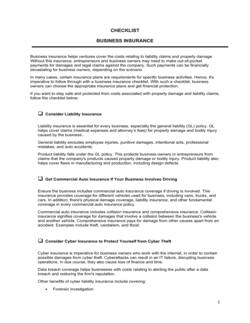
A Business Insurance Guide is an operational reference document that maps a company's insurance coverage landscape β€” cataloguing active policies, coverage limits, deductibles, renewal dates, and the risks each policy addresses. This free Word download gives you a structured, editable starting point you can tailor to your business type and export as PDF to share with leadership, lenders, or an insurance broker.
When you need it
Use it when onboarding a new business, conducting an annual insurance review, preparing for a loan or investor due diligence request, or consolidating scattered policy documents into a single reference for your operations team.
What's inside
Business risk profile, coverage type summaries, active policy register, coverage gap analysis, claims procedures, renewal calendar, and broker contact directory β€” all in one organized document.

What is a Business Insurance Guide?

A Business Insurance Guide is an operational reference document that consolidates all of a company's insurance information into a single, organized resource β€” cataloguing active policies, coverage types and limits, deductibles, renewal dates, key exclusions, claims procedures, and broker contacts. Unlike a policy document issued by an insurer, a business insurance guide is a company-authored management tool that translates insurance jargon into plain operational language, maps coverage against identified business risks, and surfaces gaps before a loss occurs. This free Word download gives you a structured starting point you can tailor to your business, share with your broker for a coverage review, and export as PDF for lenders or investors.

Why You Need This Document

Most businesses carry insurance β€” but far fewer know exactly what their policies cover, where the exclusions apply, or what to do the moment a loss occurs. That gap costs real money: claims denied because notice was not filed within the required window, coverage disputes arising from undisclosed business activities, and coverage lapses caused by missed renewal dates are among the most common and preventable insurance failures small businesses face. Without a central guide, your operations staff are searching for policy numbers during a crisis, your finance team is guessing at renewal costs during budget season, and your broker is the only person who knows the full picture. A completed Business Insurance Guide eliminates all three problems β€” giving your team a single source of truth for every policy, every renewal date, and every claims contact, so you spend less time managing insurance and more time running the business.

Which variant fits your situation?

If your situation is…Use this template
Documenting all active policies for a small business with fewer than 10 employeesBusiness Insurance Guide (Small Business)
Preparing insurance documentation for a bank loan or SBA applicationBusiness Continuity Plan
Assessing risk exposure before selecting new coverage typesRisk Assessment Template
Managing claims and incident reporting after a loss eventIncident Report Form
Evaluating professional liability exposure for a service businessProfessional Services Agreement
Reviewing contractor insurance requirements before engaging vendorsIndependent Contractor Agreement
Summarizing coverage for board or leadership reviewExecutive Summary Report

Common mistakes to avoid

❌ Maintaining no central policy register

Why it matters: When a loss occurs, staff scramble to find policy numbers and insurer contacts. Delays in reporting can breach notice requirements and void coverage for that specific claim.

Fix: Populate the active policy register section of this guide at inception and update it within 5 business days of any policy change, endorsement, or cancellation.

❌ Confusing general liability with professional liability

Why it matters: General liability covers bodily injury and property damage to third parties. It does not cover claims arising from errors or omissions in your professional services β€” a gap that can expose service businesses to six-figure uninsured losses.

Fix: If your business provides advice, design, software, healthcare, or any professional service, obtain a separate E&O or professional liability policy and document both in the guide.

❌ Skipping the coverage gap analysis

Why it matters: Businesses that assume their BOP or general liability policy covers all exposures routinely discover exclusions for cyber incidents, employment disputes, and professional errors only at the point of claim β€” when it is too late to add coverage.

Fix: Complete the coverage gap analysis section annually with your broker. Map every identified business risk to a specific policy and coverage line.

❌ Missing renewal deadlines due to no calendar system

Why it matters: A lapsed policy β€” even for one day β€” can invalidate contractual insurance requirements with clients, trigger default under a commercial lease, and leave the business uninsured during the gap period.

Fix: Enter all renewal dates in the guide and mirror them in a shared calendar with 60-day and 30-day reminders assigned to a named responsible person.

❌ Setting coverage limits based on the premium cost rather than actual exposure

Why it matters: A $1M general liability limit feels adequate until a customer slip-and-fall generates a $2.3M judgment. Limits chosen to minimize premium rather than reflect realistic loss scenarios create uninsured tail risk.

Fix: Base coverage limits on your maximum probable loss β€” largest single contract value, highest-value asset, or largest plausible third-party claim β€” and use an umbrella policy to extend limits cost-effectively.

❌ Failing to update coverage after major business changes

Why it matters: Acquiring equipment, hiring additional staff, adding a new service line, or expanding to a new location all change the risk profile. Insurers can deny claims that arise from activities or assets not disclosed at policy inception.

Fix: Build an insurance review checkpoint into every significant operational change β€” new hire batches above 10%, capital equipment purchases above $25,000, new client contracts above $100,000, and geographic expansions.

The 9 key sections, explained

Business overview and risk profile

Coverage types required by law

Active policy register

Coverage gap analysis

Key exclusions and limitations

Claims history and open claims

Claims reporting procedure

Renewal calendar and broker contacts

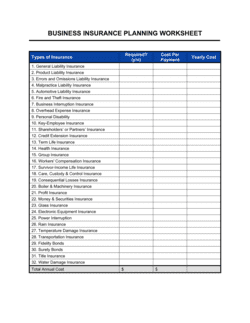
Insurance budget and cost allocation

How to fill it out

  1. 1

    Complete the business overview and risk profile

    Enter your company's industry, number of employees, location count, and revenue range. List the three to five operational risks most likely to generate a loss β€” property damage, customer injury, data breach, professional error, or vehicle accidents.

    πŸ’‘ Be specific about risk categories; 'we serve clients on-site' signals a different exposure than 'all work is remote,' and your broker will price coverage accordingly.

  2. 2

    Identify all legally required coverage types

    Research mandatory insurance in every jurisdiction where you employ staff or operate vehicles. Record the statutory minimum limits and compare them to your current coverage. Note any requirements imposed by client contracts or commercial leases.

    πŸ’‘ Workers' compensation minimums vary significantly by state and province β€” verify with your state labor board or provincial Workers' Safety Board annually, not just at policy inception.

  3. 3

    Populate the active policy register

    Pull every current policy declaration page and enter each policy into the register table β€” insurer, policy number, coverage type, limit, deductible, premium, effective date, and renewal date. Include policies held by any subsidiary or related entity.

    πŸ’‘ Scan each declaration page and attach it to the guide document as an appendix so the register and the source documents are always stored together.

  4. 4

    Conduct the coverage gap analysis

    For each risk identified in the business overview, confirm which active policy addresses it. Flag risks with no coverage or with limits below your realistic maximum probable loss. Common gaps include cyber liability, employment practices liability, and business interruption.

    πŸ’‘ Ask your broker to run a formal coverage gap analysis alongside yours β€” brokers have loss data from similar businesses and can identify gaps you would not recognize from policy language alone.

  5. 5

    Document key exclusions for each policy

    Read the exclusions section of each policy β€” not just the broker summary β€” and record the five to ten most significant exclusions in plain English. This section is what prevents unpleasant surprises when a claim is filed.

    πŸ’‘ Pay particular attention to 'care, custody, and control' exclusions in general liability policies β€” they commonly exclude damage to property in your possession, which is not obvious from the policy name.

  6. 6

    Record claims history and open claims

    Enter all claims from the past five years with type, date, policy, settlement amount, and current status. Contact your broker if you do not have a complete history β€” insurers maintain loss runs that summarize all claims under each policy.

    πŸ’‘ Request a formal loss run from each insurer annually, even in claim-free years β€” it confirms the insurer's record matches yours and is required documentation in most commercial insurance applications.

  7. 7

    Set the renewal calendar with 60-day review triggers

    Enter every policy renewal date and set review reminders 60 days in advance. Assign a named person responsible for initiating each renewal. For large or complex policies, 90 days is a safer lead time.

    πŸ’‘ Calendar the review dates in your company project management tool, not just in this document β€” a document sitting in a shared drive does not send reminders.

  8. 8

    Allocate insurance costs to business units and lock the annual budget

    Divide total premiums by business unit or cost center and enter them in the budget section. Compare to the prior year and document the reason for any increase above 5% β€” market hardening, claims history, or new coverage.

    πŸ’‘ If total premiums increased more than 15% at renewal, request competing quotes from at least two additional brokers before binding β€” loyalty alone rarely justifies that size of increase.

Frequently asked questions

What is a business insurance guide?

A business insurance guide is an operational document that consolidates all of a company's insurance information β€” active policies, coverage limits, deductibles, renewal dates, claims history, and broker contacts β€” into a single reference. It helps business owners, finance teams, and operations staff understand what risks are covered, where gaps exist, and what to do when a loss occurs.

What types of insurance do most small businesses need?

Most small businesses need at minimum: general liability insurance to cover third-party bodily injury and property damage, commercial property insurance for physical assets, and workers' compensation if they have employees. Service businesses typically also need professional liability (E&O) coverage. A Business Owner's Policy bundles general liability and property at a lower combined premium and is a practical starting point for most small businesses.

What is the difference between general liability and professional liability insurance?

General liability covers physical harm to third parties β€” a customer injured at your premises, property accidentally damaged by your staff. Professional liability (also called E&O) covers financial harm arising from errors, omissions, or failure to deliver your professional services as promised. A marketing agency, IT consultant, or accountant faces significant professional liability exposure that a general liability policy does not cover.

How much does business insurance typically cost?

Premiums vary widely by industry, revenue, employee count, claims history, and coverage types. A general liability policy for a small service business typically runs $500–$2,000 per year. A BOP (combining general liability and property) runs $1,000–$3,500 for most small businesses. Professional liability adds $1,000–$5,000 depending on the profession and revenue. Cyber liability starts around $1,500 and increases significantly with the volume of customer data held.

What is a certificate of insurance and when do you need one?

A certificate of insurance (COI) is a one-page summary of your active coverage β€” insurer, policy number, coverage type, limits, and policy period. Clients, commercial landlords, lenders, and government contracts routinely require a COI before allowing you to begin work or occupy a space. Your broker can issue a COI within minutes by calling or emailing a request β€” having your policy register complete makes this faster and less error-prone.

How often should a business review its insurance coverage?

At minimum, annually at each renewal cycle. In practice, a review should also be triggered by any significant business change β€” adding employees, acquiring equipment or real estate, expanding to a new service line or geography, or landing a large new client contract. Coverage that was adequate for a $500K revenue business may be materially inadequate at $2M.

Does my business need cyber liability insurance?

If your business holds customer personal data, processes payments, or relies on digital systems to operate, the answer is almost certainly yes. Standard general liability and property policies exclude cyber incidents. The average cost of a small business data breach exceeded $108,000 in recent studies β€” a figure that can be existential for a business with no cyber coverage. Cyber liability premiums for small businesses typically start under $2,000 per year.

What should I do immediately after a business loss or incident?

Secure the scene and document the incident with photos and a written description. Notify your designated internal contact β€” typically your operations manager or CFO β€” within the same business day. Report the incident to your insurer using the policy number and claims contact in your policy register, typically within 24–72 hours depending on policy requirements. Failure to notify promptly is one of the most common grounds on which insurers deny otherwise valid claims.

Can I use a business insurance guide template if I have a broker?

Yes β€” and having a broker makes it easier to complete. Your broker can provide loss runs, policy declaration pages, and a coverage summary that populate the register and gap analysis sections quickly. The guide then serves as your internal reference document so the business is not dependent on calling the broker every time a team member needs a policy number or renewal date.

How this compares to alternatives

vs Business Continuity Plan

A business continuity plan addresses how operations resume after a disruption β€” staff roles, recovery timelines, and backup systems. A business insurance guide documents the financial coverage in place to fund that recovery. The two documents are complementary: the continuity plan describes the response; the insurance guide identifies who pays for it.

vs Risk Assessment Template

A risk assessment identifies and scores potential threats to the business before they occur β€” assigning likelihood and impact ratings. A business insurance guide records the coverage procured to address those threats. Complete the risk assessment first, then use its output to populate the gap analysis section of the insurance guide.

vs Employee Handbook

An employee handbook may reference workers' compensation and benefits at a high level for employees. A business insurance guide is an operational management document containing policy-level detail β€” limits, deductibles, insurer contacts, and claims procedures β€” that is typically not appropriate to distribute to all staff.

vs Incident Report Form

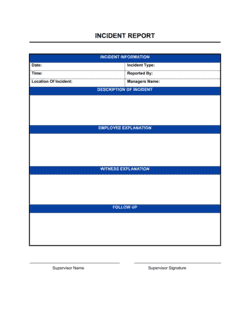
An incident report form captures the facts of a specific loss event at the time it occurs. A business insurance guide is the standing reference document that tells staff which insurer to notify, which policy number applies, and what the claims procedure requires. Both documents are needed β€” the guide informs the response; the form records the event.

Industry-specific considerations

Professional Services

E&O and professional liability coverage is central; client contracts often require minimum limits of $1M–$2M per occurrence as a condition of engagement.

Construction and Trades

Builder's risk, contractor general liability, surety bonds, and workers' compensation are all typically required β€” often by client contract, permit authority, and state law simultaneously.

Retail and E-commerce

Product liability, commercial property for inventory, and cyber liability for payment card data are the primary coverage categories alongside standard general liability.

Technology / SaaS

Technology E&O, cyber liability, and D&O coverage for funded companies are essential; standard BOPs often exclude software-related professional claims entirely.

Template vs pro β€” what fits your needs?

PathBest forCostTime
Use the templateSmall business owners and operations managers organizing existing policies and identifying coverage gapsFree2–4 hours to complete with policy documents on hand
Template + professional reviewBusinesses with 10+ employees, multiple locations, or identified coverage gaps that need broker input$0–$300 (broker consultation is typically free; independent risk advisor runs $150–$300/hr)1–2 days including broker review
Custom draftedRegulated industries, businesses with complex multi-entity structures, or companies preparing for M&A due diligence$500–$2,500 for a risk consultant or commercial insurance advisor1–2 weeks

Glossary

General Liability Insurance
Coverage that protects a business against third-party claims of bodily injury, property damage, and personal injury arising from business operations.
Deductible
The amount a business pays out of pocket before the insurance policy begins covering a loss.
Coverage Limit
The maximum dollar amount an insurer will pay for a covered claim under a given policy.
Premium
The periodic payment β€” monthly or annual β€” a business makes to maintain an insurance policy.
Business Owner's Policy (BOP)
A bundled policy combining general liability and commercial property coverage, typically offered at a lower combined premium than purchasing each separately.
Errors and Omissions (E&O)
Professional liability insurance that covers claims arising from mistakes, negligence, or failure to deliver promised services β€” common for consultants, agencies, and professional service firms.
Workers' Compensation
Mandatory coverage in most jurisdictions that pays medical expenses and lost wages for employees injured on the job, in exchange for limiting the employer's tort liability.
Umbrella Policy
Excess liability coverage that activates after the limits of an underlying policy are exhausted, providing an additional layer of protection for large claims.
Certificate of Insurance (COI)
A one-page document issued by an insurer summarizing a business's active coverage types, limits, and policy periods β€” commonly required by clients, landlords, and lenders.
Endorsement
A written amendment that modifies the terms, coverage, or exclusions of an existing insurance policy.
Exclusion
A specific condition, circumstance, or type of loss explicitly not covered by an insurance policy.
Renewal Date
The date on which a policy expires and must be renewed or replaced to maintain continuous coverage.

Part of your Business Operating System

This document is one of 3,000+ business & legal templates included in Business in a Box.

  • Fill-in-the-blanks β€” ready in minutes
  • Compatible with all office suites
  • Export to PDF and share electronically

Create your document in 3 simple steps.

From template to signed document β€” all inside one Business Operating System.
1
Download or open template

Access over 3,000+ business and legal templates for any business task, project or initiative.

2
Edit and fill in the blanks with AI

Customize your ready-made business document template and save it in the cloud.

3
Save, Share, Send, Sign

Share your files and folders with your team. Create a space of seamless collaboration.

Save time, save money, and create top-quality documents.

β˜…β˜…β˜…β˜…β˜…

"Fantastic value! I'm not sure how I'd do without it. It's worth its weight in gold and paid back for itself many times."

Managing Director Β· Mall Farm
Robert Whalley
Managing Director, Mall Farm Proprietary Limited
β˜…β˜…β˜…β˜…β˜…

"I have been using Business in a Box for years. It has been the most useful source of templates I have encountered. I recommend it to anyone."

Business Owner Β· 4+ years
Dr Michael John Freestone
Business Owner
β˜…β˜…β˜…β˜…β˜…

"It has been a life saver so many times I have lost count. Business in a Box has saved me so much time and as you know, time is money."

Owner Β· Upstate Web
David G. Moore Jr.
Owner, Upstate Web

Run your business with a system β€” not scattered tools

Stop downloading documents. Start operating with clarity. Business in a Box gives you the Business Operating System used by over 250,000 companies worldwide to structure, run, and grow their business.

Free Forever PlanΒ Β·Β No credit card required