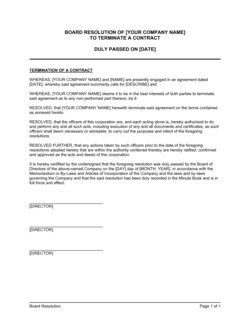
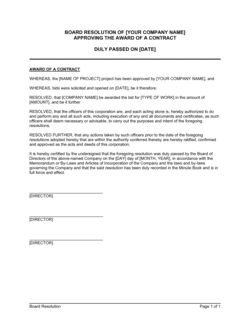
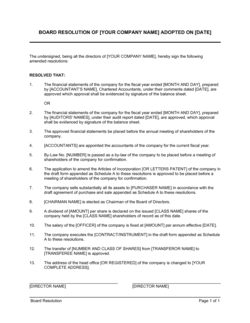
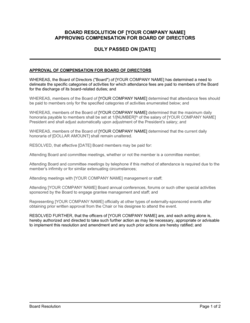
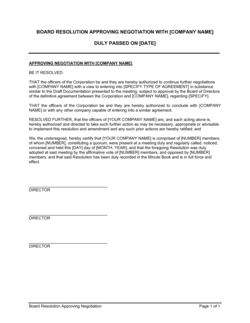
Board Resolution to Negotiate a Specific Contract Template

Free Word download • Edit online • Save & share with Drive • Export to PDF

1 page20–30 min to fillDifficulty: StandardSignature requiredLegal review recommended
Learn more ↓
FreeBoard Resolution to Negotiate a Specific Contract Template

At a glance

What it is
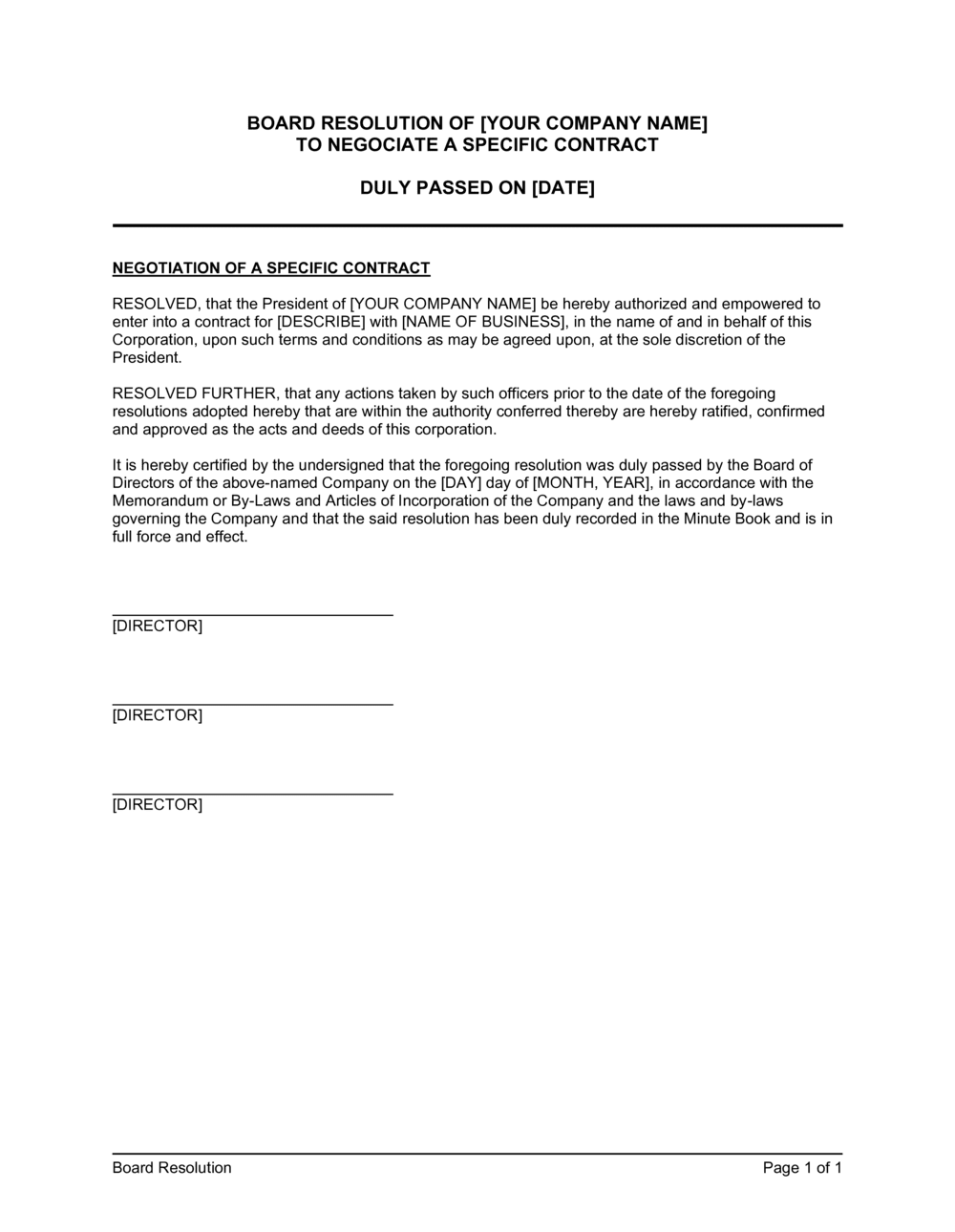
A Board Resolution To Negotiate A Specific Contract is a formal corporate governance document in which a company's board of directors officially authorizes one or more named individuals to enter into negotiations for a defined contract on the company's behalf. This free Word download gives you a structured, meeting-ready resolution you can edit online and export as PDF for signing by the board secretary or chair.
When you need it
Use it when a significant contract — a supplier agreement, real estate lease, partnership deal, or major service arrangement — requires board-level sign-off before negotiations can begin, or when a counterparty, lender, or regulator demands written evidence that your negotiator is duly authorized.
What's inside
Corporate identification, meeting details and quorum confirmation, a recital of the proposed contract, the specific grant of negotiating authority to named officers, defined scope and term limits, a ratification clause, and board member signatures with the secretary's certification.

What is a Board Resolution To Negotiate A Specific Contract?

A Board Resolution To Negotiate A Specific Contract is a formal corporate governance document through which a company's board of directors officially grants a named officer or agent the authority to negotiate the terms of a defined contract on the corporation's behalf. It identifies the proposed contract and counterparty, sets the boundaries of the negotiator's authority — including any financial or scope limits — and creates an auditable record that the board reviewed and approved the negotiation before it began. Critically, this resolution authorizes talks only; it does not itself bind the company to any agreement, with final execution authority expressly reserved for a separate board action.

Why You Need This Document

Without a board resolution in place before negotiations begin, your company faces two compounding risks. First, actions taken by an officer without documented authority can be challenged as ultra vires — potentially voiding preliminary commitments or exposing the officer personally to liability for unauthorized acts. Second, sophisticated counterparties — banks, institutional landlords, government procurement offices, and enterprise vendors — will routinely demand a certified copy of this resolution before engaging in substantive talks, and an inability to produce one stalls the deal before it starts. A properly drafted resolution also protects the authorized negotiator by defining exactly what they may and may not agree to, reducing the risk that the board later disputes a term the negotiator believed was within scope. This template gives you a clean, certifiable record of delegated authority in under 30 minutes.

Which variant fits your situation?

If your situation is…Use this template
Authorizing an officer to sign a contract that is already negotiatedBoard Resolution To Sign A Specific Contract
Granting broad ongoing authority to an officer across multiple contractsBoard Resolution To Authorize An Officer
Authorizing a real-property lease negotiation specificallyBoard Resolution To Lease Office Space
Authorizing negotiation of a bank loan or credit facilityBoard Resolution To Borrow Money
Documenting unanimous written consent in lieu of a formal meetingWritten Consent In Lieu Of Board Meeting
Recording all decisions from a full board meeting in one placeBoard Meeting Minutes
Authorizing a specific officer to open or manage a bank accountBoard Resolution To Open A Bank Account

Common mistakes to avoid

❌ Naming no specific individual as authorized negotiator

Why it matters: Authorizing 'any officer of the Corporation' creates ambiguity about who is actually empowered. Counterparties may refuse to deal, or multiple officers may take conflicting positions during negotiations.

Fix: Name at least one specific individual by full legal name and corporate title, and designate a named alternate in case the primary negotiator becomes unavailable.

❌ Omitting scope and financial limits

Why it matters: An unlimited grant of negotiating authority can inadvertently authorize the negotiator to agree to terms — unlimited liability, multi-decade commitments, or above-budget pricing — that the board never intended to permit.

Fix: Add a specific clause capping maximum contract value, permitted term length, and any non-negotiable provisions, and state clearly that exceeding those limits requires a new resolution.

❌ Failing to include the reservation-of-final-approval clause

Why it matters: Without it, a court or arbitrator may interpret the negotiating authority as also covering execution, particularly if the authorized officer signed a term sheet or letter of intent during negotiations.

Fix: Include an explicit statement that this resolution does not authorize execution of a binding agreement and that final contract approval is reserved for the board.

❌ Using a trade name instead of the registered legal entity name

Why it matters: A resolution issued in the name of a DBA or unregistered brand has no legal authority — banks, landlords, and sophisticated counterparties routinely reject such documents and will demand a corrected version.

Fix: Verify the exact registered corporate name against the certificate of incorporation or the current state or provincial registry record before drafting the resolution.

❌ Having the authorized negotiator self-certify the resolution

Why it matters: A person certifying their own authority is a red flag in any due-diligence review. Banks, lenders, and sophisticated counterparties will decline to rely on a resolution the beneficiary certified.

Fix: Always have the corporate secretary — someone other than the authorized negotiator — sign the certification block.

❌ Passing the resolution after negotiations have already begun

Why it matters: Actions taken before board authorization may be challenged as ultra vires. If the counterparty later disputes the deal, the absence of prior authority can void preliminary commitments or expose officers personally.

Fix: Pass the resolution before the first substantive negotiation meeting. If negotiations began informally before the resolution, include a ratification clause that covers prior acts and document what specifically those acts were.

The 9 key clauses, explained

Corporate identification and preamble

In plain language: Names the corporation by its full legal registered name, state or province of incorporation, and confirms the resolution is an act of the board of directors.

Sample language
The undersigned, being all the directors of [CORPORATION LEGAL NAME], a corporation duly incorporated under the laws of [STATE / PROVINCE], hereby adopt the following resolution by unanimous written consent.

Common mistake: Using a trade name or DBA instead of the legal registered corporate name. If the entity name does not match the corporate registry, third parties may challenge the authority granted.

Meeting date, location, and quorum confirmation

In plain language: Records when and where the board met (or that a written consent was circulated in lieu of a meeting), and confirms that the required quorum of directors was present.

Sample language
A meeting of the Board of Directors of [CORPORATION NAME] was duly held on [DATE] at [LOCATION / by electronic means]. A quorum of [NUMBER] directors was present, constituting all directors then in office.

Common mistake: Failing to state that a quorum was present. A resolution passed without quorum is invalid and can expose the company to liability if a counterparty later challenges the negotiator's authority.

Recitals (WHEREAS clauses)

In plain language: Sets out the background facts — why the board is acting, what the proposed contract is, who the counterparty is, and why the contract is in the company's interest.

Sample language
WHEREAS, [CORPORATION NAME] wishes to negotiate a [DESCRIPTION OF CONTRACT TYPE] with [COUNTERPARTY NAME] for the purpose of [PURPOSE]; and WHEREAS, the Board has determined that entering into such negotiations is in the best interests of the Corporation;

Common mistake: Writing recitals so vaguely that the resolution does not adequately identify the specific contract. 'A commercial agreement' is too broad — name the counterparty and subject matter.

Grant of negotiating authority

In plain language: The operative clause that formally authorizes named officers or agents to negotiate the described contract on behalf of the corporation.

Sample language
RESOLVED, that [NAME], [TITLE], is hereby authorized and directed to negotiate, on behalf of the Corporation, the terms of a [CONTRACT TYPE] with [COUNTERPARTY NAME], subject to the limitations set out herein.

Common mistake: Authorizing 'any officer' without naming a specific individual. Unnamed grants create ambiguity about who is actually authorized and can be exploited by counterparties or disputed internally.

Scope and financial limits

In plain language: Defines the outer boundaries of what the authorized negotiator may agree to — maximum contract value, permitted term length, key non-negotiable provisions, or topics that remain reserved for board approval.

Sample language
The authorized negotiator shall not agree to any term providing for total consideration exceeding $[AMOUNT], a contract duration exceeding [X] years, or any indemnification obligation beyond [DESCRIPTION] without prior board approval.

Common mistake: Omitting financial and scope limits entirely. An open-ended grant of negotiating authority can inadvertently commit the company to terms the board never contemplated, and may trigger lender covenants or shareholder notification obligations.

Ratification of prior acts

In plain language: Confirms that any preliminary discussions or actions taken by the authorized person before the resolution was passed are retroactively approved by the board.

Sample language
FURTHER RESOLVED, that any and all actions previously taken by [NAME] in connection with the negotiation of the aforesaid contract prior to the date of this resolution are hereby ratified, confirmed, and approved.

Common mistake: Including a blanket ratification clause without reviewing what actions were actually taken. A broad ratification can inadvertently approve conduct — such as a verbal commitment — that the board would have rejected.

Authority to execute ancillary documents

In plain language: Grants the authorized negotiator (or a named officer) the further authority to sign NDAs, term sheets, letters of intent, and other preliminary documents needed to advance the negotiation.

Sample language
FURTHER RESOLVED, that [NAME] is authorized to execute any non-disclosure agreement, letter of intent, or term sheet reasonably necessary to facilitate the negotiation of the aforesaid contract, subject to the scope limits above.

Common mistake: Forgetting to authorize execution of NDAs and term sheets. Negotiators who sign a confidentiality agreement without board authority may bind the company without a clear record of approval.

Reservation of final approval

In plain language: Explicitly states that the resolution authorizes negotiation only — the board retains the right to approve or reject the final contract terms before execution.

Sample language
For the avoidance of doubt, this resolution authorizes negotiation of the proposed contract and does not authorize the execution or binding commitment of the Corporation to any final agreement, which shall require a separate board resolution.

Common mistake: Omitting this clause so that the negotiating authority reads as authority to execute as well. Counterparties have argued that a broad negotiation resolution authorized the final signing — creating an unintended binding obligation.

Certification by corporate secretary

In plain language: The corporate secretary certifies that the resolution was duly passed, the meeting was properly convened, and the document is a true copy of the board's record.

Sample language
I, [SECRETARY NAME], Secretary of [CORPORATION NAME], hereby certify that the foregoing is a true and correct copy of a resolution duly adopted by the Board of Directors at a meeting held on [DATE], at which a quorum was present and voting.

Common mistake: Having the authorized negotiator rather than the secretary certify the resolution. Self-certification undermines the document's independence and is routinely rejected by banks, landlords, and sophisticated counterparties.

How to fill it out

  1. 1

    Enter the corporation's full legal name and jurisdiction

    Use the exact name as it appears in your certificate of incorporation or articles of organization — not a trade name or abbreviation. Include the state, province, or country of incorporation.

    💡 Pull the name directly from your corporate registry filing or most recent annual report to ensure an exact match.

  2. 2

    Record the meeting date, format, and quorum

    State whether the resolution was passed at a formal in-person or virtual meeting or by written consent in lieu of meeting. Record the exact date and confirm the number of directors present constituted a quorum under your bylaws.

    💡 Check your bylaws for the quorum definition — some companies require a majority of the full board, others require only a majority of those in office.

  3. 3

    Draft the recitals with the specific contract details

    Name the counterparty, describe the type of contract (e.g., 'a three-year software services agreement'), and state concisely why the contract is in the company's interest.

    💡 Attach a one-paragraph term sheet or deal summary as an exhibit rather than embedding all details in the resolution body — this keeps the resolution clean and the scope reference precise.

  4. 4

    Name the authorized negotiator by full name and title

    Enter the individual's legal name and current corporate title in the grant-of-authority clause. If you want a backup negotiator, name them explicitly as an alternate rather than using 'any officer.'

    💡 If the authorized individual may leave the company before negotiations conclude, add language such as 'or such other officer as the Board may designate' to avoid needing a new resolution.

  5. 5

    Set the scope and financial limits

    Define the maximum contract value, permitted duration, and any terms that are off-limits without further board approval. Be specific — dollar amounts and year counts, not general descriptions.

    💡 Cross-reference your existing loan covenants, shareholder agreements, and organizational documents to confirm that the proposed limits don't trigger a consent requirement from a lender or major investor.

  6. 6

    Include the reservation-of-final-approval clause

    Add explicit language stating that this resolution covers negotiation only and that execution of any binding agreement requires a separate board resolution or action.

    💡 Some counterparties will push back on this clause during negotiations — resist removing it, as it is your clearest protection against an unauthorized oral commitment becoming binding.

  7. 7

    Have the corporate secretary certify and all directors sign

    The secretary should sign the certification block confirming the resolution was duly adopted. All directors who voted in favor should sign, or the written consent should be signed by the required majority.

    💡 Date each signature individually if directors are signing in counterparts — a resolution with a single signature block but multiple undated signatures is harder to defend in a dispute.

Frequently asked questions

What is a board resolution to negotiate a specific contract?

A board resolution to negotiate a specific contract is a formal corporate governance document in which a company's board of directors officially authorizes one or more named individuals to negotiate the terms of a defined contract on the corporation's behalf. It establishes the negotiator's authority, sets the boundaries of that authority, and creates a paper trail confirming the board approved the negotiation before it began. It does not itself authorize execution of the final agreement.

When does a company need a board resolution to negotiate a contract?

A company needs this resolution whenever its bylaws, a shareholder agreement, a loan covenant, or applicable corporate law requires board approval before officers may enter into negotiations above a certain value or for a defined category of contract. It is also required when a counterparty — such as a landlord, bank, or government agency — demands written proof that the person across the table is duly authorized to negotiate on the company's behalf. Even when not strictly required, it is best practice for any contract that is material to the business.

What is the difference between a resolution to negotiate and a resolution to sign?

A resolution to negotiate authorizes a named individual to discuss and agree on proposed terms — it does not bind the corporation to any final agreement. A resolution to sign (or execute) authorizes a named officer to execute and deliver the final contract, creating a legally binding obligation. Many companies pass the negotiating resolution first and then follow it with a separate signing resolution once the board has reviewed and approved the final agreed terms.

Does a board resolution to negotiate a contract need to be notarized?

Notarization is not required for a board resolution to be effective in most US states, Canadian provinces, or UK and EU jurisdictions. However, some counterparties — particularly foreign parties, government agencies, or financial institutions — may request a notarized or apostilled copy as part of their counterparty-verification process. Check the specific requirements of the counterparty and the governing jurisdiction before assuming a plain certified copy will suffice.

Who should sign a board resolution to negotiate a contract?

The resolution should be signed by the directors who voted in favor — or by all directors if passed by written consent in lieu of a meeting. The corporate secretary should separately certify the resolution as a true and correct copy of the board's records. The authorized negotiator should not sign the secretary's certification block, as self-certification undermines the document's independence and is commonly rejected by sophisticated counterparties.

Can a single director pass a board resolution?

In most jurisdictions, a single director can act by resolution only if that person is the sole director of the corporation, or if the company's bylaws or applicable corporate statute expressly permit single-director action. Where a board has two or more members, a quorum — typically a majority of the directors then in office — must be present and voting for any resolution to be valid. Always check your company's specific bylaws and the corporate statute of your jurisdiction.

Should the resolution name specific financial limits?

Yes. Including a financial cap — for example, 'not to exceed $500,000 in total contract value' — is strongly recommended. Without defined limits, the authorized negotiator could agree to terms that exceed what the board intended, trigger loan covenants, or create obligations the company cannot fulfill. Financial limits also protect the officer personally by clarifying the exact scope of their mandate.

What happens if a negotiator exceeds the authority granted in the resolution?

Any act taken beyond the scope of the resolution may be considered ultra vires — outside the officer's authorized power. The corporation can potentially repudiate commitments made in excess of the resolution, though courts will look at whether the counterparty had reasonable cause to rely on the officer's apparent authority. To avoid this risk, include a clause in the resolution requiring the counterparty to obtain a new resolution for any terms outside the defined scope.

Can a board resolution to negotiate a contract be passed by email or written consent?

In most US states, Canadian provinces, and UK/EU jurisdictions, corporate statutes permit boards to act by written consent in lieu of a formal meeting, provided the consent is signed by all directors (or the required majority, depending on the jurisdiction and bylaws). The resolution template should be adapted to reflect this format — removing references to a meeting date and substituting written-consent language — to ensure the document is internally consistent.

Does this resolution also authorize the negotiator to sign an NDA?

Not automatically. A basic negotiating resolution covers the substantive contract discussions but does not always extend to ancillary documents like NDAs, letters of intent, or term sheets unless the resolution expressly says so. Best practice is to include a separate clause authorizing the negotiator to execute preliminary confidentiality and framework documents within the defined scope, so negotiations can begin without requiring an additional board action for each preliminary step.

How this compares to alternatives

vs Board Resolution To Sign A Specific Contract

A signing resolution authorizes a named officer to execute a contract whose terms have already been agreed and approved by the board, creating an immediate binding obligation. A negotiating resolution comes earlier in the process — it authorizes discussions only and explicitly reserves final execution authority for the board. Companies typically need both: one to begin talks, one to close the deal.

vs Board Meeting Minutes

Board meeting minutes are a comprehensive record of everything discussed and decided at a board meeting, covering multiple agenda items. A board resolution is a discrete, standalone document focused on a single decision — authorization to negotiate a specific contract. Minutes may incorporate a resolution by reference, but a standalone resolution is more portable and is what third parties (banks, counterparties) typically request as proof of authority.

vs Power of Attorney

A power of attorney grants broad or specific legal authority to an individual to act on behalf of another party in dealings with third parties, and is typically used when the principal cannot be present. A board resolution to negotiate is an internal corporate governance document that delegates authority within the corporate hierarchy and does not carry the same personal legal weight as a notarized power of attorney. For negotiations with foreign counterparties, a power of attorney may be required in addition to the resolution.

vs Written Consent In Lieu Of Board Meeting

A written consent in lieu of meeting is the procedural mechanism by which directors pass a resolution without convening a formal meeting — all directors sign a circulated document instead. A board resolution to negotiate a specific contract is the substantive decision being made. The two documents work together: the written consent format is how the resolution is adopted when no meeting takes place.

Industry-specific considerations

Real Estate and Property

Landlords and institutional lenders routinely demand a certified board resolution before entertaining lease or purchase negotiations with a corporate tenant or buyer.

Financial Services

Banks and credit unions require board authorization before an officer may negotiate loan facilities, credit lines, or interest-rate swap agreements above defined thresholds.

Technology / SaaS

Enterprise software vendors and data-sharing partners frequently require evidence of board authority before negotiating master service agreements, data processing addenda, or multi-year licensing deals.

Manufacturing and Supply Chain

Long-term supply agreements and exclusive distribution contracts typically require board sign-off before negotiations begin, particularly where minimum purchase commitments are involved.

Jurisdictional notes

United States

Corporate authority is governed by the state of incorporation, not the state where the company operates. Delaware corporations follow the Delaware General Corporation Law, which permits action by written consent of directors without a meeting unless the certificate of incorporation prohibits it. Most states require quorum to be present for a valid board vote; check whether your bylaws set a higher threshold. Loan agreements and certain regulated contracts (e.g., in banking or healthcare) may require a specific resolution format.

Canada

Federal corporations under the Canada Business Corporations Act and most provincial corporations acts permit directors to pass resolutions by written consent signed by all directors, in lieu of a meeting. Quebec civil law rules apply different formality standards than common-law provinces. Material contracts above thresholds set in unanimous shareholder agreements may require shareholder approval in addition to board authorization. French-language versions of resolutions may be required for corporations operating primarily in Quebec.

United Kingdom

Under the Companies Act 2006, private companies may pass directors' resolutions by written consent without holding a formal board meeting, provided all eligible directors sign. Public companies (PLCs) generally must hold a formal board meeting. The Companies Act also requires that authority delegated to an officer not exceed what is permitted under the company's articles of association — check the articles before defining the scope of authority. Third parties dealing with a UK company are generally entitled to rely on apparent authority under the indoor management rule.

European Union

Requirements for board resolutions vary significantly across EU member states. German GmbH and AG companies follow strict procedural rules under the GmbHG and AktG respectively, and resolutions for material contracts may require shareholder involvement. French SAS structures give considerable flexibility to set authority rules in the statuts, but counterparties often require certified extracts. GDPR-related data processing agreements typically require documented board awareness. For cross-border negotiations within the EU, have local counsel confirm the form of resolution required in the counterparty's jurisdiction.

Template vs lawyer — what fits your deal?

PathBest forCostTime
Use the templateStandard contract negotiations for domestic deals where the officer's authority is clear and contract value is below $500,000Free15–30 minutes
Template + legal reviewMaterial contracts, cross-border negotiations, or situations where loan covenants or investor agreements may restrict negotiating authority$200–$5001–2 days
Custom draftedHigh-value or complex negotiations involving regulated industries, foreign counterparties, or board authority that is unclear under the company's governing documents$800–$2,500+3–7 days

Glossary

Board Resolution
A formal written record of a decision made by a company's board of directors, which creates an official and enforceable corporate act.
Quorum
The minimum number of board members who must be present at a meeting for the board's decisions to be legally valid, as set by the company's bylaws or applicable corporate statute.
Delegated Authority
The formal grant of decision-making power from the board to a named officer or agent, defining what actions that person may take on the company's behalf.
Ultra Vires
Latin for 'beyond the powers' — an act taken by an officer or director outside the scope of authority granted by the board or the corporate charter, which may be void or voidable.
Ratification
A board's formal approval of an act already performed by an officer or agent, giving it retroactive legal effect as if the board had authorized it in advance.
Corporate Secretary
The officer responsible for maintaining corporate records, certifying board resolutions, and ensuring compliance with governance procedures.
Authorized Signatory
A person formally designated by the board to sign documents, execute agreements, or take specific actions that bind the corporation.
Recital
An introductory clause in a resolution or agreement that states the background facts and purpose, typically beginning with 'WHEREAS' — it informs but does not itself create obligations.
Scope of Authority
The defined boundaries — financial limits, subject matter, counterparty, or time frame — within which a delegated negotiator is permitted to act.
Incumbent Officer
A person currently holding a named corporate office (e.g., CEO, CFO) at the time the resolution is passed, whose authority under the resolution ceases if they vacate the role.

Part of your Business Operating System

This document is one of 3,000+ business & legal templates included in Business in a Box.

  • Fill-in-the-blanks — ready in minutes
  • 100% customizable Word document
  • Compatible with all office suites
  • Export to PDF and share electronically

Create your document in 3 simple steps.

From template to signed document — all inside one Business Operating System.
1
Download or open template

Access over 3,000+ business and legal templates for any business task, project or initiative.

2
Edit and fill in the blanks with AI

Customize your ready-made business document template and save it in the cloud.

3
Save, Share, Send, Sign

Share your files and folders with your team. Create a space of seamless collaboration.

Save time, save money, and create top-quality documents.

★★★★★

"Fantastic value! I'm not sure how I'd do without it. It's worth its weight in gold and paid back for itself many times."

Managing Director · Mall Farm
Robert Whalley
Managing Director, Mall Farm Proprietary Limited
★★★★★

"I have been using Business in a Box for years. It has been the most useful source of templates I have encountered. I recommend it to anyone."

Business Owner · 4+ years
Dr Michael John Freestone
Business Owner
★★★★★

"It has been a life saver so many times I have lost count. Business in a Box has saved me so much time and as you know, time is money."

Owner · Upstate Web
David G. Moore Jr.
Owner, Upstate Web

Run your business with a system — not scattered tools

Stop downloading documents. Start operating with clarity. Business in a Box gives you the Business Operating System used by over 250,000 companies worldwide to structure, run, and grow their business.

Start free · No credit card required