Board Resolution to Adopt a Trade Name Template

Free Word download • Edit online • Save & share with Drive • Export to PDF

1 page20–30 min to fillDifficulty: StandardSignature requiredLegal review recommended
Learn more ↓
FreeBoard Resolution to Adopt a Trade Name Template

At a glance

What it is
A Board Resolution to Adopt a Trade Name is a formal corporate document in which a company's board of directors votes to authorize the business to operate under a name other than its registered legal name — commonly called a DBA ("doing business as") or fictitious business name. This free Word download gives you a ready-to-edit resolution you can complete in minutes, sign, and file alongside your state or provincial trade name registration to satisfy most regulatory requirements.
When you need it
Use it when your corporation, LLC, or other registered entity wants to market products or services under a brand name that differs from its legal name. Many state, provincial, and local authorities require proof of internal corporate authorization before accepting a trade name registration filing.
What's inside
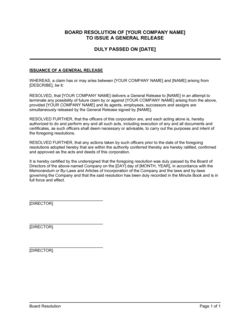
Recitals identifying the corporation and the reason for the trade name, the formal resolution authorizing the name, appointment of officers to execute any required filings, an effective date, certification of adoption, and signature blocks for the required directors or officers.

What is a Board Resolution to Adopt a Trade Name?

A Board Resolution to Adopt a Trade Name is a formal corporate governance document in which a company's board of directors votes to authorize the business to conduct commercial activities under a name other than its registered legal name — commonly referred to as a DBA ("doing business as"), fictitious business name, or assumed name. The resolution becomes a permanent part of the corporation's minute book and provides the evidentiary basis for trade name registrations with government authorities, commercial bank account openings, and contracts executed under the trade name. It is a binding internal authorization that precedes and enables every downstream public filing.

Why You Need This Document

Without a signed board resolution on file, corporations that operate under a trade name face a chain of practical and legal obstacles. Banks routinely refuse to open DBA accounts without written evidence of board authorization. State and provincial filing offices may reject a fictitious business name application that lacks a certified corporate resolution. Contracts signed under an unauthorized trade name can be challenged by counterparties who question whether the signatory had authority to bind the entity. In several US states, knowingly conducting business under an unregistered trade name carries civil penalties and, in extreme cases, bars the corporation from enforcing its own contracts in court. This template gives you a complete, properly structured resolution — with recitals, operative clauses, officer authorization, and a secretary certification — that satisfies banking, regulatory, and governance requirements in a single document you can complete in under 30 minutes.

Which variant fits your situation?

If your situation is…Use this template
Single-director corporation adopting a DBA without a formal meetingBoard Resolution by Written Consent (Trade Name)
LLC adopting a trade name instead of a corporationLLC Member/Manager Resolution to Adopt a Trade Name
Changing an existing trade name to a new oneBoard Resolution to Change a Trade Name
Abandoning or withdrawing a previously registered trade nameBoard Resolution to Abandon a Trade Name
Opening a bank account under the trade nameCorporate Banking Resolution
Renewing an expiring fictitious business name registrationBoard Resolution to Renew a Trade Name
Adopting a trade name in connection with a merger or acquisitionBoard Resolution to Authorize a Merger

Common mistakes to avoid

❌ Using the trade name before the resolution is signed

Why it matters: Operating under an unauthorized trade name exposes the corporation to fines, contract enforceability questions, and rejection of the DBA registration filing. Courts have found that contracts signed under an unregistered trade name may be voidable in some jurisdictions.

Fix: Adopt and execute the resolution before any public use of the trade name, then complete the government registration filing within the statutory window — typically 30–40 days in most US states.

❌ Inconsistent spelling or punctuation of the trade name across the document

Why it matters: Filing offices and banks match the trade name character-for-character against the resolution. A mismatch — even a missing comma or different capitalization — causes rejections that require a corrected resolution and refiling.

Fix: Define the trade name in quotation marks in the first operative clause and use the defined term 'Trade Name' throughout, rather than retyping the name in each clause.

❌ Omitting the bank and third-party authorization clause

Why it matters: Without explicit authorization to open accounts and sign contracts under the trade name, banks routinely refuse to open DBA accounts, and some counterparties will decline to contract with the trade name entity.

Fix: Include a dedicated resolved clause authorizing commercial activity — account openings, contract execution, and any required third-party reliance — under the trade name.

❌ Failing to check trade name availability before adoption

Why it matters: Adopting a trade name that is already registered by another entity in the same jurisdiction, or that infringes a registered trademark, can result in forced renaming, litigation costs, and rebranding expenses.

Fix: Run state business name, federal trademark, and domain searches before the board meeting. If a conflict exists, choose a different name before the resolution is adopted.

❌ Not retaining the executed resolution in the minute book

Why it matters: Banks, investors, and regulators routinely request evidence of corporate authorization as part of due diligence. A missing resolution creates delays in financing, account openings, and regulatory renewals.

Fix: File the executed and certified resolution in the corporate minute book immediately after execution and scan a copy to your cloud document system.

❌ Adopting the resolution without a quorum of directors present

Why it matters: A resolution adopted without a valid quorum is potentially void, making any DBA filing based on it procedurally defective and exposing the corporation to challenges from creditors or counterparties.

Fix: Confirm quorum before the meeting by counting present directors against your bylaws' quorum requirement — or use a written consent signed by all directors to sidestep the quorum issue entirely.

The 10 key clauses, explained

Caption and entity identification

In plain language: Identifies the full legal name of the corporation, its state or province of incorporation, and the document as a formal board resolution.

Sample language
BOARD RESOLUTION OF [CORPORATION LEGAL NAME], a [STATE/PROVINCE] [ENTITY TYPE] ('Corporation'), adopted on [DATE].

Common mistake: Using a brand name or shortened trade name in the caption instead of the registered legal entity name — this can invalidate the resolution as evidence of corporate authorization.

Recitals (Whereas clauses)

In plain language: States the business reason for adopting the trade name — typically a new product line, brand repositioning, or regional market expansion — establishing context for the resolution.

Sample language
WHEREAS, the Corporation desires to conduct its [PRODUCT/SERVICE] business under the trade name '[PROPOSED TRADE NAME]' in order to [BUSINESS REASON]; and WHEREAS, it is in the best interests of the Corporation to formally authorize such use;

Common mistake: Omitting the business rationale entirely. Regulators and courts treat recitals as evidence of good-faith corporate purpose; blank or generic recitals weaken the document's persuasive value.

Resolution to adopt the trade name

In plain language: The operative clause formally authorizing the corporation to use the specified trade name in its business activities.

Sample language
RESOLVED, that the Corporation is hereby authorized to conduct business under the trade name '[TRADE NAME]' (the 'Trade Name'), effective [EFFECTIVE DATE].

Common mistake: Listing the trade name inconsistently across the resolution — even minor spacing or punctuation differences between the resolution and the registration filing can cause a clerk to reject the application.

Geographic or business-line scope

In plain language: Defines whether the trade name is authorized for use across all jurisdictions and business lines, or only in a specific territory or product category.

Sample language
RESOLVED FURTHER, that the Trade Name is authorized for use in connection with the Corporation's [DESCRIPTION OF BUSINESS] operations in [JURISDICTION(S) / 'all jurisdictions where the Corporation conducts business'].

Common mistake: Leaving scope undefined, which creates ambiguity when the trade name is later used in a new state or for a different product line — requiring a new resolution to clarify authority.

Authorization to file and register

In plain language: Grants one or more named officers the authority to execute and submit fictitious name registrations, DBA filings, and any related documents with the relevant authorities.

Sample language
RESOLVED FURTHER, that the [TITLE — President / CEO / Secretary] of the Corporation, and any other officer designated by the Board, is authorized and directed to execute and file all applications, certificates, and other documents required to register the Trade Name with the applicable government authorities.

Common mistake: Naming only one officer as authorized filer without a successor designation. If that officer is unavailable at filing time, agencies may refuse to accept documents signed by anyone else.

Bank and third-party authorization

In plain language: Extends the trade name authorization to cover opening bank accounts, entering contracts, and conducting all commercial transactions under the trade name.

Sample language
RESOLVED FURTHER, that the Corporation is authorized to open and maintain bank accounts, enter into contracts, and conduct all business transactions under the Trade Name, and that financial institutions and third parties are authorized to rely on the Trade Name as a valid operating name of the Corporation.

Common mistake: Omitting bank authorization language. Many financial institutions require this specific clause before they will open a DBA account — a general trade name resolution without it forces a second resolution.

Effective date

In plain language: States the date from which the trade name authorization takes effect — which may differ from the date the resolution was adopted.

Sample language
RESOLVED FURTHER, that the authorization granted herein shall be effective as of [DATE], subject to completion of any required government filings.

Common mistake: Setting the effective date before the resolution's adoption date. Using a retroactive effective date can create gaps in corporate authority and is rejected by some regulatory agencies.

Ratification of prior acts

In plain language: Confirms and ratifies any actions already taken by officers in connection with the trade name before the formal resolution was passed.

Sample language
RESOLVED FURTHER, that all prior acts taken by any officer of the Corporation in connection with the adoption or use of the Trade Name prior to the date hereof are hereby ratified, confirmed, and approved.

Common mistake: Skipping this clause when the trade name has already been used informally. Without ratification, prior use is technically unauthorized and can create liability exposure.

Certification by corporate secretary

In plain language: The corporate secretary certifies that the resolution was duly adopted by the board at a validly called meeting (or by written consent) and that it is a true and correct extract of the corporate records.

Sample language
I, [CORPORATE SECRETARY NAME], Secretary of [CORPORATION NAME], hereby certify that the foregoing is a true and correct copy of a resolution duly adopted by the Board of Directors at a meeting held on [DATE] at which a quorum was present and acted throughout, and that such resolution has not been modified or rescinded.

Common mistake: Having the same person who signed the resolution also certify it as secretary without noting any dual-role disclosure. Regulators and banks often flag this as a procedural irregularity.

Signature block

In plain language: Records the dated signatures of the required number of directors or authorized officers, completing the formal execution of the resolution.

Sample language
IN WITNESS WHEREOF, the undersigned, being all [or a majority] of the directors of [CORPORATION NAME], have executed this Resolution as of [DATE]. _________________________ [DIRECTOR NAME], Director _________________________ [DIRECTOR NAME], Director

Common mistake: Collecting undated signatures or signatures without printed names and titles beneath them. Banks and filing offices routinely reject resolutions with incomplete signature blocks.

How to fill it out

  1. 1

    Confirm the corporation's exact legal name

    Retrieve your most recent certificate of incorporation or articles of organization to confirm the precise registered legal name, including entity suffix (Inc., LLC, Corp., Ltd.). Enter this name exactly in the caption and throughout the resolution.

    💡 A single character difference between the resolution and the corporate registry record can cause a DBA filing to be rejected.

  2. 2

    Verify the proposed trade name is available

    Search your state's or province's business name database, USPTO trademark records, and relevant domain registries before committing to the trade name. Confirm the name complies with local fictitious-name rules — most jurisdictions prohibit names that imply a different entity type (e.g., 'Holdings' or 'Bank' without regulatory approval).

    💡 Run a trademark clearance search before adopting the trade name — a $300 attorney search is far cheaper than a rebranding after a cease-and-desist letter.

  3. 3

    Draft the recitals with a specific business rationale

    Enter the specific reason the board is adopting the trade name — product line launch, regional brand, customer-facing rebrand, or franchise requirement. Vague recitals reduce the document's evidentiary value.

    💡 One sentence is sufficient for the recital, but it should be specific enough that a regulator or judge can understand the corporate purpose without additional context.

  4. 4

    Enter the trade name consistently in every clause

    Type the exact trade name — including capitalization, punctuation, and spacing — into every operative clause. Define it in the first resolution clause as 'Trade Name' and use that defined term in all subsequent clauses.

    💡 Copy-paste the trade name rather than retyping it to eliminate the risk of inconsistent capitalization between clauses.

  5. 5

    Name the authorized officer and specify their title

    Enter the full legal name and corporate title of each officer authorized to execute filings and open accounts. If you want flexibility, add 'or any officer designated by the Board' as a fallback.

    💡 Name at least two officers — a primary and an alternate — to avoid filing delays if the primary officer is unavailable.

  6. 6

    Set the effective date

    Choose an effective date that is on or after the date of the board meeting or written consent. If a government filing is required before use, add the qualifier 'subject to completion of required government filings.'

    💡 Do not backdate the effective date to cover past informal use — use the ratification clause instead to address prior acts.

  7. 7

    Obtain director signatures and complete the certification

    Collect dated signatures from the required number of directors. The corporate secretary then completes and signs the certification block, confirming quorum and proper adoption.

    💡 Use Business in a Box eSign to timestamp signatures and store the fully-executed resolution in your corporate minute book in a single step.

  8. 8

    File the DBA or fictitious name registration

    Submit the completed resolution along with any required registration form and filing fee to the appropriate state, county, or provincial authority. Retain a file-stamped copy for your minute book.

    💡 Check whether your jurisdiction also requires publication of the fictitious name in a local newspaper — roughly 10 US states still mandate this step.

Frequently asked questions

What is a board resolution to adopt a trade name?

A board resolution to adopt a trade name is a formal corporate document in which a company's board of directors votes to authorize the business to operate under a name other than its registered legal name. It records the decision, names the authorized officers, and provides the evidentiary basis for DBA filings, bank account openings, and commercial contracts conducted under the trade name. It becomes part of the corporation's official minute book once adopted.

Do I need a board resolution to register a DBA?

Most state and provincial authorities do not require a board resolution as part of the DBA filing itself, but many do require evidence of corporate authorization. Banks almost universally require one before opening an account under a trade name. In practice, having a signed resolution on file protects the corporation against internal governance challenges and satisfies every downstream requirement — it is considered best practice regardless of whether it is strictly mandated.

What is the difference between a trade name, DBA, and fictitious business name?

All three terms describe the same concept: a name a business uses in commerce that differs from its registered legal name. 'DBA' (doing business as) is the most common US informal term. 'Fictitious business name' is the statutory term used in California and several other states. 'Trade name' is the broader legal and commercial term used across jurisdictions, including Canada and the UK. The resolution authorizes use of the name; the registration filing makes it public.

Can an LLC use this board resolution template?

This template is drafted for corporations with a board of directors. An LLC is governed by members or managers, not a board, so it uses a member resolution or manager resolution instead. The operative content is nearly identical, but the authorizing body, signature block, and certification language must reflect the LLC's governance structure. Using a corporate resolution template for an LLC can create a governance mismatch that raises questions during bank account openings or due diligence.

How long is a trade name registration valid?

Registration duration varies by jurisdiction. In many US states, a fictitious business name registration expires after 5 years and must be renewed. In California, the term is also 5 years. In Canada, provincial registration periods range from 3 to 5 years depending on the province. The board resolution itself does not expire — it remains in the minute book indefinitely — but the underlying government registration must be renewed on schedule.

Does a board resolution to adopt a trade name protect the name as a trademark?

No. A board resolution and a DBA filing establish the corporation's right to use a trade name in a specific jurisdiction, but they do not create federal or provincial trademark rights. Trademark protection requires a separate application to the USPTO (in the US), CIPO (in Canada), or the relevant national IP office. Filing a DBA without a trademark search first can result in unknowingly adopting a name that infringes an existing registered mark.

Can a resolution be adopted without a formal board meeting?

Yes. Most jurisdictions permit boards to adopt resolutions by written consent — a signed document circulated to all directors — without convening a physical or virtual meeting. This is often faster for routine matters like trade name adoption. The written consent must typically be signed by all directors (not just a majority) to substitute for a meeting, and it must be filed in the minute book with the same formality as a meeting resolution.

What happens if the corporation operates under a trade name without a resolution?

Operating under an unresolved trade name creates several risks: the DBA registration may be rejected or challenged, contracts signed under the trade name may be questioned as to the authority of the signatory, and banks may freeze or refuse to open accounts. In some jurisdictions, knowingly using an unregistered fictitious business name is a misdemeanor or triggers civil penalties. A retroactive resolution with a ratification clause can cure most past use, but it does not eliminate all exposure.

Do I need a lawyer to prepare a board resolution to adopt a trade name?

For a straightforward domestic trade name adoption by a single-jurisdiction corporation, a well-drafted template is typically sufficient. Consider engaging a lawyer when the trade name will be used across multiple jurisdictions with different filing requirements, when trademark clearance is complex, when the corporation is closely held with potential shareholder disputes, or when the trade name is being adopted in connection with a merger, acquisition, or licensing arrangement.

How this compares to alternatives

vs Board Resolution to Change Corporate Name

A corporate name change resolution formally amends the company's registered legal name in the articles of incorporation — a process requiring state or provincial approval and amendment filing. A trade name resolution authorizes use of a secondary operating name without changing the legal name. Use a trade name resolution when you want a brand name for marketing; use a corporate name change when the legal entity itself will be renamed.

vs LLC Operating Agreement Amendment

An LLC operating agreement amendment updates the governing document of an LLC — including potentially its trade name authority — but it is a member-level document, not a corporate board resolution. LLCs should use a member or manager resolution to adopt a trade name, not this corporate board resolution template. The legal effect is similar, but the authorizing body and document structure differ materially.

vs Board Resolution to Open a Bank Account

A banking resolution authorizes specific officers to open and operate bank accounts on behalf of the corporation, which may or may not involve a trade name. A trade name resolution is needed first when the account will be held under a DBA — the bank will require both documents. The trade name resolution establishes the right to use the name; the banking resolution establishes the right to conduct financial transactions under it.

vs Trademark Application

A trademark application filed with the USPTO or a national IP office creates exclusive intellectual property rights in a name across the relevant jurisdiction. A board resolution to adopt a trade name is an internal governance document that authorizes the corporation to use the name — it creates no IP rights. Both are typically needed: the resolution for governance and banking, the trademark application for brand protection.

Industry-specific considerations

Retail and e-commerce

Corporations operating multiple store brands or online storefronts under a single legal entity require a separate resolution and DBA filing for each distinct brand name used in commerce.

Professional services

Law firms, accounting firms, and consulting practices frequently operate under a trade name that omits partner surnames — requiring a resolution and state professional-corporation DBA filing before client-facing use.

Franchise operations

Franchisee corporations are typically required by their franchise agreement to operate under the franchisor's brand name, making a trade name resolution and DBA filing a mandatory step in the franchise setup process.

Technology and SaaS

Tech companies frequently operate product lines or acquired brands under names separate from the parent corporation's legal name, requiring a board resolution for each trade name used in B2B or B2C contracts.

Healthcare

Healthcare corporations operating clinics or practices under a patient-facing brand name must comply with both general DBA filing requirements and profession-specific rules that restrict trade name content in several states.

Financial services

Banks, credit unions, and financial services firms face heightened scrutiny: trade names may not imply deposit insurance or regulatory affiliation, and regulators often require submission of the board resolution as part of the name-change or DBA approval process.

Jurisdictional notes

United States

DBA or fictitious business name requirements vary by state and often by county. Most states require filing with the Secretary of State or county clerk within 30–40 days of first use, accompanied by a filing fee of $10–$100. Approximately 10 states additionally require newspaper publication of the fictitious name. California, Texas, and Florida each have distinct fictitious name statutes with specific content requirements for the registration form. A board resolution is not universally required by statute but is expected by banks and is best practice for all corporations.

Canada

In Canada, trade name registration is governed provincially. Ontario requires business name registration under the Business Names Act within 60 days of first use; failure to register can bar the corporation from bringing a court action to enforce contracts made under the trade name. Quebec requires that trade names comply with the French Language Charter — an English-only trade name must be accompanied by a French version for use in Quebec. Alberta and BC have similar registration requirements under their respective Business Names Acts.

United Kingdom

UK companies operating under a business name other than their registered company name must comply with the Business Names Act 1985 (as retained and amended) and the Companies Act 2006. The trading name must be disclosed on all business correspondence, invoices, and business premises. Certain words and expressions require prior approval from Companies House or a relevant authority before use. A board resolution is not required for registration, but it is standard corporate governance practice and expected by UK banks for DBA account openings.

European Union

Trade name registration requirements vary significantly across EU member states, as there is no single EU-wide trade name registration framework. Germany requires entry of the trade name (Firma) in the Commercial Register (Handelsregister) for registered companies. France requires KBIS registration of any trade name used commercially. Spain and Italy have similar commercial registry requirements. In most member states, using an unregistered trade name commercially constitutes an unfair commercial practice under local implementation of EU Directive 2005/29/EC, and a board resolution is expected as internal authorization documentation.

Template vs lawyer — what fits your deal?

PathBest forCostTime
Use the templateSingle-jurisdiction corporations adopting a straightforward DBA for a new brand or product lineFree15–30 minutes
Template + legal reviewMulti-state operations, franchise contexts, or trade names tied to a financing or acquisition event$200–$5001–2 business days
Custom draftedComplex multi-jurisdiction trade name strategies, regulated industries (banking, healthcare, law), or trade names with trademark litigation risk$800–$2,500+3–7 business days

Glossary

Trade Name
A name under which a business operates that is different from its registered legal name, also called a fictitious business name or DBA.
DBA (Doing Business As)
A declaration filed with a government authority stating that a legal entity is conducting business under an assumed name other than its registered corporate name.
Fictitious Business Name
A statutory term used in many US states for any name a company uses in commerce that does not include the owner's full legal name or the registered entity name.
Board Resolution
A formal written record of a decision made by a company's board of directors, which becomes part of the corporation's official minute book.
Corporate Secretary
The officer responsible for maintaining company records, certifying board resolutions, and filing required documents with regulatory authorities.
Quorum
The minimum number of directors who must be present or represented at a board meeting for a vote to be legally valid — typically a majority unless the bylaws specify otherwise.
Minute Book
The official corporate record containing meeting minutes, resolutions, shareholder registers, and other governance documents required to be kept by law.
Authorized Officer
A director or officer named in a resolution who is empowered to execute documents, make filings, or take specific actions on behalf of the corporation.
Fictitious Name Registration
The state, provincial, or local filing that publicly records a business's intent to operate under a trade name, typically required before using the name commercially.
Written Consent Resolution
A board resolution adopted without a formal meeting, signed by all required directors, valid in most jurisdictions as an alternative to a voted resolution.
Recitals
The introductory 'Whereas' clauses in a resolution that state the factual background and business reasons supporting the decision being recorded.

Part of your Business Operating System

This document is one of 3,000+ business & legal templates included in Business in a Box.

  • Fill-in-the-blanks — ready in minutes
  • 100% customizable Word document
  • Compatible with all office suites
  • Export to PDF and share electronically

Create your document in 3 simple steps.

From template to signed document — all inside one Business Operating System.
1
Download or open template

Access over 3,000+ business and legal templates for any business task, project or initiative.

2
Edit and fill in the blanks with AI

Customize your ready-made business document template and save it in the cloud.

3
Save, Share, Send, Sign

Share your files and folders with your team. Create a space of seamless collaboration.

Save time, save money, and create top-quality documents.

★★★★★

"Fantastic value! I'm not sure how I'd do without it. It's worth its weight in gold and paid back for itself many times."

Managing Director · Mall Farm
Robert Whalley
Managing Director, Mall Farm Proprietary Limited
★★★★★

"I have been using Business in a Box for years. It has been the most useful source of templates I have encountered. I recommend it to anyone."

Business Owner · 4+ years
Dr Michael John Freestone
Business Owner
★★★★★

"It has been a life saver so many times I have lost count. Business in a Box has saved me so much time and as you know, time is money."

Owner · Upstate Web
David G. Moore Jr.
Owner, Upstate Web

Run your business with a system — not scattered tools

Stop downloading documents. Start operating with clarity. Business in a Box gives you the Business Operating System used by over 250,000 companies worldwide to structure, run, and grow their business.

Start free · No credit card required