Balance Sheet Template

Free Excel download β€’ Edit online β€’ Save & share with Drive β€’ Export to PDF

3 pagesβ€’20–25 min to fillβ€’Difficulty: Standard
Learn more ↓
FreeXLSBalance Sheet Template

At a glance

What it is
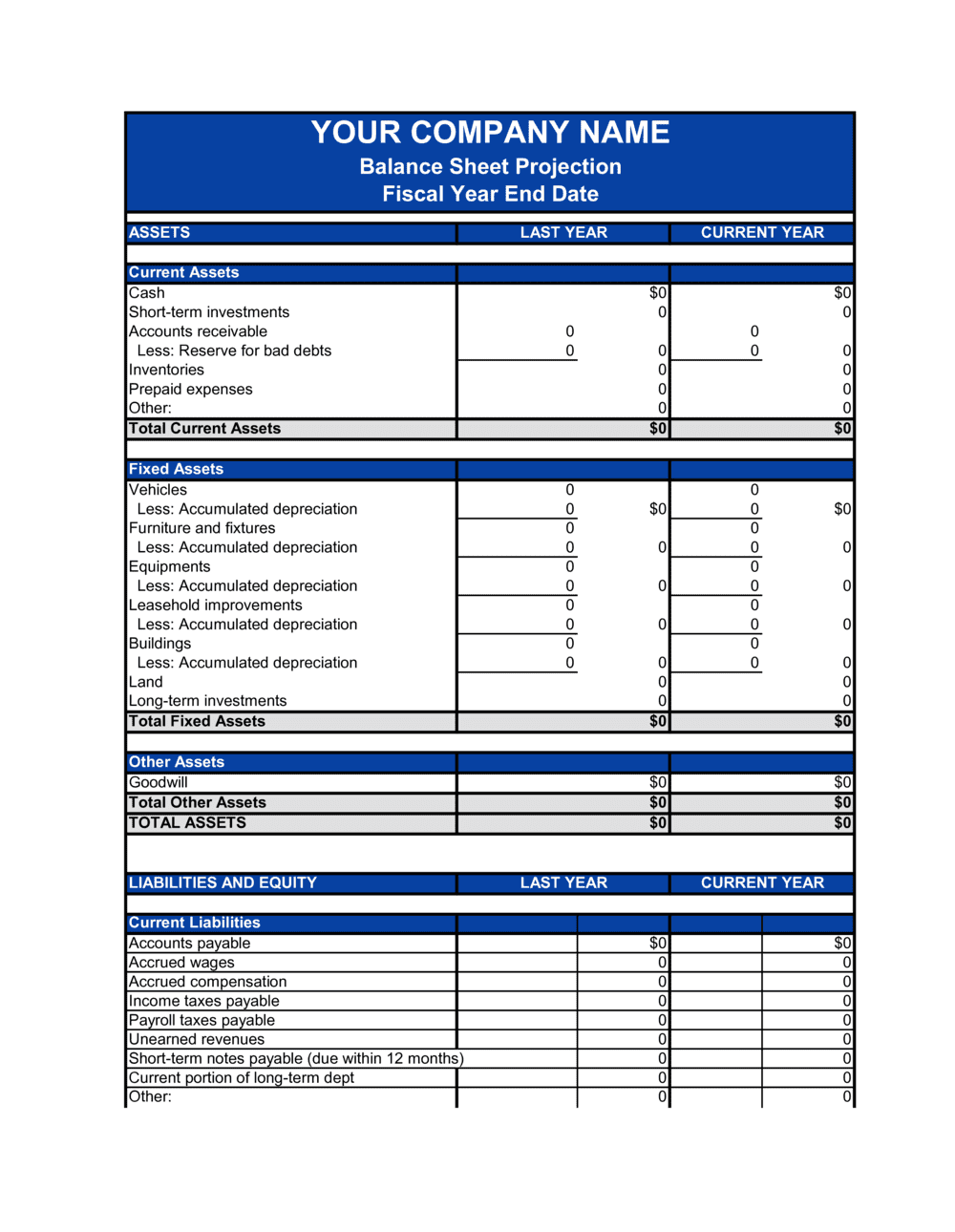
A Balance Sheet is a financial statement that records a company's assets, liabilities, and shareholders' equity at a specific point in time. This free Word download gives you a structured form you can edit online and export as PDF β€” formatted for monthly, quarterly, or annual reporting to owners, lenders, or accountants.
When you need it
Use it at the close of any accounting period β€” month-end, quarter-end, or fiscal year-end β€” to produce a snapshot of the business's financial position. Lenders and investors typically require one before approving financing or conducting due diligence.
What's inside
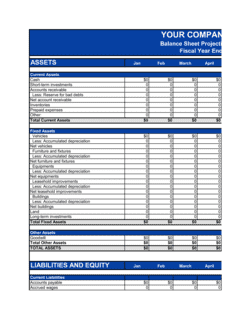
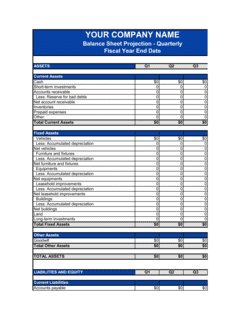
Current and non-current assets, current and long-term liabilities, owners' equity or shareholders' equity, and a totals verification row confirming that assets equal liabilities plus equity.

What is a Balance Sheet?

A Balance Sheet is a financial statement that records a business's assets, liabilities, and owners' equity at a single point in time. It is built on the foundational accounting equation β€” assets equal liabilities plus equity β€” meaning the two sides of the statement must always match exactly. Unlike an income statement, which covers a span of time, a balance sheet is a snapshot: it tells you precisely what a business owns, what it owes, and what remains for the owners on one specific date.

Why You Need This Document

Without a current balance sheet, you cannot accurately assess whether your business is solvent, how much working capital you have available, or what your debt load looks like relative to your equity. Lenders require one for virtually every loan application; investors request one before any due diligence conversation. Internally, a balance sheet prepared at each period-end catches misclassified assets, unrecorded liabilities, and retained earnings discrepancies before they compound into larger accounting problems. This template gives you a structured, professionally formatted starting point that ensures every required line item is accounted for β€” so your financials are ready when you need them.

Which variant fits your situation?

If your situation is…Use this template
Tracking financial position for a sole proprietor or single-member LLCSimple Balance Sheet
Preparing audited year-end financials for a corporationCorporate Balance Sheet
Comparing two consecutive periods side by sideComparative Balance Sheet
Reporting assets and liabilities as a percentage of total assetsCommon-Size Balance Sheet
Projecting financial position at the end of a future periodPro Forma Balance Sheet
Reporting for a nonprofit organization with fund accountingNonprofit Statement of Financial Position
Personal net worth snapshot for a sole proprietor or individualPersonal Balance Sheet

Common mistakes to avoid

❌ Using a date range instead of a single as-of date

Why it matters: A balance sheet captures a moment in time, not a span. Using a range signals a misunderstanding of the document's purpose and can cause lenders to reject or question the filing.

Fix: Always head the document with 'As of [specific date]' β€” the last day of the reporting period.

❌ Omitting accumulated depreciation from fixed assets

Why it matters: Reporting gross PP&E without depreciation overstates the asset base and inflates equity, giving an inaccurate picture of net worth to lenders and investors.

Fix: Show gross cost, accumulated depreciation as a deduction, and the resulting net book value as three separate line items for each fixed asset category.

❌ Misclassifying long-term debt as entirely non-current

Why it matters: Burying the current portion of a loan in long-term liabilities understates current liabilities and artificially inflates working capital ratios β€” metrics lenders specifically check.

Fix: Review each loan's amortization schedule and split the next 12 months of principal payments into current liabilities.

❌ Leaving the balance sheet unbalanced before submitting

Why it matters: An out-of-balance sheet tells any accountant, auditor, or lender that the bookkeeping contains an error β€” immediately undermining confidence in all the figures.

Fix: Add a total liabilities and equity line and verify it equals total assets before saving or sharing the document.

The 9 key fields, explained

Report date and entity name

Current assets

Non-current assets

Total assets

Current liabilities

Long-term liabilities

Total liabilities

Owners' equity or shareholders' equity

Total liabilities and equity

How to fill it out

  1. 1

    Enter the entity name and as-of date

    Type the full legal name of the business at the top of the form and record the single calendar date the balance sheet reflects β€” typically the last day of a month, quarter, or fiscal year.

    πŸ’‘ Use the same entity name that appears on your tax filings to avoid discrepancies during lender or audit review.

  2. 2

    List all current assets with individual balances

    Enter cash and equivalents first, then accounts receivable, inventory, and prepaid expenses. Pull each figure from your accounting software's trial balance or general ledger as of the report date.

    πŸ’‘ Reconcile your bank balance to your accounting software before recording cash β€” an unreconciled difference will cause the balance sheet to fail the assets-equal-liabilities-plus-equity check.

  3. 3

    Record non-current assets net of depreciation

    Enter the gross cost of each fixed asset, then subtract the accumulated depreciation balance to arrive at net book value. Record intangible assets separately from tangible ones.

    πŸ’‘ Keep a fixed-asset register updated throughout the year so you can pull accurate depreciation figures in minutes at period-end.

  4. 4

    Total the assets section

    Sum current and non-current assets to produce total assets. Double-check each individual line before finalizing β€” a transposition error in one line flows through to the total and causes an imbalance.

    πŸ’‘ If you are filling in a Word template manually, use a calculator and verify each subtotal independently before adding them.

  5. 5

    Enter current and long-term liabilities

    List accounts payable, accrued expenses, deferred revenue, and the current portion of long-term debt under current liabilities. Enter the remaining long-term loan balance and other non-current obligations under long-term liabilities.

    πŸ’‘ Review your loan amortization schedule to correctly split each debt between its current and long-term portions.

  6. 6

    Complete the equity section

    Record paid-in capital or owner contributions, then add retained earnings from the prior period and the current period's net income. Subtract any owner draws or dividends paid during the period.

    πŸ’‘ Retained earnings on the balance sheet should tie exactly to the ending retained earnings figure on your statement of retained earnings β€” if they differ, find the discrepancy before distributing the report.

  7. 7

    Verify the balance sheet balances

    Confirm that total assets equal total liabilities plus total equity to the dollar. Any discrepancy indicates a data entry error, a misclassified account, or a missing line item.

    πŸ’‘ An imbalance of exactly one account's value usually means that account was entered in the wrong section β€” check whether any item appears on both sides simultaneously.

Frequently asked questions

What is a balance sheet?

A balance sheet is a financial statement that shows what a business owns (assets), what it owes (liabilities), and what remains for the owners (equity) at a specific point in time. It is one of the three core financial statements, alongside the income statement and cash flow statement. The defining rule is that assets must always equal liabilities plus equity β€” this is the accounting equation that gives the document its name.

What is the difference between a balance sheet and an income statement?

A balance sheet is a snapshot of financial position on a single date β€” it shows what the business has and owes right now. An income statement covers a period of time (a month, quarter, or year) and shows revenue, expenses, and net profit or loss during that span. The net income from the income statement flows into retained earnings on the balance sheet, linking the two documents together.

How often should a balance sheet be prepared?

Most businesses prepare a balance sheet monthly for internal management, quarterly for board or investor reporting, and annually for tax filing and audit purposes. Lenders typically require year-end balance sheets for loan applications. Growing businesses benefit from monthly balance sheets to monitor working capital and debt levels in real time.

Does a balance sheet need to be prepared by an accountant?

No β€” many small business owners and bookkeepers prepare balance sheets using accounting software or a structured template. An accountant or CPA is recommended when the balance sheet will be submitted for a significant loan, audit, investor due diligence, or tax filing that involves complex asset or liability classifications.

What does it mean when a balance sheet doesn't balance?

An imbalance means total assets do not equal total liabilities plus equity, which indicates a data entry error, a misclassified account, or a missing transaction. Common causes include entering a number in the wrong section, omitting accumulated depreciation, or double-counting a line item. The fix is to trace each section subtotal back to the underlying account balances until the discrepancy is found.

What is working capital and where do I find it on the balance sheet?

Working capital is current assets minus current liabilities and represents the short-term liquidity buffer available to fund daily operations. Both figures are on the balance sheet β€” subtract the total current liabilities from the total current assets to calculate it. Positive working capital means the business can meet near-term obligations; negative working capital is a warning sign for lenders and suppliers.

Can a balance sheet be used to apply for a business loan?

Yes β€” most lenders require a balance sheet as part of any business loan application. They use it to assess debt-to-equity ratio, working capital, and the value of assets available as collateral. SBA loans and bank lines of credit typically require balance sheets for at least the two most recent fiscal years, plus a current interim balance sheet dated within 90–120 days of the application.

What is the difference between a balance sheet and a net worth statement?

For a business, a balance sheet and a net worth statement convey the same fundamental information β€” assets minus liabilities equals net worth (equity). The term 'balance sheet' is standard for businesses; 'net worth statement' or 'personal financial statement' is used for individuals or sole proprietors. The structure and accounting equation are identical.

How this compares to alternatives

vs Income Statement

An income statement covers revenue and expenses over a period to show profit or loss. A balance sheet captures financial position on a single date. The two documents are linked β€” net income from the income statement increases retained earnings on the balance sheet. You need both for a complete financial picture.

vs Cash Flow Statement

A cash flow statement tracks actual cash inflows and outflows during a period, separated into operating, investing, and financing activities. A balance sheet shows the ending cash balance but not how it changed. The cash flow statement explains the movement between two consecutive balance sheet dates.

vs Personal Balance Sheet

A personal balance sheet applies the same assets-minus-liabilities structure to an individual's finances β€” home value, savings, and personal loans β€” rather than a business entity. Use the business balance sheet for any entity with formal accounting; use the personal version for individual net worth calculations or personal loan applications.

vs Financial Projections Template

A financial projections template is a forward-looking model estimating future revenue, expenses, and balance sheet position. A balance sheet records actual historical data as of a specific date. Investors and lenders typically want both β€” the balance sheet confirms where the business stands today; projections show where it is headed.

Industry-specific considerations

Retail and e-commerce

Inventory typically represents the largest current asset line and must be carefully valued at the lower of cost or net realizable value.

Professional services

Unbilled receivables and work-in-progress are key current asset lines that distinguish service-firm balance sheets from product-based ones.

Construction and real estate

Land and property held as investment must be separated from operating PP&E, and contract retainage appears as a distinct receivable line.

Manufacturing

Raw materials, work-in-process, and finished goods inventory are reported as three separate current asset lines with distinct valuation methods.

Template vs pro β€” what fits your needs?

PathBest forCostTime
Use the templateSmall business owners, bookkeepers, and founders preparing internal reports or straightforward loan applicationsFree15–30 minutes per period
Template + professional reviewBusinesses submitting financials to lenders, investors, or for tax purposes with complex asset classifications$100–$400 (accountant review)1–2 business days
Custom draftedAudited financial statements, multi-entity consolidations, or businesses with complex lease and debt structures$500–$3,000+ (CPA or audit firm)1–4 weeks

Glossary

Assets
Everything a business owns or is owed that has measurable economic value β€” cash, inventory, equipment, and receivables.
Liabilities
All financial obligations the business owes to outside parties, such as loans, accounts payable, and accrued expenses.
Equity
The residual interest in the business after subtracting total liabilities from total assets β€” what the owners actually own.
Current Assets
Assets expected to be converted to cash or used within 12 months, such as cash, accounts receivable, and inventory.
Current Liabilities
Obligations due within 12 months, including accounts payable, accrued wages, short-term loans, and the current portion of long-term debt.
Non-Current Assets
Long-term assets not expected to be liquidated within a year, such as property, equipment, and intangible assets.
Accounts Receivable
Money owed to the business by customers for goods or services already delivered but not yet paid for.
Accounts Payable
Money the business owes to suppliers or vendors for goods or services received but not yet paid.
Working Capital
Current assets minus current liabilities β€” the liquid buffer available to fund day-to-day operations.
Retained Earnings
The cumulative net income kept in the business since inception, after subtracting all dividends or owner distributions paid out.

Part of your Business Operating System

This document is one of 3,000+ business & legal templates included in Business in a Box.

  • Fill-in-the-blanks β€” ready in minutes
  • 100% customizable Word document
  • Compatible with all office suites
  • Export to PDF and share electronically

Create your document in 3 simple steps.

From template to signed document β€” all inside one Business Operating System.
1
Download or open template

Access over 3,000+ business and legal templates for any business task, project or initiative.

2
Edit and fill in the blanks with AI

Customize your ready-made business document template and save it in the cloud.

3
Save, Share, Send, Sign

Share your files and folders with your team. Create a space of seamless collaboration.

Save time, save money, and create top-quality documents.

β˜…β˜…β˜…β˜…β˜…

"Fantastic value! I'm not sure how I'd do without it. It's worth its weight in gold and paid back for itself many times."

Managing Director Β· Mall Farm
Robert Whalley
Managing Director, Mall Farm Proprietary Limited
β˜…β˜…β˜…β˜…β˜…

"I have been using Business in a Box for years. It has been the most useful source of templates I have encountered. I recommend it to anyone."

Business Owner Β· 4+ years
Dr Michael John Freestone
Business Owner
β˜…β˜…β˜…β˜…β˜…

"It has been a life saver so many times I have lost count. Business in a Box has saved me so much time and as you know, time is money."

Owner Β· Upstate Web
David G. Moore Jr.
Owner, Upstate Web

Run your business with a system β€” not scattered tools

Stop downloading documents. Start operating with clarity. Business in a Box gives you the Business Operating System used by over 250,000 companies worldwide to structure, run, and grow their business.

Free Forever PlanΒ Β·Β No credit card required