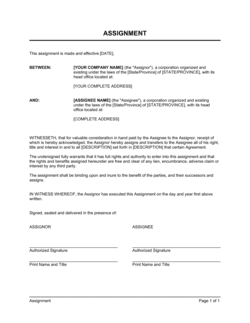
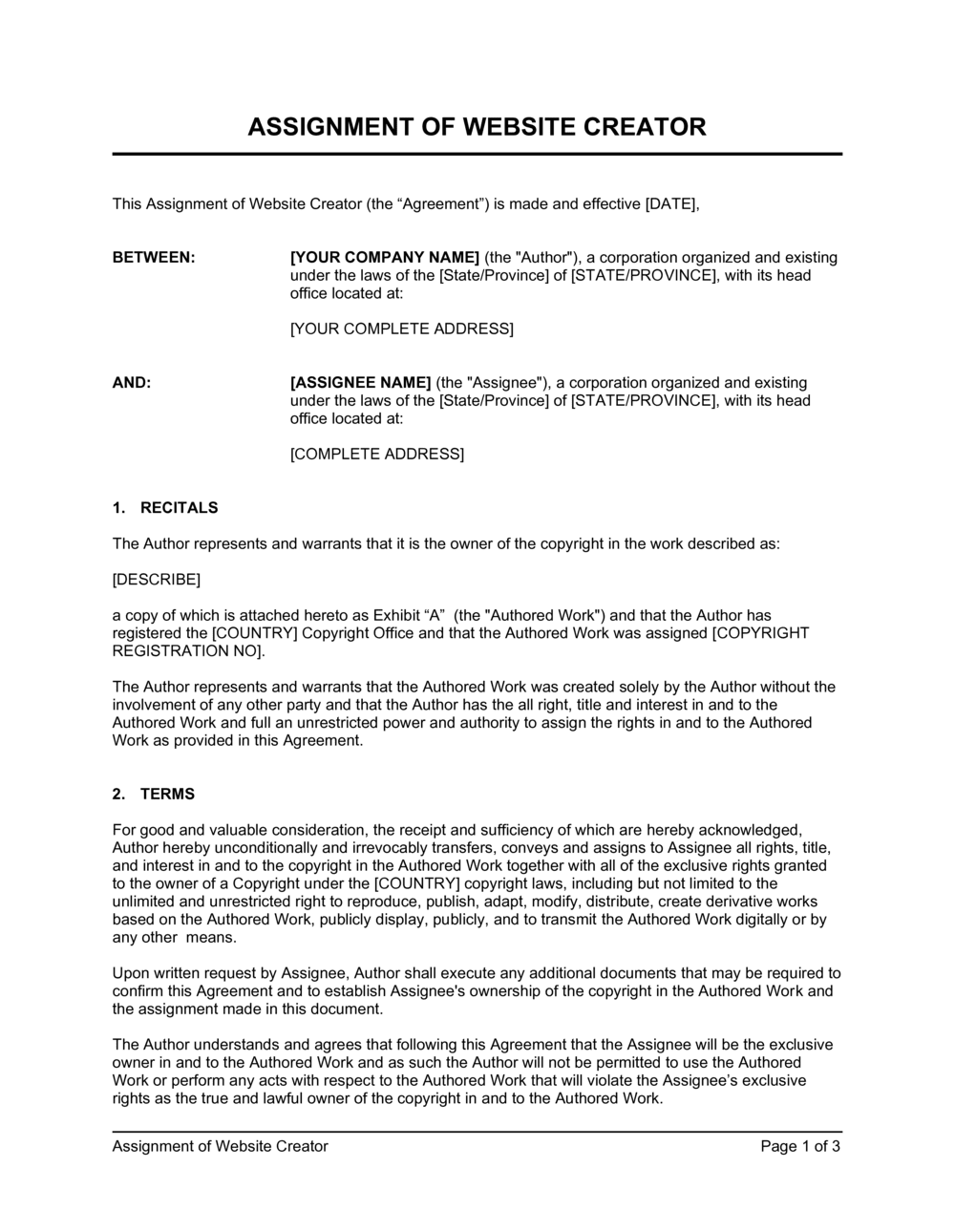
Assignment of Website Creator Template

Free Word download β€’ Edit online β€’ Save & share with Drive β€’ Export to PDF

3 pagesβ€’25–30 min to fillβ€’Difficulty: Standardβ€’Signature requiredβ€’Legal review recommended
Learn more ↓
FreeAssignment of Website Creator Template

At a glance

What it is
An Assignment of Website Creator is a legally binding agreement in which a website developer or designer transfers all intellectual property rights in a website β€” including code, design, graphics, and content β€” to the commissioning client. This template is a free Word download you can edit online and export as PDF, covering full IP transfer, representations of originality, moral rights waivers, and the consideration paid for the assignment.
When you need it
Use it when a contractor, freelance developer, or agency has built a website for your business and you need to formally take ownership of all the underlying intellectual property. It is also required when acquiring an existing website business and the creator's rights must be extinguished before the transaction closes.
What's inside
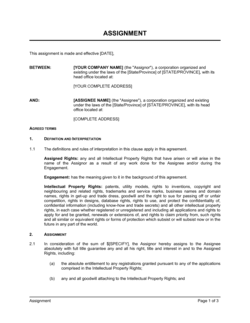
Identification of the assignor and assignee, a precise description of the website and all IP being transferred, consideration and payment terms, representations and warranties on originality and third-party licences, moral rights waiver, post-assignment cooperation obligations, and governing law with dispute resolution.

What is an Assignment of Website Creator?

An Assignment of Website Creator is a legally binding agreement in which the developer or designer who built a website β€” the assignor β€” permanently transfers all intellectual property rights in that website to the commissioning client β€” the assignee. Those rights include copyright in the source code, design files, graphics, written content, databases, and any other original elements created during the project. In most jurisdictions, paying a developer for their work does not automatically convey IP ownership; copyright vests in the creator at the moment of creation and remains with them unless explicitly transferred in a signed written document. This template formalizes that transfer in a single free Word download covering the full scope of rights, moral rights waivers, third-party component disclosures, and post-assignment delivery obligations.

Why You Need This Document

Without a signed assignment, you may be paying for the use of a website you do not legally own. A developer who retains copyright can β€” in theory β€” demand you take the site down, prevent you from modifying the design, or license the same codebase to a competitor. These are not hypothetical risks: IP ownership disputes between clients and freelance developers are among the most common digital-business litigation matters. For businesses seeking investment or preparing for acquisition, missing developer assignments are a standard due diligence red flag that can delay or derail a transaction entirely. A completed Assignment of Website Creator closes this gap before it becomes a problem, giving you clear title to every line of code and pixel of design your business depends on.

Which variant fits your situation?

If your situation is…Use this template
Transferring rights in a website built by a freelance contractorAssignment of Website Creator
Engaging a developer for ongoing work before the site is builtWeb Design and Development Agreement
Licensing β€” not transferring β€” website code to a third partySoftware Licence Agreement
Acquiring an entire website business including domain and contentWebsite Purchase Agreement
Protecting confidential specs shared with a developer before engagementNon-Disclosure Agreement
Retaining a developer as an independent contractor on an ongoing basisIndependent Contractor Agreement
Assigning all software code β€” not specifically website assets β€” to a buyerSoftware IP Assignment Agreement

Common mistakes to avoid

❌ Using a licence instead of an assignment

Why it matters: A licence β€” even an exclusive, irrevocable one β€” does not transfer ownership. The developer retains legal title, which blocks copyright registration in the assignee's name and complicates M&A due diligence.

Fix: Confirm the agreement uses the words 'assigns' and 'transfers all right, title, and interest' rather than 'grants a licence.' If an existing licence agreement is in place, execute a formal assignment to supersede it.

❌ Omitting the third-party components schedule

Why it matters: An undisclosed GPL library can obligate the assignee to open-source their entire codebase if they distribute the software. Stock photos without a valid commercial licence expose the assignee to infringement claims averaging $2,000–$8,000 per image.

Fix: Require the developer to complete Schedule B before execution. Run an independent licence scan on the repository and reconcile any discrepancies before releasing final payment.

❌ No moral rights waiver

Why it matters: In Canada, the UK, and EU member states, the developer retains moral rights even after assigning copyright. They can legally demand attribution on every page or object to a visual redesign that they consider 'derogatory.'

Fix: Add a jurisdiction-appropriate moral rights waiver clause and have the developer sign it explicitly. In the UK, the waiver must be in writing to be valid.

❌ Signing after final payment is released

Why it matters: Once a developer has been paid in full, they have no financial incentive to hand over credentials, transfer repository access, or sign additional documents. Post-payment IP disputes can take months and legal fees to resolve.

Fix: Structure payment so the final 10–20% is released only upon execution of the assignment and confirmed delivery of all files and credentials.

❌ Vague description of assigned assets

Why it matters: A clause covering 'all website assets' is routinely disputed. Developers argue that raw Figma files or unreleased features were not part of the assignment; clients assume everything related to the project is included.

Fix: Attach a detailed Schedule A listing every deliverable by name, file format, and storage location. If in doubt, include it β€” omission creates disputes.

❌ No indemnification or an inadequate cap

Why it matters: If the developer used unlicensed third-party content and the assignee receives a cease-and-desist or lawsuit, the assignee bears the legal costs without contractual recourse against the developer.

Fix: Include a clear indemnification clause and set the cap at a meaningful amount β€” at minimum, three to five times the consideration paid, or uncapped for fraud and wilful infringement.

The 10 key clauses, explained

Parties and Recitals

In plain language: Identifies the assignor (developer) and assignee (client) as legal entities, and records the background facts β€” what was built, when, and under what prior arrangement.

Sample language
This Assignment of Website Creator ('Agreement') is entered into as of [DATE] between [DEVELOPER LEGAL NAME], a [ENTITY TYPE] ('Assignor'), and [CLIENT LEGAL NAME], a [ENTITY TYPE] ('Assignee'). WHEREAS, Assignor has created the website located at [URL] ('Website') pursuant to [PRIOR AGREEMENT / PURCHASE ORDER / VERBAL ENGAGEMENT] dated [DATE].

Common mistake: Using trade names or personal aliases instead of full legal entity names. If the assignor is a sole trader or LLC, the registered legal name must appear β€” mismatches create enforceability gaps during due diligence.

Description of Assigned Property

In plain language: Precisely defines every asset being transferred β€” source code, design files, graphics, databases, domain name rights, content, and any associated documentation or credentials.

Sample language
Assignor hereby assigns to Assignee all right, title, and interest in and to: (a) the source code and compiled code of the Website; (b) all design files, wireframes, mockups, and graphic assets; (c) all textual content, images, and media created by Assignor; and (d) all associated documentation, as further described in Schedule A.

Common mistake: Omitting a Schedule A with a specific asset list. A generic 'all website assets' clause is routinely disputed β€” what counts as 'the website' is less obvious when plug-ins, third-party themes, and stock images are involved.

Consideration

In plain language: States the payment made in exchange for the assignment β€” a lump sum, the final project invoice, or a nominal amount β€” confirming the transfer is not gratuitous.

Sample language
In consideration of the payment of [AMOUNT] ([CURRENCY]), receipt of which Assignor hereby acknowledges, Assignor assigns to Assignee all rights described in this Agreement.

Common mistake: Leaving consideration as '$1 and other good and valuable consideration.' Courts rarely void assignments on this basis, but undisclosed consideration creates tax questions and signals a poorly negotiated handover.

Scope of Rights Transferred

In plain language: Confirms the assignment is exclusive, worldwide, irrevocable, and perpetual β€” covering all current and future exploitation rights including reproduction, distribution, adaptation, and public display.

Sample language
The assignment is exclusive, irrevocable, worldwide, and in perpetuity, covering all rights of reproduction, distribution, modification, public display, and all other rights now known or hereafter developed, to the fullest extent permitted by applicable law.

Common mistake: Granting a broad licence instead of an outright assignment. A licence β€” even an exclusive one β€” does not transfer ownership and can complicate future fundraising, M&A, or enforcement against infringers.

Representations and Warranties

In plain language: The developer warrants that the website is original, that they are the sole author, that no third-party rights are infringed, and that they have authority to make the assignment.

Sample language
Assignor represents and warrants that: (a) Assignor is the sole creator and owner of the Website IP; (b) the Website does not infringe any third-party intellectual property rights; (c) Assignor has not granted and will not grant any conflicting licences or assignments; and (d) the Website does not incorporate any open-source code subject to copyleft licences that would restrict Assignee's use.

Common mistake: No warranty on open-source components. GPL or AGPL-licensed libraries embedded in the codebase can impose viral sharing obligations on the assignee β€” a warranty and disclosure schedule prevents this.

Third-Party Components Disclosure

In plain language: Requires the developer to list all third-party code, plug-ins, fonts, stock images, and licenced libraries incorporated into the website, along with their licence terms.

Sample language
Assignor discloses all third-party components incorporated in the Website in Schedule B, including the applicable licence for each. Assignee acknowledges that third-party components are not assigned and must be independently licenced by Assignee.

Common mistake: Treating this clause as optional because 'every website uses some open-source code.' An undisclosed GPL dependency discovered post-acquisition can force the acquirer to open-source their entire codebase.

Moral Rights Waiver

In plain language: The developer waives any moral rights β€” such as the right of paternity or the right to object to modifications β€” to the extent permitted by law in the applicable jurisdiction.

Sample language
To the fullest extent permitted by applicable law, Assignor hereby irrevocably and unconditionally waives all moral rights in the Website, including the right to be identified as its creator and the right to object to any modification, adaptation, or treatment of the Website.

Common mistake: Omitting the moral rights waiver entirely. In Canada, the UK, and the EU, moral rights exist independently of copyright and survive an assignment. Without a waiver, the developer can later object to a redesign or demand credit attribution.

Post-Assignment Cooperation

In plain language: Obliges the developer to deliver all files and credentials, execute further documents, and assist the client in perfecting the assignment at no additional charge.

Sample language
Assignor shall, promptly upon request and at no additional cost, deliver all source code, design files, credentials, and documentation to Assignee, execute any further instruments, and take all steps reasonably necessary to vest full title in the Website IP in Assignee.

Common mistake: No cooperation clause at all. Without it, a developer who becomes unresponsive after payment has no contractual obligation to hand over FTP credentials, repository access, or Figma files.

Indemnification

In plain language: The developer agrees to indemnify the client against losses arising from any breach of the representations and warranties β€” including third-party IP claims.

Sample language
Assignor shall indemnify, defend, and hold harmless Assignee from any claims, damages, costs, and expenses (including reasonable attorneys' fees) arising out of any breach of Assignor's representations and warranties under this Agreement.

Common mistake: Capping indemnification at the consideration paid when the website is central to the business. A $2,000 indemnity cap is meaningless if a stock-photo infringement claim costs $15,000 to resolve.

Governing Law and Dispute Resolution

In plain language: Specifies which jurisdiction's law governs the agreement and how disputes are resolved β€” litigation, arbitration, or mediation.

Sample language
This Agreement is governed by the laws of [STATE / PROVINCE / COUNTRY]. Any dispute arising under this Agreement shall be resolved by [binding arbitration / mediation followed by litigation] in [CITY], except that either party may seek injunctive relief in any court of competent jurisdiction.

Common mistake: Selecting a governing law with no connection to either party's location. Courts in the developer's or client's jurisdiction may refuse to enforce a foreign choice-of-law clause that has no rational relationship to the transaction.

How to fill it out

  1. 1

    Enter the legal names and details of both parties

    Insert the developer's and client's full registered legal names, addresses, and entity types. For individuals, use the name exactly as it appears on government-issued ID.

    πŸ’‘ If the developer worked through a personal service company, the company β€” not the individual β€” must be the assignor. Confirm the correct entity before signing.

  2. 2

    Describe the website and all assets in Schedule A

    List every asset being transferred: the URL, repository link, design file locations, database schemas, media libraries, and any associated domain names or social media handles. Be exhaustive.

    πŸ’‘ A screenshot of the live site appended to Schedule A creates an unambiguous reference point if the site is later modified or taken down.

  3. 3

    State the consideration clearly

    Enter the full payment amount and currency. If the assignment price is the final invoice from the development project, reference the invoice number to link the two documents.

    πŸ’‘ Avoid 'nominal consideration' language if the actual payment is material β€” it can create VAT or sales tax characterization issues in some jurisdictions.

  4. 4

    Complete Schedule B with all third-party components

    Ask the developer to list every plug-in, library, font, stock photo, and open-source framework used, along with the licence type (MIT, GPL, Creative Commons, commercial, etc.).

    πŸ’‘ Run the codebase through an open-source licence scanner (e.g., FOSSA or Black Duck) before signing to catch undisclosed GPL components.

  5. 5

    Confirm the moral rights waiver applies

    Check that the waiver language matches the jurisdiction β€” in the UK and Canada, moral rights must be waived expressly; in the US, they apply only to works of visual art under 17 U.S.C. Β§ 106A.

    πŸ’‘ If the developer is in a different country from the client, include a waiver broad enough to cover both jurisdictions.

  6. 6

    Set the post-assignment delivery deadline

    Specify a concrete date or number of business days within which the developer must deliver all credentials, transfer repository access, and return any original materials.

    πŸ’‘ Five business days from execution is standard. Longer deadlines give developers room to delay indefinitely once payment is received.

  7. 7

    Choose governing law and dispute resolution

    Select the jurisdiction most convenient to both parties and specify whether disputes go to arbitration, mediation, or court. For international arrangements, arbitration (ICC, AAA, or LCIA) is generally preferable.

    πŸ’‘ If the deal is small (under $10,000), litigation in small-claims court is faster and cheaper than arbitration. Reserve arbitration clauses for higher-value assignments.

  8. 8

    Execute before or simultaneously with final payment

    Both parties must sign the agreement before or at the same time as the final invoice is paid. Signing after full payment removes the developer's financial incentive to cooperate with post-assignment requests.

    πŸ’‘ Use an eSign platform that timestamps both signatures β€” the execution date matters for copyright registration and due diligence records.

Frequently asked questions

What is an assignment of website creator?

An assignment of website creator is a legal agreement in which the developer or designer who built a website transfers all intellectual property rights β€” including copyright in the code, design, graphics, and content β€” to the commissioning client. Without this document, the developer typically retains copyright by default, even if the client has paid in full for the work. The assignment gives the client full legal ownership, including the right to modify, sell, or licence the website without the developer's permission.

Why doesn't paying a developer automatically give me ownership of the website?

Paying for a creative work does not automatically transfer copyright in most jurisdictions. In the US, copyright vests in the author at the moment of creation unless the work qualifies as 'work made for hire' β€” a narrow doctrine that typically does not cover independently contracted websites. In Canada, the UK, and the EU, copyright always vests in the creator unless explicitly assigned in writing. A signed assignment of website creator agreement is the only reliable mechanism to transfer ownership.

What is the difference between a website assignment and a website licence?

An assignment permanently transfers all ownership rights from the developer to the client β€” the developer no longer holds any rights in the work. A licence grants the client permission to use the website IP under defined conditions, while the developer retains ownership. For most business purposes, including resale, investment due diligence, and brand control, an assignment is preferable. A licence is appropriate when the developer wants to retain ownership and re-use elements of the work for other clients.

What happens to open-source components used in the website?

Open-source code cannot be assigned β€” it remains under its original licence (MIT, GPL, Apache, etc.) regardless of what the assignment agreement says. The agreement should require the developer to disclose all open-source components in a Schedule B so the assignee can evaluate the licence obligations independently. GPL and AGPL licences in particular impose conditions on how the software can be distributed, and the assignee must comply with those conditions after taking ownership.

Do I need an assignment of website creator if I already have a web development contract?

It depends on what your development contract says. Many standard web development agreements include a basic IP assignment clause, but they often lack a moral rights waiver, a third-party components disclosure, or specific delivery obligations. If your development contract's IP clause is comprehensive, you may not need a separate assignment. If the contract is silent on IP or uses licence language, execute a standalone assignment agreement before releasing final payment.

What are moral rights, and why do they matter for a website assignment?

Moral rights are non-economic rights that allow a creator to claim authorship of a work and to object to modifications they consider derogatory, even after selling or assigning all economic rights. They exist under UK, Canadian, and EU copyright law. For websites, this means a developer could in theory demand attribution on every page or challenge a significant redesign unless they have waived their moral rights in writing. Including a moral rights waiver in the assignment prevents these claims.

Does the assignment need to be notarized?

Notarization is generally not required for an assignment of website creator to be legally binding in the US, Canada, the UK, or the EU. A signed written agreement with consideration is sufficient in most jurisdictions. However, if the assignment will be recorded with a copyright office β€” which is optional but provides public notice of the transfer β€” some registries require a notarized or witnessed signature. Check the requirements of the relevant copyright office if registration is planned.

Can a freelancer assign rights they don't own?

No β€” a developer can only assign IP they actually own. If they used code written by a sub-contractor, images from a stock library, or a third-party theme without appropriate licences, they cannot assign those components. The representations and warranties clause in the assignment requires the developer to confirm they are the sole owner of all assigned IP, and the indemnification clause provides recourse if that warranty turns out to be false.

What should I do if the developer refuses to sign an assignment?

Withhold final payment until the assignment is signed β€” this is the most effective lever available. If the developer refuses entirely, engage a lawyer to assess whether the development contract contains an implicit assignment or a provision requiring one. In some jurisdictions, commissioning a work under a contract that specifies the client owns the output creates a constructive trust over the IP, but this is not a substitute for a signed assignment and is expensive to enforce.

How this compares to alternatives

vs Web Design and Development Agreement

A web design and development agreement governs the project relationship β€” scope, timeline, milestones, payment schedule, and revisions β€” before and during the build. An assignment of website creator transfers ownership of the finished deliverables after the project is complete. Both documents are often needed: the development agreement manages execution, the assignment closes the IP transfer.

vs Independent Contractor Agreement

An independent contractor agreement establishes the ongoing working relationship between a client and a self-employed developer β€” rates, deliverables, confidentiality, and termination. It may include a general IP assignment clause, but typically lacks the specificity needed for a website: asset schedules, moral rights waivers, and third-party component disclosure. A standalone assignment is cleaner for a defined website project.

vs Software Licence Agreement

A software licence agreement grants the client permission to use website code under defined conditions while the developer retains ownership. An assignment of website creator permanently transfers ownership to the client. Choose a licence when the developer intends to re-use or resell the codebase; choose an assignment when the client needs full, unrestricted ownership for business operations, fundraising, or resale.

vs Website Purchase Agreement

A website purchase agreement covers the acquisition of an entire website business β€” domain, content, revenue streams, customer data, and associated IP β€” typically in a commercial M&A context. An assignment of website creator is narrower, covering only the transfer of IP from developer to commissioning client. Use a purchase agreement when buying an operating web business; use a creator assignment when formalizing the handover from a developer after a build project.

Industry-specific considerations

Technology / SaaS

SaaS founders must clear all website IP before a seed round or Series A β€” investors' counsel will flag any missing developer assignment during due diligence.

E-commerce / Retail

Online retailers acquiring a competitor's storefront or brand need a website creator assignment to transfer the site's custom theme, product photography rights, and checkout code.

Media and Publishing

Publishers commissioning editorial websites with custom CMS integrations face compounded IP risk when the developer also contributed content β€” both code and text must be covered by the assignment.

Professional Services

Law firms, accounting practices, and consultancies regularly engage boutique web studios whose standard contracts omit IP assignment β€” a standalone assignment protects the firm's brand assets and client portal code.

Jurisdictional notes

United States

Under 17 U.S.C. Β§ 101, websites built by independent contractors rarely qualify as 'work made for hire' because they do not fall into the nine enumerated categories. Copyright therefore vests in the developer by default, making a signed written assignment essential. The assignment can be recorded with the US Copyright Office to provide public notice of the transfer, though recording is optional. Moral rights under 17 U.S.C. Β§ 106A apply only to limited-edition works of visual art and generally do not affect website code or design.

Canada

Under the Copyright Act (Canada), copyright vests in the author at creation unless the work is made by an employee in the course of employment β€” contractors are not employees for this purpose. An assignment must be in writing and signed by the assignor to be valid. Moral rights cannot be transferred but can be waived in writing; without a waiver, the developer retains the right to object to modifications. Quebec's civil law framework applies in that province but reaches the same practical outcome for IP assignments.

United Kingdom

Under the Copyright, Designs and Patents Act 1988 (CDPA), copyright in commissioned works vests in the creator, not the client β€” a common misconception. Assignments must be in writing and signed by the assignor. Moral rights under the CDPA (right of paternity and right of integrity) survive an assignment and must be explicitly waived in writing to be extinguished. Database rights β€” which may subsist separately in a website's content structure β€” should also be addressed in the agreement.

European Union

EU copyright law harmonizes moral rights protection across member states, though the scope and waivability of moral rights varies β€” France offers particularly strong protections that cannot be fully waived. Copyright assignments must generally be in writing and are interpreted narrowly, with any rights not explicitly mentioned presumed retained by the creator. GDPR obligations attach to any user data collected by the website and transfer with it; an acquirer should conduct a data mapping exercise alongside the IP assignment.

Template vs lawyer β€” what fits your deal?

PathBest forCostTime
Use the templateSmall business owners and freelancers completing a straightforward domestic website project with a clearly scoped asset listFree15–30 minutes
Template + legal reviewStartups preparing for fundraising, businesses acquiring a competitor's site, or any arrangement involving significant open-source components or cross-border parties$300–$7001–3 days
Custom draftedM&A transactions involving a website business, enterprise SaaS platforms with complex third-party dependencies, or heavily regulated industries$1,500–$5,000+1–2 weeks

Glossary

Assignor
The party transferring intellectual property rights β€” in this context, the website creator or developer who originally held the rights.
Assignee
The party receiving the transferred intellectual property rights β€” typically the client or business commissioning the website.
Intellectual Property (IP)
Legal rights over creations of the mind, including copyright in code, design, graphics, and text, as well as any trade marks or patents associated with the website.
Copyright Assignment
The permanent, irrevocable transfer of all copyright in a creative work from the original owner to another party.
Moral Rights
Non-economic rights an author holds in many jurisdictions β€” including the right to be identified as creator and the right to object to derogatory treatment β€” which must be explicitly waived for a clean IP transfer.
Work Made for Hire
A US doctrine under which certain works created by employees or, in limited categories, commissioned contractors are owned by the employer or commissioning party from creation β€” but websites rarely qualify automatically, making an assignment necessary.
Representations and Warranties
Contractual statements of fact made by the assignor confirming that the IP is original, unencumbered, and free from third-party claims.
Consideration
The payment or other value exchanged for the assignment β€” required in most jurisdictions for the transfer to be legally binding.
Third-Party Licence
Rights to use code, fonts, images, or plug-ins owned by someone other than the developer, which cannot be assigned and must be separately disclosed and re-licensed.
Escrow
A neutral holding arrangement under which source code or payment is held by a third party until agreed conditions β€” such as delivery and acceptance β€” are satisfied.
Indemnification
A contractual obligation by the assignor to compensate the assignee for losses arising from a breach of warranty, such as an infringement claim by a third party.

Part of your Business Operating System

This document is one of 3,000+ business & legal templates included in Business in a Box.

  • Fill-in-the-blanks β€” ready in minutes
  • 100% customizable Word document
  • Compatible with all office suites
  • Export to PDF and share electronically

Create your document in 3 simple steps.

From template to signed document β€” all inside one Business Operating System.
1
Download or open template

Access over 3,000+ business and legal templates for any business task, project or initiative.

2
Edit and fill in the blanks with AI

Customize your ready-made business document template and save it in the cloud.

3
Save, Share, Send, Sign

Share your files and folders with your team. Create a space of seamless collaboration.

Save time, save money, and create top-quality documents.

β˜…β˜…β˜…β˜…β˜…

"Fantastic value! I'm not sure how I'd do without it. It's worth its weight in gold and paid back for itself many times."

Managing Director Β· Mall Farm
Robert Whalley
Managing Director, Mall Farm Proprietary Limited
β˜…β˜…β˜…β˜…β˜…

"I have been using Business in a Box for years. It has been the most useful source of templates I have encountered. I recommend it to anyone."

Business Owner Β· 4+ years
Dr Michael John Freestone
Business Owner
β˜…β˜…β˜…β˜…β˜…

"It has been a life saver so many times I have lost count. Business in a Box has saved me so much time and as you know, time is money."

Owner Β· Upstate Web
David G. Moore Jr.
Owner, Upstate Web

Run your business with a system β€” not scattered tools

Stop downloading documents. Start operating with clarity. Business in a Box gives you the Business Operating System used by over 250,000 companies worldwide to structure, run, and grow their business.

Start freeΒ Β·Β No credit card required