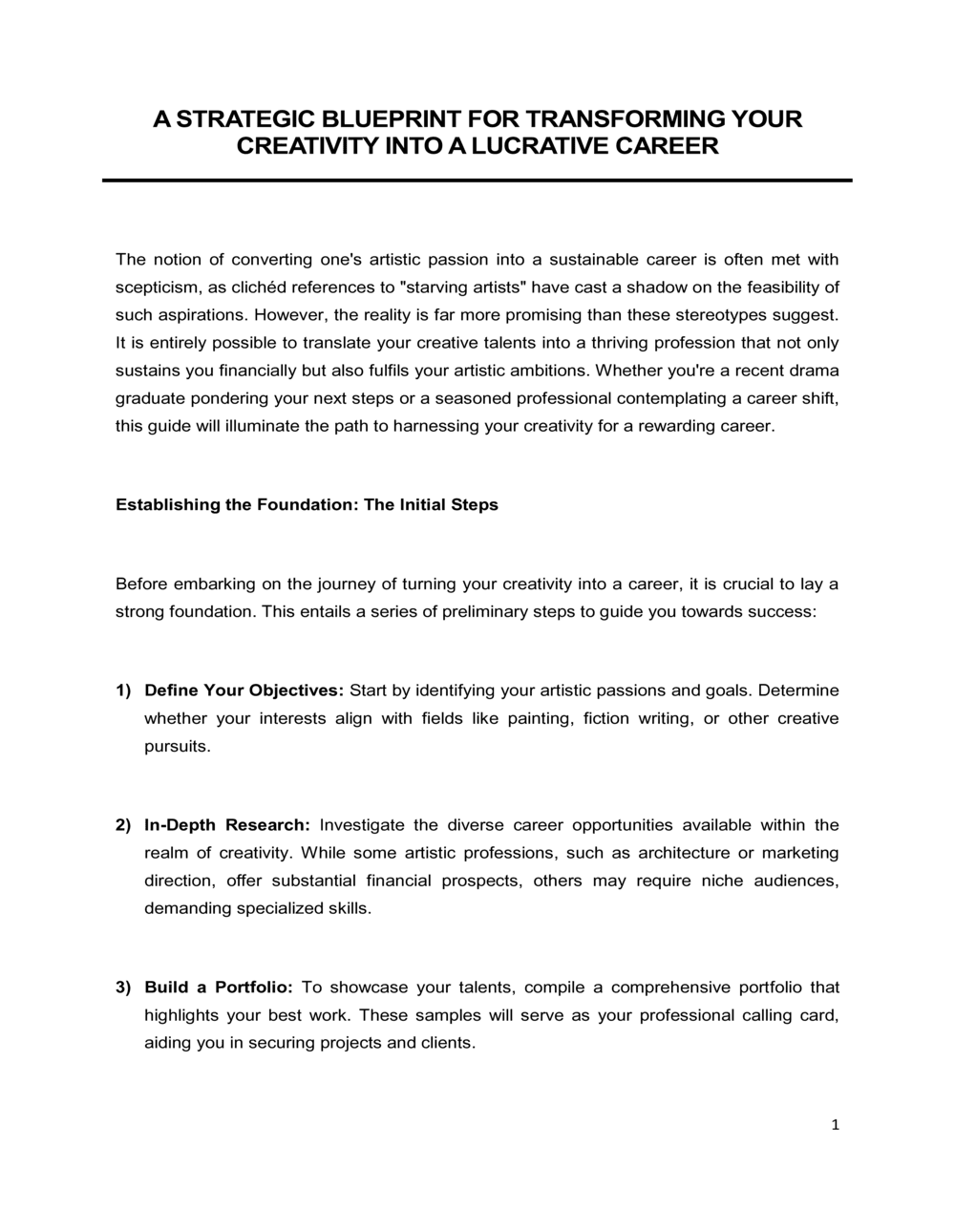
A Strategic Blueprint For Transforming Your Creativity Into A Lucrative Career Template

Free download β€’ Use as a template β€’ Print or share

3 pagesβ€’20–25 min to useβ€’Difficulty: Standard
Learn more ↓
FreeA Strategic Blueprint For Transforming Your Creativity Into A Lucrative Career Template

At a glance

What it is
A Strategic Blueprint for Transforming Your Creativity into a Lucrative Career is a structured Word document that guides creative professionals through defining their niche, building multiple income streams, setting pricing, and executing a step-by-step plan to earn a sustainable living from their craft. This free Word download gives you a ready-to-edit framework you can personalize and export as PDF to share with mentors, collaborators, or potential clients.
When you need it
Use it when you are ready to move beyond a hobby or side hustle and commit to building a revenue-generating career around a creative skill β€” whether you are launching from scratch or restructuring an existing creative practice that has plateaued.
What's inside
A personal creative audit, niche and audience definition, competitive positioning, income stream mapping, pricing strategy, brand and marketing foundations, a 90-day action plan, and milestone tracking metrics.

What is a Strategic Blueprint for Transforming Your Creativity into a Lucrative Career?

A Strategic Blueprint for Transforming Your Creativity into a Lucrative Career is a structured planning document that guides creative professionals through the full process of building a profitable, sustainable practice from their skills. It combines a personal creative audit, niche definition, competitive positioning, income stream mapping, pricing strategy, and a concrete 90-day action plan into a single cohesive document. Unlike a generic goal-setting exercise, this blueprint applies the same strategic rigor used in business planning to the specific challenges creative professionals face β€” pricing work fairly, attracting the right clients, and generating consistent income rather than feast-or-famine project cycles.

Why You Need This Document

Without a written strategy, most creative professionals default to accepting whatever work comes their way at whatever rate clients offer β€” a pattern that reliably produces unpredictable income and burnout. The absence of a defined niche means competing on price against the entire market. The absence of a pricing structure means leaving significant revenue on the table every time a client asks "what do you charge?" The absence of an action plan means motivation drives output rather than a system, and motivation is inconsistent. This blueprint changes the equation: it forces you to make deliberate decisions about who you serve, what you charge, and how you will spend the next 90 days β€” turning creative talent from an unpredictable asset into a structured, growing income source. The Business in a Box template gives you a professionally structured starting point so you spend your time on the strategic thinking, not the document formatting.

Which variant fits your situation?

If your situation is…Use this template
Launching a creative freelance business from scratchFreelance Business Plan
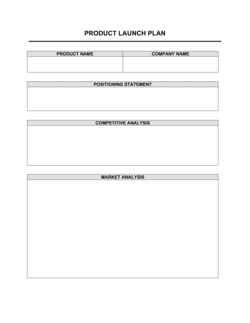
Planning a physical or digital product line from creative workNew Product Launch Plan
Building an online course or educational programTraining and Development Plan
Pitching a creative agency or studio to investors or partnersBusiness Plan
Setting quarterly goals and tracking creative business KPIsStrategic Planning Template
Defining your personal brand across platformsMarketing Plan
Pricing a new creative service or packagePricing Strategy Template

Common mistakes to avoid

❌ Targeting too broad an audience

Why it matters: Generic positioning means your marketing speaks to everyone and resonates with no one β€” you compete on price rather than fit, attracting clients who undervalue your work.

Fix: Rewrite your audience definition until it excludes at least 80% of the market. The clients who find you through a specific niche are the ones most likely to pay full rates and refer others.

❌ Launching multiple income streams simultaneously

Why it matters: Dividing effort across five revenue sources before any single one reaches $1,000/month means six months of scattered work with no sustainable income to show for it.

Fix: Identify the single income stream with existing demand signals and commit to it exclusively until it generates consistent monthly revenue before adding a second.

❌ Setting prices based on hours rather than value delivered

Why it matters: Hourly pricing commoditizes your work, caps your income at your available hours, and attracts clients who optimize for the cheapest hourly rate rather than the best outcome.

Fix: Reframe pricing around deliverables and outcomes β€” a brand identity package at $3,500 with a defined scope outperforms 35 hours at $100/hour in both income and client quality.

❌ Writing a 90-day plan but skipping the weekly review habit

Why it matters: A plan without a review cadence is a wish list β€” small deviations compound over 90 days into a result that bears no resemblance to the original strategy.

Fix: Block a fixed 60-minute slot on the same day each week to review your three leading indicators and adjust the following week's tasks based on what the data shows.

❌ Building a portfolio organized by style rather than by client outcome

Why it matters: Prospective clients are buying a result β€” more sales, a stronger brand, a cleaner user experience β€” not an aesthetic. A style-first portfolio forces them to imagine the outcome themselves, which most will not do.

Fix: Restructure each portfolio piece as a case study: client challenge, your approach, and a specific measurable result. Even estimated results ('client reported a 40% increase in inquiries') are more persuasive than images alone.

❌ Choosing marketing channels based on personal preference rather than audience presence

Why it matters: Spending 10 hours a week creating content on a platform your ideal clients never use produces reach without revenue β€” effort that could have been redirected to one channel that actually converts.

Fix: Ask your last three clients where they found you or where they look for creative professionals. Build your presence there first before expanding to channels you personally enjoy.

The 9 key sections, explained

Personal creative audit

Niche and audience definition

Competitive positioning

Income stream map

Pricing strategy

Brand and marketing foundations

Portfolio and proof strategy

90-day action plan

Milestones and success metrics

How to fill it out

  1. 1

    Complete the personal creative audit section

    List your core skills, your three strongest completed projects, and the specific feedback clients or audiences have given you. Identify the one or two areas where your work consistently outperforms expectations.

    πŸ’‘ Look at your past paid work, not your personal passion projects β€” the market has already told you what it values most about your output.

  2. 2

    Define your niche and ideal client in specific terms

    Write a one-sentence description of the exact client type you want to serve, the industry or context they operate in, and the specific problem your creative work solves for them.

    πŸ’‘ If your niche definition applies to more than 10,000 potential clients globally, narrow it further β€” the more specific your niche, the easier word-of-mouth referrals become.

  3. 3

    Research and document three to five competitors

    Find three to five creative professionals working in your niche. Record their positioning language, pricing (where visible), primary channels, and what their clients say about them in reviews or testimonials.

    πŸ’‘ Look at the language clients use in competitor testimonials β€” these exact phrases belong in your own marketing copy.

  4. 4

    Map your income streams and set a monthly revenue target

    List every potential revenue source, estimate a realistic monthly contribution from each, and total them to a monthly income target. Choose one active stream to develop fully before adding a second.

    πŸ’‘ Your first income stream should be the one where you already have demonstrated demand β€” existing clients, repeat buyers, or inbound inquiries β€” not the one that seems most exciting.

  5. 5

    Set your pricing across at least two tiers

    Create a starter package and a core package with distinct scopes and prices. Research what comparable professionals charge in your niche to ensure your rates reflect market value, not just your time cost.

    πŸ’‘ Add a premium tier even if you do not expect to sell it regularly β€” it makes the core package feel like a reasonable middle option and raises your average sale.

  6. 6

    Write your positioning statement and choose two marketing channels

    Draft a one-sentence positioning statement in the format: 'I help [AUDIENCE] achieve [OUTCOME] through [YOUR APPROACH].' Then select two channels where your ideal clients are already active and commit to a content cadence for each.

    πŸ’‘ A positioning statement that names a specific outcome β€” '30-second product videos that increase add-to-cart rates' β€” outperforms vague statements like 'creative visual content.'

  7. 7

    Build your 90-day action plan with no more than three priorities per phase

    Assign one to three specific, time-bound tasks to each 30-day phase. For each task, write the exact deliverable and the date it must be completed, not just a general intention.

    πŸ’‘ Schedule a fixed 90-minute review at the end of each 30-day phase to assess what worked, what stalled, and what the next phase's single most important priority should be.

  8. 8

    Define your milestone metrics and set a weekly review habit

    Choose three to five leading indicators you will track weekly β€” outreach volume, content posts published, discovery calls booked β€” alongside one lagging indicator like monthly revenue.

    πŸ’‘ Review your leading metrics every week on the same day. Consistent review is the single habit that separates creative professionals who execute their blueprint from those who file it and forget it.

Frequently asked questions

What is a strategic blueprint for a creative career?

A strategic blueprint for a creative career is a structured planning document that walks a creative professional through defining their niche, mapping income streams, setting pricing, building a marketing foundation, and executing a 90-day action plan. It translates creative ambition into a concrete, step-by-step business strategy β€” replacing vague goals with measurable milestones and weekly actions.

Who should use this template?

Freelance designers, photographers, writers, musicians, content creators, and creative coaches benefit most from this blueprint. It is particularly useful for anyone transitioning from a hobby, side hustle, or staff role into an independent creative practice β€” and for existing creatives whose income has plateaued and who need a structured plan to reach the next level.

How is a creative career blueprint different from a standard business plan?

A standard business plan is built for investors or lenders and focuses on market sizing, financial projections, and organizational structure. A creative career blueprint is a personal strategic tool focused on niche definition, income stream design, and execution sequencing β€” optimized for a solo or small creative practice rather than an investor audience.

How long should a creative career blueprint be?

A practical blueprint runs 10–20 pages, including the 90-day action plan and financial targets. Longer is not better β€” the goal is a document you actively reference and update, not an aspirational document you file away. Brevity in each section forces sharper thinking about what actually matters.

How do I choose which income stream to develop first?

Start with the income stream that already has a demand signal β€” existing clients asking for something, an inbound inquiry you have not acted on, or a service you have delivered informally without charging full rates. Avoid starting with the stream that seems most interesting if it has no existing demand; build to proven demand first, then expand.

How often should I update this blueprint?

Review your metrics weekly, revisit your 90-day plan at each 30-day milestone, and do a full blueprint revision every six months. Creative markets move quickly β€” a positioning statement or income stream map that was accurate six months ago may no longer reflect what clients are asking for or what the market is willing to pay.

Can I use this blueprint if I am still working a full-time job?

Yes. The 90-day action plan structure is designed to be executed in focused blocks of time rather than full working days. Completing one task per day from your action plan β€” even 45 minutes of focused work β€” compounds into a meaningful portfolio, client pipeline, and revenue base within 90 days without requiring you to leave employment before your creative income is stable.

What metrics should I track to know if my blueprint is working?

Track two categories: leading indicators that predict future revenue (outreach messages sent, discovery calls booked, content posts published, portfolio views) and lagging indicators that confirm past results (monthly revenue, clients signed, average project value). If lagging indicators stall, check your leading indicators first β€” they show where the pipeline is breaking down before it shows up in your income.

How this compares to alternatives

vs Business Plan

A business plan is designed for external audiences β€” investors and lenders β€” and requires formal market sizing, three-statement financial projections, and organizational structure detail. A creative career blueprint is an internal personal strategy tool focused on niche definition, income stream sequencing, and a 90-day execution plan. Use the business plan if you are raising capital; use the blueprint to build and run your creative practice day to day.

vs Marketing Plan

A marketing plan focuses exclusively on how you will attract and convert clients or customers β€” channels, messaging, campaigns, and budget. A creative career blueprint covers marketing as one section within a broader strategy that also addresses pricing, income streams, portfolio, and execution sequencing. You may use both: the blueprint sets the strategy, the marketing plan operationalizes the outreach component.

vs Strategic Planning Template

A strategic planning template is typically used by established businesses or teams to set multi-year goals, allocate resources, and track organizational KPIs. A creative career blueprint is optimized for individual creative professionals or micro-businesses, with a personal skills audit, niche definition, and 90-day action plan that a corporate strategic template does not address.

vs One-Page Business Plan

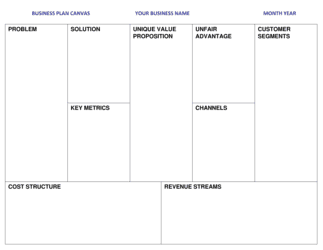
A one-page business plan captures the core elements of a business model in a single canvas β€” useful for rapid ideation and early-stage alignment. A creative career blueprint provides the depth needed to actually execute: detailed income stream mapping, competitive positioning, a tiered pricing structure, and a day-by-day 90-day action plan that a one-pager cannot accommodate.

Industry-specific considerations

Design and Visual Arts

Niche positioning by industry vertical β€” packaging, UX, editorial β€” and productized service packages that move away from hourly billing.

Media and Content Creation

Multi-stream income mapping covering brand sponsorships, digital products, paid communities, and licensing fees alongside platform revenue.

Music and Performing Arts

Revenue diversification beyond live performance β€” sync licensing, merchandise, teaching, and direct-to-fan subscription models.

Education and Coaching

Packaging creative expertise into scalable offers β€” cohort courses, one-to-one coaching retainers, and workshop licensing to institutions.

Template vs pro β€” what fits your needs?

PathBest forCostTime
Use the templateFreelancers, side-hustle creatives, and independent practitioners building or restructuring a creative practice without external capitalFree4–8 hours over 1–2 weeks
Template + professional reviewCreative professionals preparing to raise their rates significantly, launch a course, or pivot to a new niche with financial commitments at stake$200–$800 for a business coach or creative strategist session1–2 weeks
Custom draftedCreative agencies, studios seeking investment, or established creative professionals launching a scalable product business requiring formal financial modeling$1,500–$5,000 for a business strategist or consultant3–6 weeks

Glossary

Creative Niche
A specific, well-defined segment of a creative field where a practitioner focuses their skills, serving a distinct audience with particular needs.
Income Stream
A single, distinct revenue source β€” such as client commissions, digital product sales, or licensing fees β€” that contributes to total creative earnings.
Value Proposition
A clear statement explaining what specific outcome a creative professional delivers, for whom, and why their approach is preferable to alternatives.
Positioning Statement
A one- or two-sentence definition of how you want your ideal client or audience to perceive your creative work relative to competitors.
Productized Service
A service packaged with a fixed scope, deliverable, and price β€” sold like a product rather than custom-quoted each time.
Passive Income
Revenue generated from assets β€” such as digital downloads, stock licenses, or online courses β€” that continue to earn without direct active effort for each sale.
90-Day Action Plan
A focused execution schedule breaking a larger goal into weekly and monthly tasks achievable within a 90-day window.
Ideal Client Profile
A detailed description of the specific type of client or customer most likely to hire you, pay your rates, and benefit most from your creative work.
Rate Card
A document listing your standard service offerings and corresponding prices, used to communicate pricing consistently to prospective clients.
Brand Identity
The visual and verbal elements β€” name, logo, color palette, tone of voice β€” that communicate who you are and what you stand for as a creative professional.

Part of your Business Operating System

This document is one of 3,000+ business & legal templates included in Business in a Box.

  • Fill-in-the-blanks β€” ready in minutes
  • 100% customizable Word document
  • Compatible with all office suites
  • Export to PDF and share electronically

Create your document in 3 simple steps.

From template to signed document β€” all inside one Business Operating System.
1
Download or open template

Access over 3,000+ business and legal templates for any business task, project or initiative.

2
Edit and fill in the blanks with AI

Customize your ready-made business document template and save it in the cloud.

3
Save, Share, Send, Sign

Share your files and folders with your team. Create a space of seamless collaboration.

Save time, save money, and create top-quality documents.

β˜…β˜…β˜…β˜…β˜…

"Fantastic value! I'm not sure how I'd do without it. It's worth its weight in gold and paid back for itself many times."

Managing Director Β· Mall Farm
Robert Whalley
Managing Director, Mall Farm Proprietary Limited
β˜…β˜…β˜…β˜…β˜…

"I have been using Business in a Box for years. It has been the most useful source of templates I have encountered. I recommend it to anyone."

Business Owner Β· 4+ years
Dr Michael John Freestone
Business Owner
β˜…β˜…β˜…β˜…β˜…

"It has been a life saver so many times I have lost count. Business in a Box has saved me so much time and as you know, time is money."

Owner Β· Upstate Web
David G. Moore Jr.
Owner, Upstate Web

Run your business with a system β€” not scattered tools

Stop downloading documents. Start operating with clarity. Business in a Box gives you the Business Operating System used by over 250,000 companies worldwide to structure, run, and grow their business.

Free Forever PlanΒ Β·Β No credit card required