You Are Absolutely Right - You Owe Us Nothing Template

Free Word download β€’ Edit online β€’ Save & share with Drive β€’ Export to PDF

1 pageβ€’20–30 min to fillβ€’Difficulty: Standardβ€’Signature requiredβ€’Legal review recommended
Learn more ↓
FreeYou Are Absolutely Right - You Owe Us Nothing Template

At a glance

What it is
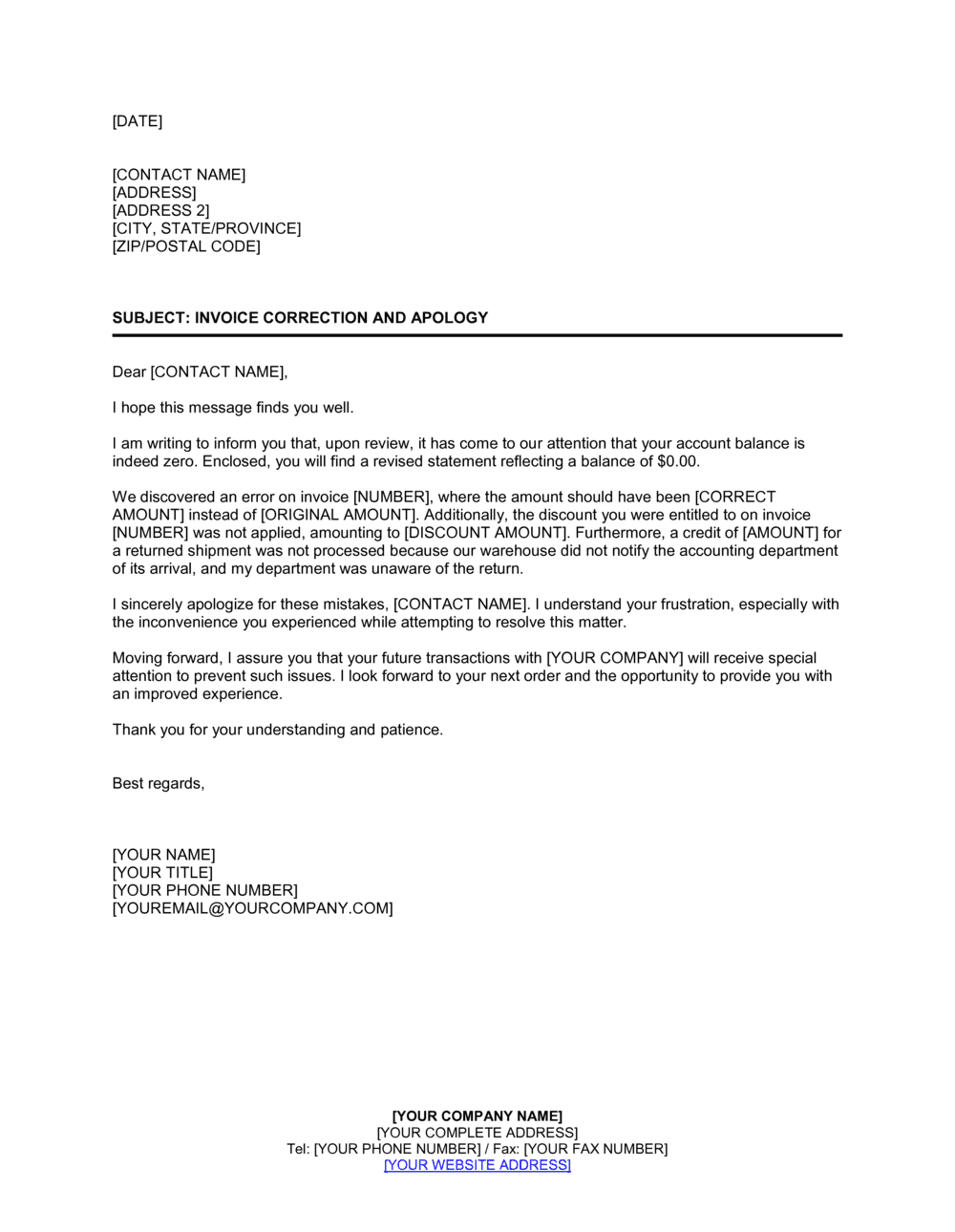
A debt waiver and release letter β€” sometimes titled "You Are Absolutely Right, You Owe Us Nothing" β€” is a signed, binding document in which a creditor formally confirms that a debtor is released from all or part of a financial obligation. This free Word download gives you a professionally structured starting point you can edit online and export as PDF to provide the debtor with a clear, enforceable record of the forgiveness.
When you need it
Use it when you have decided to forgive a debt in full or in part β€” whether after a negotiated settlement, a goodwill concession, or a formal dispute resolution β€” and need a signed document confirming that no further amounts are owed or will be pursued.
What's inside
Identification of both parties and the original obligation, the precise amount being waived, an unconditional release of all claims related to that debt, representations by the creditor that no assignment of the debt has occurred, and mutual signature blocks confirming the agreement.

What is a Debt Waiver and Release Letter?

A Debt Waiver and Release Letter β€” sometimes titled "You Are Absolutely Right, You Owe Us Nothing" β€” is a signed legal document in which a creditor formally and permanently relinquishes the right to collect all or part of a financial obligation owed by a debtor. It identifies the parties, describes the original debt by reference to the underlying instrument, specifies the exact amount being forgiven, and releases all related claims β€” including accrued interest, late fees, and collection costs. Once executed, the document provides the debtor with enforceable written proof that no further amounts are owed and that the creditor cannot later reverse course.

Why You Need This Document

Without a signed waiver, a verbal agreement to forgive a debt is worth very little β€” creditors have successfully pursued debts years after informal forgiveness conversations, and debtors have no defense without documentation. The absence of a written release also leaves both parties exposed operationally: the debtor cannot close the matter on their books or respond to a credit bureau dispute, and the creditor cannot substantiate a bad-debt expense deduction for tax purposes. A properly executed waiver closes these gaps in one document, creating a clean audit trail for accountants, a clear record for credit reporting purposes, and an enforceable estoppel against any future collection attempt. This template gives you a professionally drafted starting point that covers every material clause β€” including the tax notice that creditors routinely overlook β€” so you can close the matter definitively and move on.

Which variant fits your situation?

If your situation is…Use this template
Releasing a debtor from the full outstanding balanceFull Debt Waiver and Release Letter
Accepting a partial lump sum and forgiving the remainderDebt Settlement Agreement
Extending time to pay without forgiving the principalDebt Repayment Agreement
Releasing a guarantor from liability on a third-party debtRelease of Guarantor Agreement
Settling a broader dispute that includes a debt componentGeneral Release and Settlement Agreement
Documenting that an invoice was issued in error and is voidInvoice Cancellation Letter
Confirming that a promissory note has been paid in fullSatisfaction of Promissory Note

Common mistakes to avoid

❌ Releasing principal but not accrued interest and fees

Why it matters: If the release clause names only the principal amount, the creditor retains a legal right to pursue accrued interest and collection costs β€” defeating the purpose of the waiver and exposing the debtor to continued collection efforts.

Fix: Enumerate every component of the total obligation in the release clause β€” principal, interest calculated through a specific date, late fees, and any collection costs β€” and release each explicitly.

❌ Issuing the waiver without verifying the debt was not previously assigned

Why it matters: A creditor who has already sold or assigned the debt to a collections agency has no authority to waive it. The debtor remains legally obligated to the assignee despite signing the waiver.

Fix: Before executing the document, confirm in writing from any collections agency that the debt has not been formally purchased. Include the creditor's no-assignment warranty in the signed document.

❌ Omitting the tax notice for forgiven amounts of $600 or more

Why it matters: In the US, forgiven debts of $600 or more trigger a mandatory Form 1099-C filing. Omitting the notice leaves the debtor blindsided by a tax liability they did not anticipate and can expose the creditor to IRS reporting penalties.

Fix: Include a tax notice paragraph in every waiver and file Form 1099-C (or equivalent) with the IRS by the applicable deadline. Direct the debtor to a tax advisor to assess their specific liability.

❌ Getting only the creditor's signature

Why it matters: A unilaterally signed waiver creates ambiguity about whether the debtor accepted the release and its terms β€” including any non-disparagement, confidentiality, or remaining balance obligations.

Fix: Always obtain both parties' signatures. A dual-signed document is unambiguous evidence that the debtor acknowledged and accepted the waiver, eliminating future disputes about its scope.

❌ Using a different governing law than the original debt instrument

Why it matters: Conflicting governing-law clauses in related documents force courts to resolve which law applies before they can even address the substance of a dispute β€” increasing litigation cost and uncertainty.

Fix: Use the same governing law as the original invoice, loan agreement, or contract that created the debt. If the original instrument is silent, explicitly choose the applicable jurisdiction in the waiver.

❌ Describing the waived amount only as a percentage

Why it matters: If the original debt balance is subsequently disputed, a percentage-only description makes the waived amount unresolvable and may be treated as ambiguous or unenforceable in court.

Fix: Always state the waived amount as a specific dollar figure. If using a percentage for clarity, include the underlying dollar base and the resulting forgiven amount β€” e.g., '50% of $8,000.00, equaling $4,000.00'.

The 9 key clauses, explained

Identification of parties and original obligation

In plain language: Names the creditor and debtor as legal entities or individuals, and describes the specific debt being waived β€” including the original amount, date incurred, and the instrument that created it (invoice, promissory note, or agreement).

Sample language
This Debt Waiver and Release ('Agreement') is entered into as of [DATE] between [CREDITOR LEGAL NAME] ('Creditor') and [DEBTOR LEGAL NAME] ('Debtor'). The parties acknowledge a debt of $[ORIGINAL AMOUNT] arising from [INVOICE NO. / AGREEMENT DATED] on [DATE] for [DESCRIPTION OF OBLIGATION].

Common mistake: Using informal names or trade names instead of legal entity names. If the creditor entity name does not match the original debt instrument, enforceability and the debtor's ability to record the release accurately are both compromised.

Amount waived and outstanding balance confirmation

In plain language: States precisely the dollar amount being forgiven β€” whether the full balance or a partial amount β€” and confirms the remaining balance, if any, that the debtor still owes.

Sample language
Creditor hereby waives and forgives the sum of $[WAIVED AMOUNT], representing [the full outstanding balance / [X]% of the outstanding balance] owed by Debtor. [After this waiver, the remaining balance owed by Debtor is $[REMAINING AMOUNT] / No further amounts remain due.]

Common mistake: Describing the waived amount only as a percentage without stating the dollar figure. If the original balance is disputed later, a percentage alone is unresolvable without the base number.

Unconditional release of claims

In plain language: The creditor permanently and unconditionally releases the debtor from all claims, demands, and causes of action arising from the waived debt β€” including related late fees, interest, and collection costs.

Sample language
In consideration of the mutual agreements herein, Creditor hereby irrevocably releases and discharges Debtor from any and all claims, demands, actions, and causes of action, known or unknown, arising out of or relating to the Debt described above, including accrued interest of $[AMOUNT], late fees of $[AMOUNT], and any collection costs.

Common mistake: Releasing only the principal and inadvertently preserving claims for accrued interest or collection costs. If the intent is full forgiveness, every component of the total obligation must be named and released.

Creditor's warranty of no prior assignment

In plain language: The creditor warrants that they have not previously sold, transferred, or assigned the debt to any third party such as a collection agency, ensuring the release is coming from the party with authority to grant it.

Sample language
Creditor represents and warrants that it is the sole owner of the Debt, has not sold, assigned, pledged, or transferred the Debt or any rights thereto to any third party, and has full authority to execute this release.

Common mistake: Omitting this warranty entirely. If the debt was previously sold to a collections agency, the debtor remains exposed to collection efforts despite signing the waiver β€” this clause protects the debtor and exposes any creditor misrepresentation.

Tax notice and disclaimer

In plain language: Informs the debtor that forgiven debt may constitute taxable income under applicable law and that the creditor may be required to report the forgiveness to tax authorities using a Form 1099-C or equivalent.

Sample language
Debtor acknowledges that the forgiveness of debt evidenced by this Agreement may constitute taxable income under applicable federal, state, or provincial law. Creditor may be required to file Form 1099-C (or equivalent) with applicable tax authorities. Debtor is advised to consult a qualified tax advisor regarding the tax consequences of this waiver.

Common mistake: Treating a debt waiver as a purely operational document and omitting the tax notice. Debtors who receive forgiven debt of $600 or more are typically subject to cancellation-of-debt income rules, and failing to flag this creates liability exposure for both parties.

Non-disparagement and confidentiality (optional)

In plain language: If agreed, prevents both parties from making negative public statements about the other in connection with the debt matter, and may restrict disclosure of the waiver's terms to third parties.

Sample language
Each party agrees not to make, publish, or communicate any disparaging or defamatory statements regarding the other in connection with the Debt or this Agreement. The terms of this Agreement shall be kept confidential except as required by law or as necessary to obtain tax or legal advice.

Common mistake: Including a non-disparagement clause in a one-sided waiver without the debtor's explicit agreement. Without the debtor's signature acknowledging this clause, it is unenforceable against them.

Governing law and jurisdiction

In plain language: Specifies which jurisdiction's laws govern the agreement and where any disputes must be resolved, ensuring consistency with the governing law of the original debt instrument.

Sample language
This Agreement shall be governed by and construed in accordance with the laws of [STATE / PROVINCE / COUNTRY], without regard to its conflict of law principles. Any dispute arising hereunder shall be resolved in the courts of [CITY / COUNTY / JURISDICTION].

Common mistake: Selecting a governing law that differs from the original debt instrument's governing law. This creates a conflict where the waiver and the underlying obligation are governed by different legal standards.

Entire agreement and amendment clause

In plain language: Confirms that this document constitutes the complete agreement between the parties on the subject of the waived debt and that any modification must be in writing and signed by both parties.

Sample language
This Agreement constitutes the entire agreement between the parties with respect to the subject matter hereof and supersedes all prior negotiations, representations, and understandings. No amendment or modification shall be effective unless made in writing and signed by both parties.

Common mistake: No entire-agreement clause in a waiver issued after prior email exchanges or verbal discussions. Without it, a debtor can argue that earlier correspondence imposed conditions on the release.

Signature and execution block

In plain language: Provides dated signature lines for both the creditor and the debtor (and any authorized representative), confirming both parties' acceptance of the waiver's terms.

Sample language
IN WITNESS WHEREOF, the parties have executed this Debt Waiver and Release as of the date first written above. [CREDITOR LEGAL NAME]: Signature: _____________ Name: [NAME] Title: [TITLE] Date: [DATE]. [DEBTOR LEGAL NAME]: Signature: _____________ Name: [NAME] Title: [TITLE] Date: [DATE].

Common mistake: Obtaining only the creditor's signature and treating the document as a unilateral notice. While a unilateral waiver can be legally effective in some jurisdictions, a dual-signature document eliminates disputes about whether the debtor acknowledged and accepted the release.

How to fill it out

  1. 1

    Enter the legal names of both parties

    Use the creditor's and debtor's full registered legal names β€” not trade names or abbreviated names. Cross-reference the name against the original invoice, loan agreement, or contract that created the debt.

    πŸ’‘ If the creditor is a corporation, confirm the exact entity name in the state or provincial corporate registry before completing this field.

  2. 2

    Describe the original obligation in specific terms

    Identify the debt by reference to the original instrument β€” invoice number, agreement date, or promissory note number β€” and state the original amount, the date incurred, and a brief description of what the debt was for.

    πŸ’‘ Attaching a copy of the original invoice or agreement as Exhibit A strengthens the waiver and eliminates any ambiguity about which debt is being released.

  3. 3

    State the exact amount being waived

    Enter the precise dollar figure being forgiven. If only part of the debt is being waived, state both the waived amount and the remaining balance. Itemize any forgiven interest or fees separately.

    πŸ’‘ Use numerals and words together β€” e.g., '$4,500.00 (four thousand five hundred dollars)' β€” to prevent any later dispute over the amount.

  4. 4

    Complete the release of claims language

    Confirm that the release covers all components of the obligation β€” principal, accrued interest, late fees, and collection costs. If any amount remains owed, explicitly state that the release is limited and does not cover the remaining balance.

    πŸ’‘ If the intent is a clean, full release, review the original debt instrument for any ancillary charges before completing this section.

  5. 5

    Confirm the creditor's warranty of no assignment

    Verify internally that the debt has not been sold or assigned to a third party before completing this clause. If the debt was referred to a collection agency but not formally sold, confirm the referral has been withdrawn.

    πŸ’‘ Request a written confirmation from any collection agency that it has ceased all collection activity and has no ownership interest in the debt before executing the waiver.

  6. 6

    Add the tax notice

    Ensure the tax notice paragraph is included in the final document. For US-based debts of $600 or more, the creditor must file Form 1099-C with the IRS and provide a copy to the debtor by January 31 of the following year.

    πŸ’‘ Consult your accountant before issuing the waiver to confirm your own tax treatment β€” forgiving a business debt may also affect your deductible bad-debt expense.

  7. 7

    Select governing law consistent with the original obligation

    Enter the same state, province, or country that governed the original debt instrument. If the original agreement is silent on governing law, use the jurisdiction where the creditor is domiciled.

    πŸ’‘ If the creditor and debtor are in different jurisdictions, choose the jurisdiction with clearer debt-release case law β€” your attorney can advise on this in 15 minutes.

  8. 8

    Execute with dated signatures from both parties

    Have both the creditor and debtor sign and date the agreement. For corporate parties, include the signatory's name and title. Provide the debtor with a fully executed copy immediately after signing.

    πŸ’‘ Use Business in a Box eSign to timestamp execution and store the executed copy automatically β€” this prevents the debtor from later claiming they never received a signed original.

Frequently asked questions

What is a debt waiver and release letter?

A debt waiver and release letter is a signed legal document in which a creditor formally relinquishes the right to collect all or part of a debt owed by a debtor. It creates an enforceable record that the obligation has been forgiven, preventing the creditor from later pursuing the same amount through collections, litigation, or credit reporting. It is typically used after a negotiated settlement, a goodwill concession, or as part of a broader dispute resolution.

Is a debt waiver legally binding?

Yes, a properly executed debt waiver is generally binding in most jurisdictions when it identifies the parties, specifies the obligation being released, and is signed by the creditor. Courts in the US, Canada, the UK, and the EU have consistently upheld creditor waivers as enforceable releases of the underlying obligation. Obtaining the debtor's signature as well strengthens enforceability by confirming mutual acceptance of the terms.

Does forgiven debt count as taxable income?

In most jurisdictions, yes. In the United States, forgiven debt of $600 or more is treated as cancellation-of-debt (COD) income and must be reported by the creditor on Form 1099-C and by the debtor on their tax return. Canada, the UK, and most EU member states have equivalent rules. Exceptions exist β€” such as insolvency or bankruptcy exclusions β€” but the debtor should consult a qualified tax advisor before signing the waiver to understand their specific exposure.

What is the difference between a debt waiver and a debt settlement?

A debt waiver is a unilateral or mutual release in which the creditor forgives the debt, typically with no payment from the debtor in return. A debt settlement involves the debtor paying a negotiated lesser amount in full satisfaction of the larger obligation. Both result in the debt being closed, but a settlement includes a defined payment while a waiver may require no payment at all. Both should be documented in writing to be enforceable.

Can a creditor waive a debt and then change their mind?

Once a signed debt waiver has been delivered to and accepted by the debtor, the creditor is generally estopped from reversing it β€” meaning they cannot later claim the debt is still owed. The legal doctrine of promissory estoppel prevents a party from retracting a clear promise that the other party has relied upon. This is one of the primary reasons to obtain both signatures and retain a fully executed copy of the document.

What happens if the creditor already sold the debt to a collections agency?

If the debt has been legally assigned to a third-party collector, the original creditor no longer has authority to waive it β€” the release would be legally ineffective. The debtor must obtain the waiver from the current owner of the debt. Before signing any waiver, the debtor should verify in writing that the creditor issuing the document is still the holder of the obligation.

Does a debt waiver need to be notarized?

In most jurisdictions, notarization is not required for a debt waiver to be enforceable. The signed document itself is typically sufficient. However, notarization adds an additional layer of authentication that can be useful if the waiver is later challenged in court β€” particularly for large amounts or complex multi-party obligations. Check the requirements of your specific jurisdiction if the debt exceeds a significant threshold.

Should the debtor sign the debt waiver?

While a creditor's unilateral signature can create a valid waiver in some jurisdictions, obtaining the debtor's signature is strongly recommended. A dual-signature document confirms the debtor acknowledged and accepted the release β€” including any conditions, remaining balances, or confidentiality terms attached to it. It also prevents a later claim that the debtor never received or agreed to the specific terms of the waiver.

Can I use a debt waiver to release a personal guarantee?

A standard debt waiver addresses the primary obligor's liability. If a personal guarantor also needs to be released, a separate release-of-guarantor clause or a standalone release of guaranty document is required. Simply releasing the principal debtor does not automatically release a guarantor unless the waiver explicitly includes the guarantor's name and obligation by reference.

How this compares to alternatives

vs Debt Settlement Agreement

A debt settlement agreement involves the debtor paying a negotiated lesser amount in exchange for full release of the larger obligation β€” there is always a defined payment. A debt waiver releases the obligation without requiring any payment in return. Use a settlement agreement when the debtor can pay something; use a waiver when the creditor is forgiving the debt entirely as a goodwill gesture or after determining collection is not viable.

vs Debt Repayment Agreement

A debt repayment agreement restructures how and when an existing debt will be paid β€” it does not forgive any portion of the balance. A debt waiver eliminates the obligation. Use a repayment agreement when you want the full amount paid over time; use a waiver when you have decided the debt will not be collected.

vs General Release Form

A general release covers a broad range of claims between two parties β€” often used after disputes, accidents, or contract terminations β€” and may include debt forgiveness as one component. A debt waiver is narrowly targeted at a specific financial obligation. Use a general release when multiple types of claims need to be resolved simultaneously; use a debt waiver when the only matter being closed is a defined sum of money.

vs Demand Letter

A demand letter is sent by the creditor to the debtor requesting payment of an overdue balance and preserving the right to take legal action. A debt waiver does the opposite β€” it confirms the creditor is relinquishing that right. The two documents sit at opposite ends of the collections process; a demand letter initiates collection, while a waiver ends it.

Industry-specific considerations

Financial Services

Lenders use formal debt waivers to close out non-performing loan files, satisfy internal write-off procedures, and comply with Form 1099-C reporting requirements before year end.

Retail and E-commerce

Retailers issuing waivers on disputed customer accounts or uncollectable B2B balances use the document to reconcile accounts receivable and remove aged receivables from the books.

Real Estate and Property Management

Landlords releasing former tenants from rent arrears β€” particularly after negotiated move-out agreements β€” rely on signed waivers to prevent post-departure collection disputes and credit bureau disputes.

Professional Services

Law firms, consultancies, and agencies forgiving disputed invoices after client relationship breakdowns use debt waivers to formally close the matter and support their bad-debt expense deduction.

Jurisdictional notes

United States

Creditors forgiving $600 or more of debt must file Form 1099-C with the IRS and provide a copy to the debtor by January 31 of the following calendar year. The debtor must report the forgiven amount as ordinary income unless an exclusion applies β€” such as insolvency or bankruptcy under IRC Β§108. State law variations are limited but some states impose additional consumer-protection requirements on waivers issued to individual debtors.

Canada

Forgiven business debts in Canada are subject to the debt forgiveness rules in Section 80 of the Income Tax Act, which can reduce the debtor's tax attributes (losses, CCA pools) rather than triggering immediate income inclusion in all cases. Individual consumer debt forgiveness is treated similarly to the US approach. Quebec-governed waivers should be drafted in French or bilingual format for parties subject to the Charter of the French Language.

United Kingdom

In the UK, a creditor's written waiver is generally enforceable as a unilateral variation supported by estoppel principles, even without fresh consideration from the debtor, provided it is clear and unconditional. HMRC treats forgiven business debts as a taxable receipt for the debtor under the loan relationship rules (CTA 2009). Consumer debt waivers may intersect with FCA regulatory requirements if the creditor is an authorised firm.

European Union

Debt waiver treatment varies significantly across EU member states. In Germany, a debt waiver (Erlass) requires acceptance by the debtor to be effective β€” a unilateral creditor release is insufficient. In France, a remise de dette is similarly a bilateral act requiring debtor consent. GDPR considerations apply where the waiver document contains personal data of individual debtors β€” retention and processing of that data must comply with applicable national data protection law.

Template vs lawyer β€” what fits your deal?

PathBest forCostTime
Use the templateSmall business owners and individuals releasing a clearly defined debt of modest value with no disputed historyFree15–20 minutes
Template + legal reviewDebts above $10,000, corporate parties, or situations involving prior assignment, a guarantor, or confidentiality requirements$200–$5001–2 days
Custom draftedComplex multi-party debt restructurings, regulated lenders, cross-border obligations, or waiver tied to broader litigation settlement$1,000–$3,500+1–2 weeks

Glossary

Debt Waiver
A creditor's formal, voluntary relinquishment of the right to collect all or part of a debt owed by a debtor.
Release of Liability
A legally binding statement that one party gives up the right to bring future claims against another party related to a specific obligation.
Consideration
Something of value exchanged between parties to make a contract enforceable β€” in a waiver, the release itself typically constitutes consideration.
Obligee
The party to whom a debt or obligation is owed; also referred to as the creditor in a lending context.
Obligor
The party who owes the debt or must perform the obligation; also referred to as the debtor.
Debt Forgiveness
The cancellation of a debt by the creditor, which may create taxable income for the debtor under applicable tax law.
Cancellation of Debt (COD) Income
The amount of forgiven debt that the IRS and most tax authorities treat as taxable income to the debtor in the year of forgiveness.
Assignment of Debt
The transfer of a creditor's right to collect a debt to a third party, such as a collections agency β€” a waiver is invalid if the debt was previously assigned without the debtor's notice.
Accord and Satisfaction
A legal doctrine where a creditor accepts a lesser payment or alternative performance in full settlement of a disputed or uncertain debt.
Mutual Release
A release in which both parties agree to relinquish any claims against each other, not just the creditor releasing the debtor.
Estoppel
A legal principle preventing a party from asserting a claim or right that contradicts a prior position they took β€” once a waiver is signed, the creditor is typically estopped from later pursuing the waived debt.

Part of your Business Operating System

This document is one of 3,000+ business & legal templates included in Business in a Box.

  • Fill-in-the-blanks β€” ready in minutes
  • 100% customizable Word document
  • Compatible with all office suites
  • Export to PDF and share electronically

Create your document in 3 simple steps.

From template to signed document β€” all inside one Business Operating System.
1
Download or open template

Access over 3,000+ business and legal templates for any business task, project or initiative.

2
Edit and fill in the blanks with AI

Customize your ready-made business document template and save it in the cloud.

3
Save, Share, Send, Sign

Share your files and folders with your team. Create a space of seamless collaboration.

Save time, save money, and create top-quality documents.

β˜…β˜…β˜…β˜…β˜…

"Fantastic value! I'm not sure how I'd do without it. It's worth its weight in gold and paid back for itself many times."

Managing Director Β· Mall Farm
Robert Whalley
Managing Director, Mall Farm Proprietary Limited
β˜…β˜…β˜…β˜…β˜…

"I have been using Business in a Box for years. It has been the most useful source of templates I have encountered. I recommend it to anyone."

Business Owner Β· 4+ years
Dr Michael John Freestone
Business Owner
β˜…β˜…β˜…β˜…β˜…

"It has been a life saver so many times I have lost count. Business in a Box has saved me so much time and as you know, time is money."

Owner Β· Upstate Web
David G. Moore Jr.
Owner, Upstate Web

Run your business with a system β€” not scattered tools

Stop downloading documents. Start operating with clarity. Business in a Box gives you the Business Operating System used by over 250,000 companies worldwide to structure, run, and grow their business.

Start freeΒ Β·Β No credit card required