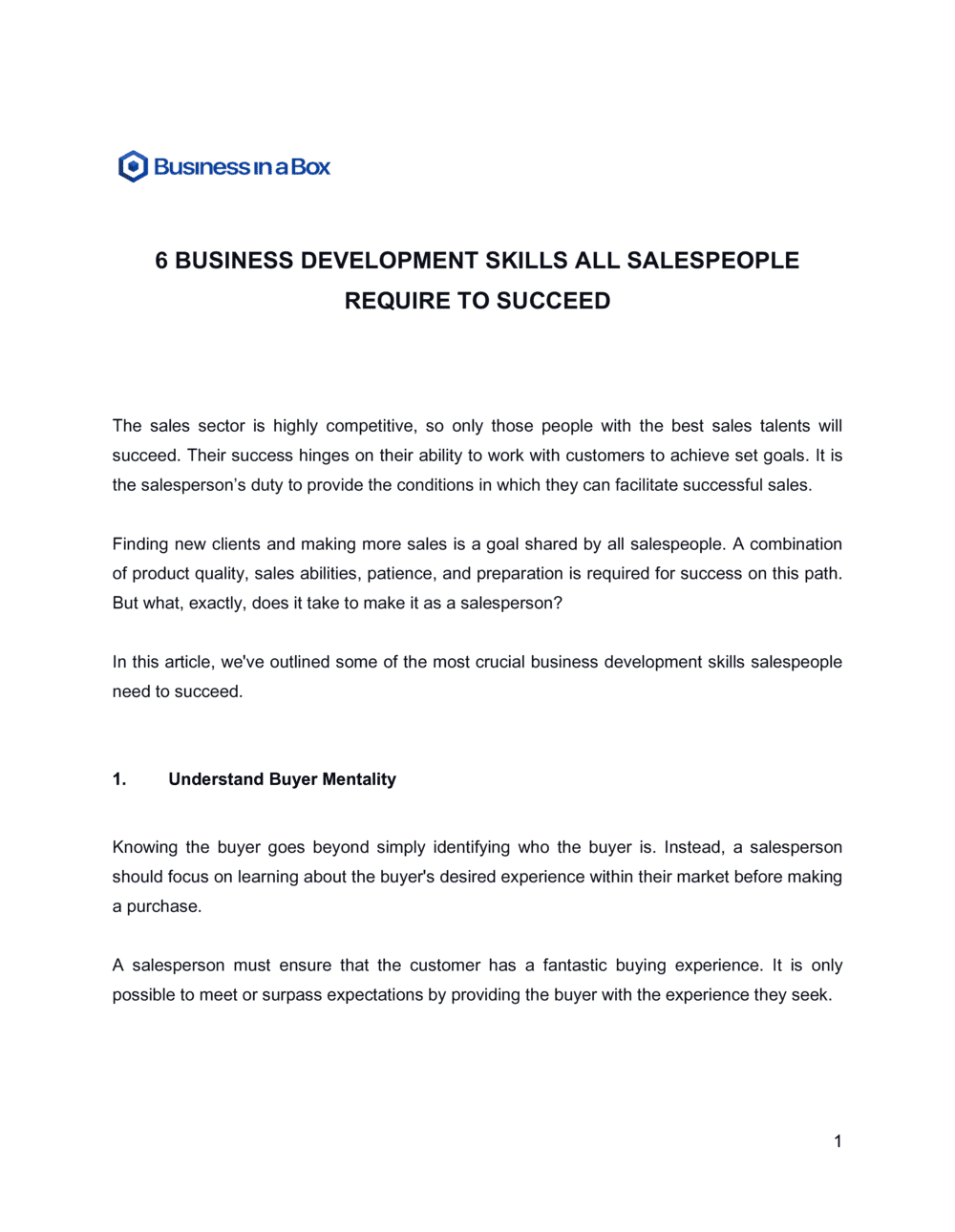
6 Business Development Skills All Salespeople Require To Succeed Template

Free to read β€’ Save or share with one click

Free6 Business Development Skills All Salespeople Require To Succeed Template

At a glance

What it is
This document is a structured operational guide that identifies and explains the six core business development skills every salesperson needs to drive consistent revenue growth. Available as a free Word download, it can be edited online and used as a training reference, onboarding resource, or skills assessment framework for individual reps and sales teams alike.
When you need it
Use it when onboarding new sales hires, designing a sales training curriculum, conducting performance reviews, or when a team's pipeline activity isn't converting at the expected rate. It is equally useful for individual contributors looking to benchmark their own skill gaps.
What's inside
Six fully developed skill modules covering prospecting, active listening, relationship management, negotiation, product knowledge, and pipeline discipline β€” each with a definition, why it matters, and how to develop it. Accompanying sections address self-assessment prompts and practical application tips for each competency.

What is a 6 Business Development Skills All Salespeople Require To Succeed?

The 6 Business Development Skills All Salespeople Require To Succeed is a structured operational guide that defines, explains, and provides a development framework for the six core competencies that drive consistent sales performance: prospecting and lead qualification, active listening and needs analysis, relationship building, negotiation and objection handling, product and market knowledge, and pipeline management. Unlike a sales playbook β€” which documents what to say and when β€” this document explains why each skill matters, how to develop it deliberately, and how to measure improvement over time. It functions as both a training resource for new hires and a benchmarking tool for experienced reps assessing where their performance gaps lie.

Why You Need This Document

Teams that rely on instinct and activity volume alone hit unpredictable results β€” strong quarters followed by pipeline droughts, high-effort closes that fall apart at negotiation, and onboarding that leaves new reps without a clear picture of what good looks like. Without a defined skills framework, managers coach reactively, reps develop unevenly, and performance reviews devolve into opinions rather than evidence. This guide gives sales managers a shared language for development conversations, gives individual reps a clear self-assessment tool, and gives organizations a reusable standard that survives rep turnover and team growth. Used consistently, it converts intuitive selling ability into a teachable, measurable system β€” and that's what turns a collection of individual contributors into a repeatable revenue engine.

Which variant fits your situation?

If your situation is…Use this template
Evaluating an existing sales rep's performance against defined criteriaSales Performance Review
Laying out a structured 30-60-90 day ramp plan for a new hire30-60-90 Day Sales Plan
Defining the full sales process from lead to closeSales Process Template
Forecasting monthly or quarterly revenue from current pipelineSales Forecast Template
Setting individual rep quotas and tracking attainmentSales Plan Template
Documenting a repeatable outbound prospecting sequenceSales Prospecting Plan
Creating a competitive positioning document for the sales teamCompetitive Analysis Template

Common mistakes to avoid

❌ Using the document as a one-time onboarding handout

Why it matters: Skills decay without reinforcement. A guide read once during week one of onboarding has no lasting effect on behavior by month three.

Fix: Schedule a quarterly review of the framework in team meetings and tie at least one coaching conversation per month to a specific skill from the guide.

❌ Skipping the self-assessment section

Why it matters: Without self-reflection, reps cannot identify which skill is limiting their performance β€” and managers coach to symptoms rather than root causes.

Fix: Make the self-assessment a required step before every formal performance review and include scores in the rep's development file.

❌ Leaving all placeholders and examples unchanged

Why it matters: Generic examples β€” unrelated to what the rep actually sells β€” make the framework feel irrelevant, reducing engagement and adoption.

Fix: Spend 30 minutes updating every sample script, discovery question, and feature-outcome statement with real product and customer language before distributing.

❌ Focusing exclusively on closing skills while neglecting prospecting discipline

Why it matters: A rep with no pipeline cannot close. Teams that invest all their training budget in closing techniques while ignoring prospecting create feast-or-famine revenue cycles.

Fix: Treat Skill 1 (prospecting) as foundational in every training cycle and measure prospecting activity metrics β€” calls, emails, meetings set β€” weekly alongside pipeline value.

The 8 key sections, explained

Introduction: Why business development skills matter

Skill 1 β€” Prospecting and lead qualification

Skill 2 β€” Active listening and needs analysis

Skill 3 β€” Relationship building and trust development

Skill 4 β€” Negotiation and objection handling

Skill 5 β€” Product and market knowledge

Skill 6 β€” Pipeline management and sales discipline

Self-assessment and development planning

How to fill it out

  1. 1

    Customize the company and team context

    Replace all [PLACEHOLDERS] with your company name, product names, and relevant customer segments. This grounds the skills framework in your specific sales environment rather than leaving it generic.

    πŸ’‘ Add a one-paragraph 'About our sales motion' section at the top explaining whether your team is inbound, outbound, or hybrid β€” this shapes how each skill applies.

  2. 2

    Adapt examples to your product or service

    Update the sample discovery questions, objection-handling scripts, and feature-outcome statements in each skill module to reflect what your reps actually sell.

    πŸ’‘ Pull two or three real objections your team hears weekly and write the response script using the objection-handling framework in Skill 4.

  3. 3

    Set proficiency benchmarks for each skill

    Define what 'proficient' looks like at your company for each of the six skills β€” for example, 'Prospecting: sources 20 qualified leads per week from at least two channels.'

    πŸ’‘ Anchor benchmarks to observable behaviors and outputs, not personality traits. 'Responds to all prospects within 4 hours' is measurable; 'has a good attitude' is not.

  4. 4

    Distribute to the team with a self-assessment deadline

    Ask each rep to complete the self-assessment in Section 8 before a scheduled 1:1 review. Give them 48–72 hours so the scores reflect genuine reflection, not a rushed read.

    πŸ’‘ Send the document in read-only view first so reps engage with the content before the editable self-assessment version is shared.

  5. 5

    Run manager review sessions using the self-assessment scores

    Compare each rep's self-scores to your own observation of their performance. Focus the 1:1 on any skill where the gap between self-score and manager score is two or more points.

    πŸ’‘ Prepare one concrete behavioral example β€” positive or corrective β€” for each skill before the review so feedback is specific, not impressionistic.

  6. 6

    Set a 90-day development plan for each identified gap

    For each skill rated below proficiency, complete the development-planning template in Section 8: specific action, completion date, and measurable success indicator.

    πŸ’‘ Limit each rep to two development goals per quarter. Trying to improve all six skills simultaneously produces improvement in none.

Frequently asked questions

What are the most important business development skills for salespeople?

The six core skills are prospecting and lead qualification, active listening and needs analysis, relationship building, negotiation and objection handling, product and market knowledge, and pipeline management. Research consistently shows that prospecting discipline and active listening are the highest-leverage skills for new reps, while negotiation and pipeline hygiene differentiate top performers at the senior level.

How is business development different from sales?

Sales focuses on converting qualified opportunities into closed revenue. Business development focuses on creating those opportunities β€” through prospecting, partnership development, and market expansion. In many organizations, business development representatives (BDRs) handle top-of-funnel activity and pass qualified leads to account executives who own the close. This guide covers skills relevant to both functions.

Can this document be used for sales training and onboarding?

Yes. The guide is structured specifically to support onboarding β€” each skill module is self-contained, includes a development prompt, and can be assigned as pre-reading before a training session. Many sales managers use it as the foundation for a 30-day onboarding curriculum, assigning one skill module per week and reinforcing with role-play exercises.

How do I measure whether a salesperson has developed a skill?

Tie each skill to an observable, measurable output. For prospecting, measure qualified meetings booked per week. For active listening, review call recordings for question-to-statement ratios. For pipeline management, check stage accuracy and average deal age weekly. Behavioral evidence in the CRM and on recorded calls is more reliable than self-reported scores.

What is the difference between a sales skills guide and a sales playbook?

A sales skills guide defines the competencies a rep must develop β€” the what and why of effective selling behavior. A sales playbook documents the specific processes, scripts, objection responses, and competitive positioning a team uses β€” the how. The skills guide is the foundation; the playbook is the execution layer built on top of it.

How often should salespeople review and update their skills framework?

A full skills review once per quarter is standard for high-growth teams. At minimum, review the framework annually or whenever there is a significant change in product, market, or go-to-market motion. Individual reps should revisit their self-assessment scores at every formal performance review cycle.

Is this guide suitable for both B2B and B2C salespeople?

The six core skills apply across both contexts, but the emphasis differs. B2B salespeople typically spend more time on needs analysis, relationship management, and multi-stakeholder negotiation. B2C salespeople rely more heavily on rapid qualification, objection handling under time pressure, and product knowledge delivered in shorter conversations. Customize the examples and benchmarks in each section to reflect your specific sales environment.

What role does CRM discipline play in business development skills?

CRM hygiene underpins Skill 6 (pipeline management) and amplifies every other skill. Accurate, timely CRM updates give managers visibility into deal health, enable coaching conversations grounded in data, and ensure that no follow-up falls through the cracks. Reps who treat CRM entry as optional consistently have less accurate forecasts and lower close rates than those who log activity in real time.

How this compares to alternatives

vs Sales Plan Template

A sales plan sets revenue targets, defines territories, and allocates headcount for a specific period. A business development skills guide develops the competencies individual reps need to execute that plan. The plan defines what to achieve; the skills guide builds the capability to achieve it. Both are needed β€” the plan without the skills guide produces targets without a development path.

vs Sales Playbook

A sales playbook documents specific scripts, email templates, objection responses, and competitive battle cards used by the team. A skills guide defines the underlying competencies β€” listening, negotiation, pipeline discipline β€” that make those scripts effective. The playbook is the tool; the skills guide is the training that teaches reps how to use the tool well.

vs Employee Performance Review Template

A performance review evaluates past outcomes and behaviors against set goals. A business development skills guide is a forward-looking development document that identifies gaps and prescribes improvement actions. Use the skills guide to set development expectations, then reference it during the performance review to measure progress against those expectations.

vs Sales Forecast Template

A sales forecast predicts revenue from current pipeline opportunities using historical conversion rates. A business development skills guide addresses the quality of the pipeline being generated β€” accurate forecasts depend on reps who qualify properly, update stages honestly, and manage follow-up discipline. Skills development is the upstream input; the forecast is the downstream output.

Industry-specific considerations

SaaS / Technology

Product knowledge depth is critical given complex feature sets; pipeline management maps to MRR forecasting; multi-stakeholder deals require advanced relationship and negotiation skills.

Professional Services

Relationship building and consultative listening dominate; trust development is the primary sales tool in industries where engagements are long and referral-driven.

Financial Services

Regulatory knowledge is embedded in product expertise; objection handling must address risk aversion and compliance concerns rather than feature gaps.

Retail / E-commerce

Active listening and rapid qualification matter most given short interaction windows; upsell and cross-sell skills drive account expansion at the point of purchase.

Template vs pro β€” what fits your needs?

PathBest forCostTime
Use the templateSales managers and small business owners building a skills framework without an L&D departmentFree1–2 hours to customize and distribute
Template + professional reviewTeams of 10+ reps where a sales trainer or consultant validates the framework against observed performance gaps$500–$2,000 for a sales coach review session1–2 weeks including observation and calibration
Custom draftedEnterprise sales organizations requiring a fully branded competency model integrated into an LMS or formal career ladder$5,000–$20,000 for a custom L&D engagement4–12 weeks

Glossary

Business Development
The pursuit of strategic opportunities that grow revenue, whether through new customer acquisition, partnerships, or market expansion.
Prospecting
The systematic process of identifying and qualifying potential buyers who fit the target customer profile.
Pipeline
The collection of active sales opportunities at various stages between initial contact and closed deal, used to forecast future revenue.
Active Listening
A communication technique in which the salesperson fully focuses on the prospect's words, pauses, and tone to understand needs before responding.
Needs Analysis
A structured conversation or questionnaire designed to surface a prospect's pain points, goals, and buying criteria before presenting a solution.
Value Proposition
A concise statement of the specific outcome or benefit a product or service delivers to a defined customer, differentiated from alternatives.
Objection Handling
The skill of acknowledging, understanding, and reframing a prospect's concerns without dismissing them, to keep the sales conversation moving forward.
Consultative Selling
A sales approach that prioritizes diagnosing a prospect's problem before recommending a solution, positioning the rep as an advisor rather than a vendor.
Close Rate
The percentage of qualified opportunities in the pipeline that result in a signed deal within a given period.
Account Expansion
Revenue growth generated from existing customers through upsells, cross-sells, or renewals rather than new customer acquisition.

Part of your Business Operating System

This document is one of 3,000+ business & legal templates included in Business in a Box.

  • Fill-in-the-blanks β€” ready in minutes
  • Compatible with all office suites
  • Export to PDF and share electronically

Create your document in 3 simple steps.

From template to signed document β€” all inside one Business Operating System.
1
Download or open template

Access over 3,000+ business and legal templates for any business task, project or initiative.

2
Edit and fill in the blanks with AI

Customize your ready-made business document template and save it in the cloud.

3
Save, Share, Send, Sign

Share your files and folders with your team. Create a space of seamless collaboration.

Save time, save money, and create top-quality documents.

β˜…β˜…β˜…β˜…β˜…

"Fantastic value! I'm not sure how I'd do without it. It's worth its weight in gold and paid back for itself many times."

Managing Director Β· Mall Farm
Robert Whalley
Managing Director, Mall Farm Proprietary Limited
β˜…β˜…β˜…β˜…β˜…

"I have been using Business in a Box for years. It has been the most useful source of templates I have encountered. I recommend it to anyone."

Business Owner Β· 4+ years
Dr Michael John Freestone
Business Owner
β˜…β˜…β˜…β˜…β˜…

"It has been a life saver so many times I have lost count. Business in a Box has saved me so much time and as you know, time is money."

Owner Β· Upstate Web
David G. Moore Jr.
Owner, Upstate Web

Run your business with a system β€” not scattered tools

Stop downloading documents. Start operating with clarity. Business in a Box gives you the Business Operating System used by over 250,000 companies worldwide to structure, run, and grow their business.

Free Forever PlanΒ Β·Β No credit card required