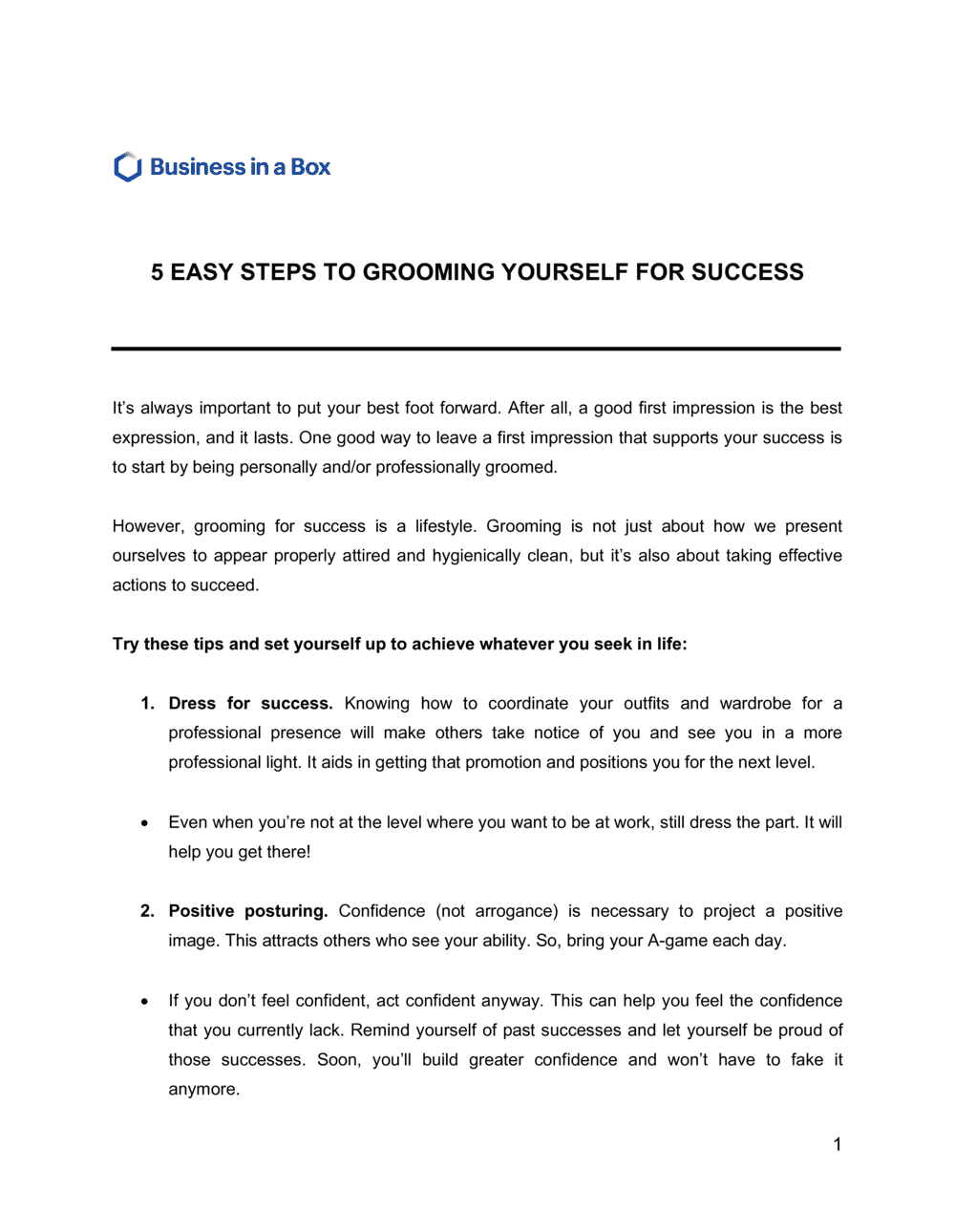
5 Easy Steps To Grooming Yourself For Success

Free to read β€’ Save or share with one click

Free5 Easy Steps To Grooming Yourself For Success Template

At a glance

What it is
5 Easy Steps To Grooming Yourself For Success is a structured personal and professional development guide that walks individuals through five concrete areas of self-improvement β€” from mindset and physical presentation to communication skills, habit formation, and goal-setting. This free Word download gives you a practical, editable framework you can tailor to your own career stage and industry, then export as PDF to share with a mentor, coach, or team.
When you need it
Use it when preparing for a promotion, entering a new industry, starting a business, or any moment when closing the gap between where you are and where you want to be requires a structured, honest self-assessment.
What's inside
A five-step framework covering mindset and attitude, professional appearance, communication and interpersonal skills, daily habits and routines, and goal-setting with accountability checkpoints. Each step includes a self-assessment prompt, an action plan section, and measurable milestones for tracking progress.

What is 5 Easy Steps To Grooming Yourself For Success?

5 Easy Steps To Grooming Yourself For Success is a structured personal and professional development guide that walks individuals through five concrete, sequenced areas of self-improvement β€” mindset and attitude, professional appearance, communication and interpersonal skills, daily habits and routines, and goal-setting with accountability. Unlike a generic self-help checklist, this template provides a scored self-assessment baseline, a step-by-step action plan, and a 30-60-90-day review structure that turns intentions into measurable behavioral commitments. It is available as a free Word download you can edit online and export as PDF for use with a mentor, manager, or coaching program.

Why You Need This Document

Professionals who navigate career transitions, seek promotions, or build a business without a deliberate self-development structure frequently plateau β€” not from lack of ability, but from unexamined habits, inconsistent presentation, and goals that never get written down or reviewed. The cost of this gap is concrete: a first meeting lost because of a credibility signal mismatch, a promotion passed over because of communication patterns that read as junior, or a client relationship that stalls because the follow-through habits were never built. This guide forces the structured self-honesty that informal development rarely produces β€” a scored baseline, specific actions with deadlines, and a named person who will hold you accountable. Using this template does not guarantee success, but it eliminates the most common structural reasons people fail to develop at the rate their ability warrants.

Which variant fits your situation?

If your situation is…Use this template
Preparing for a promotion or performance reviewPersonal Development Plan
Onboarding new employees with professional standardsEmployee Onboarding Checklist
Setting measurable career goals with timelinesProfessional Development Plan
Improving team-wide communication and presentationCommunication Skills Workshop Guide
Building a 90-day improvement plan for underperformersPerformance Improvement Plan
Assessing strengths and gaps before a career transitionSWOT Analysis (Personal)
Coaching a direct report on executive presenceCoaching Plan Template

Common mistakes to avoid

❌ Starting with appearance instead of mindset

Why it matters: Appearance improvements without a supporting mindset shift are superficial and temporary. A new wardrobe or haircut worn with defensive body language and fixed-mindset responses produces no lasting credibility change.

Fix: Complete the mindset self-assessment and identify one limiting belief before opening any other section. Behavior change follows belief change, not the reverse.

❌ Setting more than two new habits at once

Why it matters: Habit research consistently shows that forming multiple new behaviors simultaneously depletes willpower and reduces the success rate of all of them. Most fall away within three weeks.

Fix: Select your top two habits and defer the others to your 60-day review. Once the first two are automatic β€” requiring no conscious decision β€” add the next pair.

❌ Omitting a named accountability partner

Why it matters: Self-monitored goals are abandoned at a significantly higher rate than goals shared with a committed external observer. Without accountability, the document becomes a journaling exercise with no consequence for inaction.

Fix: Name a specific person β€” not 'a mentor' or 'my manager' β€” and contact them with a written summary of your goals before you close the completed document.

❌ Skipping the progress review checkpoints

Why it matters: Without scheduled reviews, most people cannot recall their specific commitments after 30 days. The guide becomes a one-time exercise rather than a development system.

Fix: Block the 30-, 60-, and 90-day reviews in your calendar on the same day you complete the guide. Attach the document to each calendar event.

❌ Using generic benchmarks for professional appearance

Why it matters: Appearance standards vary dramatically across industries and roles. Following a generic 'business professional' standard in a creative or tech environment actively signals poor cultural awareness β€” the opposite of the intended effect.

Fix: Research three to five professionals in your exact target role and use their visible presentation as your calibration benchmark, not a generic dress code.

❌ Writing goals without measurable success criteria

Why it matters: Vague goals like 'communicate better' or 'be more confident' cannot be tracked, cannot be achieved definitively, and cannot be reviewed objectively at 30 days.

Fix: Rewrite every goal until it contains a specific metric and deadline: 'Complete two Toastmasters sessions by [DATE]' is reviewable; 'improve public speaking' is not.

The 8 key sections, explained

Step 1 β€” Mindset and attitude

Step 2 β€” Professional appearance

Step 3 β€” Communication and interpersonal skills

Step 4 β€” Daily habits and routines

Step 5 β€” Goal-setting and accountability

Self-assessment baseline

Action plan and timeline

Progress tracking and review

How to fill it out

  1. 1

    Complete the self-assessment baseline first

    Before reading the five steps, score yourself honestly on each of the five dimensions using the 1–5 scale. Record the date so you have a timestamped baseline to compare against at your 30-day review.

    πŸ’‘ Show your baseline scores to one person who knows you professionally and ask them to validate or adjust them β€” external calibration cuts score inflation significantly.

  2. 2

    Work through each step in order

    Each step builds on the previous one. Fill in the self-assessment prompt, identify your specific gap, and write one concrete action before moving to the next step. Do not skip Step 1 (mindset) to get to appearance or habits.

    πŸ’‘ Spend no more than 20 minutes on each step in your first pass β€” the goal is honest capture, not perfection. You will refine during your first review.

  3. 3

    Calibrate appearance standards to your industry

    In Step 2, look up three to five professionals in your target role or industry on LinkedIn and note their visible presentation. Use those observations to set realistic, context-appropriate appearance targets rather than a generic business formal standard.

    πŸ’‘ Take a photo of yourself in your current most common work attire and compare it to your benchmarks. The gap is usually smaller β€” or larger β€” than you expect.

  4. 4

    Select a maximum of two new habits in Step 4

    Review your current daily schedule and identify two existing anchors β€” recurring behaviors you already do reliably β€” to attach new habits to. Write the habit loop explicitly: cue, routine, and reward.

    πŸ’‘ Choose habits that take under five minutes to complete in their initial form. A habit that is too demanding to start rarely becomes automatic.

  5. 5

    Convert every action item to a SMART goal

    For each gap identified in Steps 1–4, write one SMART goal with a specific due date and measurable outcome. Enter all goals into the action plan and timeline section.

    πŸ’‘ If a goal cannot be measured, it is a wish. Rewrite it until you can answer 'how will I know I achieved this?' in one sentence.

  6. 6

    Name your accountability partner before closing the document

    Before saving the completed guide, write in the name of a specific person who will hold you accountable. Send them a message the same day summarizing your three most important goals and your 30-day check-in date.

    πŸ’‘ An accountability partner who agreed verbally but never received written goals from you is unlikely to follow up. Put it in writing.

  7. 7

    Schedule your 30-, 60-, and 90-day reviews in your calendar now

    Open your calendar and block three recurring review sessions β€” 30, 60, and 90 days from today. Attach the document to each calendar event so you can access it immediately during the review.

    πŸ’‘ Set the review for 30 minutes. If it runs longer, the plan needs simplification β€” not more time.

Frequently asked questions

What does grooming yourself for success mean in a professional context?

In a professional context, grooming yourself for success means intentionally developing the five dimensions that shape how others perceive and respond to you: mindset, physical presentation, communication skills, daily habits, and goal orientation. It goes beyond appearance β€” it is the deliberate alignment of how you think, present, communicate, and behave with the standards expected at the level you are targeting. The process is structured, measurable, and repeatable.

Who should use this guide?

This guide is useful for anyone at a professional inflection point β€” early-career professionals building their first serious professional image, founders preparing to pitch investors, sales professionals sharpening their client-facing presence, managers modeling standards for their team, or career changers repositioning for a new industry. HR and L&D teams also use it as a structured self-development tool during onboarding or coaching programs.

How long does the five-step program take to complete?

The initial guide takes approximately 60–90 minutes to complete honestly. The development program it describes runs 90 days, with review checkpoints at 30, 60, and 90 days. Habit formation research suggests that most simple professional behaviors take 21–66 days to become automatic, depending on complexity β€” which is why the 90-day arc is the recommended minimum commitment.

What is the most important step in the guide?

Step 1 β€” mindset β€” is foundational. Every other improvement depends on a growth-oriented belief system. Professionals who address appearance, communication, or habits without examining their underlying mindset typically revert to baseline behaviors within 30–60 days. The research on lasting behavior change consistently points to belief systems as the primary driver, with tactical changes serving as reinforcement rather than the cause.

How is this guide different from a personal development plan?

A personal development plan is typically a broad, multi-year career roadmap covering skills, training, and advancement milestones. This guide is narrower and more behavioral β€” it focuses specifically on the five dimensions of professional self-presentation and daily performance that others observe directly. Think of the development plan as the strategic document and this guide as the 90-day tactical intervention that supports it.

Can this guide be used in a team or organizational setting?

Yes. HR and L&D professionals commonly distribute structured self-development guides like this during new employee onboarding, high-potential leadership programs, or performance coaching conversations. In a team context, participants complete the guide individually, then share their top three goals with a peer or manager who serves as their accountability partner. The shared accountability structure significantly improves follow-through.

How do I measure progress at my 30-day review?

Return to your self-assessment baseline scores from Day 1 and re-score yourself honestly on each of the five dimensions. Compare the before and after scores, note at least one specific behavioral win you can attribute to the plan, and identify one action item that needs adjustment. A score improvement of even one point on any dimension in 30 days represents a meaningful, measurable change in a difficult-to-shift area.

What if I do not have a mentor or coach to serve as an accountability partner?

A peer who is also working on professional development, a trusted colleague at your level, or a friend with direct professional knowledge of your industry can all serve as effective accountability partners. The key requirement is that they receive your written goals, agree to a check-in cadence, and are willing to give honest feedback. Formal coaching relationships are valuable but not required for the accountability structure to work.

Should I share my completed guide with my manager?

Sharing is optional and depends on your workplace culture and the trust level of the relationship. In a development-oriented culture, sharing your goals with a manager who has a coaching mindset can accelerate progress by creating formal visibility and sponsorship. In environments where self-identified gaps might be used against you, share selectively β€” naming a peer or external contact as your accountability partner is equally effective.

How this compares to alternatives

vs Personal Development Plan

A personal development plan maps long-term career skills, training, and advancement over one to three years. This guide is a focused 90-day behavioral intervention targeting the five observable dimensions of professional self-presentation. Use the development plan for career architecture and this guide for the immediate behavioral changes that support it.

vs Performance Improvement Plan

A performance improvement plan is a formal employer-issued document addressing documented deficiencies with required timelines and consequences. This guide is self-initiated and development-focused β€” used proactively by individuals who want to advance, not reactively by managers addressing underperformance. The two can complement each other but serve opposite contexts.

vs Employee Onboarding Checklist

An onboarding checklist covers administrative, systems, and policy tasks required during a new hire's first weeks. This guide addresses the personal development work β€” mindset, communication, habits β€” that determines how quickly a new employee builds credibility and moves beyond the onboarding phase. They are complementary documents rather than alternatives.

vs SWOT Analysis (Personal)

A personal SWOT analysis is a one-time diagnostic that maps strengths, weaknesses, opportunities, and threats at a point in time. This guide is an action-oriented program β€” it takes the insights a SWOT might surface and converts them into a structured five-step plan with habits, goals, and accountability checkpoints. Use the SWOT to diagnose; use this guide to act.

Industry-specific considerations

Financial Services

Client-facing roles in banking, wealth management, and insurance require strict appearance and communication standards where a structured grooming guide supports compliance with client-conduct expectations.

Sales and Business Development

Sales professionals use the guide to audit and sharpen the personal-presence elements β€” appearance, communication, and habits β€” that directly correlate with first-meeting credibility and close rates.

Technology / SaaS

Founders and senior ICs in tech use the guide to develop executive presence for board meetings, investor pitches, and enterprise sales cycles where credibility signals differ from technical competence.

Retail / Hospitality

Customer-facing managers and team leads use the guide during onboarding and leadership development programs where consistent professional presentation directly impacts customer experience scores.

Template vs pro β€” what fits your needs?

PathBest forCostTime
Use the templateSelf-directed professionals using the guide independently for career advancement or personal rebrandingFree60–90 minutes to complete; 90 days to implement
Template + professional reviewProfessionals working with a coach, mentor, or L&D partner who will review and co-develop the plan$150–$500 for a single coaching session2–3 hours total with review
Custom draftedOrganizations building a custom grooming and professional-standards program for large cohorts or leadership pipelines$1,000–$5,000 for a facilitator or L&D consultant to adapt and deliver2–4 weeks to design and deploy

Glossary

Executive Presence
The combination of appearance, communication style, and confidence that causes others to perceive someone as a credible, capable leader.
Personal Brand
The consistent impression a person creates through their behavior, communication, appearance, and online presence in a professional context.
Growth Mindset
The belief that abilities and intelligence can be developed through effort and learning, as opposed to being fixed traits.
Professional Image
The visual and behavioral signals β€” dress, posture, grooming, and demeanor β€” that shape how colleagues and clients perceive your competence and character.
Active Listening
A communication technique involving full attention, minimal interruption, and verbal or nonverbal acknowledgment that signals genuine engagement.
Accountability Partner
A person who agrees to track another's progress toward stated goals and provide honest feedback on commitment and follow-through.
SMART Goals
Goals that are Specific, Measurable, Achievable, Relevant, and Time-bound β€” a standard framework for translating intentions into trackable commitments.
Self-Assessment
A structured honest evaluation of one's own skills, behaviors, and presentation against a defined professional standard.
Habit Loop
A neurological pattern composed of a cue, a routine, and a reward that governs automatic behaviors β€” positive or negative.
Elevator Pitch
A 30–60 second verbal summary of who you are, what you do, and the value you deliver β€” designed for an impromptu professional introduction.

Part of your Business Operating System

This document is one of 3,000+ business & legal templates included in Business in a Box.

  • Fill-in-the-blanks β€” ready in minutes
  • Compatible with all office suites
  • Export to PDF and share electronically

Create your document in 3 simple steps.

From template to signed document β€” all inside one Business Operating System.
1
Download or open template

Access over 3,000+ business and legal templates for any business task, project or initiative.

2
Edit and fill in the blanks with AI

Customize your ready-made business document template and save it in the cloud.

3
Save, Share, Send, Sign

Share your files and folders with your team. Create a space of seamless collaboration.

Save time, save money, and create top-quality documents.

β˜…β˜…β˜…β˜…β˜…

"Fantastic value! I'm not sure how I'd do without it. It's worth its weight in gold and paid back for itself many times."

Managing Director Β· Mall Farm
Robert Whalley
Managing Director, Mall Farm Proprietary Limited
β˜…β˜…β˜…β˜…β˜…

"I have been using Business in a Box for years. It has been the most useful source of templates I have encountered. I recommend it to anyone."

Business Owner Β· 4+ years
Dr Michael John Freestone
Business Owner
β˜…β˜…β˜…β˜…β˜…

"It has been a life saver so many times I have lost count. Business in a Box has saved me so much time and as you know, time is money."

Owner Β· Upstate Web
David G. Moore Jr.
Owner, Upstate Web

Run your business with a system β€” not scattered tools

Stop downloading documents. Start operating with clarity. Business in a Box gives you the Business Operating System used by over 250,000 companies worldwide to structure, run, and grow their business.

Free Forever PlanΒ Β·Β No credit card required