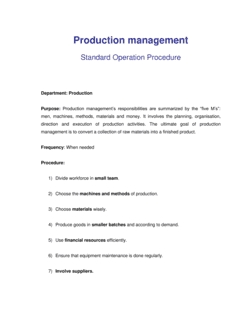
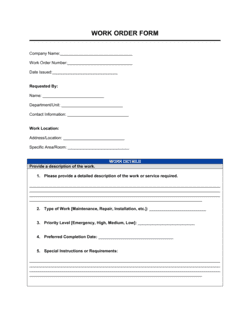
Standard Operating Procedure Templates
★★★★★4.7from 280+ reviews· Trusted by 20M+ businesses
Document your processes once so your team can execute them correctly every time, without asking.
WordEditable onlinePDF14+ SOP templates
Other Production & Operations categories
Most popular SOP templates
Industry-specific procedures
Operations planning and management
250K+Clients
20M+Free users
20+Years
190+Countries
10,000+Law firms
50M+Downloads
Trusted across review platforms
- Capterra★★★★☆4.649 reviews
- G2★★★★☆4.713 reviews
- GetApp★★★★☆4.649 reviews
- Google Play★★★★☆4.6179 ratings
- Google Reviews★★★★☆4.567 reviews
Frequently asked questions
What is a standard operating procedure?
A standard operating procedure (SOP) is a written document that describes how a recurring task should be performed, step by step, to produce a consistent and correct result. SOPs replace verbal instruction and individual memory with a durable, auditable reference. They are used in manufacturing, healthcare, hospitality, finance, and virtually every other industry where process consistency matters.
Why do businesses need SOPs?
SOPs reduce errors, training time, and reliance on institutional memory held by individual employees. When a process is documented, a new hire can perform it correctly on day one, a manager can audit it objectively, and a quality team can improve it systematically. Without SOPs, quality depends entirely on who is doing the work — which creates risk whenever staff turn over or workloads scale.
How long should an SOP be?
As long as the process requires — no longer. A simple task might need five steps on a single page; a complex multi-department process might need several pages with a flowchart. The rule is that the person performing the task should be able to read the SOP in under five minutes before starting. If your SOP is growing beyond 10–15 pages, consider splitting it into sub-procedures.
What is the difference between an SOP and a policy?
A policy defines what must be done and why — it sets the rule. An SOP defines how to do it — it gives the instructions. Both are necessary: policy sets the standard; the SOP delivers the execution path. Many organizations store them together, but they serve different purposes and should be written separately so either can be updated without rewriting the other.
How often should SOPs be reviewed and updated?
At minimum, every 12 months. In practice, any change to equipment, software, regulations, or the process itself should trigger an immediate review. A good SOP includes a document control block showing the current version number, effective date, and the next scheduled review date so nothing gets overlooked.
Who should approve an SOP before it is published?
Typically the process owner (the person responsible for the outcome) and a subject-matter expert who performs the task. For regulated industries — healthcare, food service, financial services — a compliance or quality officer should also sign off. For safety-critical procedures, a senior manager or department head approval is standard practice.
Can a checklist replace a full SOP?
For simple, linear tasks where every item is mandatory and no judgment is required, a checklist is often the better tool — it is faster to complete and harder to misread under pressure. A full SOP is needed when the process involves conditional steps, explanations of why a step matters, multiple roles, or safety notes. Many organizations use both: a full SOP for training and a checklist as the daily job aid.
Do SOPs need to be industry-specific?
General SOPs work for administrative and support functions common to any business. For regulated or operationally specific industries — hotels, restaurants, hospitals, construction sites — industry-specific templates are worth using because they pre-populate the sections and terminology relevant to that context, cutting drafting time significantly.
Standard Operating Procedure vs. related documents
Standard Operating Procedure vs. Policy
A policy states what must or must not be done and why — it sets expectations and rules. An SOP explains how to do something, step by step. Both are often published together: the policy sets the standard, the SOP delivers the instructions. For example, an expense policy says "all travel over $500 requires pre-approval"; the expense SOP walks employees through submitting the approval request.
Standard Operating Procedure vs. Work instruction
Work instructions are narrower than SOPs. An SOP covers an end-to-end process involving multiple roles or decisions; a work instruction covers a single, granular task — often a piece of equipment operation or a specific technique. Use a work instruction when the task is too narrow for a full SOP but too technical for a simple checklist.
Standard Operating Procedure vs. Process map
A process map is a visual diagram showing the flow of a process; an SOP is a written narrative or numbered procedure. They serve different audiences: process maps communicate structure at a glance; SOPs give the practitioner the detail needed to execute. Well-designed procedure documentation often includes both.
Standard Operating Procedure vs. Checklist
A checklist is the simplest form of an SOP — a flat list of items to verify or complete. Use a checklist when the sequence is fixed, every item is mandatory, and no branching decisions are required. Use a full SOP when the process involves conditional steps, multiple roles, or explanations of why each step matters.
Key clauses every Standard Operating Procedure contains
Every SOP — regardless of industry or function — is built from the same core sections. The content changes; the structure stays consistent.
- Purpose and scope. States what the procedure accomplishes and which teams, locations, or situations it applies to.
- Definitions. Explains any technical terms, abbreviations, or role names used in the document so there is no ambiguity.
- Roles and responsibilities. Names who owns each step — operator, supervisor, QA, manager — so accountability is clear.
- Materials and equipment. Lists every tool, software, form, or material required before the procedure begins.
- Step-by-step procedure. The numbered sequence of actions, written in plain language, in the order they must be performed.
- Safety and compliance notes. Flags regulatory requirements, PPE, food safety rules, data-privacy obligations, or any step that carries a risk.
- Quality checkpoints. Defines what a correct output looks like and where in the process to verify it.
- Document control. Records the version number, effective date, author, approver, and next review date so the SOP stays current.
How to write a standard operating procedure
A usable SOP is specific, short enough to read before the task, and written for the person doing the work — not for the person writing it.
1
Define the scope and trigger
Identify the exact process, who performs it, and under what conditions it starts and ends.
2
Choose the right format
Use a numbered list for linear processes, a checklist for verification tasks, and a flowchart for processes with decision branches.
3
List required inputs
Document every tool, material, software access, or form the operator needs before step one.
4
Write each step in plain language
Use the imperative voice — 'Click Save', 'Weigh the portion to 150 g' — so steps are unambiguous and action-oriented.
5
Add safety, compliance, and quality notes inline
Insert warnings, regulatory references, or quality checks at the step where they apply, not in a separate appendix.
6
Assign roles to each step
If more than one person is involved, label who does what so handoffs are explicit.
7
Test the SOP before publishing
Have someone unfamiliar with the process follow the SOP exactly as written and note where they hesitate or make errors.
8
Set a review date and version it
Record the version number and schedule a review every 12 months or whenever the underlying process changes.
At a glance
- What it is
- A standard operating procedure (SOP) is a written document that describes, step by step, how a recurring task or process should be performed to achieve a consistent result. SOPs give employees a clear, authoritative reference so work is done the same way regardless of who is doing it.
- When you need one
- Any time a task is repeated across shifts, teams, or locations — and mistakes or inconsistency would cost time, money, safety, or customer trust — you need an SOP in place before the next time it runs.
Which Standard Operating Procedure do I need?
The right SOP template depends on your industry and the type of process you are documenting. Match your situation below to find the best starting point.
Your situation
Recommended template
Documenting a general business process for any department
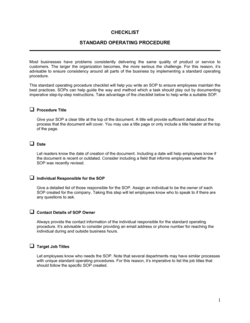
General-purpose format that works for operations, HR, IT, and most internal workflows.Creating a step-by-step checklist for a repeatable task
Checklist format reduces errors on sequential tasks where every step must be completed.Standardizing front-desk, housekeeping, or guest-service procedures
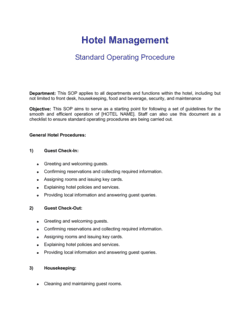
Pre-built for hotel operations including check-in, room turnover, and guest complaints.Defining kitchen, service, or opening and closing routines for a restaurant
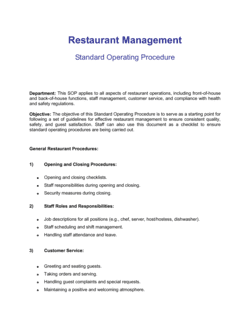
Covers food safety, service flow, and shift-handover specifics common in food service.Documenting financial controls, month-end close, or expense approval workflows
Combines policy statements with step-by-step procedures for finance and accounting teams.Preparing staff for fire, evacuation, or other emergencies
Emergency checklists must be quick to scan and act on under pressure — this format is designed for that.Glossary
- SOP
- Short for Standard Operating Procedure — a written, step-by-step instruction for performing a recurring task consistently.
- Process owner
- The individual or role accountable for the outcome of a process and responsible for keeping its SOP current.
- Document control
- The system for tracking SOP versions, effective dates, authors, approvers, and scheduled review dates.
- Work instruction
- A narrower, more granular document than an SOP that describes a single specific task or technique.
- Flowchart
- A visual diagram showing the sequence and decision points of a process; often used alongside an SOP for complex workflows.
- Version control
- The practice of numbering SOP revisions (v1.0, v1.1, v2.0) so everyone knows which version is current and changes are traceable.
- Quality checkpoint
- A defined point in a procedure where the operator verifies that the output meets a specified standard before continuing.
- Scope
- The section of an SOP that states which teams, locations, products, or situations the procedure applies to.
- Corrective action
- The documented steps to take when a process produces a non-conforming result — often referenced in SOPs as a deviation path.
- Job aid
- A simplified, condensed reference — often a laminated card or one-page checklist — derived from an SOP for use at the point of work.
What is a standard operating procedure?
A standard operating procedure (SOP) is a written document that describes, step by step, how a recurring task or process should be carried out to produce a consistent, correct result every time. SOPs replace verbal instruction and individual habit with a durable reference that any trained employee can follow — regardless of experience level, shift, or location. When a task is documented in an SOP, its quality no longer depends on who performs it.
SOPs range from a single-page numbered list for a simple task to a multi-section document covering roles, materials, safety requirements, and quality checkpoints for a complex, multi-department process. The format — numbered steps, checklist, flowchart, or a combination — should match the nature of the work. What all effective SOPs share is plain language, a clear sequence, and enough detail that someone new to the task can follow it without asking for help.
When you need an SOP
Any time a task runs more than once, involves more than one person, or carries a consequence for getting it wrong, the process should be in writing before the next run. The cost of skipping documentation is usually invisible until someone makes an error, a key employee leaves, or an auditor asks to see your procedures.
Common triggers:
- Onboarding a new employee to a role with defined repeatable tasks
- Opening a new location, shift, or production line where consistency matters
- Preparing for a food safety, ISO, financial, or regulatory audit
- Reducing errors after a recurring quality or compliance problem
- Standardizing service across a hotel, restaurant, or franchise network
- Documenting a financial close, expense approval, or reconciliation workflow
- Creating an emergency response or evacuation protocol for staff safety
- Capturing institutional knowledge before a senior employee transitions out
Without written procedures, every instance of a task is an improvisation. That may be fine for one person in one location — but it cannot scale, it cannot be audited, and it cannot be improved systematically. A well-written SOP takes an hour or two to produce and saves multiples of that every time the process runs without error.
Award-winning platform
- Great Place to Work 2025
- BIG Award — Product of the Year 2025
- Smartest Companies 2025
- Global 100 Excellence 2026
- Best of the Best 2025