Receiving and Returns Templates

4.7from 280+ reviews Trusted by 20M+ businesses

Document every inbound shipment, reject non-conforming goods, and handle returns with the right form every time.

WordEditable onlinePDF10+ receiving and returns templates

Other Production & Operations categories

250K+Clients
20M+Free users
20+Years
190+Countries
10,000+Law firms
50M+Downloads

Trusted across review platforms

  • Capterra★★★★☆4.649 reviews
  • G2★★★★☆4.713 reviews
  • GetApp★★★★☆4.649 reviews
  • Google Play★★★★☆4.6179 ratings
  • Google Reviews★★★★☆4.567 reviews

Related categories

Frequently asked questions

What is a goods received note and why does it matter?
A goods received note (GRN) is an internal document completed when a delivery arrives, recording what was received, in what quantity, and in what condition. It matters because it is the primary evidence in any later dispute about whether goods arrived, whether they matched the order, and whether they were damaged on delivery. Without a GRN, proving a shortage or damage claim is significantly harder.
When can a buyer legally reject delivered goods?
A buyer can generally reject goods that do not conform to the purchase order — wrong items, wrong quantity, damaged condition, or failure to meet specified standards. In most jurisdictions, rejection must happen within a reasonable time after delivery and before the goods are used or incorporated into production. Using the goods typically constitutes acceptance, even if you later discover defects. Issue a rejection notice promptly and in writing.
What is the difference between a full rejection and a partial rejection?
A full rejection refuses the entire shipment. A partial rejection accepts the conforming portion of a delivery and rejects only the non-conforming items. Partial rejection is appropriate when some goods are usable and you do not want to disrupt operations, but you still want to preserve your claims on the defective portion. Both should be documented in writing with the same level of specificity.
Can I cancel a purchase order if delivery is late?
Yes, in most cases — particularly if the purchase order included a firm delivery date or a "time is of the essence" clause. Even without an express clause, persistent or material lateness can justify cancellation. Send a formal Cancellation of Purchase Order for Late Delivery to put the supplier on notice and document your grounds for cancellation. Consider consulting a lawyer if significant sums or long-term contracts are involved.
What should a product returns and refunds policy include?
A returns and refunds policy should cover the timeframe within which returns are accepted, the condition goods must be in to qualify, who pays return shipping, whether the customer receives a refund or store credit, how long refunds take to process, and any categories of goods excluded from returns. Clear, specific policies reduce customer disputes and are often required by consumer protection law in many jurisdictions.
What is a reservation of rights and when should I use it?
A reservation of rights is a written statement that you are accepting goods or making payment without waiving any legal claims you may have for defects, shortages, or other breaches. Use it when you need to take possession of goods (for example, to avoid a production stoppage) but the goods are not fully conforming. Without this clause, accepting goods or paying the invoice can be interpreted as waiving your right to later compensation.
How long should I keep receiving and returns documents?
Retention periods vary by jurisdiction and industry, but a common practice is to keep receiving records for at least three to seven years to cover typical contract limitation periods and tax audit windows. Documents related to damage claims or disputes should be kept until the matter is fully resolved and any appeal period has expired.
Do I need a separate document for every delivery discrepancy?
Yes. Each discrepancy — a damaged shipment, a short delivery, a wrong item — should be recorded in a separate written notice referencing the specific purchase order and delivery date. Combining multiple complaints in one informal message creates ambiguity about which goods are affected and weakens your position if the dispute escalates.

Receiving and Return vs. related documents

Goods Received Note vs. Receiving Order

A Receiving Order is issued before delivery and instructs warehouse staff to expect and accept a specific shipment. A Goods Received Note is completed after delivery to confirm exactly what arrived, in what quantity, and in what condition. Both are needed: the Receiving Order authorizes the intake; the Goods Received Note is the evidence that it happened.

Rejection of Non-Conforming Goods vs. Delivery Rejection Notice

A Delivery Rejection Notice is used at the point of delivery when goods are refused at the dock — typically because they are visibly damaged, wrong, or unauthorized. A Rejection of Non-Conforming Goods is used after inspection reveals that goods do not meet the contracted specification. Use the Delivery Rejection Notice for on-the-spot refusals; use the Rejection of Non-Conforming Goods once you have documented the defect.

Claim for Damage vs. Notice of Defective Goods

A Claim for Damage on Shipped Goods targets the carrier or freight company when physical damage occurred in transit. A Notice of Defective Goods targets the supplier when the goods themselves are faulty — regardless of how they arrived. Both can be used simultaneously if goods were both damaged in transit and inherently defective.

Cancellation of Purchase Order vs. Notice of Rescission

A Cancellation of Purchase Order is used before or immediately after delivery fails — for late delivery or an unfulfilled order. A Notice of Rescission goes further: it voids the entire contract from inception, typically because of a material misrepresentation or fundamental breach. Use cancellation for operational failures; use rescission for serious contractual breaches where you want to unwind the deal entirely.

Key clauses every Receiving and Return contains

Whether you are accepting, rejecting, or returning goods, the documents in this category share a common set of elements that determine their legal and operational effectiveness.

  • Identification of parties and order reference. Every document must name the buyer, seller, and link back to the original purchase order number to establish context.
  • Description of goods. Specifies the item, quantity, SKU, and any lot or batch number so the dispute cannot be applied to the wrong goods.
  • Condition or non-conformance details. Describes exactly what is wrong — damage, shortage, wrong specification — with enough detail to support a claim.
  • Date and method of delivery. Records when goods arrived or were expected, which determines whether delivery deadlines were met.
  • Reservation of rights. Preserves the buyer's right to pursue remedies even when goods are conditionally accepted or payment is made under protest.
  • Required action and deadline. States what the supplier must do — replace, repair, refund, or collect goods — and by when.
  • Governing contract or purchase order terms. References the underlying agreement whose terms apply to the dispute, avoiding ambiguity about which rules govern.
  • Authorized signature. Confirms the document is issued by someone with authority to accept, reject, or cancel on behalf of the company.

How to write a receiving and returns document

Effective receiving and returns documentation follows a consistent structure regardless of whether you are recording a clean delivery or pursuing a damage claim.

  1. 1

    Identify the document type you need

    Decide whether you are recording receipt, rejecting goods, claiming damages, requesting a return, or cancelling an order — each situation calls for a different document.

  2. 2

    Reference the original purchase order

    Every document should cite the PO number, date, and contracted terms so the supplier and any third party can locate the underlying transaction.

  3. 3

    Describe the goods precisely

    Include item names, quantities, part or SKU numbers, and lot or batch identifiers to leave no ambiguity about which goods are affected.

  4. 4

    Document the condition or discrepancy

    Record exactly what is wrong — visible damage, missing items, wrong specification, or late arrival — with dates, photos where available, and inspection notes.

  5. 5

    State your position and any reservation of rights

    Make clear whether you are refusing the goods, accepting them conditionally, or paying under protest, and explicitly reserve your right to pursue further remedies.

  6. 6

    Specify the required remedy and deadline

    Tell the supplier what you expect — replacement, repair, refund, or collection of rejected goods — and give a firm deadline to avoid open-ended obligations.

  7. 7

    Obtain authorized signatures and retain copies

    Have the document signed by an authorized representative, send it promptly to the supplier, and file a copy against the purchase order record.

At a glance

What it is
Receiving and returns documents are the formal records and notices that govern how a business accepts, inspects, disputes, and returns goods from suppliers or customers. They create a documented chain of accountability from the moment goods arrive to the moment a dispute is resolved.
When you need one
Any time goods change hands — whether you're accepting a delivery, rejecting damaged stock, requesting a refund, or enforcing a returns policy — you need a written record to protect your rights and resolve disputes quickly.

Which Receiving and Return do I need?

The right template depends on where you are in the receiving or returns process and what has gone wrong. Match your situation below to find the correct document.

Your situation
Recommended template

Goods arrived and you need to record that they were received

Creates a timestamped record of what was delivered, in what quantity and condition.

Shipment arrived damaged and you need to file a carrier or supplier claim

Formally documents damage for insurance or supplier liability purposes.

Goods do not match the purchase order and you are refusing them

Puts the supplier on notice that non-conforming goods have been refused.

Shipment only partially arrived and you need to notify the supplier

Records the shortfall and triggers the supplier's obligation to deliver the balance.

Supplier delivered late and you want to cancel the purchase order

Formally cancels the order and preserves any chargeback or damages rights.

Customer wants to return a product and you need a clear policy document

Sets out the terms under which returns and refunds are accepted, reducing disputes.

You received goods under protest and want to pay conditionally while reserving rights

Allows payment without waiving the right to pursue a claim for defects or shortages.

Wrong items were shipped and you need return authorization from the supplier

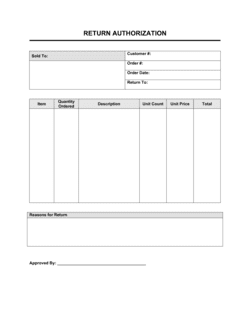
Notifies the supplier of the error and formally requests a return merchandise authorization.

Glossary

Goods received note (GRN)
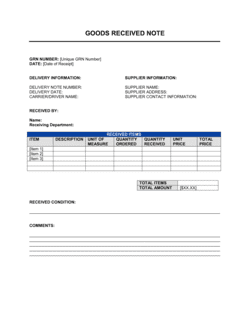
An internal document confirming that a delivery has been received, recording quantities, condition, and any discrepancies against the purchase order.
Non-conforming goods
Goods that do not meet the specifications, quantity, or quality agreed in the purchase order or contract.
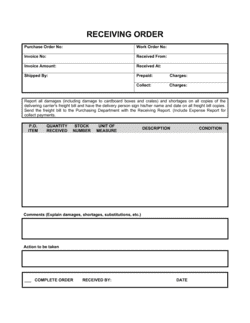
Receiving order
An internal authorization document that instructs warehouse or receiving staff to accept a specific incoming shipment.
Bill of lading
A carrier-issued document that serves as a receipt for shipped goods, a contract of carriage, and sometimes a document of title.
Return merchandise authorization (RMA)
A supplier-issued approval number that authorizes a buyer to send goods back, typically required before a return can be processed.
Reservation of rights
A written statement preserving a party's legal claims even when accepting goods or making payment under protest.
Chargeback
A deduction applied by a buyer to a supplier invoice to recover costs caused by a supplier's failure, such as late delivery or non-conforming goods.
Conditional acceptance
Taking possession of goods while formally noting defects and reserving the right to claim damages or demand correction.
Rescission
The cancellation of a contract from its inception, restoring both parties to their pre-contract positions, used for serious contractual breaches.
Packing slip
A document included with a shipment that lists the contents, quantities, and order reference — used to verify delivery against the purchase order.
Back order
Goods that were ordered but not yet shipped because they are temporarily out of stock with the supplier.
Carrier claim
A formal demand against a freight carrier for compensation for goods lost or damaged during transit.

What is a receiving and returns document?

A receiving and returns document is any formal record or written notice used to manage the intake of incoming goods and the resolution of delivery problems — including damage, non-conformance, shortage, late delivery, and product returns. These documents create a written trail that protects a buyer's legal rights from the moment goods arrive until any dispute is fully settled.

The category spans a wide range of document types: internal records like goods received notes and receiving orders that confirm what arrived; outward-facing notices like rejection letters and damage claims that put suppliers on notice of a problem; and policy documents like a product returns and refunds policy that govern how customers interact with your returns process. Together they form the operational and legal backbone of any business that buys, stocks, or ships physical goods.

When you need a receiving and returns document

Every business that purchases or sells physical goods will eventually face a delivery that is late, short, damaged, or simply wrong. Having the right document ready at that moment determines whether you can enforce your rights quickly or spend months trying to reconstruct what happened from memory and email chains.

Common triggers:

  • A supplier delivers goods that are visibly damaged on arrival
  • A shipment contains fewer units than the purchase order specified
  • Goods arrive but do not match the contracted specification or SKU
  • A supplier misses the agreed delivery date and you need to cancel or reschedule
  • A customer requests a return or refund and you need a policy to govern it
  • You need to accept goods temporarily but want to preserve a claim for defects
  • A carrier loses or damages goods in transit and you need to file a formal claim
  • A supplier ships the wrong items and you need return authorization before sending them back

Without written documentation, proving what was delivered, when, and in what condition becomes a matter of competing recollections — and suppliers and carriers routinely contest undocumented claims. A single well-drafted goods received note or rejection notice, issued promptly, is often enough to resolve a dispute before it escalates. The templates in this folder give you the right document for every stage of that process.

Award-winning platform

  • Great Place to Work 2025
  • BIG Award — Product of the Year 2025
  • Smartest Companies 2025
  • Global 100 Excellence 2026
  • Best of the Best 2025

Create your document in 3 simple steps.

From template to signed document — all inside one Business Operating System.
1
Download or open template

Access over 3,000+ business and legal templates for any business task, project or initiative.

2
Edit and fill in the blanks with AI

Customize your ready-made business document template and save it in the cloud.

3
Save, Share, Send, Sign

Share your files and folders with your team. Create a space of seamless collaboration.

Save time, save money, and create top-quality documents.

★★★★★

"Fantastic value! I'm not sure how I'd do without it. It's worth its weight in gold and paid back for itself many times."

Managing Director · Mall Farm
Robert Whalley
Managing Director, Mall Farm Proprietary Limited
★★★★★

"I have been using Business in a Box for years. It has been the most useful source of templates I have encountered. I recommend it to anyone."

Business Owner · 4+ years
Dr Michael John Freestone
Business Owner
★★★★★

"It has been a life saver so many times I have lost count. Business in a Box has saved me so much time and as you know, time is money."

Owner · Upstate Web
David G. Moore Jr.
Owner, Upstate Web

Run your business with a system — not scattered tools

Stop downloading documents. Start operating with clarity. Business in a Box gives you the Business Operating System used by over 250,000 companies worldwide to structure, run, and grow their business.

Free Forever Plan · No credit card required