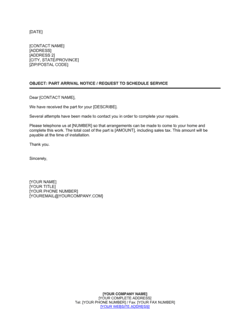
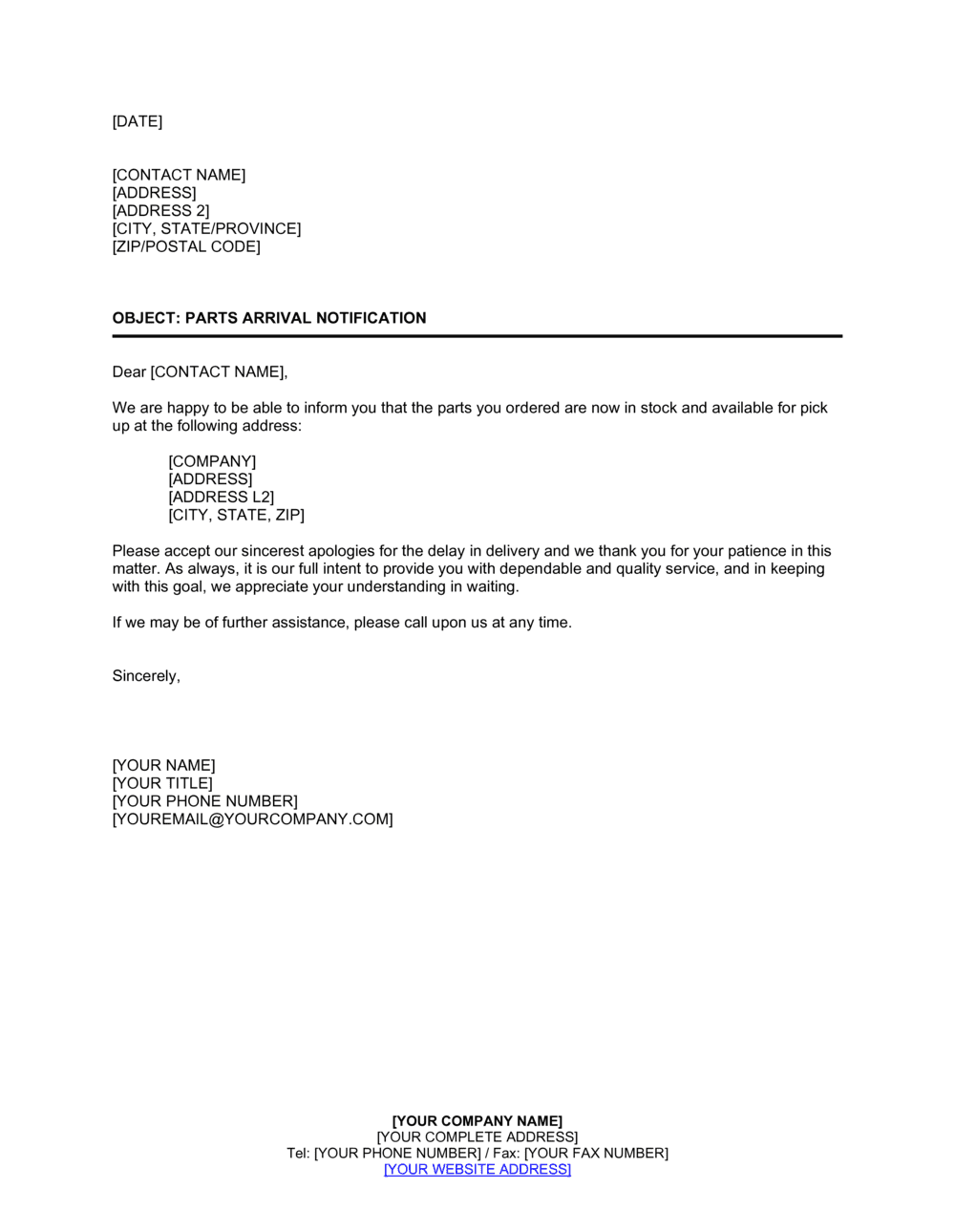
Parts Arrival Notification Template

Free Word download • Edit online • Save & share with Drive • Export to PDF

1 page20–30 min to fillDifficulty: StandardSignature requiredLegal review recommended
Learn more ↓
FreeParts Arrival Notification Template

At a glance

What it is
A Parts Arrival Notification is a binding formal document issued by a receiving party to a supplier or vendor to confirm that ordered parts or components have arrived, been inspected, and either accepted or flagged for discrepancy. This free Word download gives you a professionally structured template you can edit online and export as PDF, covering part identification, condition assessment, quantity verification, and formal acceptance or rejection terms.
When you need it
Use it whenever a shipment of parts or components is received against a purchase order, service agreement, or supply contract — particularly where inspection obligations, warranty triggers, or acceptance timelines are tied to documented receipt. It is especially critical in manufacturing, automotive, aerospace, and industrial maintenance environments where a verified receipt record determines warranty coverage and liability.
What's inside
Receiving party and supplier identification, purchase order reference, shipment and delivery details, itemized parts list with quantities and condition, inspection findings and discrepancy reporting, formal acceptance or rejection statement, and authorized signatory block with date.

What is a Parts Arrival Notification?

A Parts Arrival Notification is a formal binding document issued by a receiving party to a supplier or vendor confirming that an ordered shipment of parts or components has been physically delivered, inspected, and either accepted, conditionally accepted, or formally rejected. It references the originating purchase order, records each part by number and quantity, documents inspection findings and any discrepancies, and states the receiving party's formal position on acceptance — all under the authority of a named, authorized signatory. The notification is not a casual acknowledgment; it is the document that determines when warranty periods begin, preserves the buyer's right to seek correction or replacement, and establishes the factual record relied upon in any subsequent supplier dispute, insurance claim, or regulatory audit.

Why You Need This Document

Without a formal Parts Arrival Notification, your organization has no documented record of what arrived, in what condition, and when you became aware of any deficiency. Under the UCC in the United States and equivalent sale-of-goods statutes in Canada, the UK, and the EU, a buyer who fails to notify a seller of defects within a reasonable time after discovery loses the right to any remedy — regardless of how defective the parts actually were. An unsigned or ambiguous receipt creates the same exposure: suppliers routinely argue that silence or vague language constitutes acceptance in full, releasing them from the obligation to ship short quantities or replace damaged items. For regulated industries including aerospace, defense, and medical devices, the notification is also a mandatory element of the quality record — without it, parts may not legally enter production. This template gives you a structured, professionally drafted notification that protects your rights at the moment of receipt, before the acceptance period clock runs out.

Which variant fits your situation?

If your situation is…Use this template
Notifying a supplier of parts received in full and in acceptable conditionParts Arrival Notification (Full Acceptance)
Formally rejecting a shipment due to damage, wrong parts, or short quantityParts Rejection Notice
Recording a partial shipment with balance outstanding on the purchase orderPartial Delivery Confirmation
Triggering a warranty claim based on a defective part receivedWarranty Claim Letter
Requesting replacement or corrective action from the supplierSupplier Corrective Action Request
Documenting arrival and inspection of goods under an international trade contractGoods Receipt Note (International)
Confirming receipt of parts ordered through an automotive dealer networkAutomotive Parts Arrival Notice

Common mistakes to avoid

❌ Accepting a partial shipment without reserving rights

Why it matters: Signing an unconditional receipt when quantities are short can be treated as acceptance of the partial delivery as full performance, releasing the supplier from their obligation to ship the balance.

Fix: Always include a discrepancy statement on the notification and explicitly reserve your right to the outstanding quantity or a corrective delivery before signing.

❌ Using vague acceptance language

Why it matters: Phrases like 'received with comments' or 'pending review' do not constitute a clear acceptance or rejection and prevent the acceptance period clock from starting, creating timeline disputes later.

Fix: Choose one of three explicit options — full acceptance, conditional acceptance with a stated deadline, or formal rejection — and use that language verbatim in the acceptance clause.

❌ Omitting the warranty reservation clause

Why it matters: Without an express reservation, suppliers may argue that your acceptance of the delivery closed all quality and defect claims, leaving you without recourse for latent defects discovered after installation.

Fix: Include a standard warranty reservation that expressly states acceptance is without prejudice to rights under the supply agreement and applicable product warranties.

❌ Failing to document the inspector's identity and credentials

Why it matters: If the inspection finding is later disputed, an anonymous or improperly authorized inspection record carries little weight in a supplier dispute or arbitration.

Fix: Record the full name, job title, and date of the individual who conducted the inspection, and confirm they have authority to accept or reject on behalf of the company.

❌ Accepting parts before reviewing accompanying documentation

Why it matters: In regulated industries such as aerospace, defense, and medical devices, accepting parts without a valid Certificate of Conformance can trigger regulatory non-compliance findings independent of the supplier dispute.

Fix: Place any shipment without required documentation on formal quality hold and set a written deadline for the supplier to provide it before acceptance is granted.

❌ Sending the notification late or not at all

Why it matters: Most supply agreements specify an acceptance period of 5–30 days from receipt. Missing this window can be deemed acceptance by default, waiving your right to reject even visibly defective parts.

Fix: Assign receipt and notification responsibilities to a named individual in your procurement process, and build notification deadlines into your purchase order tracking system.

The 9 key clauses, explained

Parties and Reference Details

In plain language: Identifies the receiving company and the supplier by legal name, states the purchase order number, shipment reference, and the date of physical receipt.

Sample language
This Parts Arrival Notification is issued by [RECEIVING COMPANY NAME] ('Receiver') to [SUPPLIER LEGAL NAME] ('Supplier') in reference to Purchase Order No. [PO NUMBER], dated [PO DATE], for parts received on [RECEIPT DATE] at [DELIVERY ADDRESS].

Common mistake: Referencing only an internal job number instead of the supplier's PO number. When a discrepancy arises, the supplier cannot trace the shipment in their system and resolution is delayed.

Shipment and Delivery Identification

In plain language: Records the carrier name, tracking or airway bill number, number of packages, and gross weight — establishing the shipment as received in a specific physical state.

Sample language
Shipment delivered via [CARRIER NAME], Tracking No. [TRACKING NUMBER], consisting of [NUMBER] package(s) with a total gross weight of [WEIGHT] [UNIT]. Packing slip No. [PACKING SLIP NUMBER] accompanied the delivery.

Common mistake: Omitting the carrier tracking number. Without it, proving when and in what condition the shipment arrived is difficult if the supplier disputes liability for transit damage.

Itemized Parts Description

In plain language: Lists each part received with its part number, description, ordered quantity, received quantity, lot or serial number where applicable, and unit of measure.

Sample language
Part No. [PART NUMBER] — [PART DESCRIPTION] | Ordered Qty: [X] [UOM] | Received Qty: [Y] [UOM] | Lot/Serial No.: [LOT/SERIAL] | Certificate of Conformance attached: [YES / NO].

Common mistake: Grouping multiple part numbers into a single line. If one item in the group has a defect or shortage, the record cannot isolate which part triggered the discrepancy, complicating any warranty or correction claim.

Condition and Inspection Findings

In plain language: Documents the physical condition of the parts as inspected upon arrival — packaging integrity, visible damage, corrosion, contamination, or compliance with specified preservation requirements.

Sample language
Inspection conducted by [INSPECTOR NAME] on [INSPECTION DATE]. Condition of received parts: [ACCEPTABLE / CONDITIONAL / UNACCEPTABLE]. Findings: [DESCRIPTION OF CONDITION — e.g., 'Outer packaging intact; 3 units of Part No. [X] show surface corrosion inconsistent with specified preservation standard MIL-P-XXXX'].

Common mistake: Recording only 'acceptable' without noting minor cosmetic defects or packaging damage. Minor issues noted at receipt protect the buyer from later supplier claims that damage occurred post-delivery.

Quantity Verification and Discrepancy Statement

In plain language: Confirms whether the received quantity matches the purchase order and formally states any shortage, overage, or substitution, preserving the buyer's right to seek correction.

Sample language
Received quantities [MATCH / DO NOT MATCH] Purchase Order No. [PO NUMBER]. Discrepancy: [DESCRIPTION — e.g., 'Short shipment of [X] units of Part No. [Y]; [Z] units of Part No. [A] received as substitution not authorized under PO terms']. Receiver reserves all rights to seek correction per the terms of the governing supply agreement.

Common mistake: Accepting a partial shipment without reserving rights in writing. Signing an unconditional receipt for a short shipment can be construed as acceptance of the partial quantity as full performance, releasing the supplier from the balance.

Certificate of Conformance and Documentation Review

In plain language: Confirms whether required documentation — CoC, material test reports, RoHS/REACH declarations, or import certificates — was received with the shipment and is complete.

Sample language
Required documentation received: Certificate of Conformance [RECEIVED / MISSING]; Material Test Report [RECEIVED / MISSING]; RoHS/REACH Declaration [RECEIVED / MISSING]; Import Certificate No. [NUMBER] [RECEIVED / NOT REQUIRED]. Missing documents must be provided by [DATE] or the shipment will be placed on quality hold.

Common mistake: Accepting parts into production before confirming the CoC is on file. In aerospace and medical device industries, using parts without a valid CoC can result in regulatory non-compliance and audit findings.

Formal Acceptance or Rejection Statement

In plain language: States clearly whether the receiving party accepts the shipment in full, accepts it conditionally pending resolution of noted issues, or formally rejects all or part of it.

Sample language
[RECEIVING COMPANY NAME] hereby: [select one] (a) ACCEPTS the shipment in full; (b) CONDITIONALLY ACCEPTS the shipment subject to resolution of discrepancies noted above by [DATE]; or (c) REJECTS the shipment in whole / in part as described above and requests return authorization and replacement delivery within [X] business days.

Common mistake: Using vague language like 'received with comments' instead of a clear acceptance, conditional acceptance, or rejection. Ambiguous language prevents the acceptance period clock from starting cleanly and creates disputes about whether warranty coverage has been triggered.

Warranty and Liability Reservation

In plain language: Confirms that acceptance of the physical delivery does not waive the buyer's rights under applicable product warranties or the governing supply agreement, and reserves the right to raise latent defect claims within the warranty period.

Sample language
Acceptance of this shipment is without prejudice to [RECEIVING COMPANY NAME]'s rights under any applicable product warranty, the governing Purchase Agreement dated [DATE], or applicable law. Receiver reserves the right to raise claims for latent defects discovered within [X] days / months of acceptance.

Common mistake: Omitting the warranty reservation entirely. A supplier can argue that inspection and acceptance closed all quality claims, leaving the buyer with no recourse for defects that only become apparent once parts are installed or tested.

Authorized Signatory and Date

In plain language: Provides the signature, printed name, job title, and date of the authorized representative who conducted or oversaw the inspection and is authorized to accept or reject on behalf of the receiving company.

Sample language
Authorized by: ___________________________ | Name: [FULL NAME] | Title: [JOB TITLE] | Date: [DATE] | On behalf of: [RECEIVING COMPANY NAME].

Common mistake: Having a warehouse clerk sign as the authorized representative without confirming they have actual authority. If the notification is later relied on as a binding acceptance document, a signature from an unauthorized person may not bind the company.

How to fill it out

  1. 1

    Enter the parties and reference the purchase order

    Fill in the receiving company's legal name, the supplier's legal name, and the exact purchase order number and date. These fields are the anchor that ties the notification to the underlying commercial obligation.

    💡 Copy the PO number directly from the purchase order document — even a single digit error makes the notification hard to match in the supplier's system.

  2. 2

    Record the shipment and carrier details

    Enter the carrier name, tracking or airway bill number, number of packages, and gross weight as shown on the shipping documents. Note the actual date and time of physical receipt.

    💡 Photograph the shipment before opening any packages — timestamped photos are your strongest evidence if transit damage is disputed later.

  3. 3

    List each part individually with quantities and identifiers

    Complete one line per part number, entering the ordered quantity from the PO, the actual received quantity, the lot or serial number from the label, and whether a Certificate of Conformance was included.

    💡 If the supplier uses a different part numbering system from yours, record both numbers — your internal number and the supplier's — to avoid confusion during returns or re-orders.

  4. 4

    Conduct and document the physical inspection

    Inspect each package and item for damage, corrosion, incorrect labeling, or signs of tampering. Record the inspector's name, date of inspection, and specific findings — even if all items pass.

    💡 A clean inspection record ('no defects found') has equal legal value to a discrepancy record — it establishes the condition at receipt and prevents the supplier from claiming damage occurred after delivery.

  5. 5

    Record any discrepancies clearly

    For every shortage, overage, wrong part, or damaged item, write the part number, the issue, and the exact quantity affected. Use the discrepancy statement clause to formally reserve your rights to seek correction.

    💡 Attach photographs or test reports as numbered exhibits referenced in the discrepancy statement — they prevent the supplier from disputing that the defect was present at delivery.

  6. 6

    Confirm documentation received or flag missing items

    Check off each required document — CoC, material test report, customs paperwork — and set a deadline for any missing items before parts enter production or inventory.

    💡 A documentation hold is far less costly than a production halt caused by non-conforming parts discovered mid-build.

  7. 7

    Select and state acceptance, conditional acceptance, or rejection

    Choose one of the three formal options and complete the acceptance statement clearly. If conditionally accepting, state the specific resolution required and the deadline.

    💡 Never leave the acceptance status blank or ambiguous. Courts treat silence or vague language as acceptance in most jurisdictions, which can waive your right to withhold payment.

  8. 8

    Obtain an authorized signature before distributing

    Have the person conducting or overseeing inspection sign the document with their full name, title, and date. Send a copy to the supplier within the contractual or commercially standard notice period.

    💡 Use a timestamped email or e-signature platform to send the notification — it creates an irrefutable delivery record that protects you if the supplier later claims they never received it.

Frequently asked questions

What is a Parts Arrival Notification?

A Parts Arrival Notification is a formal document issued by a receiving party to a supplier confirming that an ordered shipment of parts or components has been delivered, inspected, and either accepted, conditionally accepted, or rejected. It references the original purchase order, records quantities and condition at receipt, documents any discrepancies, and serves as a binding record that triggers warranty periods and supplier correction obligations under the governing supply agreement.

Is a Parts Arrival Notification legally binding?

Yes, when properly executed by an authorized representative and issued within the acceptance period specified in the supply agreement, a Parts Arrival Notification is generally enforceable as a formal acceptance or rejection of goods. It creates a documented record of the condition and quantity of parts at the time of receipt, which is admissible in supplier disputes, warranty claims, and insurance proceedings. Its enforceability depends on the governing contract terms and the applicable jurisdiction's commercial law.

When should a Parts Arrival Notification be issued?

Issue it as soon as practicable after physical receipt and inspection — ideally within 24–72 hours of delivery. Most supply agreements specify an acceptance period of 5–30 days from receipt, and failing to notify within that window can constitute deemed acceptance under the contract or applicable commercial law. For critical or high-value parts, same-day or next-day notification is best practice.

What is the difference between a Parts Arrival Notification and a Goods Receipt Note?

A Goods Receipt Note (GRN) is typically an internal warehouse document used to update inventory systems and trigger payment processing. A Parts Arrival Notification is an external communication issued to the supplier that formally records acceptance, conditional acceptance, or rejection under the supply contract. The notification carries contractual weight in supplier disputes; the GRN is primarily an internal accounting record. In many organizations, both documents are generated from the same receipt event.

What happens if I accept parts and later discover a defect?

If the notification included a standard warranty reservation clause, you retain rights to raise latent defect claims within the warranty period even after formal acceptance. Without a reservation clause, the supplier may argue that inspection and acceptance closed all quality claims. In most jurisdictions, acceptance does not automatically waive warranty rights for latent defects that were not discoverable on reasonable inspection — but express reservation language in the notification is significantly stronger protection.

Do I need to sign a Parts Arrival Notification?

Yes. A Parts Arrival Notification should be signed by an authorized representative of the receiving party — typically a procurement manager, quality assurance inspector, or operations supervisor with authority to accept goods on behalf of the company. An unsigned notification may lack the binding force needed to formally trigger acceptance or rejection under the supply agreement. Electronic signatures are accepted in most jurisdictions for this type of commercial document.

What should I do if parts arrive damaged?

Photograph the damage before moving or opening packages, complete the inspection findings and discrepancy sections of the notification in full detail, select the rejection or conditional acceptance option, and send the notification to the supplier immediately. Simultaneously notify the carrier to initiate a damage claim, as liability for transit damage may sit with the carrier rather than the supplier depending on the shipping terms (FOB, CIF, DAP) stated in the purchase order.

How long should I keep Parts Arrival Notifications on file?

Retention periods vary by industry and jurisdiction, but best practice is to retain notifications for the duration of the product warranty period plus the applicable statute of limitations for contract disputes — typically 6–10 years in most commercial contexts. In regulated industries such as aerospace (FAA), defense (ITAR/DFARS), and medical devices (FDA), specific record retention requirements apply and may extend to the life of the product or equipment.

Can a Parts Arrival Notification be used for international shipments?

Yes. For international shipments, the notification should additionally reference the airway bill or bill of lading number, the customs entry number, and any import certificates or country-of-origin documentation. The governing law clause in your supply agreement determines which jurisdiction's commercial law applies to the acceptance or rejection. INCOTERMS stated in the purchase order (FOB, CIF, DAP) determine at what point risk transfers from supplier to buyer and therefore who bears responsibility for transit damage.

How this compares to alternatives

vs Purchase Order

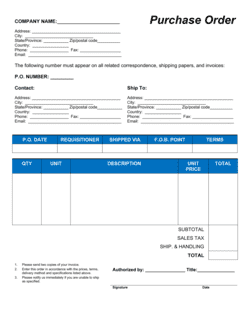
A Purchase Order is a buyer-issued authorization for the supplier to ship specific parts at agreed terms — it initiates the transaction. A Parts Arrival Notification closes the loop by confirming whether the supplier performed as ordered. Both documents must reference the same PO number to be matched in each party's records.

vs Delivery Receipt

A Delivery Receipt is typically a simple acknowledgment that a package was physically received — it carries no inspection detail, acceptance language, or discrepancy reservation. A Parts Arrival Notification is a substantively richer document that formally documents inspection findings, triggers warranty periods, and preserves legal rights. Use a Delivery Receipt for low-value, non-technical shipments and a Parts Arrival Notification when components are safety-critical, high-value, or covered by a quality agreement.

vs Supplier Corrective Action Request (SCAR)

A SCAR is issued after a defect has been formally documented and the supplier is required to investigate root cause and implement a corrective action. A Parts Arrival Notification is the document that first records the defect at receipt and triggers the SCAR process. The notification is step one; the SCAR is the formal follow-up response demand.

vs Warranty Claim Letter

A Warranty Claim Letter is issued when a defect surfaces after parts are accepted and put into service — it invokes the supplier's warranty obligation. A Parts Arrival Notification addresses defects identified at the time of receipt, before acceptance. The notation in the arrival notification that warranty rights are reserved is what preserves the buyer's ability to issue a Warranty Claim Letter for latent defects discovered later.

Industry-specific considerations

Automotive

OEM and aftermarket parts require part number and VIN cross-referencing at receipt; dealer networks use arrival notifications to trigger customer appointment scheduling and parts-ready communications.

Aerospace and Defense

FAA and ITAR requirements mandate traceable lot and serial numbers, Certificate of Conformance, and material test reports at receipt; acceptance notifications initiate the traceability record required for airworthiness documentation.

Manufacturing and Industrial

Production line scheduling depends on confirmed parts availability; notifications trigger MRP system updates and flag short shipments that would cause line stoppages before production is committed.

Healthcare and Medical Devices

FDA 21 CFR Part 820 quality system regulations require documented incoming inspection and acceptance of components; notifications form part of the Device History Record and are subject to FDA audit.

Jurisdictional notes

United States

Under the Uniform Commercial Code (UCC) Article 2, buyers must notify sellers of defects within a reasonable time after discovery — failure to do so bars the buyer from any remedy. Most commercial supply agreements specify the acceptance period explicitly; absent a contract term, courts interpret 'reasonable time' based on industry practice. State UCC adoptions are largely uniform but may vary in detail.

Canada

Canadian contract law governing goods sale is largely provincial, with most provinces enacting Sale of Goods Acts modeled on the UK statute. Buyers are generally required to examine goods within a reasonable time and give notice of breach promptly. Quebec operates under the Civil Code of Quebec, which imposes specific notification obligations for hidden defects within a reasonable time after discovery.

United Kingdom

The Sale of Goods Act 1979 and the Consumer Rights Act 2015 require buyers to examine goods and give notice of defects within a reasonable time. For commercial (B2B) sales, the parties' supply agreement typically specifies the acceptance window. Post-Brexit, CE mark and UKCA documentation requirements for technical parts differ from EU requirements and should be confirmed in the documentation clause.

European Union

The UN Convention on Contracts for the International Sale of Goods (CISG) applies to cross-border supply transactions between EU and non-EU parties where both states are signatories, requiring prompt notice of non-conformity after discovery. Within the EU, CE marking documentation and REACH/RoHS declarations must accompany regulated parts; their receipt and review should be explicitly confirmed in the notification. GDPR considerations apply if the notification contains personal data of identified individuals.

Template vs lawyer — what fits your deal?

PathBest forCostTime
Use the templateStandard domestic parts receipts under established supply agreements with clear PO termsFree10–20 minutes per notification
Template + legal reviewHigh-value components, regulated industries (aerospace, medical devices), or international shipments with complex customs and INCOTERMS implications$200–$500 for a legal or quality compliance review1–2 days
Custom draftedLong-term supply agreements for critical systems where notifications are contractually specified documents with defined legal effect, or multi-jurisdiction supply chains requiring tailored governing law and language$1,000–$3,000+1–2 weeks

Glossary

Purchase Order (PO)
A buyer-issued document authorizing a supplier to ship specific parts at an agreed price and quantity, which the Arrival Notification references to confirm fulfillment.
Goods Receipt Note (GRN)
An internal record confirming that delivered goods have been physically received and counted — the Parts Arrival Notification serves this function in external supplier communications.
Inspection Acceptance
Formal acknowledgment by the receiving party that delivered parts meet specified quality, quantity, and condition requirements.
Discrepancy Report
A documented list of deviations between what was ordered on the purchase order and what was actually delivered, including short shipments, wrong part numbers, or damaged items.
Part Number (PN)
A unique alphanumeric identifier assigned by the manufacturer or supplier to a specific component, used to verify the correct item was shipped.
Lot Number
A supplier-assigned identifier linking a batch of parts to a specific production run, enabling traceability for quality and recall purposes.
Certificate of Conformance (CoC)
A supplier-issued document certifying that delivered parts meet the specifications, standards, or regulatory requirements stated in the purchase order.
Acceptance Period
The contractually or commercially defined window — typically 5–30 days from delivery — within which the buyer must formally accept or reject delivered goods.
Conditional Acceptance
A qualified acceptance where the receiving party acknowledges delivery but reserves the right to raise defect or shortage claims within the acceptance period.
Back Order
A portion of a purchase order that the supplier cannot fulfill immediately due to stock shortages, noted in the notification when a partial shipment is received.
Chain of Custody
A documented record of who handled parts at each stage from production through delivery, used to establish liability if damage or loss occurs in transit.

Part of your Business Operating System

This document is one of 3,000+ business & legal templates included in Business in a Box.

  • Fill-in-the-blanks — ready in minutes
  • 100% customizable Word document
  • Compatible with all office suites
  • Export to PDF and share electronically

Create your document in 3 simple steps.

From template to signed document — all inside one Business Operating System.
1
Download or open template

Access over 3,000+ business and legal templates for any business task, project or initiative.

2
Edit and fill in the blanks with AI

Customize your ready-made business document template and save it in the cloud.

3
Save, Share, Send, Sign

Share your files and folders with your team. Create a space of seamless collaboration.

Save time, save money, and create top-quality documents.

★★★★★

"Fantastic value! I'm not sure how I'd do without it. It's worth its weight in gold and paid back for itself many times."

Managing Director · Mall Farm
Robert Whalley
Managing Director, Mall Farm Proprietary Limited
★★★★★

"I have been using Business in a Box for years. It has been the most useful source of templates I have encountered. I recommend it to anyone."

Business Owner · 4+ years
Dr Michael John Freestone
Business Owner
★★★★★

"It has been a life saver so many times I have lost count. Business in a Box has saved me so much time and as you know, time is money."

Owner · Upstate Web
David G. Moore Jr.
Owner, Upstate Web

Run your business with a system — not scattered tools

Stop downloading documents. Start operating with clarity. Business in a Box gives you the Business Operating System used by over 250,000 companies worldwide to structure, run, and grow their business.

Start free · No credit card required