Business Continuity Templates
★★★★★4.7from 280+ reviews· Trusted by 20M+ businesses
Keep operations running before, during, and after any disruption with ready-to-use continuity documents.
WordEditable onlinePDF12+ business continuity templates
Other Production & Operations categories
Core business continuity documents
Travel risk and safety policies
Business planning foundations
250K+Clients
20M+Free users
20+Years
190+Countries
10,000+Law firms
50M+Downloads
Trusted across review platforms
- Capterra★★★★☆4.649 reviews
- G2★★★★☆4.713 reviews
- GetApp★★★★☆4.649 reviews
- Google Play★★★★☆4.6179 ratings
- Google Reviews★★★★☆4.567 reviews
Frequently asked questions
What is a business continuity plan?
A business continuity plan is a documented set of procedures that allows an organization to maintain or quickly restore critical operations following an unexpected disruption. It covers people, processes, facilities, suppliers, and technology — not just IT. A complete BCP includes a business impact analysis, risk assessment, recovery strategies, team roles, and a communication plan.
Who needs a business continuity plan?
Any organization that cannot tolerate extended downtime should have a BCP. Regulated industries — financial services, healthcare, utilities — are often legally required to maintain one. Small businesses are not exempt: a 2023 FEMA study found that 40% of small businesses do not reopen after a major disaster. A basic BCP takes a few hours to draft with a template and can prevent weeks of chaotic recovery.
What is the difference between a BCP and a disaster recovery plan?
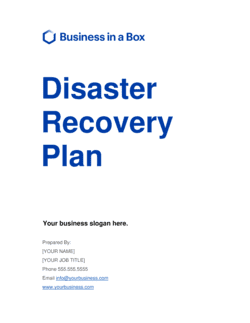
A disaster recovery plan (DRP) focuses on restoring IT systems and data. A business continuity plan covers all critical functions — including people, facilities, and supply chains — not just technology. Most organizations need both; the DRP is typically a technical appendix or sub-plan within the broader BCP.
How long does it take to write a business continuity plan?
A small business can complete a basic BCP in one to two days using a structured template. A mid-sized organization with multiple locations and complex dependencies typically needs two to six weeks to conduct a business impact analysis, validate recovery strategies, and complete internal review. Using a template significantly reduces drafting time; the analysis and stakeholder alignment take the most time regardless of organization size.
How often should a business continuity plan be updated?
Most frameworks — ISO 22301, NIST SP 800-34 — recommend a formal review at least once a year and an out-of-cycle update whenever a material change occurs: a new location, a key acquisition, a significant IT change, or a change in regulatory requirements. The date of last review should be recorded on the cover page of the plan.
What is a recovery time objective (RTO)?
An RTO is the maximum acceptable length of time a business function can be offline before the disruption causes unacceptable harm. For example, an RTO of four hours means payroll processing must be restored within four hours of a failure. RTOs drive recovery strategy choices — a two-hour RTO typically requires active-active failover; a 24-hour RTO may allow manual workarounds.
Does a small business need a formal BCP?
Yes, though the plan can be proportionally simpler. A small business BCP might be a single-page document that identifies two or three critical functions, names a backup contact for each, lists key supplier and customer contacts, and describes where data backups are stored. The goal is to reduce decision-making time during a crisis, not to produce a lengthy report.
What should a business continuity policy include?
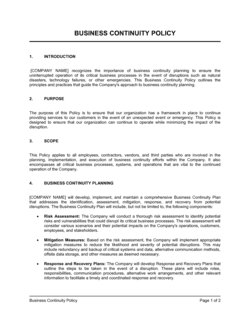
A business continuity policy should state the organization's commitment to continuity, define the scope of the program, assign ownership (typically a named role or committee), set minimum standards for plan development and testing, and reference the supporting operational plan. It is the governance document that gives the BCP its authority and triggers mandatory compliance.
Business Continuity vs. related documents
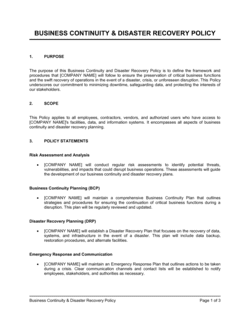
A disaster recovery plan (DRP) focuses specifically on restoring IT systems, data, and technology infrastructure after a failure. A business continuity plan is broader — it covers all critical business functions, not just IT, and includes people, facilities, suppliers, and communications. In practice, the DRP is usually a subset of the BCP. Organizations with significant IT dependencies often need both.
An emergency response plan addresses the immediate, life-safety actions taken in the first minutes and hours of an incident — evacuation, first aid, emergency services contact. A business continuity plan picks up where the emergency response ends, focusing on how the organization resumes operations after the immediate crisis is contained. Both documents are needed; they cover different time horizons.
A risk management plan identifies, assesses, and prioritizes risks before they occur. A business continuity plan defines what to do after a risk materializes. Risk management reduces the probability of disruption; business continuity reduces its impact. A strong BCP is informed by a current risk register.
The policy sets governance: who owns continuity, what standards apply, and what the organization's obligations are. The plan is the operational document: specific procedures, recovery teams, contact lists, and RTO/RPO targets. Most organizations need both — the policy provides authority; the plan provides instruction.
Key clauses every Business Continuity contains
Every business continuity plan and policy shares the same structural components, regardless of industry or organization size.
- Scope and objectives. Defines which locations, business units, and functions the plan covers and states the recovery time and recovery point objectives.
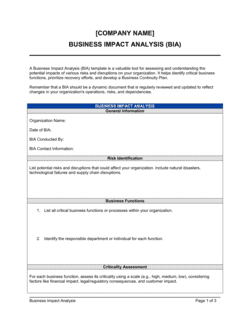
- Business impact analysis (BIA). Identifies which functions are critical, what the financial and operational impact of downtime is, and which processes must be restored first.
- Risk assessment. Documents the specific threats the organization faces — natural disasters, cyberattacks, supply chain failure — and their likelihood.
- Recovery strategies. Describes the specific approaches for restoring each critical function, including alternate sites, backup systems, and manual workarounds.
- Roles and responsibilities. Names the continuity team, assigns ownership of each recovery task, and designates an incident commander or BCP coordinator.
- Communication plan. Specifies how staff, customers, suppliers, and regulators will be notified during a disruption and who is authorized to issue communications.
- Testing and exercise schedule. Requires regular walkthroughs, tabletop exercises, or live drills to verify the plan works before it is needed.
- Plan maintenance and review. Establishes how often the plan is reviewed, who approves updates, and what triggers an out-of-cycle revision.
How to write a business continuity plan
A business continuity plan is built in layers — you cannot write recovery procedures until you know which functions to recover and how quickly.
1
Define scope and objectives
Decide which business units, locations, and functions the plan covers and state your target recovery time objective (RTO) and recovery point objective (RPO).
2
Conduct a business impact analysis
Identify every critical function, estimate the cost of downtime per hour or day, and rank functions in the order they must be restored.
3
Assess your risks
List the credible threats your organization faces — power outages, floods, ransomware, key-person loss — and rate each by likelihood and impact.
4
Develop recovery strategies
For each critical function, document at least one recovery approach: failover site, cloud backup, alternate supplier, manual process, or remote work protocol.
5
Assign roles and build the response team
Name a BCP coordinator, assign recovery tasks to specific individuals by role, and document primary and backup contacts for each.
6
Write the communication plan
Define notification sequences for staff, customers, suppliers, and regulators, and designate the single authorized spokesperson for external communications.
7
Test, review, and update
Run a tabletop exercise at least annually, document gaps, update the plan after every significant organizational change, and record the review date in the policy.
At a glance
- What it is
- A business continuity plan (BCP) is a documented framework that defines how an organization will maintain or quickly resume critical operations following an unexpected disruption — whether a natural disaster, cyberattack, power outage, or key-staff absence. It identifies essential functions, assigns recovery responsibilities, and sets measurable recovery time objectives.
- When you need one
- Any organization that cannot afford prolonged downtime needs a BCP in place before a disruption occurs. Waiting until an event happens makes orderly recovery nearly impossible.
Which Business Continuity do I need?
The right document depends on whether you are setting governance-level expectations, building an operational recovery plan, or addressing a specific risk category such as travel or IT disaster recovery.
Your situation
Recommended template
Creating an organization-wide framework for continuity governance
Sets board-level obligations, scope, and ownership before an operational plan is written.Building a step-by-step plan to recover operations after a disruption
Covers risk assessment, critical functions, recovery procedures, and team roles in one document.Combining IT disaster recovery with business continuity in one policy
Addresses both operational and technology recovery under a single governance policy.Verifying your insurance coverage before finalizing the continuity plan
Ensures every operational risk category is matched to the correct insurance product.Setting rules for employee safety during business travel disruptions
Defines duty-of-care obligations and emergency procedures for employees traveling on company business.Controlling costs when travel disruptions trigger unplanned expenses
Establishes pre-approval thresholds so emergency travel spend stays within budget.Glossary
- Business continuity plan (BCP)
- A documented framework of procedures for maintaining or restoring critical operations following a disruption.
- Recovery time objective (RTO)
- The maximum acceptable downtime for a given business function before the organization suffers unacceptable harm.
- Recovery point objective (RPO)
- The maximum acceptable amount of data loss measured in time — how far back in time recovery can go and still be acceptable.
- Business impact analysis (BIA)
- An assessment that identifies critical business functions, estimates the cost of their disruption, and prioritizes recovery order.
- Disaster recovery plan (DRP)
- A sub-plan focused specifically on restoring IT systems, data, and technology infrastructure after a failure.
- Incident commander
- The designated individual who leads the organization's response during a continuity event and has authority to activate the BCP.
- Failover
- The automatic or manual switching of operations to a backup system, site, or process when the primary one fails.
- Tabletop exercise
- A discussion-based simulation where the continuity team walks through a hypothetical disruption scenario to test the plan without activating it.
- Critical function
- A business process or service that, if interrupted for longer than the RTO, would cause unacceptable financial, operational, or legal harm.
- ISO 22301
- The international standard that specifies requirements for a business continuity management system (BCMS).
- Maximum tolerable downtime (MTD)
- The absolute longest period a function can be unavailable before recovery becomes impossible or the harm irreversible.
What is a business continuity plan?
A business continuity plan (BCP) is a documented framework that defines how an organization will maintain or restore its critical operations when an unexpected disruption occurs — whether that disruption is a natural disaster, a ransomware attack, a prolonged power outage, a supply chain collapse, or the sudden loss of key personnel. The plan identifies which functions are essential to the organization's survival, sets target recovery timeframes, assigns responsibilities to named individuals, and documents the specific procedures each team will follow to restore normal operations.
Business continuity planning is distinct from simply having insurance or a data backup. Insurance compensates after the fact; a BCP is the operational instruction set that determines whether recovery takes hours or weeks. A BCP typically contains four core components: a business impact analysis that ranks functions by criticality, a risk assessment that catalogues credible threats, a set of recovery strategies for each critical function, and a communication plan that tells staff, customers, and regulators what is happening and when to expect resolution.
Organizations of every size benefit from a BCP. Regulated industries — financial services, healthcare, utilities, and critical infrastructure — are often required by law or standard (ISO 22301, NIST SP 800-34) to maintain a current, tested plan. Smaller businesses without a regulatory mandate are equally vulnerable to disruption and typically have less financial cushion to absorb the cost of extended downtime.
When you need a business continuity plan
The right time to build a BCP is before any disruption occurs. Organizations that start writing their plan during an active incident are working under exactly the conditions — time pressure, incomplete information, stressed decision-makers — that make good planning impossible.
Common triggers for creating or updating a business continuity plan:
- Opening a new facility, acquiring a company, or entering a new market
- Passing a regulatory audit that identifies a continuity gap
- Experiencing a near-miss event (power outage, minor flood, ransomware attempt)
- Onboarding a significant new client that requires demonstrated resilience
- Moving critical systems to the cloud or changing a key technology platform
- Losing a key employee who held undocumented institutional knowledge
- Annual review cycle required by ISO 22301 or an internal governance policy
The cost of operating without a BCP is not abstract. Studies consistently find that businesses without a continuity plan take two to four times longer to resume operations after a major disruption — and a significant share never recover at all. A documented, tested BCP reduces that recovery time, limits financial loss, and demonstrates to clients, insurers, and regulators that the organization is managed responsibly.
Award-winning platform
- Great Place to Work 2025
- BIG Award — Product of the Year 2025
- Smartest Companies 2025
- Global 100 Excellence 2026
- Best of the Best 2025