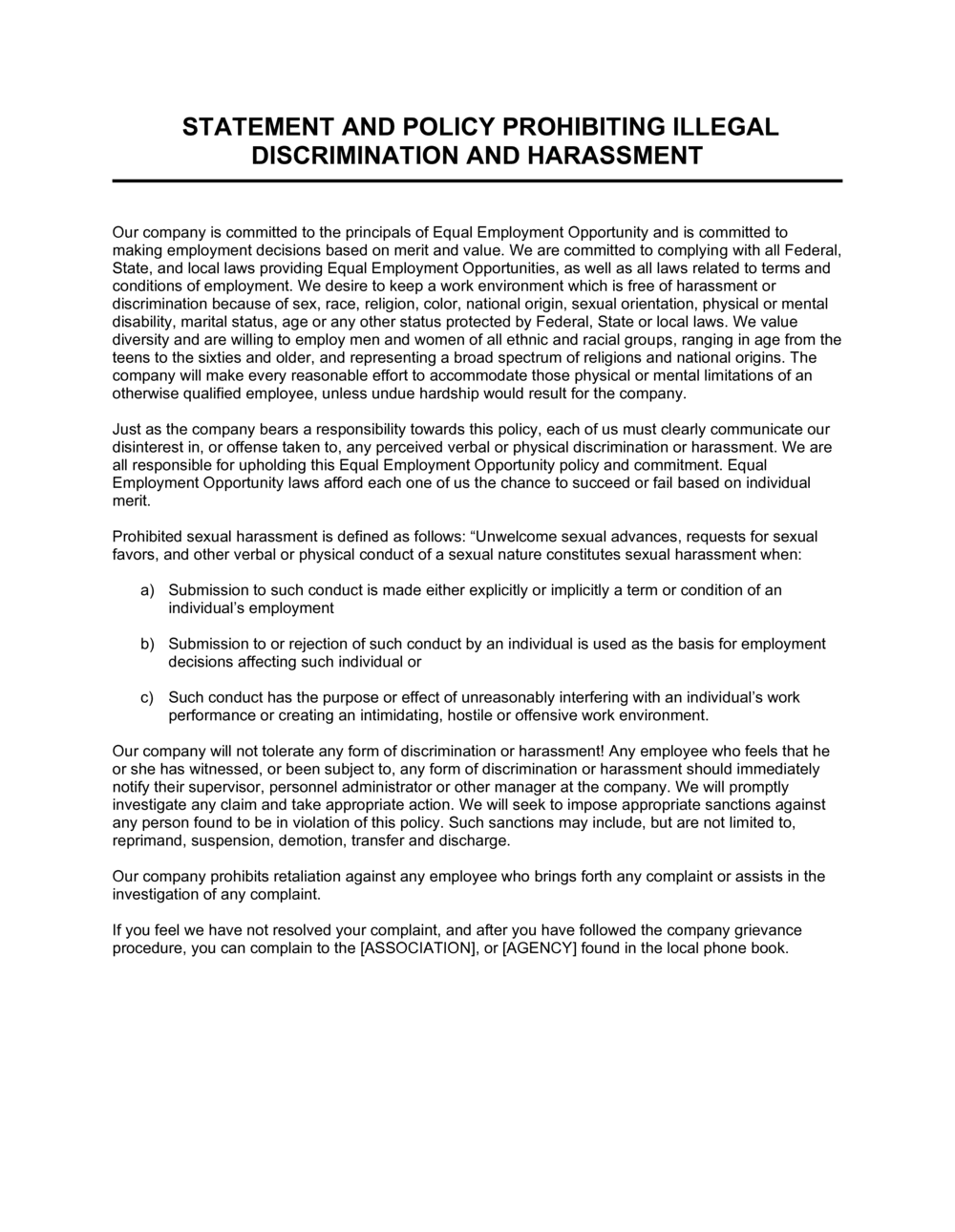
Statement and Policy Prohibiting Illegal Discrimination Template

Free Word download β€’ Edit online β€’ Save & share with Drive β€’ Export to PDF

1 pageβ€’20–25 min to fillβ€’Difficulty: Standard
Learn more ↓
FreeStatement and Policy Prohibiting Illegal Discrimination Template

At a glance

What it is
A Statement and Policy Prohibiting Illegal Discrimination is a formal written document in which an employer declares its commitment to a discrimination-free workplace and establishes the rules, procedures, and enforcement mechanisms that support that commitment. This free Word download is fully editable online and can be exported as a PDF to include in employee handbooks, onboarding packets, or posted on company bulletin boards.
When you need it
Use it when onboarding new employees, updating an employee handbook, responding to a regulatory audit, or formalizing workplace standards after a period of rapid growth. Organizations with 15 or more employees are subject to federal EEO laws in the United States, making a written policy a practical baseline for any business of that size or larger.
What's inside
A policy statement of commitment, a list of covered protected classes, definitions of prohibited conduct (including harassment and retaliation), a complaint and reporting procedure, an investigation process, disciplinary consequences, and contact information for the designated policy administrator.

What is a Statement and Policy Prohibiting Illegal Discrimination?

A Statement and Policy Prohibiting Illegal Discrimination is a formal workplace document in which an employer declares its commitment to equal employment opportunity and establishes specific rules, reporting procedures, and enforcement mechanisms that prohibit discriminatory conduct based on protected characteristics. It covers illegal discrimination in hiring, promotion, compensation, discipline, and termination, as well as workplace harassment and retaliation. Unlike a general code of conduct, this policy is specifically anchored to applicable employment law β€” naming the protected classes, defining the prohibited conduct with legal precision, and providing employees with a clear process for reporting violations and seeking remedies.

Why You Need This Document

Without a written, distributed, and enforced anti-discrimination policy, an employer faces sharply elevated liability in any discrimination or harassment claim. The US Supreme Court's Faragher-Ellerth doctrine gives employers an affirmative defense against certain harassment claims β€” but only if they can demonstrate they maintained a clear policy, distributed it to employees, and enforced it consistently. An employer who cannot produce a signed, dated policy acknowledgment from a complaining employee loses that defense entirely. Beyond litigation, the EEOC treats the absence of a written policy as evidence of systemic indifference during investigations, which accelerates the agency's process and increases the risk of a cause finding. This template gives any organization β€” regardless of size β€” a professionally structured, legally grounded starting point that closes the most common coverage gaps and provides the documentation trail that regulators and courts expect to see.

Which variant fits your situation?

If your situation is…Use this template
Comprehensive HR policy document covering all workplace conduct rulesEmployee Handbook
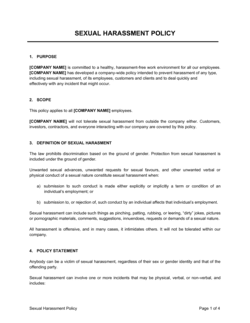
Policy covering sexual harassment specificallySexual Harassment Policy
Formal complaint intake record for a discrimination allegationEmployee Grievance Form
Policy governing workplace accommodation requests under the ADAReasonable Accommodation Policy
Policy addressing retaliation protections for whistleblowersWhistleblower Policy
Government contractor EEO affirmative action documentationAffirmative Action Plan
Diversity and inclusion program charter for larger organizationsDiversity and Inclusion Policy

Common mistakes to avoid

❌ Listing only federal protected classes

Why it matters: State and local laws frequently protect additional characteristics not covered by federal law. An employee in California, New York, or Illinois who is discriminated against on a state-protected basis will find the policy inadequate, and the employer loses a key defense.

Fix: Audit your operating locations and add all applicable state and local protected classes to the policy's prohibited-basis list.

❌ Designating a single complaint contact with no alternate

Why it matters: If the only named contact is the subject of the complaint, the employee has nowhere to go β€” the reporting procedure breaks down at the most critical moment.

Fix: Name a primary and at least one alternate contact, and add an external option (hotline or third-party HR service) for situations where internal reporting is not feasible.

❌ Promising complete confidentiality during investigations

Why it matters: A thorough investigation requires interviewing witnesses, which inherently discloses some information. Promising absolute confidentiality and then failing to deliver it creates a second, independent liability.

Fix: Replace 'confidential' with 'as confidential as reasonably practicable' and explain to employees that limited disclosure to relevant parties is necessary.

❌ Distributing the policy once at onboarding and never revisiting it

Why it matters: Courts and the EEOC treat a policy that was never reinforced as essentially inoperative. Employers who cannot show regular re-distribution and re-acknowledgment lose a key affirmative defense in harassment claims.

Fix: Require annual re-acknowledgment, link the policy in onboarding, post it in break rooms and on the intranet, and document every distribution with a date-stamped record.

The 10 key sections, explained

Policy statement and commitment

Scope and covered individuals

Protected classes

Prohibited conduct

Complaint and reporting procedure

Investigation process

Disciplinary consequences

No-retaliation assurance

Accommodation request process

Policy review, distribution, and acknowledgment

How to fill it out

  1. 1

    Enter your company name and effective date

    Replace all [COMPANY NAME] placeholders with your organization's full legal name. Set an effective date that matches when you plan to formally adopt or distribute the policy.

    πŸ’‘ Use the same legal entity name that appears on employment contracts and payroll β€” not a brand name or DBA.

  2. 2

    Identify and name the policy administrator

    Designate a specific individual β€” typically the HR manager or compliance officer β€” as the primary contact for complaints. Add their name, title, email, and phone number to the reporting section. Add an alternate contact for complaints involving the primary administrator.

    πŸ’‘ If your organization is small and has no dedicated HR staff, name an owner or operations lead and also include a third-party HR hotline as the alternate channel.

  3. 3

    Review and expand the protected classes list

    The template includes standard federal protected classes. Add any additional classes required by your state or city β€” sexual orientation, gender identity, marital status, military status, and others vary by jurisdiction.

    πŸ’‘ Search '[your state] protected classes employment' on your state labor department's website for a current, authoritative list.

  4. 4

    Set the investigation timeline

    Fill in the number of business days within which an investigation will commence and the target timeframe for completing it. A typical range is 5 business days to commence and 30–45 calendar days to complete.

    πŸ’‘ Keep timelines realistic β€” committing to 5 days and consistently missing it is worse than committing to 10 days and meeting it.

  5. 5

    Configure the reporting channels

    Decide whether you will offer anonymous reporting (hotline, online form, or suggestion box) and add those details. Anonymous channels reduce fear of retaliation and often surface issues that employees would not report directly.

    πŸ’‘ If you use an anonymous reporting tool, document your process for investigating anonymous reports β€” regulators expect a consistent response regardless of report source.

  6. 6

    Attach or reference the acknowledgment form

    Add a signature block or acknowledgment form at the end of the policy, or reference a standalone form. The form should confirm the employee received, read, and agrees to comply with the policy.

    πŸ’‘ Store signed acknowledgments in each employee's personnel file. In a complaint proceeding, proof of distribution is a key defense element.

  7. 7

    Integrate the policy into your employee handbook

    If you maintain an employee handbook, insert this policy in the workplace conduct or HR policies section. Cross-reference any related policies β€” harassment, code of conduct, grievance procedures β€” by section name.

    πŸ’‘ Publish an electronic version on your intranet or HRIS so employees can access it at any time, not just at onboarding.

  8. 8

    Schedule an annual review

    Set a recurring calendar reminder to review the policy each year or following any significant change in applicable law. Update the effective date and re-distribute to all employees with a new acknowledgment signature requirement.

    πŸ’‘ Assign the annual review task to a named owner β€” without ownership, policy reviews slip until a complaint makes the gap visible.

Frequently asked questions

What is an anti-discrimination policy?

An anti-discrimination policy is a formal written statement in which an employer prohibits workplace discrimination based on protected characteristics such as race, sex, religion, national origin, age, and disability. It defines prohibited conduct, establishes a complaint process, and specifies consequences for violations. A written policy is the foundation of a legally defensible equal employment opportunity program.

Is a written anti-discrimination policy legally required?

No single federal law mandates a written anti-discrimination policy by name, but the EEOC and federal courts treat its absence as a significant factor against employers defending harassment or discrimination claims. Employers subject to Title VII, the ADA, or the ADEA who can demonstrate a clearly communicated, enforced policy have access to the Faragher-Ellerth affirmative defense, which can limit or eliminate employer liability in certain harassment cases. In practice, any employer with 15 or more employees should maintain one.

What protected classes should the policy cover?

At the federal level in the United States, the policy should cover race, color, religion, sex (including pregnancy and related conditions), national origin, age (40 and older), disability, and genetic information. Many states and cities add sexual orientation, gender identity, marital status, military status, criminal history, and others. Review the laws in every jurisdiction where your employees work and include all applicable classes.

How is this policy different from a sexual harassment policy?

A sexual harassment policy addresses one specific form of prohibited conduct β€” sex-based harassment. An anti-discrimination policy is broader, covering all forms of illegal discrimination and harassment across every protected class, as well as retaliation and accommodation procedures. Many employers maintain both, with the sexual harassment policy providing greater detail on a specific high-risk area and the anti-discrimination policy serving as the overarching framework.

Who should receive and sign this policy?

All employees β€” full-time, part-time, temporary, and seasonal β€” should receive and acknowledge the policy. Best practice also extends distribution to contractors and vendors who regularly work on company premises. Signed acknowledgments should be collected at hire and after any material policy revision, then retained in each employee's personnel file for the duration of employment plus any applicable statute of limitations period.

What should happen after a discrimination complaint is filed?

The policy administrator should acknowledge receipt of the complaint promptly β€” typically within one to two business days β€” and initiate a confidential investigation within five business days. The investigation should involve interviews with the complainant, respondent, and relevant witnesses, followed by a written findings summary. Both parties should be informed of the outcome. Disciplinary action, if warranted, should follow promptly. Document every step.

Can small businesses use this template?

Yes. While federal EEO laws apply to employers with 15 or more employees, many state laws apply to smaller employers β€” some as small as one employee. More practically, adopting a written anti-discrimination policy before you reach legal thresholds establishes a professional culture and reduces the risk of costly disputes. The template scales to any organization size and can be simplified or expanded as needed.

How often should the policy be updated?

Review the policy at least once per year and after any significant change in federal, state, or local anti-discrimination law. Common triggers for an off-cycle update include expansion into a new state with different protected classes, a change in EEOC guidance, or a significant legal ruling in your jurisdiction. Each revision should be re-distributed to all employees with a new acknowledgment signature.

Does this policy need to be reviewed by a lawyer?

For most small to mid-size employers, a well-structured template is a sound starting point. Consider engaging an employment attorney when you operate in multiple states with varying protected-class lists, when your workforce exceeds 100 employees (triggering additional EEOC reporting obligations), or when you are responding to an active complaint or EEOC charge. A one-hour legal review typically costs $200–$400 and is worthwhile at any scale above 50 employees.

How this compares to alternatives

vs Employee Handbook

An employee handbook is a comprehensive document covering all workplace policies β€” attendance, compensation, benefits, code of conduct, and more. An anti-discrimination policy is a standalone document that can be embedded in a handbook or distributed independently. Use the standalone policy when you need a signed acknowledgment on this specific topic or when a funder or regulator requests it separately.

vs Code of Conduct

A code of conduct addresses broad professional and ethical behavior standards, including conflicts of interest, confidentiality, and integrity. An anti-discrimination policy focuses specifically on EEO obligations, protected classes, prohibited conduct, and the complaint process. The two documents complement each other but serve distinct purposes and should both be maintained.

vs Sexual Harassment Policy

A sexual harassment policy drills into one specific form of prohibited conduct with detailed examples, reporting scripts, and state-mandated training requirements. An anti-discrimination policy is the broader framework covering all protected classes. Many employers maintain both, with the harassment policy providing depth on the highest-risk area and this policy serving as the overarching EEO statement.

vs Whistleblower Policy

A whistleblower policy protects employees who report legal violations, financial misconduct, or regulatory breaches β€” broader in scope than employment discrimination alone. An anti-discrimination policy focuses specifically on EEO-related reports and retaliation. Both policies should include explicit no-retaliation language, but they address different categories of protected activity.

Industry-specific considerations

Professional Services

Client-facing roles and billable staff require clear policies on third-party harassment, including conduct by clients toward employees β€” an area where standard templates often need an explicit addendum.

Retail and Hospitality

High turnover and hourly workforces make consistent policy distribution and re-acknowledgment at rehire critical; many state wage-and-hour investigations also audit EEO policy compliance simultaneously.

Healthcare

Patient and caregiver interactions add a third-party harassment dimension; disability accommodation under the ADA is especially complex given physical job requirements and licensure prerequisites.

Technology / SaaS

Remote and distributed teams require explicit policy language confirming coverage extends to digital communications, virtual meetings, and company-sponsored online channels.

Manufacturing

Shift-based operations and unionized workforces require coordination with applicable collective bargaining agreements; EEO posting requirements apply to physical bulletin boards at every facility.

Nonprofit

Grant funders and government contracts frequently require a written non-discrimination policy as a condition of award; board oversight of the policy administrator is an additional governance requirement.

Template vs pro β€” what fits your needs?

PathBest forCostTime
Use the templateSmall to mid-size employers formalizing or updating their EEO policy without an in-house legal teamFree30–60 minutes
Template + professional reviewEmployers operating in multiple states, those with 50+ employees, or organizations responding to an EEOC inquiry$200–$500 for a one-hour employment attorney review2–5 business days
Custom draftedEmployers with 100+ employees, government contractors with affirmative action obligations, or organizations with active discrimination litigation$800–$2,500+1–2 weeks

Glossary

Protected Class
A group of people sharing a characteristic β€” such as race, sex, religion, national origin, age, or disability β€” that is shielded from employment discrimination by federal or state law.
EEO (Equal Employment Opportunity)
A legal principle and regulatory framework requiring that employment decisions be made without regard to an individual's membership in a protected class.
Hostile Work Environment
A form of workplace harassment in which conduct based on a protected characteristic is severe or pervasive enough to alter the conditions of employment.
Quid Pro Quo Harassment
Harassment in which a person in authority conditions employment benefits β€” a promotion, raise, or continued employment β€” on submission to unwelcome conduct.
Retaliation
Adverse action taken against an employee for reporting discrimination, filing a complaint, or participating in an investigation β€” prohibited under most EEO laws.
Reasonable Accommodation
A modification to a job, work environment, or process that enables a qualified employee with a disability or religious obligation to perform essential job functions without undue hardship to the employer.
EEOC (Equal Employment Opportunity Commission)
The US federal agency responsible for enforcing federal anti-discrimination laws and investigating workplace discrimination complaints.
Disparate Treatment
A form of discrimination in which an employer treats an individual less favorably than others specifically because of a protected characteristic.
Disparate Impact
A situation in which a facially neutral employment policy or practice disproportionately disadvantages members of a protected class, even without discriminatory intent.
Policy Administrator
The designated individual β€” typically an HR manager or compliance officer β€” responsible for receiving complaints, overseeing investigations, and enforcing the policy.

Part of your Business Operating System

This document is one of 3,000+ business & legal templates included in Business in a Box.

  • Fill-in-the-blanks β€” ready in minutes
  • 100% customizable Word document
  • Compatible with all office suites
  • Export to PDF and share electronically

Create your document in 3 simple steps.

From template to signed document β€” all inside one Business Operating System.
1
Download or open template

Access over 3,000+ business and legal templates for any business task, project or initiative.

2
Edit and fill in the blanks with AI

Customize your ready-made business document template and save it in the cloud.

3
Save, Share, Send, Sign

Share your files and folders with your team. Create a space of seamless collaboration.

Save time, save money, and create top-quality documents.

β˜…β˜…β˜…β˜…β˜…

"Fantastic value! I'm not sure how I'd do without it. It's worth its weight in gold and paid back for itself many times."

Managing Director Β· Mall Farm
Robert Whalley
Managing Director, Mall Farm Proprietary Limited
β˜…β˜…β˜…β˜…β˜…

"I have been using Business in a Box for years. It has been the most useful source of templates I have encountered. I recommend it to anyone."

Business Owner Β· 4+ years
Dr Michael John Freestone
Business Owner
β˜…β˜…β˜…β˜…β˜…

"It has been a life saver so many times I have lost count. Business in a Box has saved me so much time and as you know, time is money."

Owner Β· Upstate Web
David G. Moore Jr.
Owner, Upstate Web

Run your business with a system β€” not scattered tools

Stop downloading documents. Start operating with clarity. Business in a Box gives you the Business Operating System used by over 250,000 companies worldwide to structure, run, and grow their business.

Start freeΒ Β·Β No credit card required