Work Life Balance Policy Template

Free Word download β€’ Edit online β€’ Save & share with Drive β€’ Export to PDF

3 pagesβ€’20–25 min to fillβ€’Difficulty: Standard
Learn more ↓
FreeWork Life Balance Policy Template

At a glance

What it is
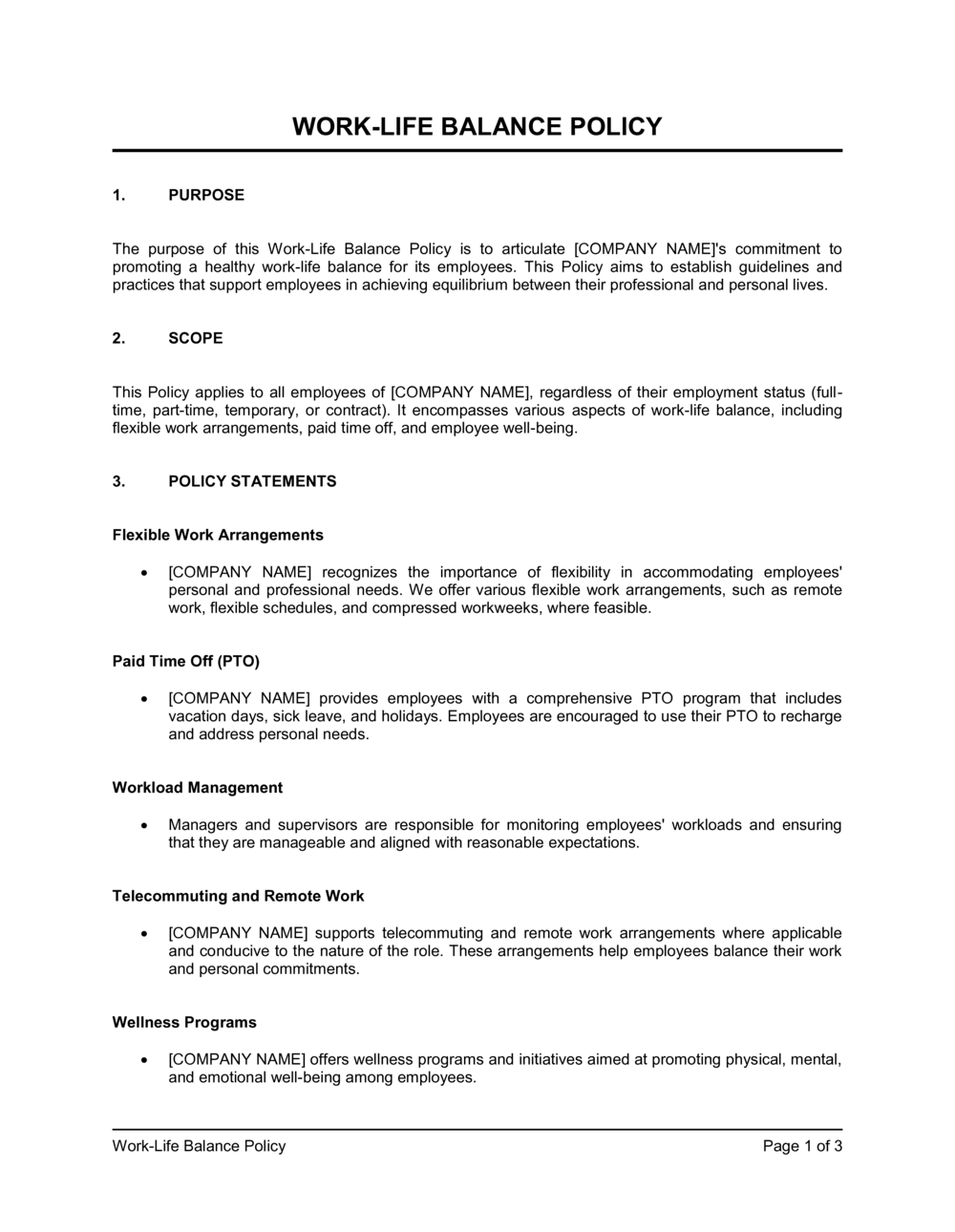
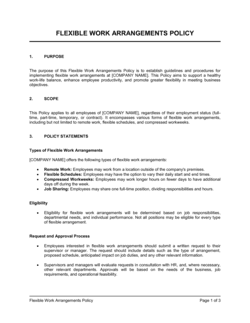
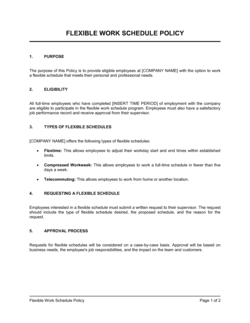
A Work Life Balance Policy is a formal HR document that defines an organization's commitments and guidelines for helping employees manage their professional responsibilities alongside personal wellbeing. This free Word download gives you a ready-to-edit policy covering flexible scheduling, remote work eligibility, PTO usage, after-hours communication expectations, and manager accountability β€” export as PDF and distribute to your team in minutes.
When you need it
Use it when onboarding new employees, updating your employee handbook, responding to retention concerns, or formalizing informal flexibility arrangements that have grown inconsistently across departments.
What's inside
Policy purpose and scope, flexible and remote work guidelines, paid time off expectations, boundaries around after-hours communication, mental health and wellness support, manager responsibilities, and a review and compliance schedule.

What is a Work Life Balance Policy?

A Work Life Balance Policy is a formal HR document that establishes an organization's commitments and guidelines for supporting employees in managing professional demands alongside personal wellbeing. It defines the practical rules governing flexible scheduling, remote work eligibility, paid time off usage, after-hours communication expectations, and access to mental health resources β€” turning what are often informal or manager-dependent arrangements into a consistent, organization-wide standard. Unlike a general employee handbook, a standalone work life balance policy is designed to be distributed prominently and referenced regularly, signaling that leadership treats wellbeing as an operational priority rather than a background benefit.

Why You Need This Document

Without a written work life balance policy, flexibility arrangements develop unevenly across your organization: some managers approve remote Fridays freely while others deny identical requests, PTO accrues into large unused balances that create both burnout and accounting liabilities, and employees who receive late-night messages from their manager cannot practically ignore them regardless of what your culture documentation says. The absence of a policy does not mean the absence of norms β€” it means those norms are set by whoever has the most authority in each reporting line, with no accountability mechanism. A documented policy gives HR a standard to enforce, gives managers a consistent framework to apply, and gives employees a clear picture of what they are entitled to ask for. It also positions your organization to comply with right-to-disconnect legislation that is active or emerging in Ontario, France, Ireland, and several other jurisdictions without requiring a reactive scramble when regulators inquire.

Which variant fits your situation?

If your situation is…Use this template
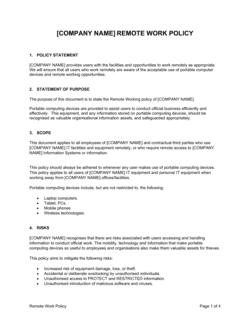
Employees working fully remotely across multiple time zonesRemote Work Policy
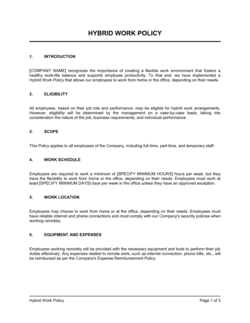
Formalizing a hybrid in-office and remote scheduleHybrid Work Policy
Establishing flexible start and end times within core hoursFlexible Working Hours Policy
Setting standards for paid time off accrual and usagePaid Time Off Policy
Addressing employee mental health support and EAP accessEmployee Wellness Policy
Covering parental leave and family care arrangementsParental Leave Policy
Documenting overtime and after-hours work compensationOvertime Policy

Common mistakes to avoid

❌ Publishing the policy without manager training

Why it matters: Employees read the policy and then watch their manager ignore it. Inconsistency between the written standard and daily behavior destroys credibility and accelerates disengagement.

Fix: Before publishing, run a one-hour briefing with all people managers covering expectations, the request-approval process, and consequences for non-compliance.

❌ Setting core hours that span the full workday

Why it matters: Core hours of 8 a.m. to 5 p.m. eliminate every flexibility benefit described in the policy, signaling that the document is performative rather than substantive.

Fix: Limit core hours to a four- to five-hour window and clearly state that employees may schedule the remaining hours around their personal needs.

❌ Omitting a minimum PTO usage expectation

Why it matters: Without a minimum, employees accumulate large unused balances, increasing the organization's accrued-liability risk and producing the burnout the policy is meant to prevent.

Fix: Add a minimum annual usage requirement of at least 10 days and a carryover cap, and require managers to actively schedule coverage so team members can take leave.

❌ No after-hours enforcement mechanism for managers

Why it matters: Employees who receive late-night messages from their manager cannot practically ignore them, regardless of what the policy says β€” the power imbalance defeats the standard.

Fix: Include an explicit clause holding managers accountable for after-hours communication habits and reference the disciplinary policy that applies if the standard is repeatedly violated.

❌ Failing to update the policy after organizational changes

Why it matters: A policy referencing outdated tools, roles, or office locations erodes confidence in HR documentation across the board and can create compliance gaps.

Fix: Assign a named policy owner and calendar a mandatory annual review. Record the review date and version number in the document footer.

❌ Listing mental health resources without access details

Why it matters: An EAP referenced by name only β€” with no phone number, URL, or explanation of coverage β€” is effectively inaccessible to an employee in distress.

Fix: Include the full contact details, the number of covered sessions, the languages supported, and confirmation that the service is confidential within the mental health section itself.

The 9 key sections, explained

Purpose and scope

Flexible working arrangements

Remote and hybrid work guidelines

Working hours and core hours

Paid time off and vacation expectations

After-hours communication standards

Mental health and wellness support

Manager responsibilities

Policy review and compliance

How to fill it out

  1. 1

    Define scope and eligible employee groups

    Enter your company name, locations covered, and which employee classifications β€” full-time, part-time, contract β€” are included. Be explicit about any roles or departments excluded and why.

    πŸ’‘ If contractors are excluded, note it and consider a separate contractor engagement policy so the gap does not create confusion.

  2. 2

    Select and document flexibility options

    Choose which arrangements your business can support β€” flexible hours, compressed weeks, remote, hybrid β€” and document the eligibility criteria for each. Tie eligibility to role characteristics, not to seniority or personal relationships.

    πŸ’‘ Limit flexibility options to those you can operationally deliver. Listing options you cannot consistently approve erodes trust faster than not offering them.

  3. 3

    Set core hours proportionate to your collaboration needs

    Define a core-hours window of no more than four to five hours that covers your team's essential overlap. Enter the time zone reference for remote or distributed teams.

    πŸ’‘ For teams spanning more than three time zones, consider a rolling two-hour window rather than a fixed block.

  4. 4

    Fill in PTO accrual rates and minimum usage expectations

    Enter the accrual rate, the minimum annual usage, carryover cap, and the tool or process employees use to request leave. Confirm the figures match your payroll system before publishing.

    πŸ’‘ Add a sentence encouraging managers to actively plan team coverage so employees do not feel guilty requesting PTO during busy periods.

  5. 5

    Write the after-hours communication standard

    State your cutoff time for expected responses, describe the on-call exception process if applicable, and name the manager-accountability obligation explicitly.

    πŸ’‘ Reference your messaging platform by name (e.g., Slack, Teams) so the standard is concrete and employees know exactly which channels it applies to.

  6. 6

    Add EAP and mental health resource details

    Enter the EAP provider name, contact number or URL, the number of covered sessions, and any mental health day allowance. Confirm the details are current with your benefits provider before inserting them.

    πŸ’‘ Include the EAP contact in at least two places in the policy β€” in the mental health section and in a summary box at the end β€” so it is easy to find in a moment of need.

  7. 7

    Assign named owners for manager responsibilities and review

    Replace all [TITLE] and [CONTACT] placeholders with specific role names or email addresses. Enter the annual review month and the policy version date.

    πŸ’‘ Version the document with a date in the footer (e.g., 'Version 1.0 β€” May 2026') so employees and managers always know whether they are reading the current policy.

  8. 8

    Distribute and confirm acknowledgment

    Share the final policy via your HRIS or intranet, request a written or digital acknowledgment from all employees, and store signed confirmations in each employee's personnel file.

    πŸ’‘ Pair distribution with a brief 15-minute team meeting β€” live explanation reduces the number of questions you receive afterward and signals that leadership takes the policy seriously.

Frequently asked questions

What is a work life balance policy?

A work life balance policy is a formal HR document that defines an organization's commitments to helping employees manage their work responsibilities alongside personal wellbeing. It typically covers flexible scheduling, remote work eligibility, PTO usage expectations, after-hours communication standards, and mental health support. Unlike informal arrangements, a written policy creates consistent, enforceable standards that apply equally across teams and managers.

Why do companies need a work life balance policy?

Without a written policy, flexibility arrangements develop inconsistently β€” one manager approves remote Fridays while another does not, and employees make decisions based on rumor rather than clear rules. A formal policy reduces manager-by-manager inconsistency, limits claims of favoritism, and gives HR a documented standard to enforce. Research consistently links perceived work-life balance to lower voluntary turnover, reduced absenteeism, and higher engagement scores.

What should a work life balance policy include?

At minimum: a scope statement identifying which employees it covers, flexible work options and the request process, core hours, PTO accrual and minimum usage expectations, after-hours communication standards, mental health resources with contact details, manager accountability obligations, and a review schedule with a named policy owner. Policies that omit manager accountability are consistently ineffective regardless of how well the other sections are written.

Is a work life balance policy legally required?

No jurisdiction universally mandates a standalone work life balance policy by that name. However, several jurisdictions have enacted right-to-disconnect legislation β€” including Ontario, Canada, and France β€” that requires employers to publish a written policy on after-hours communication. The broader policy supports compliance with those requirements and with general duty-of-care obligations under occupational health and safety law in many countries.

How is a work life balance policy different from a flexible work policy?

A flexible work policy focuses specifically on scheduling arrangements β€” flexible hours, compressed weeks, remote eligibility β€” and the approval process for requesting them. A work life balance policy is broader: it includes flexible work as one component but also addresses PTO, mental health, after-hours communication, and manager responsibilities. If your organization only needs to govern scheduling flexibility, a standalone flexible work policy is sufficient; if you want to address the full range of wellbeing expectations, use the broader policy.

How do you enforce a work life balance policy?

Enforcement requires three things: manager training before the policy launches, a named HR contact employees can approach without fear of retaliation, and a link to the disciplinary policy for repeated violations. The most common enforcement failure is treating manager non-compliance β€” late-night messages, discouraging PTO β€” as a culture issue rather than a policy issue. Documenting it as a policy breach with defined consequences is the only reliable correction mechanism.

How often should a work life balance policy be reviewed?

An annual review is standard. Trigger an unscheduled review if the company changes its remote or hybrid model significantly, if engagement survey data shows a sustained decline in wellbeing scores, or if jurisdiction-specific right-to-disconnect or mental health legislation changes in a location where the company operates. Each reviewed version should carry a new date in the document footer and be redistributed with an acknowledgment requirement.

Should managers be covered by the same policy as employees?

Yes β€” and the policy should say so explicitly. Managers who are visibly excluded from the policy's obligations send a signal that the rules apply downward only, which destroys credibility. The manager responsibilities section should hold people managers to a higher standard on modeling behavior, not exempt them from the baseline obligations that apply to all staff.

Can a small business use a work life balance policy template?

A template is particularly well-suited to small businesses, which typically lack a dedicated HR team to draft policy from scratch. The main adjustment for small businesses is scope: remove sections that reference approval chains or tools you do not use, and simplify the request process so it reflects how decisions are actually made. A two-page policy that is actively followed is more effective than a ten-page document that employees never consult.

How this compares to alternatives

vs Remote Work Policy

A remote work policy governs specifically where employees work β€” eligibility for remote arrangements, equipment standards, and home-office security requirements. A work life balance policy is broader, treating remote work as one component alongside PTO, after-hours communication, and mental health. Use the remote work policy when you only need to govern location flexibility; use the work life balance policy when you want a single document covering the full wellbeing framework.

vs Employee Handbook

An employee handbook is a comprehensive reference document covering all HR policies β€” onboarding, conduct, compensation, leave, and more. A work life balance policy is a single focused document suitable for standalone distribution, intranet publishing, or inclusion as a chapter within the handbook. Most organizations embed the work life balance policy into the handbook while also distributing it separately for high visibility.

vs Flexible Working Hours Policy

A flexible working hours policy addresses scheduling arrangements only β€” when employees can start and finish, how core hours are structured, and how to request a schedule change. A work life balance policy adds PTO expectations, after-hours communication standards, mental health resources, and manager accountability to that foundation. Use the narrower document if scheduling is the only gap; use the broader policy if you want to address the full range of work-life expectations.

vs Employee Wellness Policy

An employee wellness policy focuses on physical and mental health programs β€” EAP access, gym benefits, health screenings, and mental health days. A work life balance policy incorporates wellness resources as one section but primarily governs scheduling, availability, and workload expectations. Organizations with mature wellness programs often maintain both: the work life balance policy sets behavioral standards, and the wellness policy details available support resources.

Industry-specific considerations

Technology / SaaS

Async-first communication standards, engineering on-call carve-outs, and explicit no-meeting blocks protect deep work time for distributed engineering teams.

Professional Services

Client-facing roles require a clear distinction between billable availability and internal core hours, with PTO minimums enforced despite seasonal workload peaks.

Healthcare

Shift-based scheduling requires flexibility provisions tailored to clinical and non-clinical staff separately, with EAP prominence given documented burnout rates in the sector.

Retail / Hospitality

Variable and weekend schedules make standard core hours impractical; policies should address advance schedule notice periods and swap procedures as the primary flexibility mechanism.

Template vs pro β€” what fits your needs?

PathBest forCostTime
Use the templateSmall to mid-size businesses formalizing informal flexibility practices without a dedicated HR functionFree1–2 hours to customize and distribute
Template + professional reviewCompanies operating in jurisdictions with right-to-disconnect legislation, or organizations with union agreements that intersect with working-hours standards$200–$600 for an HR consultant or employment lawyer review3–5 business days
Custom draftedLarge enterprises with multiple locations, regulated industries, or complex multi-jurisdiction employment across regions with differing statutory obligations$1,000–$3,000+ for a full HR policy audit and custom drafting2–4 weeks

Glossary

Flexible Working Arrangement
A formal or informal agreement allowing an employee to vary their start time, end time, total hours, or work location relative to standard business hours.
Core Hours
The fixed window β€” typically 10 a.m. to 3 p.m. β€” during which all employees are expected to be available, regardless of their flexible schedule choice.
Async Communication
Collaboration that does not require immediate response, such as email or recorded video, enabling team members in different time zones or schedules to work without constant overlap.
Right to Disconnect
An employee's recognized ability to refrain from responding to work communications outside contracted hours without negative consequence β€” codified in law in several jurisdictions.
Employee Assistance Program (EAP)
A confidential employer-provided service offering counseling, mental health support, and financial or legal referrals to employees at no direct cost.
Compressed Workweek
A schedule in which an employee works their full weekly hours across fewer days β€” typically four 10-hour days instead of five 8-hour days.
PTO (Paid Time Off)
A combined bank of paid leave days covering vacation, personal days, and sometimes sick leave, which employees accrue and use at their discretion.
Manager Accountability
The explicit expectation that people managers model and enforce the policy's standards β€” including not sending after-hours messages and not discouraging PTO use.
Reasonable Adjustment
A modification to work schedule, location, or responsibilities made to accommodate an employee's health, disability, or caregiving needs.
Policy Scope
The defined boundaries of who the policy applies to β€” full-time, part-time, contract, or all workers β€” and which locations or business units it covers.

Part of your Business Operating System

This document is one of 3,000+ business & legal templates included in Business in a Box.

  • Fill-in-the-blanks β€” ready in minutes
  • 100% customizable Word document
  • Compatible with all office suites
  • Export to PDF and share electronically

Create your document in 3 simple steps.

From template to signed document β€” all inside one Business Operating System.
1
Download or open template

Access over 3,000+ business and legal templates for any business task, project or initiative.

2
Edit and fill in the blanks with AI

Customize your ready-made business document template and save it in the cloud.

3
Save, Share, Send, Sign

Share your files and folders with your team. Create a space of seamless collaboration.

Save time, save money, and create top-quality documents.

β˜…β˜…β˜…β˜…β˜…

"Fantastic value! I'm not sure how I'd do without it. It's worth its weight in gold and paid back for itself many times."

Managing Director Β· Mall Farm
Robert Whalley
Managing Director, Mall Farm Proprietary Limited
β˜…β˜…β˜…β˜…β˜…

"I have been using Business in a Box for years. It has been the most useful source of templates I have encountered. I recommend it to anyone."

Business Owner Β· 4+ years
Dr Michael John Freestone
Business Owner
β˜…β˜…β˜…β˜…β˜…

"It has been a life saver so many times I have lost count. Business in a Box has saved me so much time and as you know, time is money."

Owner Β· Upstate Web
David G. Moore Jr.
Owner, Upstate Web

Run your business with a system β€” not scattered tools

Stop downloading documents. Start operating with clarity. Business in a Box gives you the Business Operating System used by over 250,000 companies worldwide to structure, run, and grow their business.

Free Forever PlanΒ Β·Β No credit card required