Parental Leave Policy Template

Free Word download β€’ Edit online β€’ Save & share with Drive β€’ Export to PDF

3 pagesβ€’20–25 min to fillβ€’Difficulty: Standard
Learn more ↓
FreeParental Leave Policy Template

At a glance

What it is
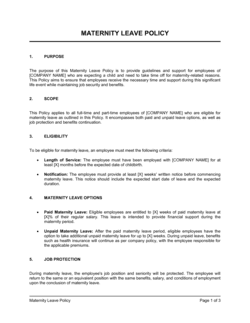
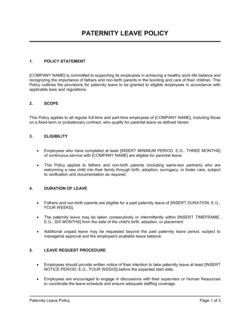
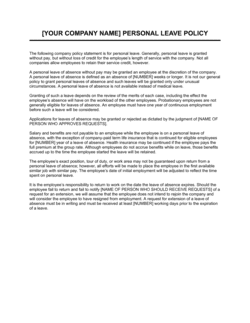
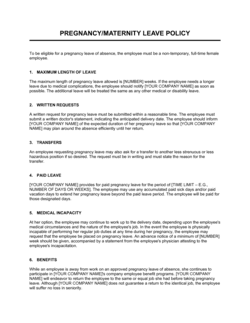
A Parental Leave Policy is a written workplace policy that defines the leave entitlements available to employees welcoming a new child β€” by birth, adoption, or foster placement. This free Word download gives you a structured, editable template covering eligibility, leave duration, pay continuation, benefit continuation, and return-to-work procedures that you can adapt to your organization's size and jurisdiction and export as PDF for distribution to employees.
When you need it
Use it when onboarding your first employees, when an employee notifies you of an upcoming birth or adoption, when your headcount crosses a threshold that triggers statutory leave obligations, or when you are reviewing your benefits package to remain competitive in hiring.
What's inside
Eligibility criteria and qualifying events, leave duration and pay continuation schedules, benefit continuation during leave, notification and documentation requirements, job protection and return-to-work procedures, and coordination with statutory leave programs such as FMLA, state paid leave, and provincial plans.

What is a Parental Leave Policy?

A Parental Leave Policy is a written workplace document that defines the leave entitlements available to employees who welcome a new child through birth, adoption, or foster placement. It specifies which employees qualify, how long they can be away, what portion of their salary continues during the absence, how group benefits are maintained, and what procedures govern the notification and return-to-work process. Beyond setting individual entitlements, the policy explains how employer-provided leave interacts with statutory programs β€” such as the federal FMLA, state paid family leave programs, or short-term disability β€” so employees and managers understand the total leave picture without needing to piece it together from multiple sources.

Why You Need This Document

Without a written parental leave policy, every leave request becomes a negotiation β€” and inconsistent outcomes create discrimination exposure, damage trust, and generate resentment among employees who compare what they received to what a colleague was offered. The absence of a documented policy also means managers make decisions without guardrails, often granting extensions or pay arrangements informally that set binding precedent for future requests. From a compliance standpoint, employers in states with paid family leave programs face penalties for failing to coordinate benefits correctly, and a policy that does not address statutory interaction leaves both the employer and employee confused about who pays what. This template gives you a clear, editable structure to document your commitment, set consistent expectations across your workforce, and protect the company from the legal and operational costs of ad-hoc leave management.

Which variant fits your situation?

If your situation is…Use this template
Offering paid leave fully funded by the employerPaid Parental Leave Policy
Coordinating leave with FMLA and state paid leave programsFMLA-Integrated Parental Leave Policy
Setting a separate policy for primary versus secondary caregiversPrimary and Secondary Caregiver Leave Policy
Covering adoption or foster placement specificallyAdoption and Foster Care Leave Policy
Documenting a phased or flexible return-to-work arrangementReturn-to-Work Plan
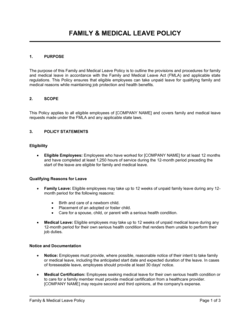
Creating a broad family leave policy that includes parental, bereavement, and caregiving leaveFamily and Medical Leave Policy
Documenting all employee leave entitlements in a single reference documentEmployee Leave of Absence Policy

Common mistakes to avoid

❌ Running employer leave and statutory leave additively

Why it matters: An employee in California could stack 12 weeks of FMLA plus 12 weeks of company leave, resulting in 24 weeks of absence. This is rarely the intent and can be operationally destabilizing.

Fix: Include an explicit concurrency clause stating that employer leave runs at the same time as any applicable statutory leave, so the total absence equals the longer of the two entitlements.

❌ Offering unequal leave by family formation type

Why it matters: Policies that give more leave for childbirth than for adoption or foster placement expose the employer to discrimination claims and signal that some families are less valued.

Fix: State explicitly that the same leave entitlement applies to birth, adoption, and foster placement events, and review the policy with an HR advisor before publishing.

❌ No premium-recovery clause for employees who do not return

Why it matters: Without this clause, you cannot recoup health insurance premiums paid during leave if the employee resigns immediately after returning, even though FMLA regulations permit recovery.

Fix: Add a clause allowing the company to recover employer-paid health premiums if the employee fails to return for at least 30 days after leave, except where prohibited by applicable law.

❌ Case-by-case leave extension approvals with no documented process

Why it matters: Ad-hoc extensions granted informally create inconsistency β€” the next employee who requests an extension and is denied will compare their situation to a colleague who was approved.

Fix: Define a written extension request process with a decision timeline, approval authority, and the factors that will be considered, and apply it consistently.

The 10 key sections, explained

Purpose and scope

Eligibility requirements

Leave duration and caregiver designation

Pay continuation schedule

Benefit continuation

Notification and documentation requirements

Interaction with statutory leave programs

Job protection and return-to-work procedures

Leave extensions and additional time off

Policy administration and amendments

How to fill it out

  1. 1

    Insert your company name and HR contact details

    Replace all [COMPANY NAME] and [HR CONTACT] placeholders throughout the document with the correct legal entity name and the name, email, and phone number of your HR point of contact.

    πŸ’‘ Use a shared HR inbox rather than an individual's email address so leave requests are received even when one person is out of office.

  2. 2

    Set eligibility thresholds

    Enter the minimum service length required before an employee qualifies for employer-provided leave. Check the statutory minimum in every jurisdiction where you have employees before setting this number.

    πŸ’‘ If your threshold is 6 months but FMLA applies at 12 months of service, employees between 6 and 12 months get your policy but not FMLA β€” flag this clearly in the interaction section.

  3. 3

    Define leave duration for each caregiver type

    Enter the number of weeks for primary and secondary caregivers. Decide whether to equalize entitlements or differentiate, and confirm the same duration applies to birth, adoption, and foster events.

    πŸ’‘ Equalizing primary and secondary caregiver leave (e.g., 12 weeks for both) eliminates the most common discrimination complaint and signals an inclusive culture to candidates.

  4. 4

    Complete the pay continuation schedule

    Specify what percentage of base salary is paid, for how many weeks, and how it coordinates with state disability or paid family leave benefits. Decide whether you will top up to 100% or offset employer pay dollar for dollar.

    πŸ’‘ Model the annualized cost before finalizing the pay rate β€” 12 weeks at 100% pay for a $90,000 employee costs approximately $20,800 in payroll plus benefits.

  5. 5

    Confirm benefit continuation terms

    State which benefits continue during leave, who pays premiums, and whether you will exercise premium recovery rights if an employee does not return.

    πŸ’‘ Check your group health plan documents before finalizing β€” some plans have their own continuation rules that supersede employer policy language.

  6. 6

    Set notification and documentation requirements

    Enter the required advance-notice period and the list of acceptable supporting documents. Include a carve-out for unforeseeable events like premature birth.

    πŸ’‘ 30 days' notice for foreseeable events is the FMLA standard β€” aligning your policy to this threshold avoids confusion for employees and managers.

  7. 7

    Review the statutory leave interaction section

    Confirm whether your policy runs concurrently with FMLA and state leave, and specify the combined maximum leave duration. Update this section if you operate in states with their own paid family leave laws (CA, NY, WA, NJ, CO, CT, MA, OR, RI).

    πŸ’‘ List each state where you have employees and the applicable statutory leave program in a footnote or appendix so managers can reference the right rules quickly.

  8. 8

    Distribute and acknowledge

    Add the finalized policy to your employee handbook, share it with all current employees, and collect signed acknowledgments. Store acknowledgments in each employee's personnel file.

    πŸ’‘ Send a one-page plain-language summary alongside the full policy β€” employees in the middle of a pregnancy announcement are not reading a 10-page document for the first time.

Frequently asked questions

What is a parental leave policy?

A parental leave policy is a written document that defines the leave entitlements available to employees who welcome a new child β€” by birth, adoption, or foster placement. It specifies who is eligible, how long they can take off, whether leave is paid, how benefits continue during the absence, and how the return to work is managed. It also explains how the employer's policy interacts with statutory programs like FMLA and state paid family leave.

Is a parental leave policy required by law?

The US has no federal law requiring paid parental leave. However, employers with 50 or more employees must provide 12 weeks of unpaid, job-protected leave under FMLA for qualifying birth and adoption events. Several states β€” including California, New York, Washington, and New Jersey β€” have their own paid family leave programs that apply to smaller employers. Even where not legally required, a written policy is strongly recommended to ensure consistent, defensible treatment of all employees.

How long should parental leave be?

There is no universal standard, but the most common employer-funded primary caregiver leave in the US ranges from 8 to 16 weeks. Secondary caregiver leave typically ranges from 2 to 4 weeks. Tech and professional-services companies offering competitive benefits packages increasingly offer 16–20 weeks for primary caregivers. The minimum floor in most US states is the FMLA entitlement of 12 weeks unpaid.

Should parental leave be paid or unpaid?

FMLA leave is unpaid at the federal level, but many state programs provide partial pay replacement (typically 60–90% of wages, up to a weekly cap). Employers who want to remain competitive typically top up state benefits to 100% of base salary for some or all of the leave period. A written policy should specify the employer's pay commitment and explain how it interacts with any state benefit payments the employee may receive simultaneously.

What is the difference between maternity leave and parental leave?

Maternity leave historically referred to leave taken by a birth mother around childbirth, often including a short-term disability period for physical recovery. Parental leave is a broader term covering any employee welcoming a new child β€” by birth, adoption, or foster placement β€” regardless of gender or family structure. Most modern policies use the term parental leave to reflect this inclusivity and avoid potential discrimination issues.

Can an employer require an employee to use PTO during parental leave?

Yes, in most US jurisdictions an employer can require employees to use accrued PTO concurrently with FMLA leave. This does not extend the total leave period but replaces unpaid leave with paid time using the employee's PTO balance. The policy should state clearly whether PTO substitution is required, optional, or prohibited during the leave period.

What happens to health insurance during parental leave?

During FMLA leave, employers must maintain group health coverage on the same terms as if the employee had continued working. Employers can require the employee to continue paying their share of premiums. If the employee does not return after leave, the employer may recover the employer-paid portion of premiums paid during the leave period in most circumstances. Your policy should address all three scenarios explicitly.

How far in advance should an employee notify the employer?

For foreseeable events like a planned birth or adoption, FMLA requires 30 days' advance notice where practicable. For unforeseeable events, notice must be given as soon as possible. Your policy should mirror this standard and include a carve-out for premature births or emergency placements so employees are not penalized for circumstances outside their control.

Do small businesses need a parental leave policy?

Businesses with fewer than 50 employees are generally exempt from FMLA but may still be subject to state leave laws depending on their location and headcount. Regardless of legal obligation, a written parental leave policy protects small employers from inconsistency claims, helps attract and retain employees, and sets clear expectations for both sides when a qualifying event occurs. A single undocumented decision made for one employee creates informal precedent for every future request.

How this compares to alternatives

vs Employee Handbook

An employee handbook is a comprehensive reference document covering all workplace policies β€” conduct, benefits, leave, performance, and more. A parental leave policy is a standalone document focusing on a single leave entitlement in full detail. Standalone policies are easier to update when leave laws change without requiring a full handbook revision, and they can be distributed selectively to employees with an immediate need.

vs Leave of Absence Policy

A leave of absence policy covers all types of extended leave β€” medical, personal, military, bereavement, and parental. A parental leave policy is a dedicated document that goes deeper on the specific rules, pay schedules, and return-to-work procedures for new-parent employees. Organizations with active hiring often benefit from a standalone parental leave policy they can share with candidates as a benefits document.

vs FMLA Policy

An FMLA policy documents compliance with the federal Family and Medical Leave Act, covering all qualifying reasons for leave β€” not just parental leave. It is a compliance document; a parental leave policy is a benefits document. Employers subject to FMLA need both: the FMLA policy to satisfy federal notice requirements and the parental leave policy to document any employer-provided enhancements beyond the statutory minimum.

vs Return-to-Work Plan

A return-to-work plan is an individualized document created for a specific employee mapping their phased schedule back to full-time hours. A parental leave policy establishes the organizational rules and entitlements that govern all employees. The policy creates the framework; the return-to-work plan is the execution document for a single case.

Industry-specific considerations

Technology / SaaS

Competitive paid leave of 16–20 weeks is now a baseline expectation in tech hiring markets; policies often include equity vesting pause provisions during extended leave.

Professional Services

Client coverage and project handoff procedures must be embedded in or referenced by the policy to manage account continuity during the absence of billable staff.

Healthcare

Shift-based staffing means coverage planning must be initiated earlier; policies typically require earlier notification windows and detailed handoff protocols for credentialed roles.

Retail / Hospitality

High turnover and hourly workforces mean eligibility thresholds and part-time inclusion rules are especially critical; state paid leave programs often apply even to smaller retail employers.

Template vs pro β€” what fits your needs?

PathBest forCostTime
Use the templateSmall and mid-sized businesses creating or updating a parental leave policy for a domestic workforceFree1–2 hours
Template + professional reviewEmployers with staff in multiple states with differing paid family leave laws, or companies offering above-market paid leave benefits$200–$600 for an HR advisor or employment attorney review3–5 business days
Custom draftedEnterprise employers with operations in multiple countries, heavily unionized workforces, or organizations undergoing a benefits overhaul$1,000–$4,000+2–4 weeks

Glossary

FMLA
The US Family and Medical Leave Act, which entitles eligible employees at covered employers to 12 weeks of unpaid, job-protected leave per year for qualifying family and medical reasons.
Primary caregiver
The employee who will be the principal day-to-day caregiver for a new child, typically entitled to the longer leave duration under policies that differentiate by caregiver role.
Secondary caregiver
An employee who shares caregiving responsibilities but is not the primary caregiver; typically offered a shorter leave period β€” often 2–4 weeks β€” under differentiated policies.
Job protection
A guarantee that the employee's same or equivalent position will be available upon return from leave, as required by most statutory leave programs.
Benefit continuation
The employer's commitment to maintain health insurance and other benefits during leave, with premiums continuing on the same employee/employer cost-sharing basis.
Qualifying event
A birth, adoption, or foster placement that triggers an employee's eligibility to take parental leave under the policy.
Pay continuation
Employer-funded full or partial salary payments made during leave, distinct from statutory benefit payments from a government or insurance program.
Leave stacking
The practice of combining parental leave with other leave types β€” such as FMLA, short-term disability, or PTO β€” to extend the total leave period.
Concurrent leave
Running employer-provided parental leave and statutory leave (FMLA or state leave) at the same time so total time away from work equals the longer of the two entitlements.
Phased return
A scheduled, gradual ramp-up to full-time hours after parental leave β€” for example, working three days per week for the first month back.

Part of your Business Operating System

This document is one of 3,000+ business & legal templates included in Business in a Box.

  • Fill-in-the-blanks β€” ready in minutes
  • 100% customizable Word document
  • Compatible with all office suites
  • Export to PDF and share electronically

Create your document in 3 simple steps.

From template to signed document β€” all inside one Business Operating System.
1
Download or open template

Access over 3,000+ business and legal templates for any business task, project or initiative.

2
Edit and fill in the blanks with AI

Customize your ready-made business document template and save it in the cloud.

3
Save, Share, Send, Sign

Share your files and folders with your team. Create a space of seamless collaboration.

Save time, save money, and create top-quality documents.

β˜…β˜…β˜…β˜…β˜…

"Fantastic value! I'm not sure how I'd do without it. It's worth its weight in gold and paid back for itself many times."

Managing Director Β· Mall Farm
Robert Whalley
Managing Director, Mall Farm Proprietary Limited
β˜…β˜…β˜…β˜…β˜…

"I have been using Business in a Box for years. It has been the most useful source of templates I have encountered. I recommend it to anyone."

Business Owner Β· 4+ years
Dr Michael John Freestone
Business Owner
β˜…β˜…β˜…β˜…β˜…

"It has been a life saver so many times I have lost count. Business in a Box has saved me so much time and as you know, time is money."

Owner Β· Upstate Web
David G. Moore Jr.
Owner, Upstate Web

Run your business with a system β€” not scattered tools

Stop downloading documents. Start operating with clarity. Business in a Box gives you the Business Operating System used by over 250,000 companies worldwide to structure, run, and grow their business.

Free Forever PlanΒ Β·Β No credit card required