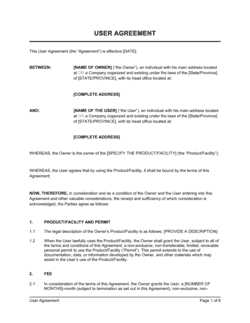
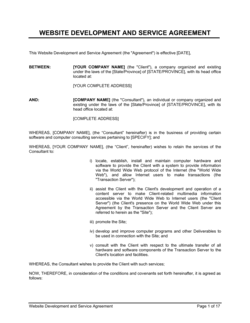
User Agreement for Web Hosting Services Template

Free Word download β€’ Edit online β€’ Save & share with Drive β€’ Export to PDF

4 pagesβ€’25–35 min to fillβ€’Difficulty: Complexβ€’Signature requiredβ€’Legal review recommended
Learn more ↓
FreeUser Agreement for Web Hosting Services Template

At a glance

What it is
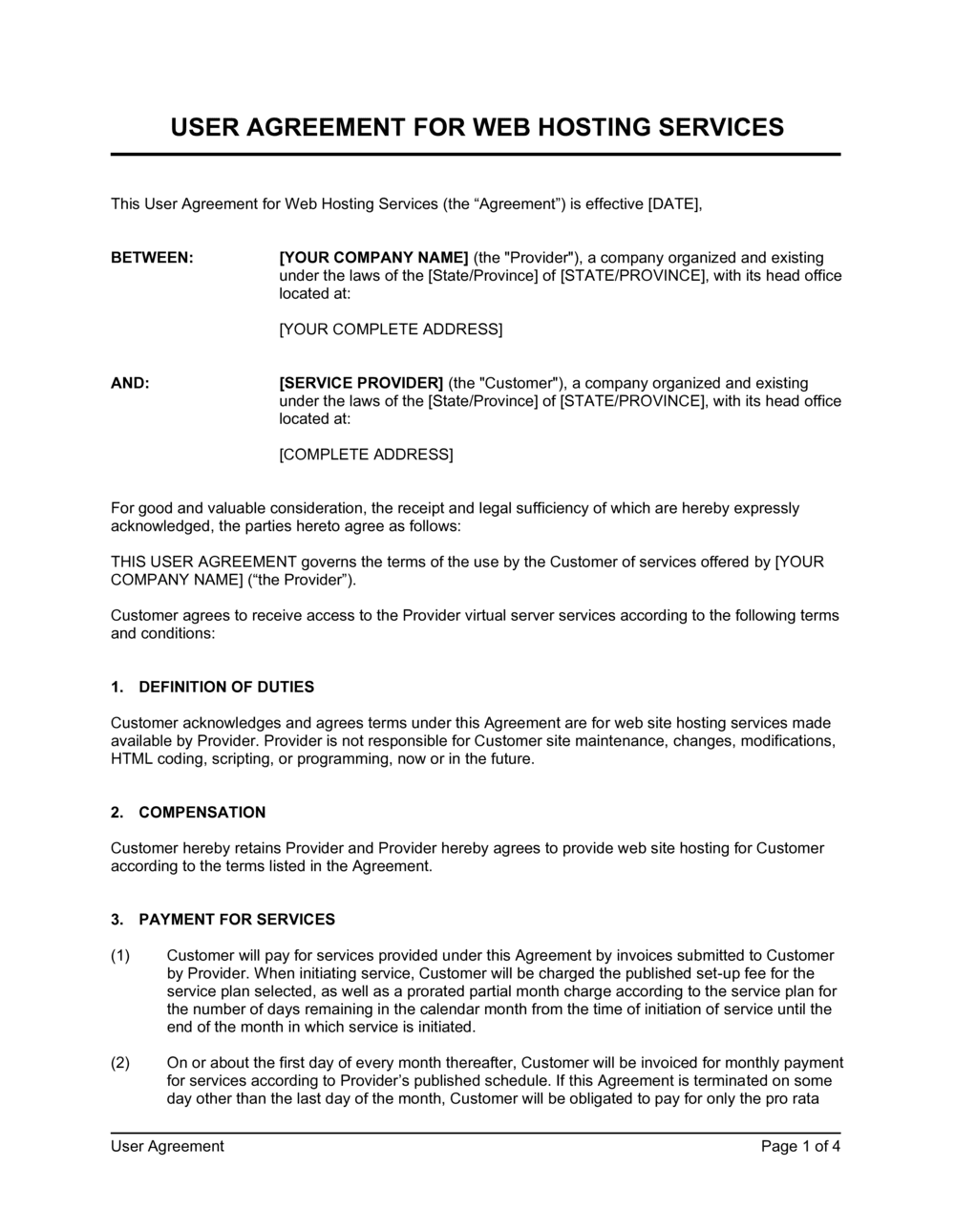
A User Agreement for Web Hosting Services is a legally binding contract between a hosting provider and a customer that governs how the hosting service is delivered, used, and terminated. This free Word download covers service scope, uptime commitments, payment terms, acceptable use, data handling, liability limits, and dispute resolution in a single document you can edit online and export as PDF.
When you need it
Use it when launching or formalizing a web hosting business, onboarding new hosting customers, or replacing informal service arrangements that lack enforceable terms around uptime, data, and payment obligations.
What's inside
Service description and scope, SLA and uptime guarantees, payment and renewal terms, acceptable use policy, data ownership and privacy obligations, limitation of liability, indemnification, termination conditions, and governing law.

What is a User Agreement for Web Hosting Services?

A User Agreement for Web Hosting Services is a legally binding contract between a hosting provider and a customer that defines the terms under which hosting infrastructure is delivered, used, and terminated. It establishes the provider's service obligations β€” including uptime commitments, backup policies, and data handling β€” and the customer's responsibilities around acceptable use, payment, and content compliance. Unlike a generic website terms of service, a hosting agreement addresses the technical and commercial specifics of an infrastructure relationship: bandwidth limits, SLA remedies, data ownership, and the liability boundaries that protect both parties when something goes wrong. This free Word download gives providers a structured, enforceable starting point they can edit online and export as PDF before onboarding their first customer.

Why You Need This Document

Operating a hosting business without a written user agreement exposes the provider to claims that are disproportionate to the revenue at stake. A four-hour outage affecting an e-commerce merchant can generate a lost-revenue claim worth many times the monthly hosting fee β€” and without a liability cap, there is no contractual ceiling on that exposure. Without an acceptable use policy, suspending a customer for hosting malware or sending spam becomes a breach-of-contract dispute rather than a straightforward enforcement action. Without defined data-retrieval terms, terminated customers can allege unlawful destruction of their property or assert data subject rights under GDPR to compel the provider to retain data indefinitely. This template closes all four gaps before they become litigation. It also satisfies the practical threshold requirements most payment processors and data center partners impose β€” a signed customer agreement is typically a condition of obtaining merchant services or infrastructure access at commercial rates.

Which variant fits your situation?

If your situation is…Use this template
Providing shared hosting plans to individual or small-business customersUser Agreement for Web Hosting Services
Offering dedicated server or VPS hosting with custom SLAsManaged Hosting Services Agreement
Reselling third-party hosting capacity to end clientsWeb Hosting Reseller Agreement
Delivering ongoing IT infrastructure management beyond hostingManaged Services Agreement (IT)
Licensing a SaaS platform that includes hosted infrastructureSaaS Subscription Agreement
Governing cloud storage and backup services specificallyCloud Services Agreement
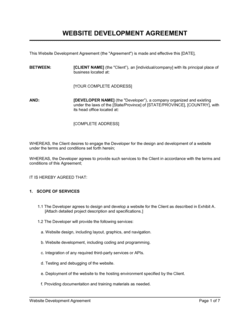
Engaging an external developer to build and host a web applicationWebsite Development Agreement

Common mistakes to avoid

❌ Promising 100% uptime in the SLA

Why it matters: No hosting infrastructure can achieve 100% uptime, and the promise creates strict liability for every minute of outage β€” including scheduled maintenance. A single multi-hour incident could expose the provider to claims far exceeding the customer's monthly fee.

Fix: Use a 99.9% uptime commitment with a defined measurement methodology, exclude scheduled maintenance windows, and cap service credits at a percentage of the monthly fee.

❌ Omitting data-retrieval terms on termination

Why it matters: Without a defined retrieval window, terminated customers can claim the provider unlawfully destroyed their property or used data access as leverage β€” a particularly serious exposure under GDPR and UK data protection law.

Fix: Specify a minimum 15-day post-termination window for data export and state clearly that data will be permanently deleted after that period.

❌ No limitation of liability clause

Why it matters: An outage affecting a customer's e-commerce store for 6 hours could generate a lost-revenue claim worth many multiples of the monthly hosting fee. Without a cap, the provider's exposure is theoretically unlimited.

Fix: Include a liability cap tied to fees paid in the prior 30 days and explicitly exclude consequential, indirect, and lost-profit damages.

❌ Vague or missing acceptable use policy

Why it matters: A generic prohibition on 'harmful content' gives the provider no clear enforcement mechanism and gives customers no notice of what will get their account suspended β€” leading to disputes over takedowns and refunds.

Fix: Include a specific enumerated list of prohibited activities and state that violations are grounds for immediate termination without refund.

❌ Ignoring GDPR data processing requirements for EU customers

Why it matters: Under GDPR Article 28, any hosting provider processing personal data on behalf of EU-based customers must have a signed Data Processing Agreement. Operating without one exposes both parties to regulatory fines of up to 4% of global annual turnover.

Fix: Attach a compliant DPA as a schedule to the hosting agreement and require it to be executed for any customer whose end users include EU residents.

❌ Auto-renewal terms buried in fine print without conspicuous disclosure

Why it matters: California, the UK, and EU member states have specific requirements for auto-renewal disclosures β€” and regulators in all three jurisdictions have taken enforcement action against hosting providers for non-compliant renewal practices.

Fix: Present the auto-renewal clause in a visually distinct format β€” bold text, a separate checkbox, or a highlighted box β€” and send a renewal reminder at least 30 days before the charge.

The 10 key clauses, explained

Parties and service description

In plain language: Identifies the hosting provider and the customer as legal entities and describes the specific hosting plan, features, and infrastructure being provided.

Sample language
This User Agreement is entered into between [PROVIDER LEGAL NAME], a [STATE/COUNTRY] [ENTITY TYPE] ('Provider'), and [CUSTOMER LEGAL NAME OR INDIVIDUAL NAME] ('Customer'). Provider agrees to supply the [PLAN NAME] web hosting services described in Schedule A, commencing [START DATE].

Common mistake: Using a brand or trade name instead of the registered legal entity name. If a dispute reaches court, the wrong entity name can invalidate the contract or create jurisdictional confusion.

Service level agreement and uptime commitment

In plain language: Commits the provider to a minimum uptime percentage, defines how downtime is measured and reported, and states the service credit formula when the commitment is not met.

Sample language
Provider guarantees [99.9]% monthly uptime, excluding scheduled maintenance windows. Downtime is measured from the time a verified support ticket is opened. If monthly uptime falls below [99.9]%, Customer is entitled to a service credit equal to [X]% of that month's hosting fee for each full hour below the threshold.

Common mistake: Promising 100% uptime. No infrastructure can guarantee this, and the promise creates unlimited liability for any outage regardless of cause. Use 99.9% and define scheduled maintenance as excluded.

Payment, billing cycle, and auto-renewal

In plain language: States the plan fee, billing frequency, accepted payment methods, late-payment consequences, and the auto-renewal terms including the cancellation notice window.

Sample language
Customer shall pay $[X] per [month/year] in advance. Invoices unpaid after [10] days accrue interest at [1.5]% per month. This Agreement automatically renews for successive [TERM] periods unless Customer provides written cancellation notice at least [30] days prior to renewal.

Common mistake: Omitting the cancellation notice window for auto-renewal. Several jurisdictions β€” including California and EU member states β€” require conspicuous pre-renewal notice and restrict automatic charges when that notice is absent.

Acceptable use policy

In plain language: Lists activities that are prohibited on the hosting platform and states that violation is grounds for immediate termination without refund.

Sample language
Customer shall not use the hosting services to: (a) distribute malware, ransomware, or phishing content; (b) send unsolicited bulk email (spam); (c) host content that infringes third-party intellectual property; (d) conduct distributed denial-of-service attacks; or (e) store or transmit content that is illegal under applicable law. Violation of this policy constitutes a material breach and grounds for immediate termination.

Common mistake: A vague AUP that says only 'illegal or harmful content is prohibited.' Without a specific list, enforcement is subjective and disputes over takedowns are harder to resolve.

Data ownership and backups

In plain language: Confirms that the customer owns all data and content stored on the hosting platform and states the provider's backup policy, frequency, and retention period β€” or expressly disclaim any backup obligation.

Sample language
All data, files, and content uploaded by Customer to the hosting environment remain the sole property of Customer. Provider performs automated backups [daily/weekly] with a [X]-day retention period. Customer is solely responsible for maintaining independent backups of mission-critical data. Provider's backups are provided as a courtesy and are not guaranteed.

Common mistake: Implying backups are the provider's responsibility without defining frequency and retention. Customers who lose data after an outage often sue based on an implied backup obligation. Explicit language β€” either committing to a schedule or disclaiming the obligation β€” eliminates the ambiguity.

Privacy and data processing

In plain language: Addresses how the provider handles personal data belonging to the customer and the customer's end users, including compliance with applicable privacy laws and the availability of a DPA on request.

Sample language
Provider processes Customer data solely to deliver the hosting services. Provider shall implement reasonable technical and organizational measures to protect personal data. To the extent Customer's data includes personal data of EU residents, Provider and Customer shall execute a Data Processing Agreement in the form attached as Schedule B.

Common mistake: Ignoring GDPR and other privacy obligations entirely. Hosting providers that process EU resident data without a DPA expose both themselves and their customers to regulatory fines under GDPR Article 28.

Limitation of liability and disclaimers

In plain language: Caps the provider's maximum financial exposure and disclaims implied warranties β€” limiting liability to fees paid in a recent period rather than consequential or indirect damages.

Sample language
Provider's total liability for any claim arising under this Agreement shall not exceed the fees paid by Customer in the [30] days preceding the claim. In no event shall Provider be liable for lost profits, lost data, or indirect, incidental, or consequential damages, even if advised of the possibility of such damages.

Common mistake: No liability cap at all. Without one, a single customer's lost-revenue claim for a 4-hour outage could theoretically exceed the provider's entire annual revenue from that account.

Indemnification

In plain language: Requires the customer to defend and hold harmless the provider against third-party claims arising from the customer's content, conduct, or violations of the AUP.

Sample language
Customer shall indemnify, defend, and hold harmless Provider and its officers, employees, and agents from any claim, loss, or expense (including reasonable attorneys' fees) arising from: (a) Customer's content hosted on the platform; (b) Customer's breach of this Agreement; or (c) any infringement of third-party rights by Customer.

Common mistake: One-sided indemnification with no mutual obligation. In some jurisdictions, a completely one-sided indemnity clause may be found unenforceable as unconscionable, especially against consumer customers.

Termination and data retrieval

In plain language: Defines the conditions under which either party may terminate, the notice required, and the window during which the customer can retrieve their data before it is deleted.

Sample language
Either party may terminate this Agreement with [30] days' written notice. Provider may terminate immediately for material breach of the AUP. Upon termination, Customer has [15] days to export their data. After that period, Provider may permanently delete all Customer data with no obligation of recovery.

Common mistake: Not specifying the data-retrieval window. If a customer's account is suspended or terminated without a defined retrieval period, they may claim the provider unlawfully destroyed their data or held it hostage β€” especially in the UK and EU where data subject rights apply.

Governing law and dispute resolution

In plain language: Specifies which jurisdiction's law governs the agreement and how disputes are resolved β€” arbitration, mediation, or litigation β€” and where proceedings must be initiated.

Sample language
This Agreement is governed by the laws of [STATE/PROVINCE/COUNTRY], without regard to conflict of law principles. Any dispute shall be resolved by binding arbitration administered by [AAA/JAMS] in [CITY], except that either party may seek injunctive relief in a court of competent jurisdiction.

Common mistake: Choosing a governing law jurisdiction solely for convenience without considering where customers are located. Courts in the EU, UK, and several Canadian provinces may override a chosen governing law to protect local consumers or businesses.

How to fill it out

  1. 1

    Identify both parties with their legal entity names

    Enter the hosting provider's full registered legal name, state or country of incorporation, and business address. Then add the customer's legal name β€” individual or company β€” and billing address.

    πŸ’‘ Cross-check the provider entity name against your business registration filing before finalizing. Mismatches between the contract name and billing records create enforcement problems.

  2. 2

    Define the specific hosting plan and service scope

    Complete Schedule A with the plan name, storage limits, bandwidth allowance, number of hosted domains, email accounts, and any included features like SSL certificates or CDN access.

    πŸ’‘ Put plan specifics in a schedule rather than the body so you can update plan features without amending the core agreement.

  3. 3

    Set the uptime SLA and service credit formula

    Enter your uptime commitment percentage, the measurement methodology (e.g., verified support ticket), excluded maintenance windows, and the credit percentage or dollar formula for missed SLA periods.

    πŸ’‘ Cap total monthly service credits at 30% of that month's fee. Uncapped credit obligations can compound quickly across a large customer base during a major outage.

  4. 4

    Complete the payment, billing, and auto-renewal terms

    State the monthly or annual fee, billing date, accepted payment methods, late-payment interest rate, and the auto-renewal cancellation notice period.

    πŸ’‘ Make the auto-renewal notice period prominent β€” bold or separately boxed β€” to satisfy conspicuous disclosure requirements in California, the EU, and the UK.

  5. 5

    Customize the acceptable use policy list

    Review the default AUP list and add any industry-specific prohibited activities relevant to your platform β€” for example, cryptocurrency mining, adult content, or high-volume API scraping.

    πŸ’‘ Reference your AUP as a living document that you can update with reasonable notice, rather than embedding a static list in the contract body β€” this avoids amendment obligations every time you add a restriction.

  6. 6

    Address data ownership, backups, and the DPA

    Confirm customer data ownership, specify your backup frequency and retention period (or expressly disclaim backup obligations), and attach the GDPR Data Processing Agreement as Schedule B if you serve EU customers.

    πŸ’‘ If you genuinely do not provide backups, state this explicitly and recommend a third-party backup solution. Silence on backups is consistently interpreted as an implied obligation by courts.

  7. 7

    Set the liability cap and indemnification terms

    Enter the liability cap β€” typically fees paid in the prior 30 days β€” and confirm the list of excluded damages (lost profits, lost data, consequential losses). Review the indemnification clause for mutual balance.

    πŸ’‘ For enterprise or high-revenue customers, consider a tiered liability cap tied to annual contract value rather than a flat 30-day fee, which may be commercially unacceptable for large accounts.

  8. 8

    Confirm governing law and dispute resolution venue

    Enter the governing jurisdiction and dispute resolution mechanism. If your customer base is primarily domestic, name your home state or province. If you serve EU customers, consider whether your chosen governing law will be recognized.

    πŸ’‘ For consumer-facing hosting plans, include a brief plain-language summary of dispute resolution steps β€” many jurisdictions require this for B2C contracts.

Frequently asked questions

What is a user agreement for web hosting services?

A user agreement for web hosting services is a legally binding contract between a hosting provider and a customer that governs the terms under which hosting infrastructure is provided, used, and terminated. It covers service scope, uptime commitments, payment terms, acceptable use, data handling, liability limits, and dispute resolution. It replaces informal arrangements and gives both parties enforceable rights and obligations.

Is a web hosting agreement legally required?

No law specifically mandates a web hosting agreement, but operating without one exposes the provider to unlimited liability for outages, data loss, and customer disputes. In practice, most payment processors and data center providers require hosting businesses to have binding customer terms in place before they will process transactions or grant infrastructure access. A written agreement is also typically required by GDPR and similar privacy laws when the provider handles personal data.

What is an uptime SLA and why does it matter?

An uptime SLA is a contractual commitment by the hosting provider to maintain a minimum level of service availability β€” typically expressed as a percentage such as 99.9%. It defines how downtime is measured, what counts as an outage, what is excluded (scheduled maintenance), and what remedies the customer receives when the threshold is missed. Without an SLA, a customer can theoretically claim full damages for any outage, regardless of cause or duration.

What should an acceptable use policy include for web hosting?

An AUP for web hosting should specifically prohibit: distributing malware or phishing content, sending unsolicited bulk email, hosting content that infringes third-party copyrights or trademarks, conducting network attacks or DDoS activity, storing or transmitting illegal content, and resource abuse such as cryptocurrency mining on shared infrastructure. The AUP should state that violations are grounds for immediate account suspension or termination without refund.

Does a web hosting agreement need to address GDPR?

Yes, if the hosting provider's customers have end users in the EU or UK. Under GDPR Article 28, any party that processes personal data on behalf of another must have a Data Processing Agreement in place. The hosting provider acts as a data processor for customer data stored on its infrastructure. Operating without a DPA exposes both the provider and the customer to regulatory enforcement, including fines of up to €20 million or 4% of global annual turnover.

Can a hosting provider limit their liability for data loss?

Generally yes, through a well-drafted limitation of liability clause that caps damages at fees paid in a recent period and excludes consequential and indirect losses including lost data and lost profits. However, enforceability depends on jurisdiction β€” UK and EU consumer protection laws restrict liability exclusions for negligence causing harm, and courts in several US states apply reasonableness standards. The clause is more consistently enforced in B2B hosting relationships than in consumer-facing plans.

What happens to customer data when a hosting account is terminated?

The agreement should define a specific post-termination window β€” typically 15 to 30 days β€” during which the customer can export their data. After that window closes, the provider is permitted to permanently delete all customer data. Without a defined retrieval window, terminated customers may claim the provider unlawfully destroyed their property or that the provider's continued possession of data violates applicable data protection law.

Should a web hosting agreement include an auto-renewal clause?

Auto-renewal is standard in the hosting industry, but the clause must be conspicuously disclosed to be enforceable. California's Automatic Renewal Law, UK Consumer Contracts Regulations, and EU Unfair Commercial Practices rules all require clear pre-renewal notice and an easy cancellation mechanism. Hiding auto-renewal terms in dense fine print has resulted in class-action litigation and regulatory fines against hosting providers. Always disclose the renewal term, charge amount, and cancellation notice period prominently.

Do I need a lawyer to draft a web hosting agreement?

For straightforward shared hosting plans with domestic customers, a well-structured template reviewed by legal counsel is typically sufficient. Engage a lawyer when serving enterprise customers with custom SLAs, when your customer base includes EU residents requiring a compliant DPA, when you are operating as a regulated entity (financial services, healthcare data), or when the agreement will govern significant infrastructure with high liability exposure. A 2–3 hour template review by a technology lawyer typically costs $400–$900 and is worthwhile before commercial launch.

How this compares to alternatives

vs Terms of Service Agreement

A general terms of service governs a user's access to a website or platform β€” typically covering account use, content rules, and disclaimers. A web hosting user agreement is narrower and more technical, governing the infrastructure relationship between provider and customer β€” with specific SLA, backup, bandwidth, and data-processing obligations that a generic ToS does not address.

vs Managed Services Agreement

A managed services agreement covers ongoing IT management β€” monitoring, patching, help desk, and infrastructure support β€” across a broad scope of systems. A hosting agreement is limited to the delivery of hosting infrastructure and the terms under which the customer uses that environment. When a provider does both, the managed services agreement should reference or incorporate the hosting agreement.

vs Website Development Agreement

A website development agreement governs the design and build of a website β€” deliverables, milestones, IP ownership, and acceptance testing. A hosting agreement governs the ongoing operation of the environment where that website lives. The two agreements cover different phases and different obligations; clients often need both.

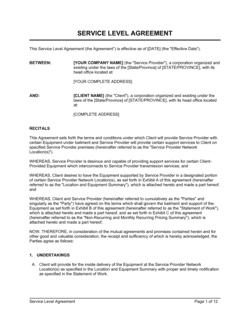
vs Service Level Agreement (SLA)

A standalone SLA defines performance metrics, measurement methodology, and remedies for a specific service. A web hosting user agreement is broader β€” it embeds the SLA within a full commercial contract that also covers payment, liability, termination, and data handling. For most hosting relationships, the full agreement is more appropriate; a standalone SLA is typically used to supplement an existing master services agreement.

Industry-specific considerations

Technology / SaaS

SaaS platforms hosting customer data need AUP enforcement tied to API rate limits, multi-tenant data isolation obligations, and GDPR DPA schedules for EU customer data.

E-commerce

Merchants require uptime SLAs with specific peak-traffic provisions, PCI DSS compliance obligations for payment data, and clear liability caps for lost-sales claims during outages.

Healthcare

Hosting agreements covering medical data must address HIPAA Business Associate obligations, encrypted storage requirements, and breach notification timelines under applicable federal and state law.

Media and Publishing

High-bandwidth content delivery requires specific CDN and overage terms, DMCA safe harbor compliance procedures, and clear IP ownership language for user-generated content hosted on the platform.

Jurisdictional notes

United States

No federal law specifically regulates web hosting agreements, but several state laws apply. California's Automatic Renewal Law (ARL) requires conspicuous disclosure and easy cancellation for auto-renewing plans. The CAN-SPAM Act and CFAA (Computer Fraud and Abuse Act) inform AUP enforcement. Hosting providers handling health data must comply with HIPAA Business Associate requirements; those handling payment data must meet PCI DSS standards. Limitation of liability clauses are generally enforceable in B2B contexts but may be restricted in consumer contracts under state consumer protection statutes.

Canada

Canada's Anti-Spam Legislation (CASL) must be addressed in the AUP for any hosting customer using the platform for commercial electronic messaging. PIPEDA (federal) and provincial equivalents such as Quebec's Law 25 impose data handling and breach notification obligations on hosting providers processing personal information. Quebec's Law 25 is particularly strict and requires a Privacy Impact Assessment for systems processing Quebec residents' data. Auto-renewal terms must comply with provincial consumer protection laws, which vary in their notice requirements.

United Kingdom

Post-Brexit, the UK GDPR and the Data Protection Act 2018 govern personal data processing β€” hosting providers serving UK customers need a compliant UK-specific DPA. The Consumer Rights Act 2015 restricts unfair terms in B2C hosting contracts, including broad liability exclusions and one-sided termination clauses. The UK's Digital Markets, Competition and Consumers Act introduces new requirements for subscription auto-renewal disclosure and cancellation ease. ICO guidance should inform data handling obligations for providers with UK-resident customers.

European Union

GDPR Article 28 mandates a signed Data Processing Agreement between the hosting provider (as data processor) and any customer whose end users include EU residents β€” this is non-negotiable and cannot be replaced by a generic privacy policy. The Digital Services Act (DSA) imposes additional content moderation and transparency obligations on larger hosting providers. Consumer hosting contracts must comply with the EU Consumer Rights Directive, including the right of withdrawal and mandatory auto-renewal disclosure. Cross-border data transfers to non-EU infrastructure must be governed by Standard Contractual Clauses or an equivalent transfer mechanism.

Template vs lawyer β€” what fits your deal?

PathBest forCostTime
Use the templateHosting providers and agencies launching standard shared hosting plans for domestic SMB customersFree30–60 minutes
Template + legal reviewProviders serving EU customers, handling healthcare or payment data, or offering enterprise SLAs$400–$9003–5 business days
Custom draftedLarge-scale hosting providers, data center operators, or platforms with complex multi-tier SLAs and international customers$2,000–$8,000+2–4 weeks

Glossary

Uptime SLA
A service-level agreement clause that commits the hosting provider to a minimum percentage of availability β€” typically 99.9% β€” and defines remedies when that threshold is missed.
Acceptable Use Policy (AUP)
A contractual schedule listing activities that are prohibited on the hosting platform, such as sending spam, hosting malware, or distributing illegal content.
Bandwidth Overage
Data transfer consumed by the customer's hosted content that exceeds the monthly allowance included in the plan, typically triggering additional charges.
Force Majeure
A clause that excuses a party from performance obligations caused by events outside their reasonable control β€” such as natural disasters, cyberattacks, or power grid failures.
Limitation of Liability
A clause capping the maximum damages the hosting provider owes a customer, typically limited to fees paid in the prior 30 or 90 days.
Data Processor
Under privacy law frameworks such as GDPR, a party that processes personal data on behalf of a data controller β€” often the role a hosting provider plays relative to its customers.
Auto-Renewal Clause
A provision that automatically extends the hosting plan for a subsequent term unless the customer provides cancellation notice within a defined window before expiration.
Indemnification
A contractual obligation by which one party agrees to compensate and defend the other against third-party claims arising from the indemnifying party's actions or content.
Termination for Cause
The right to end the agreement immediately without notice or refund when the other party materially breaches the contract β€” such as violating the acceptable use policy.
Data Processing Agreement (DPA)
A supplemental contract, often required by GDPR, that governs how the hosting provider handles personal data belonging to the customer's users.
Service Credits
Partial refunds or account credits issued to the customer when the provider fails to meet its SLA uptime commitment during a billing period.

Part of your Business Operating System

This document is one of 3,000+ business & legal templates included in Business in a Box.

  • Fill-in-the-blanks β€” ready in minutes
  • 100% customizable Word document
  • Compatible with all office suites
  • Export to PDF and share electronically

Create your document in 3 simple steps.

From template to signed document β€” all inside one Business Operating System.
1
Download or open template

Access over 3,000+ business and legal templates for any business task, project or initiative.

2
Edit and fill in the blanks with AI

Customize your ready-made business document template and save it in the cloud.

3
Save, Share, Send, Sign

Share your files and folders with your team. Create a space of seamless collaboration.

Save time, save money, and create top-quality documents.

β˜…β˜…β˜…β˜…β˜…

"Fantastic value! I'm not sure how I'd do without it. It's worth its weight in gold and paid back for itself many times."

Managing Director Β· Mall Farm
Robert Whalley
Managing Director, Mall Farm Proprietary Limited
β˜…β˜…β˜…β˜…β˜…

"I have been using Business in a Box for years. It has been the most useful source of templates I have encountered. I recommend it to anyone."

Business Owner Β· 4+ years
Dr Michael John Freestone
Business Owner
β˜…β˜…β˜…β˜…β˜…

"It has been a life saver so many times I have lost count. Business in a Box has saved me so much time and as you know, time is money."

Owner Β· Upstate Web
David G. Moore Jr.
Owner, Upstate Web

Run your business with a system β€” not scattered tools

Stop downloading documents. Start operating with clarity. Business in a Box gives you the Business Operating System used by over 250,000 companies worldwide to structure, run, and grow their business.

Start freeΒ Β·Β No credit card required