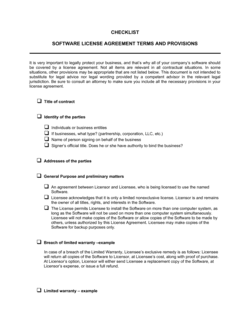
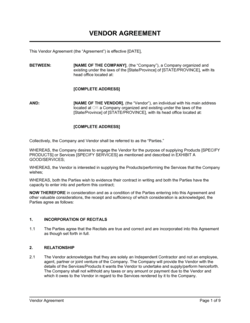
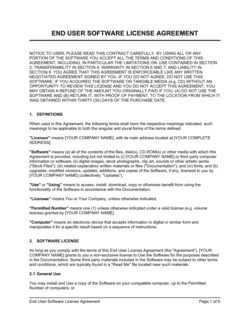
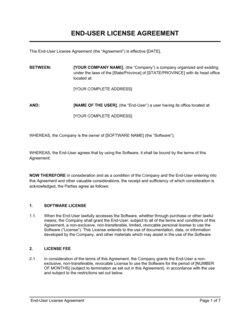
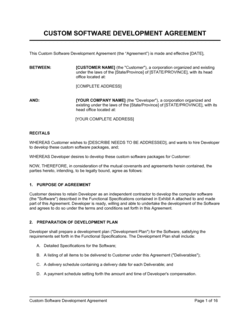
Vendor-Oriented Software License Agreement Template

Free Word download • Edit online • Save & share with Drive • Export to PDF

10 pages30–40 min to fillDifficulty: ComplexSignature requiredLegal review recommended
Learn more ↓
FreeVendor-Oriented Software License Agreement Template

At a glance

What it is
A Vendor Oriented Software License Agreement is a legally binding contract drafted from the software vendor's perspective that governs how a licensee may install, access, and use the vendor's proprietary software. This free Word download gives vendors a structured, enforceable starting point they can edit online and export as PDF — covering license scope, IP ownership, restrictions, warranties, liability limitations, and termination in a single document.
When you need it
Use it whenever you sell, distribute, or deploy proprietary software to customers, partners, or enterprise clients and need to control how the software is used, protect your source code and IP, and limit your liability exposure. It is equally necessary for on-premise installations, SaaS subscriptions, and embedded OEM deployments.
What's inside
License grant and scope, permitted and prohibited uses, IP ownership and reservation of rights, fees and payment terms, limited warranty and disclaimer, limitation of liability and indemnification, confidentiality, audit rights, term and termination, and governing law. Together these clauses define the boundaries of the customer relationship and protect the vendor's commercial and legal position.

What is a Vendor Oriented Software License Agreement?

A Vendor Oriented Software License Agreement is a legally binding contract drafted from the software licensor's perspective that governs how a customer may install, access, and use the vendor's proprietary software. Unlike a neutral bilateral agreement, a vendor-oriented draft starts from the position most protective of the licensor — preserving full IP ownership, restricting permitted uses, limiting warranty obligations, and capping liability — and is negotiated from that position. The agreement creates a license relationship, not a sale: the vendor retains ownership of the software and grants only the specific rights written into the contract, with all other rights reserved.

Why You Need This Document

Distributing software without a signed license agreement is one of the most common and costly legal mistakes software vendors make. Without it, a customer can argue they own the software they purchased, that all implied warranties apply, and that the vendor bears unlimited liability for any business disruption caused by a defect. There is no mechanism to audit for under-licensing, no contractual basis to terminate access when a customer stops paying, and no enforceable restriction preventing them from reverse engineering your product or feeding it into a competing AI system. A well-drafted vendor-oriented software license agreement closes all of these gaps before the first deployment — protecting your IP, your revenue, and your liability exposure for the life of the customer relationship. This template gives you a structured, enforceable starting point in minutes, not days.

Which variant fits your situation?

If your situation is…Use this template
Licensing desktop or on-premise software to a single organizationVendor Oriented Software License Agreement
Providing cloud-hosted SaaS access with subscription billingSaaS Subscription Agreement
Licensing software to a consumer end user (B2C)End User License Agreement (EULA)
Licensing software components to a manufacturer for resale in a productOEM Software License Agreement
Granting a third party the right to resell or sublicense your softwareSoftware Reseller Agreement
Distributing software under open-source terms alongside a commercial tierDual License Software Agreement
Engaging a developer to build custom software you will ownSoftware Development Agreement

Common mistakes to avoid

❌ Defining license scope in vague or ambiguous terms

Why it matters: A license that says 'for use within the company' without defining company or user gives enterprise licensees grounds to include all subsidiaries, affiliates, and contractors — turning a 50-seat deal into an unlimited deployment.

Fix: Define every license metric precisely: named user means a specific individual assigned by name, not a role; installation means a single physical or virtual machine at a defined site.

❌ Omitting the limitation of liability clause or failing to make it conspicuous

Why it matters: Without a limitation of liability, the vendor's exposure is theoretically uncapped — a single software defect causing a business disruption could result in claims far exceeding the contract value. Courts in some US states require the clause to be visually prominent to enforce it.

Fix: Include the limitation in ALL CAPS, bold, or a separate box, and have the licensee initial it separately to create a clear record of mutual assent.

❌ No post-termination obligations clause

Why it matters: When a license is terminated, a licensee with no contractual obligation to uninstall, return, or destroy the software and related confidential materials may continue using both — and the vendor has no contractual basis to compel compliance.

Fix: Add an explicit clause requiring certified destruction or return of all copies and confidential materials within 30 days of termination, with a written certification requirement.

❌ No restriction on AI training or competitive reverse engineering

Why it matters: Licensees who feed software outputs into machine-learning models can effectively replicate core functionality without accessing source code. Standard template restrictions drafted before 2020 do not address this risk.

Fix: Add an explicit prohibition on using the software, its outputs, or its documentation to train, benchmark, or develop any AI or machine-learning model, or any product that competes with the licensed software.

❌ Failing to address source code escrow for critical enterprise deployments

Why it matters: Enterprise customers buying business-critical software often require assurance that they can access source code if the vendor ceases operations. Without an escrow provision, this becomes a deal-blocking negotiation point.

Fix: Include an optional escrow clause referencing a standard escrow arrangement with a provider such as Iron Mountain or NCC Group, triggered by defined events such as insolvency or cessation of support.

❌ Choosing a governing law jurisdiction with no connection to either party

Why it matters: Courts in the EU, UK, and many US states will disregard or override a governing-law clause that appears designed solely to strip the licensee of mandatory local consumer or business protections.

Fix: Select a governing law jurisdiction where the vendor is incorporated or primarily operates, and ensure the choice is defensible. Delaware and New York for US entities, England & Wales for UK entities, are well-accepted defaults.

The 10 key clauses, explained

License grant and scope

In plain language: Defines exactly what rights the licensee receives — the type of license (perpetual or subscription), whether it is exclusive or non-exclusive, the permitted number of users or installations, and whether sublicensing or transfer is allowed.

Sample language
[VENDOR NAME] hereby grants [LICENSEE NAME] a non-exclusive, non-transferable, non-sublicensable license to install and use [SOFTWARE NAME] solely for [LICENSEE]'s internal business purposes on up to [NUMBER] authorized devices or named users during the License Term.

Common mistake: Failing to define 'authorized user' or 'installation' precisely. Vague scope language means a licensee can argue that every employee across every subsidiary is covered, turning a single-site deal into an enterprise-wide license.

Restrictions and prohibited uses

In plain language: Lists what the licensee is expressly forbidden from doing — reverse engineering, decompiling, copying, creating derivative works, benchmarking for competitive purposes, or using the software to build a competing product.

Sample language
Licensee shall not: (a) reverse engineer, decompile, or disassemble the Software; (b) sublicense, rent, or transfer the Software to any third party; (c) use the Software to develop a competing product; or (d) remove or obscure any proprietary notices.

Common mistake: Omitting a prohibition on using the software to train machine-learning models or feed AI systems. Without this clause, output derived from your software can be used to replicate its functionality.

Intellectual property ownership and reservation of rights

In plain language: Confirms that the vendor retains all ownership of the software, source code, documentation, and any improvements — and that the license conveys only the rights explicitly stated, nothing more.

Sample language
All right, title, and interest in and to the Software, including all intellectual property rights, remain exclusively with [VENDOR NAME]. This Agreement confers no ownership rights. All rights not expressly granted are reserved by [VENDOR NAME].

Common mistake: Using 'license' and 'transfer' interchangeably in early drafts. A single careless use of 'conveys' or 'transfers' IP can be read by a court as an assignment, not a license, stripping the vendor of ownership.

Fees, payment terms, and license metrics

In plain language: States the license fee structure — one-time, annual, or usage-based — payment due dates, accepted methods, currency, and consequences for late payment including interest or suspension of access.

Sample language
Licensee shall pay the License Fee of $[AMOUNT] per [YEAR / USER / MODULE] within [30] days of invoice. Fees unpaid after [30] days accrue interest at [1.5]% per month. [VENDOR NAME] may suspend access upon [10] days' written notice if fees remain unpaid.

Common mistake: Not specifying the currency or tax treatment. International deals where the contract is silent on VAT, GST, or withholding tax create billing disputes and, in some jurisdictions, make the vendor liable for uncollected tax.

Limited warranty and disclaimer

In plain language: Provides a narrow warranty that the software will perform materially as described in the documentation for a defined period (typically 90 days), and expressly disclaims all other warranties — implied or statutory.

Sample language
[VENDOR NAME] warrants that the Software will perform materially in accordance with the Documentation for [90] days following delivery. EXCEPT FOR THIS LIMITED WARRANTY, THE SOFTWARE IS PROVIDED 'AS IS.' VENDOR EXPRESSLY DISCLAIMS ALL IMPLIED WARRANTIES, INCLUDING MERCHANTABILITY AND FITNESS FOR A PARTICULAR PURPOSE.

Common mistake: Providing a warranty without a corresponding remedy. If the warranty is breached, the agreement must state what the vendor will do — repair, replace, or refund — otherwise courts will imply a remedy that may exceed the vendor's intent.

Limitation of liability

In plain language: Caps the vendor's total financial exposure for all claims arising from the agreement — typically limited to the fees paid in the preceding 12 months — and excludes consequential, incidental, and indirect damages.

Sample language
IN NO EVENT SHALL [VENDOR NAME]'S AGGREGATE LIABILITY EXCEED THE FEES PAID BY LICENSEE IN THE [12] MONTHS PRECEDING THE CLAIM. IN NO EVENT SHALL EITHER PARTY BE LIABLE FOR INDIRECT, INCIDENTAL, CONSEQUENTIAL, OR PUNITIVE DAMAGES, EVEN IF ADVISED OF THE POSSIBILITY OF SUCH DAMAGES.

Common mistake: Failing to write the limitation of liability clause in ALL CAPS or an equivalent conspicuous format. In many US states, a limitation of liability clause that is not visually distinguished from surrounding text may be unenforceable as unconscionable.

Confidentiality

In plain language: Requires the licensee to protect the vendor's confidential information — including the software, pricing, and technical documentation — from unauthorized disclosure, using at least the same care applied to its own confidential information.

Sample language
Licensee shall hold all Confidential Information of [VENDOR NAME] in strict confidence and shall not disclose it to any third party without prior written consent. 'Confidential Information' includes the Software, source code, Documentation, pricing, and technical data.

Common mistake: Not carving out permitted disclosures — such as disclosures required by law or court order — and not specifying a required notice period before the licensee complies with a legal compulsion order, leaving the vendor no time to seek a protective order.

Audit rights

In plain language: Grants the vendor the right to audit the licensee's use of the software — with reasonable notice — to verify compliance with license scope, seat counts, and installation limits.

Sample language
Upon [30] days' written notice, [VENDOR NAME] may audit Licensee's records and systems to verify compliance with this Agreement. If an audit reveals underpayment of [5]% or more, Licensee shall pay the shortfall plus the reasonable cost of the audit within [30] days.

Common mistake: Setting no audit frequency limit. Without a cap — such as once per 12-month period — the vendor can theoretically audit quarterly, creating operational disruption that damages the customer relationship.

Term and termination

In plain language: Defines the initial license term, renewal mechanics (auto-renew vs. manual), and the grounds on which either party may terminate — for cause (material breach with a cure period), for insolvency, or for convenience.

Sample language
This Agreement commences on [START DATE] and continues for [1] year, renewing automatically unless either party provides [60] days' written notice of non-renewal. Either party may terminate for material breach upon [30] days' written notice if the breach is not cured within that period.

Common mistake: No post-termination obligations clause. Without one, a licensee that has been terminated may argue it has no obligation to uninstall the software or return confidential materials, leaving the vendor with no contractual basis to demand compliance.

Governing law, dispute resolution, and jurisdiction

In plain language: Specifies which jurisdiction's law governs the agreement, how disputes will be resolved (litigation, arbitration, or mediation), the venue, and any waiver of jury trial.

Sample language
This Agreement is governed by the laws of [STATE], without regard to its conflict-of-law principles. Any dispute shall be resolved by binding arbitration administered by [AAA / JAMS] in [CITY, STATE], except that either party may seek injunctive relief in any court of competent jurisdiction.

Common mistake: Choosing a governing law jurisdiction with no meaningful connection to either party's operations. Several US states — and courts in the UK and EU — will disregard governing-law selections that appear designed solely to evade protective local laws.

How to fill it out

  1. 1

    Identify the parties and software being licensed

    Enter the vendor's full registered legal entity name and the licensee's name. Describe the software product by its commercial name and version number, and attach or reference the product documentation as an exhibit.

    💡 Use the exact entity name as it appears in your corporate registry — brand names and trade names create enforceability gaps if the contracting entity ever changes.

  2. 2

    Define the license type and scope precisely

    Choose between perpetual and subscription, exclusive and non-exclusive, and set the specific metric that governs scope — named users, concurrent users, CPU cores, or installation sites. Enter the exact number permitted.

    💡 Define 'user' to include or exclude contractors, affiliates, and subsidiaries explicitly. Enterprise licensees will always push for the broadest possible interpretation.

  3. 3

    Complete the fees and payment terms block

    Enter the license fee amount, currency, invoice frequency, due date (Net 30 is standard), late-payment interest rate, and the grace period before the vendor may suspend access for non-payment.

    💡 State whether fees are exclusive of applicable taxes. For cross-border deals, specify whether the licensee is responsible for withholding tax and whether the vendor is entitled to gross-up payments.

  4. 4

    Tailor the restrictions clause to your IP risks

    Review the prohibited-uses list and add restrictions specific to your software — such as prohibitions on use in competing products, AI training, or high-risk environments like medical devices or nuclear facilities.

    💡 High-risk use exclusions (aviation, medical, nuclear) reduce your liability exposure significantly and are standard practice for general-purpose software vendors.

  5. 5

    Set the warranty scope and remedy

    Define the warranty period (90 days is most common), what performance standard the software must meet (material conformance with documentation), and the exclusive remedy if the warranty is breached (repair, replace, or pro-rata refund).

    💡 Making the limited warranty remedy exclusive — 'this is licensee's sole and exclusive remedy for warranty breach' — prevents claims under implied warranty theories that could expose you to greater damages.

  6. 6

    Confirm the limitation of liability and format it conspicuously

    Set the aggregate liability cap (typically 12 months of fees), list the excluded damage categories, and format both paragraphs in ALL CAPS or bold to satisfy conspicuousness requirements in US states and common-law jurisdictions.

    💡 Consider carving out indemnification obligations, fraud, and willful misconduct from the liability cap — courts are more likely to enforce a cap that does not attempt to immunize intentional wrongdoing.

  7. 7

    Set the term, renewal, and post-termination obligations

    Enter the initial term length, the notice period for non-renewal, cure periods for material breach, and the post-termination obligations — return or certified destruction of confidential materials and uninstallation of the software.

    💡 Auto-renewal with a 60-day notice window protects your revenue pipeline. A 30-day window is too short for enterprise customers to get internal approval for non-renewal.

  8. 8

    Choose governing law and sign before deployment

    Select a governing law jurisdiction with a well-developed body of commercial software case law — Delaware, New York, and England & Wales are common choices. Both parties must sign before the licensee deploys the software.

    💡 Use an eSignature service to timestamp execution. Post-deployment signatures raise the same fresh-consideration risks as post-start-date employment contracts.

Frequently asked questions

What is a vendor oriented software license agreement?

A vendor oriented software license agreement is a contract drafted to protect the software vendor's interests — preserving IP ownership, controlling how the software is used, limiting warranty exposure, and capping liability. Unlike a balanced bilateral agreement, a vendor-oriented draft starts from the position most favorable to the licensor and is negotiated down from there. It is the standard starting point for any vendor selling commercial software to business customers.

What is the difference between a software license agreement and a EULA?

A software license agreement (SLA) is a negotiated B2B contract between a vendor and a business customer, typically signed by both parties and covering complex commercial terms including audit rights, indemnification, and enterprise pricing. An end user license agreement (EULA) is a standard click-through or shrink-wrap agreement presented to individual consumer or business end users without negotiation. EULAs are appropriate for mass-market software; negotiated SLAs are used for enterprise and mid-market commercial deployments.

Does a software license agreement need to be signed?

For a negotiated B2B software license, yes — both parties should sign before deployment begins. A signed agreement creates a clear record of mutual assent to specific terms, which is critical for enforcing restrictions, audit rights, and limitation of liability clauses. Click-through agreements can be binding in many jurisdictions, but for enterprise deals with material financial exposure, a countersigned written contract is the appropriate standard.

What should a software license agreement include?

At minimum: a precise license grant defining scope and permitted users, a restrictions clause covering prohibited uses, an IP ownership clause confirming the vendor retains all rights, fee and payment terms, a limited warranty with an exclusive remedy, a limitation of liability in conspicuous format, confidentiality obligations, audit rights, term and termination conditions including post-termination obligations, and governing law. Missing any of these leaves material gaps that courts fill with jurisdiction-specific defaults.

How is a perpetual license different from a subscription license?

A perpetual license grants the right to use the software indefinitely after a one-time fee, typically with an optional annual maintenance or support fee for updates. A subscription license grants access for a defined period — monthly or annually — and terminates automatically if payment lapses. Subscription models give vendors more control over access and are now the standard structure for cloud and SaaS software. Perpetual licenses are still common for on-premise enterprise software.

Can a software license agreement prevent reverse engineering?

In most jurisdictions, yes — a contractual prohibition on reverse engineering, decompiling, and disassembly is enforceable against licensees who agreed to those terms. However, certain statutory exceptions exist: EU Directive 2009/24/EC permits decompilation for interoperability purposes regardless of contract language, and some US courts have held that reverse engineering for security research is protected under the DMCA's interoperability exceptions. Vendors should include the restriction and seek legal advice if a licensee invokes a statutory exception.

What is an audit right in a software license agreement?

An audit right gives the vendor the contractual ability to inspect the licensee's systems, records, and usage logs — typically with 30 days' written notice — to verify that software deployment complies with the licensed scope (seat counts, installation limits, or usage metrics). Audit rights are standard in enterprise software agreements and are the primary mechanism vendors use to identify and collect on under-licensed deployments. Agreements should cap audit frequency at once per year to avoid damaging the customer relationship.

Does a software vendor need to include a limitation of liability clause?

Yes — without it, a vendor's exposure to damages claims arising from software defects, data loss, or service interruptions is theoretically unlimited. A well-drafted limitation caps aggregate liability at 12 months of fees paid and excludes consequential and indirect damages. The clause must be written conspicuously (ALL CAPS or bold) in many US states and common-law jurisdictions to be enforceable. Certain categories — fraud, willful misconduct, and indemnification obligations — are typically carved out of the cap to avoid unenforceability.

Do I need a lawyer to draft a software license agreement?

For straightforward commercial deployments with a domestic customer, a high-quality vendor-oriented template is a defensible starting point. Engage a technology lawyer when the deal involves significant enterprise revenue, cross-border deployments, regulated industries such as healthcare or financial services, source-code escrow requirements, or heavily negotiated indemnification and IP warranty obligations. A 1–3 hour template review typically costs $400–$900 and is cost-effective for any deal exceeding $50,000 in annual contract value.

How this compares to alternatives

vs End User License Agreement (EULA)

A EULA is a standardized, non-negotiated click-through agreement presented to individual end users of consumer or mass-market software. A vendor-oriented software license agreement is a negotiated B2B contract with specific commercial terms, audit rights, and enterprise pricing. EULAs are appropriate for broad distribution; negotiated SLAs are used for commercial deals where both parties review and sign the terms.

vs Software Development Agreement

A software development agreement governs the creation of custom software — defining deliverables, milestones, IP ownership of the work product, and payment. A software license agreement governs the use of already-existing software. If you are commissioning custom development, use the development agreement; if you are licensing a finished product, use the license agreement.

vs SaaS Subscription Agreement

A SaaS subscription agreement is tailored for cloud-hosted software accessed via the internet, addressing uptime SLAs, data security, data processing under GDPR, and subscription renewal mechanics. A traditional software license agreement is better suited for on-premise installations or perpetual licenses where the software is delivered to and installed by the licensee. Many modern vendors need elements of both.

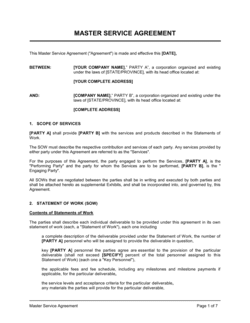
vs Master Service Agreement (MSA)

A master service agreement establishes an overarching commercial framework covering liability, payment, and dispute resolution for an ongoing service relationship, with individual statements of work for specific projects. A software license agreement governs a specific product deployment rather than a broader service engagement. Vendors with both product and services revenue often use an MSA with a software license exhibit.

Industry-specific considerations

SaaS / Technology

Subscription-based license structures, usage-based pricing metrics, uptime SLA cross-references, and AI/ML training prohibitions are standard additions for SaaS vendors.

Financial Services

Regulatory compliance obligations (SOC 2, ISO 27001), data residency requirements, and enhanced audit rights aligned with financial regulator expectations are typically required by financial services licensees.

Healthcare / Life Sciences

HIPAA business associate agreement cross-references, medical device software disclaimers, and explicit high-risk use exclusions (clinical decision-making, life-critical applications) are essential for healthcare software vendors.

Manufacturing / Industrial

Embedded and OEM license structures, hardware-tied activation terms, and explicit exclusions from use in safety-critical or nuclear applications are standard considerations for industrial software vendors.

Jurisdictional notes

United States

The Uniform Computer Information Transactions Act (UCITA) applies in Maryland and Virginia; elsewhere, Article 2 of the UCC is sometimes applied by analogy to software transactions, though courts are inconsistent. Limitation of liability clauses must be conspicuous under UCC §2-316 to be enforceable. California courts scrutinize limitation of liability and indemnification clauses closely, and the CCPA imposes data-related obligations on vendors serving California businesses. Export control laws (EAR, ITAR) must be addressed if the software has encryption or dual-use capabilities.

Canada

Software license agreements in Canada are governed by provincial common law (or Quebec civil law) rather than a unified statute. PIPEDA and provincial privacy laws (including Quebec's Law 25) impose obligations on vendors who process personal data on behalf of Canadian licensees and should be addressed in a separate data processing addendum. Limitation of liability clauses are generally enforceable if not unconscionable, but Quebec courts apply a reasonableness standard under the Civil Code that may limit extreme caps.

United Kingdom

The Unfair Contract Terms Act 1977 (UCTA) and the Consumer Rights Act 2015 restrict the enforceability of exclusion and limitation clauses — particularly against consumers and where the clause fails a reasonableness test. Business-to-business software license limitations are generally enforceable if reasonable in the circumstances. Post-Brexit, UK GDPR applies separately from EU GDPR and must be addressed for any vendor processing UK-resident data. Governing-law clauses choosing English law are respected by English courts in B2B contracts.

European Union

EU Directive 2009/24/EC on the legal protection of computer programs permits licensees to decompile software for interoperability purposes regardless of contractual prohibitions — this statutory right cannot be waived. GDPR applies to any vendor processing personal data of EU residents and typically requires a Data Processing Agreement (DPA) in addition to the license agreement. The EU AI Act (phased enforcement 2024–2027) imposes additional obligations on vendors whose software qualifies as an AI system under the Regulation. Limitation of liability clauses that exclude liability for gross negligence or willful misconduct are unenforceable in most EU member states.

Template vs lawyer — what fits your deal?

PathBest forCostTime
Use the templateSoftware vendors licensing products to domestic SMB customers with standard deal terms and annual contract values below $25,000Free30–45 minutes to customize
Template + legal reviewEnterprise deals above $25,000 ACV, cross-border deployments, regulated industries, or deals requiring source code escrow or custom indemnification$400–$900 for a 1–3 hour attorney review2–5 business days
Custom draftedStrategic enterprise accounts, multi-jurisdiction global deployments, heavily negotiated IP indemnification, or OEM embedded licensing arrangements$2,000–$8,000+2–4 weeks

Glossary

License Grant
The clause that defines precisely what the licensee is permitted to do with the software — including whether the license is exclusive or non-exclusive, perpetual or term-based, and site-limited or enterprise-wide.
Perpetual License
A license that allows the customer to use the software indefinitely after a one-time payment, as opposed to a subscription license that expires unless renewed.
Subscription License
A time-limited license renewed periodically — monthly or annually — with access typically terminating automatically if payment lapses.
Source Code
The human-readable instructions that make up a software program, as distinguished from object code (compiled, machine-readable form). Vendors typically license object code only and retain source code as a trade secret.
Derivative Work
A work based on or incorporating the licensed software — such as a modified version or integration — that may trigger IP ownership questions if not addressed in the agreement.
Limitation of Liability
A clause that caps the vendor's total financial exposure for damages arising from the agreement, typically at the fees paid by the licensee in the preceding 12 months.
Indemnification
A contractual obligation by which one party agrees to compensate the other for specified losses — commonly used to allocate IP infringement risk between vendor and licensee.
Audit Right
A vendor's contractual right to inspect the licensee's deployment records, installation logs, or usage data to verify compliance with license scope and seat counts.
Escrow (Source Code Escrow)
An arrangement where source code is deposited with a neutral third party and released to the licensee only if a defined trigger event occurs, such as the vendor's insolvency.
Warranty Disclaimer
A clause in which the vendor expressly excludes implied warranties — such as merchantability and fitness for a particular purpose — limiting the software to an 'as-is' basis.
Governing Law
The jurisdiction whose laws will be used to interpret and enforce the agreement, and where disputes will be resolved.

Part of your Business Operating System

This document is one of 3,000+ business & legal templates included in Business in a Box.

  • Fill-in-the-blanks — ready in minutes
  • 100% customizable Word document
  • Compatible with all office suites
  • Export to PDF and share electronically

Create your document in 3 simple steps.

From template to signed document — all inside one Business Operating System.
1
Download or open template

Access over 3,000+ business and legal templates for any business task, project or initiative.

2
Edit and fill in the blanks with AI

Customize your ready-made business document template and save it in the cloud.

3
Save, Share, Send, Sign

Share your files and folders with your team. Create a space of seamless collaboration.

Save time, save money, and create top-quality documents.

★★★★★

"Fantastic value! I'm not sure how I'd do without it. It's worth its weight in gold and paid back for itself many times."

Managing Director · Mall Farm
Robert Whalley
Managing Director, Mall Farm Proprietary Limited
★★★★★

"I have been using Business in a Box for years. It has been the most useful source of templates I have encountered. I recommend it to anyone."

Business Owner · 4+ years
Dr Michael John Freestone
Business Owner
★★★★★

"It has been a life saver so many times I have lost count. Business in a Box has saved me so much time and as you know, time is money."

Owner · Upstate Web
David G. Moore Jr.
Owner, Upstate Web

Run your business with a system — not scattered tools

Stop downloading documents. Start operating with clarity. Business in a Box gives you the Business Operating System used by over 250,000 companies worldwide to structure, run, and grow their business.

Start free · No credit card required