1
Define the policy scope and affected roles
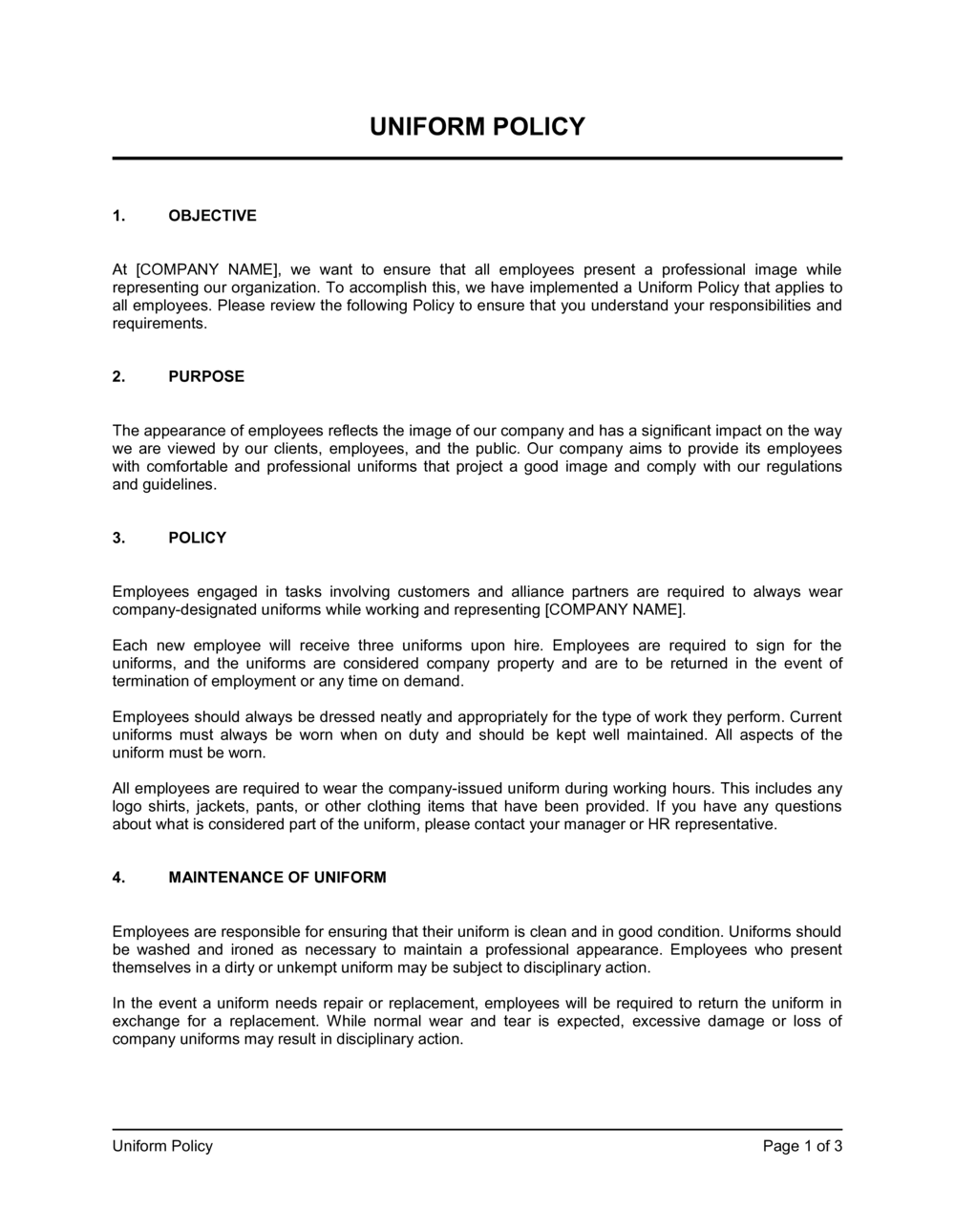
Identify every job title in your organization. Decide which roles require a full issued uniform, which require safety PPE, and which fall under a general dress code. Document these in the role classification table.
💡 Start from your org chart, not a blank list — you will catch newly created roles that fall through the cracks of informal practice.
2
Specify uniform items, colors, and brand standards
List each garment by name, color code, and logo placement for every role tier. Reference your brand guidelines document to confirm exact Pantone or hex codes, logo dimensions, and approved embroidery locations.
💡 Attach a visual reference sheet (photo or line drawing) as an appendix — it eliminates ambiguity faster than any written description.
3
Set the issuance quantities and sign-off process
Decide how many of each item each role tier receives at hire. Create a Uniform Receipt Form that lists every item, quantity, and condition, signed by both the employee and the issuing manager.
💡 Number each item (e.g., shirt #1 of 3) on the receipt form — this makes it easier to reconcile returns at separation.
4
Write the care and replacement standards
State laundering responsibilities and frequency. Set a clear replacement trigger — either time-based (annual) or condition-based (manager approval on inspection). Confirm whether a cleaning allowance is paid.
💡 Check your jurisdiction's minimum wage rules before assigning laundering costs to employees — uncompensated uniform maintenance can reduce effective hourly pay below the legal floor.
5
Draft the accommodation process
Write a simple request-and-review procedure: employee submits written request, HR reviews within a defined timeframe, and the outcome is documented. Name the HR contact and the form or email address to use.
💡 Keep the accommodation section factual and process-oriented — avoid language that signals the company will rarely or never grant requests.
6
Define the disciplinary steps for non-compliance
Write out at least three progressive steps (verbal reminder, written warning, final warning or suspension) with documentation requirements at each stage. Cross-reference your general disciplinary procedure.
💡 Align the language here with your existing employee handbook disciplinary section — inconsistency between the two creates enforcement gaps.
7
Prepare the acknowledgment form and distribution plan
Create a one-page Acknowledgment Form that references the policy by name and version date. Plan how you will distribute updates — email, HR portal, or physical copy — and how you will collect signatures from existing staff.
💡 Set a 10-business-day deadline for signature return and assign follow-up responsibility to a named manager, not a general HR inbox.
8
Schedule annual review and assign policy ownership
Enter a recurring calendar reminder for the policy review date. Name a specific role — HR Manager or Operations Director — as the policy owner responsible for initiating the review and updating the version number.
💡 Pair the annual review with your brand standards refresh cycle so uniform specifications stay aligned with any logo or color changes.