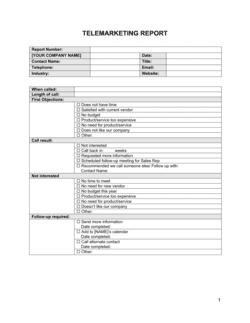
Telemarketing Tips

Free Word download • Edit online • Save & share with Drive • Export to PDF

3 pages25–30 min to fillDifficulty: ComplexSignature requiredLegal review recommended
Learn more ↓
FreeTelemarketing Tips Template

At a glance

What it is
A Telemarketing Tips document is a structured compliance and operational policy that governs how a business and its sales representatives conduct outbound telephone and text-message marketing. This free Word download covers Do Not Call obligations, calling-hour restrictions, consent requirements, record-keeping duties, and rep conduct standards — all in a single document you can edit online and export as PDF for internal training or regulatory review.
When you need it
Use it before launching any outbound calling or SMS campaign, when onboarding new telemarketing staff, or when your business is expanding its direct sales operation into new states or countries with their own telemarketing regulations.
What's inside
Purpose and scope, Do Not Call list management, permitted calling hours, consumer consent and opt-out handling, required call disclosures, record-keeping and audit obligations, rep conduct standards, complaint escalation procedures, and enforcement and disciplinary measures.

What is a Telemarketing Tips Document?

A Telemarketing Tips document is a structured compliance and operational policy that defines the rules, procedures, and conduct standards governing all outbound telephone and SMS marketing activities carried out by a business and its representatives. It translates the requirements of the FTC Telemarketing Sales Rule, the Telephone Consumer Protection Act, and equivalent laws in Canada, the UK, and the EU into actionable internal procedures — covering Do Not Call list management, permitted calling hours, required call disclosures, consumer consent handling, record-keeping obligations, and enforcement measures. Unlike a generic marketing policy, a telemarketing tips document addresses the specific statutory and regulatory framework that makes outbound calling one of the highest-liability marketing channels a business can operate.

Why You Need This Document

Without a written telemarketing policy, a single campaign can expose your business to per-call fines of up to $51,744 under the TSR and uncapped class-action liability under the TCPA — class actions involving automated calls have resulted in settlements exceeding $75 million. Regulators look first for a written compliance program when investigating complaints; a company with no documented policy loses safe-harbor protections immediately. Beyond regulatory risk, the absence of standardized procedures means individual reps make their own judgments about calling hours, disclosures, and opt-out handling — creating inconsistency that generates complaints and strains customer relationships. This template gives you a legally grounded, audit-ready starting point that you can tailor to your calling channels, headcount, and target jurisdictions, cutting the time to a defensible compliance program from weeks to hours.

Which variant fits your situation?

If your situation is…Use this template
Running outbound voice calls to consumer prospectsTelemarketing Tips (Outbound Voice)
Sending promotional SMS or text-message campaignsSMS Marketing Compliance Policy
Engaging a third-party call center on your behalfTelemarketing Services Agreement
Collecting written consent before automated dialingTCPA Consent Form
Documenting a company-wide marketing conduct codeMarketing Policy
Managing inbound customer service calls with sales componentsCall Center Policy and Procedures
Training new sales reps on calling scripts and objection handlingSales Training Manual

Common mistakes to avoid

❌ Using the caller's time zone instead of the consumer's

Why it matters: The TSR measures permitted calling hours against the consumer's local time, not the call center's. A 7:45 a.m. call from a Mountain Time center to an Eastern consumer is a federal violation regardless of what the clock says in the office.

Fix: Configure your dialing platform to reference the area code of the number being dialed and block calls outside 8 a.m.–9 p.m. in that time zone. Test the filter before each new campaign launch.

❌ Failing to scrub call lists within 31 days before each dial wave

Why it matters: A scrub older than 31 days eliminates the TSR safe-harbor defense entirely. If a called number was added to the national DNC registry after your last scrub, you have no protection from enforcement action.

Fix: Build a mandatory 31-day scrub check into your campaign launch checklist and retain timestamped scrub certificates for at least 24 months.

❌ Treating a prior purchase as TCPA written consent

Why it matters: A prior business relationship allows you to call a consumer on the internal DNC list under the TSR for 18 months after their last purchase. It does not satisfy TCPA's prior express written consent requirement for autodialed or prerecorded calls — the standards are separate statutes.

Fix: Obtain and document express written consent separately for any autodialed or prerecorded campaign, even for existing customers. Store consent with a timestamp and the specific campaign it covers.

❌ No documented complaint log

Why it matters: Regulators treat the absence of a complaint log as evidence that complaints were ignored or suppressed. Companies without one cannot demonstrate good-faith compliance and automatically lose safe-harbor protection in FTC investigations.

Fix: Create a complaint intake process — a CRM ticket type, a shared spreadsheet, or a dedicated inbox — that timestamps every complaint and documents the resolution within the required window.

❌ Omitting third-party vendors from the policy scope

Why it matters: The FTC holds the company that initiates the telemarketing campaign liable for violations committed by its outsourced call-center vendors. A policy that covers only direct employees leaves the originating company exposed.

Fix: Name all vendors and contractors in the scope clause, attach the policy as an exhibit to every telemarketing services agreement, and include a vendor audit right.

❌ No annual recertification or regulatory update process

Why it matters: State mini-TCPA laws, FTC rule updates, and FCC rulemaking change the compliance landscape every 12–18 months. A policy written in Year 1 and never updated will be non-compliant by Year 2 in several states.

Fix: Schedule an annual legal review of the policy, assign a compliance owner to monitor FTC and FCC rulemaking, and set a 30-day window to update the policy and retrain all reps after any material change.

The 10 key clauses, explained

Purpose, Scope, and Covered Activities

In plain language: Defines what the document governs — all outbound telephone and SMS sales contacts made by company staff, agents, and contractors — and which products, campaigns, and channels are included.

Sample language
This policy applies to all outbound telemarketing activities conducted by [COMPANY NAME], its employees, and any third-party vendors acting on its behalf, including voice calls, prerecorded messages, and text-message campaigns targeting [PRODUCT/SERVICE] prospects.

Common mistake: Limiting scope to direct employees and omitting contractors or offshore call-center vendors. Regulators hold the originating company liable for violations committed by its agents regardless of employment status.

Do Not Call List Management

In plain language: Establishes procedures for maintaining an internal DNC list, scrubbing call lists against the national registry, honoring consumer opt-outs, and the required scrub frequency.

Sample language
[COMPANY NAME] shall maintain an internal Do Not Call list updated within [24 HOURS] of any opt-out request. All call lists shall be scrubbed against the National DNC Registry no more than [31] days prior to each calling campaign.

Common mistake: Scrubbing call lists once at campaign launch and not rescanning before each subsequent dial wave. The TSR requires scrubs no older than 31 days; a stale scrub eliminates the safe-harbor defense.

Permitted Calling Hours

In plain language: Sets the days and times during which outbound calls may be placed, calibrated to the time zone of the consumer's area code — not the caller's location.

Sample language
Outbound calls shall only be placed between 8:00 a.m. and 9:00 p.m. local time in the consumer's time zone, Monday through Saturday. Calls shall not be placed on federally observed holidays without prior legal review.

Common mistake: Using the call center's time zone instead of the consumer's. A rep in Phoenix calling an eastern-standard consumer at 7:45 a.m. EST violates the TSR even if it is 9:45 a.m. locally.

Required Call Disclosures

In plain language: Lists the mandatory opening statements every rep must make at the start of each call — caller identity, company name, the commercial purpose of the call, and, where required, that recording is occurring.

Sample language
At the start of each call, the representative shall disclose: (1) their first name, (2) the name of [COMPANY NAME], (3) the commercial purpose of the call, and (4) the telephone number or address at which the company can be reached. In states requiring all-party consent, reps shall additionally state: 'This call may be recorded for quality and compliance purposes.'

Common mistake: Omitting the company's contact information from the opening disclosure. The TSR requires it on every call; a rep who only gives their first name exposes the company to per-call penalties of up to $51,744 per violation.

Consumer Consent and Prior Authorization

In plain language: Specifies when express written consent is required (autodialed or prerecorded calls), when implied consent or a prior business relationship is sufficient, and how consent records must be stored.

Sample language
Prior express written consent, obtained via [CONSENT METHOD — web form / signed paper form / electronic signature], is required before placing any autodialed or prerecorded call or text message. Consent records shall be retained for a minimum of [5] years from the date of consent.

Common mistake: Treating a customer's prior purchase as blanket consent for automated marketing calls. A prior business relationship exempts a company from internal DNC obligations under the TSR but does not substitute for TCPA written consent for autodialed calls.

Prohibited Practices and Misrepresentations

In plain language: Lists conduct that is expressly forbidden — threatening or abusive language, false identity claims, fabricated prize offers, unauthorized charges, and calling numbers on the DNC list — with the consequence for each violation.

Sample language
Representatives shall not: (a) make false or misleading statements about any product, service, or affiliation; (b) use threatening or obscene language; (c) call any number on the company's or national DNC list; (d) charge a consumer's account without express verifiable authorization; or (e) misrepresent the caller's identity or the company's name.

Common mistake: Listing prohibited practices without defining the disciplinary consequence for each. A policy without teeth is treated as aspirational by regulators — document the enforcement escalation for each violation.

Opt-Out Honoring and Complaint Escalation

In plain language: Sets the maximum time frame for honoring opt-out requests, identifies who is responsible for updating the internal DNC list, and describes the intake and escalation path for consumer complaints.

Sample language
Opt-out requests made during a call shall be honored immediately. Written opt-out requests shall be processed within [30] days. Consumer complaints shall be logged in [COMPLAINT TRACKING SYSTEM] within [24] hours and escalated to [COMPLIANCE MANAGER NAME/TITLE] within [3] business days.

Common mistake: No formal complaint log. Regulators reviewing a TSR investigation expect to see a timestamped complaint record — companies without one cannot demonstrate good-faith compliance and lose safe-harbor protection.

Record-Keeping and Audit Obligations

In plain language: Defines the minimum records the company must retain — call logs, consent records, DNC scrub certificates, training records, and complaint files — and the minimum retention period for each.

Sample language
[COMPANY NAME] shall retain the following records for a minimum of [24] months: (a) call logs identifying date, time, number dialed, and rep ID; (b) DNC scrub certificates with scrub dates; (c) consent documentation for autodialed contacts; (d) rep training completion records; and (e) all consumer complaints and resolution notes.

Common mistake: Retaining call logs but discarding training records. The FTC's safe-harbor defense requires documented training — no training records means no safe harbor, even if the calls were fully compliant.

Representative Training and Certification

In plain language: Requires all reps, supervisors, and relevant contractors to complete telemarketing compliance training before placing their first call and to recertify annually or when regulations change.

Sample language
All individuals placing outbound calls on behalf of [COMPANY NAME] shall complete [COMPANY NAME]'s Telemarketing Compliance Training before their first calling shift. Recertification is required annually and within [30] days of any material regulatory change. Completion shall be documented in [TRAINING SYSTEM].

Common mistake: One-time onboarding training with no recertification schedule. Telemarketing rules change frequently — a rep trained in Year 1 who is unaware of a Year 3 rule amendment is still a liability for the company.

Enforcement, Disciplinary Measures, and Policy Amendments

In plain language: States the consequences for policy violations — from written warning through termination — and the process for amending the policy when regulations change.

Sample language
Violations of this policy shall result in the following disciplinary action: first offense — written warning and mandatory retraining; second offense — suspension without pay for [X] days; third offense or willful violation — immediate termination. Policy amendments shall be reviewed by [LEGAL COUNSEL] and communicated to all covered personnel within [15] days of adoption.

Common mistake: No amendment and communication clause. Regulations change and so do calling lists — a policy that has no formal update mechanism becomes dangerously stale, and courts have found that out-of-date written policies weigh against the company in enforcement actions.

How to fill it out

  1. 1

    Identify all covered activities and personnel

    List every outbound contact method your company uses — voice, prerecorded, SMS — and every person or vendor who places calls on your behalf. The scope clause must name all of them explicitly.

    💡 Include offshore and outsourced vendors by name or category; a generic 'and agents' clause may not be enough to establish the agency relationship needed for regulatory safe harbor.

  2. 2

    Configure your DNC list management procedures

    Decide whether you will use a third-party DNC scrubbing service or manage it internally. Document the scrub frequency (no older than 31 days per the TSR), the responsible role, and the storage format for scrub certificates.

    💡 Schedule automated reminders in your CRM or dialing platform to flag call lists that have not been scrubbed within 28 days — 3 days of buffer prevents an accidental lapse.

  3. 3

    Set permitted calling hours by consumer time zone

    Enter the 8 a.m.–9 p.m. window and configure your dialing software to block calls outside those hours based on the area code of the number being dialed, not your office location.

    💡 Add a holiday exclusion list to the policy and program it into your dialer — federal and provincial holidays are frequently missed and can generate complaints.

  4. 4

    Draft required call disclosures and script openings

    Write a standard opening script that includes the rep's name, company name, commercial purpose of the call, and — in all-party consent states — the recording disclosure. Attach it as Schedule A.

    💡 A laminated one-page script card at each rep's workstation reduces opening-disclosure violations more reliably than training alone.

  5. 5

    Document consent collection and storage procedures

    Specify how express written consent is obtained (web form, e-signature, paper), where it is stored, and the minimum retention period. Link the consent method to the campaign type — autodialed campaigns require the strictest consent standard.

    💡 Store consent records in a system that timestamps both the collection date and the method — screenshot or PDF evidence is required if a consumer later disputes consent.

  6. 6

    Define opt-out and complaint procedures

    Assign a named role as DNC list owner, set the time limit for processing opt-outs (immediately during a call; within 30 days for written requests), and create a complaint log template to capture timestamps, consumer information, and resolution steps.

    💡 Build the complaint log into your CRM as a ticket category so escalations happen automatically — manual complaint tracking creates gaps that show up in regulatory audits.

  7. 7

    Complete the training and certification section

    Set the training completion deadline for new hires (before first call), the annual recertification date, and the trigger for off-cycle retraining (material regulatory change). Link to your training materials or LMS.

    💡 Attach a sign-off sheet or use an LMS completion certificate — a blank 'training completed' checkbox with no timestamp does not satisfy the FTC's documentation requirement.

  8. 8

    Have legal counsel review before deployment

    Have a telemarketing or consumer-protection attorney review the completed policy before you place your first campaign call. State-level rules — particularly in Florida, Indiana, Texas, and California — frequently exceed federal minimums and require specific additions.

    💡 Ask counsel to flag any state where you are calling that has a mini-TCPA or state DNC registration requirement — several states require separate registration fees and forms before you may call their residents.

Frequently asked questions

What is a telemarketing tips document?

A telemarketing tips document is a written compliance and operational policy that governs how a business places outbound sales calls and SMS messages. It covers Do Not Call list management, calling-hour restrictions, required disclosures, consumer consent, opt-out handling, rep conduct, and record-keeping obligations. It serves as both an internal training reference and an auditable record of the company's compliance program.

Who needs a telemarketing compliance policy?

Any business that places unsolicited outbound calls or text messages to consumers or businesses needs a written telemarketing policy. This includes inside sales teams, call centers, marketing agencies running outbound campaigns, and companies that outsource calling to third-party vendors. The company that originates the campaign — not just the vendor making the calls — is legally responsible for compliance.

What is the FTC Telemarketing Sales Rule and how does it affect my business?

The Telemarketing Sales Rule (TSR) is an FTC regulation that applies to most outbound telemarketing to US consumers. It restricts calling hours to 8 a.m.–9 p.m. local time, requires specific opening disclosures, mandates DNC list scrubs no older than 31 days, limits abandoned call rates to 3%, and prohibits a wide range of deceptive and abusive practices. Violations carry civil penalties of up to $51,744 per call. A written compliance policy with documented training is the foundation of the TSR safe-harbor defense.

What is the difference between the TSR and the TCPA?

The TSR is an FTC trade regulation covering outbound telemarketing practices broadly — calling hours, disclosures, DNC lists, and payment rules. The TCPA is a separate federal statute enforced by the FCC that specifically restricts autodialed calls, prerecorded messages, and text messages to consumers without prior express written consent. Both apply simultaneously to most outbound campaigns, and violating either carries significant per-call liability. A compliant telemarketing policy must address the requirements of both.

Do I need to register with the National Do Not Call Registry?

Companies that place telemarketing calls to US consumers must subscribe to the National DNC Registry and pay an annual fee to access call-list scrubbing data. As of 2025, access fees are $70 per area code per year, capped at $19,715 for all US area codes. Failure to subscribe before placing calls is itself a TSR violation. Some states also maintain separate state DNC registries that require independent registration and scrubbing — check the requirements for every state you call.

What are permitted telemarketing calling hours?

Under the TSR, outbound calls may only be placed between 8:00 a.m. and 9:00 p.m. in the consumer's local time zone — not the call center's. Many states have stricter windows; for example, several states prohibit calls before 9:00 a.m. or after 8:00 p.m. local time. In Canada, the CRTC restricts calls to between 9:00 a.m. and 9:30 p.m. local time on weekdays and 10:00 a.m. to 6:00 p.m. on Saturdays, with Sunday calls generally prohibited.

Does this policy apply to B2B telemarketing?

The national DNC Registry primarily protects residential and personal wireless numbers; most B2B calls to business lines are not covered by TSR DNC requirements. However, calls to the personal cell phones of business contacts — even for B2B purposes — can trigger TCPA consent requirements if an autodialer is used. Several states, including California, extend DNC protections to sole proprietors. A written policy should address both B2C and B2B calling separately to avoid inadvertent violations.

What records must a telemarketing operation keep?

The TSR requires telemarketers to retain records for 24 months covering advertising materials, prize and gift promotions, sales records, employee training records, and DNC compliance documentation including scrub certificates. TCPA consent records should be retained for the life of the customer relationship plus at least five years given the six-year statute of limitations in many states. Complaint logs, opt-out records, and call recordings (where legally required) should be retained for the same 24-month minimum.

How this compares to alternatives

vs Marketing Policy

A marketing policy covers all promotional activities — digital ads, email, social, events, and print — at a high level. A telemarketing tips document focuses specifically on the legal and operational requirements of outbound telephone and SMS campaigns, including TSR and TCPA-specific rules that a general marketing policy does not address. Companies with active calling programs need both.

vs Privacy Policy

A privacy policy governs how consumer data is collected, stored, and used across all channels. A telemarketing compliance policy governs specifically how that data may be used to make outbound calls or send text messages, including consent requirements and DNC obligations. The two documents are complementary — the privacy policy covers data rights; the telemarketing policy covers the calling rules that flow from those rights.

vs Telemarketing Services Agreement

A telemarketing services agreement is a binding contract between a company and a third-party call center defining services, fees, liability, and indemnification. A telemarketing tips document is the internal compliance policy that governs how those calls must be conducted. The services agreement should attach the tips document as an exhibit and require the vendor to comply with it — the two work together, not interchangeably.

vs Employee Code of Conduct

A code of conduct sets broad behavioral and ethical expectations for all employees across all functions. A telemarketing tips document provides the specific regulatory detail — calling hours, required disclosures, consent standards, DNC procedures — that applies only to outbound calling staff. Sales reps need both: the code of conduct for general workplace behavior and the telemarketing policy for their specific legal obligations.

Industry-specific considerations

Financial Services

Additional FINRA, SEC, and state insurance regulations layer on top of the TSR for calls promoting investment products, insurance, or loan offers — enhanced disclosure scripts and suitability screening are standard practice.

Healthcare

HIPAA restricts the use of patient data for marketing calls; separate authorization beyond TCPA consent is required before calling patients to promote services not directly related to their treatment.

Real Estate

Real estate agents are subject to both federal TSR rules and state real-estate commission regulations on solicitation calls; DNC scrubbing is mandatory before calling any listed or expired-listing contact.

Retail / E-commerce

Outbound calls and SMS to customers promoting new products or abandoned-cart campaigns must distinguish between TSR prior-business-relationship exemptions and TCPA written consent for automated messages — two separate legal standards.

Insurance

State insurance regulators impose calling restrictions beyond the TSR, including restrictions on calling accident victims within a defined period after the incident and enhanced disclosure requirements on the purpose of the call.

Technology / SaaS

SaaS companies running inside sales teams with predictive dialers must manage TCPA exposure carefully — automated dialing to mobile numbers without written consent generates one of the highest per-call liability profiles in the TSR/TCPA landscape.

Jurisdictional notes

United States

Federal compliance requires adherence to both the FTC's Telemarketing Sales Rule and the FCC's TCPA. Per-violation penalties under the TSR can reach $51,744 per call. At least 27 states maintain additional telemarketing statutes — Florida, Indiana, Texas, and California impose some of the strictest rules, including shorter calling windows, state DNC registration requirements, and, in California, automatic TCPA-like protections under the CPRA. Multi-state campaigns should be reviewed state-by-state.

Canada

The CRTC's Unsolicited Telecommunications Rules govern most telemarketing calls in Canada, requiring registration with the National DNCL and restricting calls to weekdays 9:00 a.m.–9:30 p.m. and Saturdays 10:00 a.m.–6:00 p.m. local time; Sunday calls are generally prohibited. CASL applies to commercial electronic messages and certain telemarketing communications. Quebec imposes additional French-language disclosure requirements. Penalties for CRTC violations can reach CAD $1,500 per individual violation.

United Kingdom

The Privacy and Electronic Communications Regulations (PECR) and the Information Commissioner's Office (ICO) regulate telemarketing calls in the UK. Calls to numbers registered with the Telephone Preference Service (TPS) are prohibited without prior consent. The ICO enforces penalties of up to £500,000 for serious violations. Calling hours are not prescribed by statute but regulators consider calls before 8:00 a.m. or after 9:00 p.m. as potential harassment. Live call ID must always be provided.

European Union

GDPR requires a lawful basis for processing the personal data used to generate call lists — legitimate interest or consent being most common for telemarketing. Many member states require opt-in consent before any unsolicited commercial call, rather than the opt-out model used in North America. Germany, France, and Spain have national DNC registries with mandatory pre-call scrubbing. GDPR data-subject rights also apply to consent and opt-out records, requiring retention and erasure procedures within the telemarketing policy.

Template vs lawyer — what fits your deal?

PathBest forCostTime
Use the templateSmall businesses placing low-volume outbound calls in a single US state or Canadian province with no autodialerFree30–60 minutes
Template + legal reviewMulti-state campaigns, SMS marketing using an autodialer, or any company operating a dedicated inside sales team$400–$900 for a telemarketing compliance attorney review3–5 business days
Custom draftedHigh-volume call centers, companies calling across US, Canada, and EU simultaneously, or businesses in regulated industries such as financial services or insurance$2,000–$8,000+2–4 weeks

Glossary

Do Not Call (DNC) List
A registry of telephone numbers whose owners have requested not to receive unsolicited telemarketing calls; both national (e.g., the US FTC's National DNC Registry) and company-internal lists must be honored.
Telemarketing Sales Rule (TSR)
The US FTC regulation governing outbound telemarketing, covering call-time restrictions, prohibited practices, disclosure requirements, and payment authorization rules.
TCPA (Telephone Consumer Protection Act)
US federal law restricting autodialed calls, prerecorded messages, and text messages to consumers without prior express written consent.
Express Written Consent
A consumer's clear, affirmative agreement — signed or electronically confirmed — authorizing a specific company to contact them via autodialer or prerecorded message.
Abandoned Call
An outbound call connected to a live consumer but disconnected by the telemarketer before a rep speaks; the FTC limits abandoned call rates to 3% of answered calls per campaign.
Predictive Dialer
An automated system that dials multiple numbers simultaneously and connects answered calls to available agents; subject to strict FTC and TCPA regulations.
Opt-Out
A consumer's request to be removed from a company's calling list; companies must honor opt-outs within 30 days under the TSR and immediately under many state laws.
Safe Harbor
A legal protection available to telemarketers who can demonstrate they have established and enforced written DNC procedures, trained staff, and scrubbed call lists within the required period.
CASL (Canada's Anti-Spam Legislation)
Canadian federal law requiring express or implied consent before commercial electronic messages — including certain telemarketing calls — and mandating opt-out mechanisms.
Prior Business Relationship (PBR)
An existing customer relationship that, under certain rules, permits a company to call a consumer on the DNC list for a defined period — typically 18 months from the last purchase under the TSR.
Robocall
An automated outbound call delivering a prerecorded message; subject to the strictest consent requirements under TCPA and equivalent rules in Canada and the UK.

Part of your Business Operating System

This document is one of 3,000+ business & legal templates included in Business in a Box.

  • Fill-in-the-blanks — ready in minutes
  • 100% customizable Word document
  • Compatible with all office suites
  • Export to PDF and share electronically

Create your document in 3 simple steps.

From template to signed document — all inside one Business Operating System.
1
Download or open template

Access over 3,000+ business and legal templates for any business task, project or initiative.

2
Edit and fill in the blanks with AI

Customize your ready-made business document template and save it in the cloud.

3
Save, Share, Send, Sign

Share your files and folders with your team. Create a space of seamless collaboration.

Save time, save money, and create top-quality documents.

★★★★★

"Fantastic value! I'm not sure how I'd do without it. It's worth its weight in gold and paid back for itself many times."

Managing Director · Mall Farm
Robert Whalley
Managing Director, Mall Farm Proprietary Limited
★★★★★

"I have been using Business in a Box for years. It has been the most useful source of templates I have encountered. I recommend it to anyone."

Business Owner · 4+ years
Dr Michael John Freestone
Business Owner
★★★★★

"It has been a life saver so many times I have lost count. Business in a Box has saved me so much time and as you know, time is money."

Owner · Upstate Web
David G. Moore Jr.
Owner, Upstate Web

Run your business with a system — not scattered tools

Stop downloading documents. Start operating with clarity. Business in a Box gives you the Business Operating System used by over 250,000 companies worldwide to structure, run, and grow their business.

Start free · No credit card required