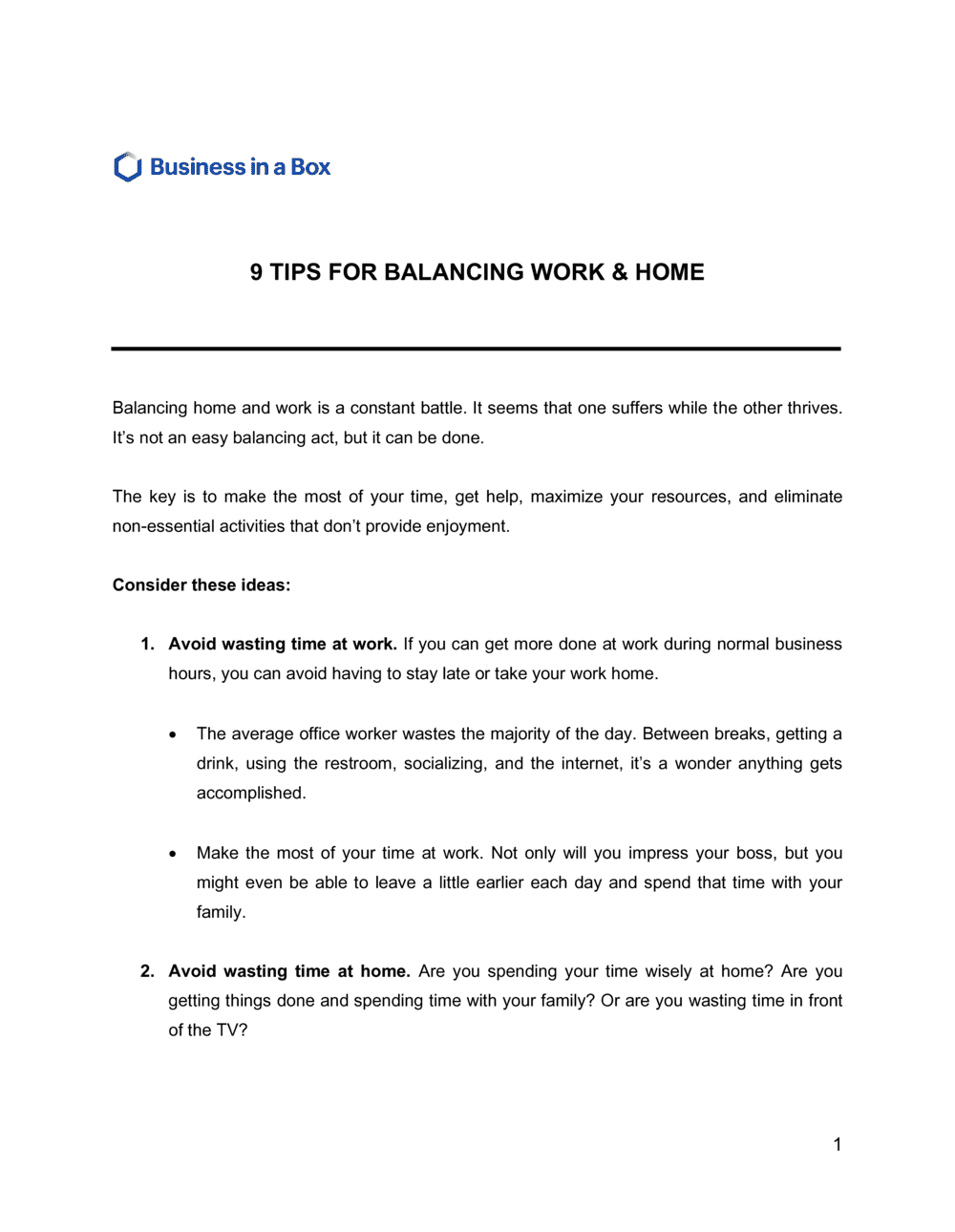
9 Tips For Balancing Work and Home

Free to read • Save or share with one click

Free9 Tips For Balancing Work and Home Template

At a glance

What it is
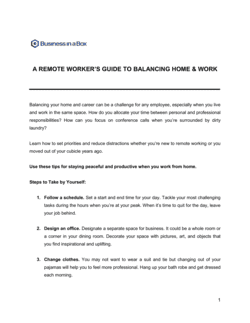
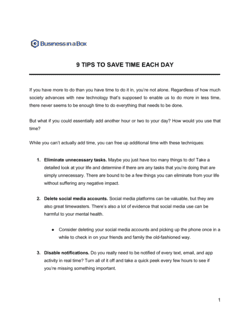
The 9 Tips For Balancing Work And Home is a structured guidance document that helps employees, managers, and HR teams address the practical challenges of separating professional obligations from personal life. This free Word download provides nine actionable, evidence-based tips you can customize for your organization, distribute to your team, or use as the foundation of a wellbeing initiative — then export as PDF for easy sharing.
When you need it
Use it when onboarding remote or hybrid employees, launching an employee wellness program, or responding to burnout signals in your team. It is equally useful for individual contributors setting personal boundaries as it is for HR managers building a formal work-life balance policy.
What's inside
The document covers nine structured tips organized around boundary-setting, time management, physical and mental health habits, communication norms, and personal productivity strategies. Each tip includes a rationale, a concrete action step, and a customizable placeholder so managers can tailor the guidance to their team's specific context.

What is a 9 Tips For Balancing Work And Home document?

The 9 Tips For Balancing Work And Home is a structured operational guide that gives employees, managers, and HR teams nine concrete, actionable strategies for maintaining a sustainable boundary between professional and personal life. Each tip addresses a specific dimension of the work-home boundary — from setting defined working hours and creating a dedicated workspace to establishing communication norms and building a daily shutdown ritual. The document is designed to be customized with an organization's specific defaults, distributed as part of onboarding or a wellness initiative, and revisited as a living reference rather than a one-time read.

Why You Need This Document

Without clear, shared guidance on work-life balance, employees default to the most visible behavior around them — and in most organizations, that behavior is overwork. The consequences compound: burnout-driven attrition costs businesses an estimated six to nine months of an employee's salary to replace, and presenteeism — being logged on while mentally disengaged — reduces output quality without reducing hours. A single distributed guide cannot fix a cultural problem, but it gives employees a concrete reference point, equips managers with a shared vocabulary, and signals that the organization takes sustainable performance seriously. This template removes the blank-page barrier so you can customize and distribute a professional, evidence-grounded resource in under an hour.

Which variant fits your situation?

If your situation is…Use this template
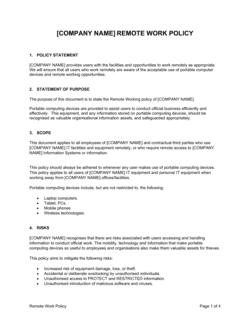
Formalizing work-life balance as a company-wide HR policyRemote Work Policy
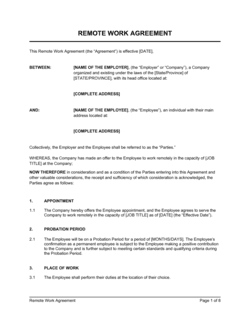
Setting clear expectations for remote employee availabilityRemote Work Agreement
Helping employees manage daily schedules and prioritiesDaily Work Schedule Template
Documenting employee wellness benefits and programsEmployee Benefits Summary
Addressing burnout through a performance support frameworkEmployee Performance Improvement Plan
Building a broader internal communications guide for hybrid teamsInternal Communications Plan
Onboarding new hires with company culture and wellbeing expectationsEmployee Handbook

Common mistakes to avoid

❌ Distributing the guide without manager endorsement

Why it matters: Employees calibrate their behavior to what their manager models and permits, not what a document says. A guide distributed without visible leadership support is ignored within days.

Fix: Have the distributing manager or HR leader send a short personal note alongside the document explaining that the tips reflect real organizational expectations — and that they personally follow them.

❌ Leaving all time placeholders as defaults

Why it matters: Generic placeholders like [START TIME] signal that no one customized the document for this team, reducing credibility and adoption.

Fix: Fill in every time-based placeholder with values aligned to your HR policy before distribution. Even if employees can deviate, a clear default anchors expectations.

❌ Framing balance tips as individual responsibility only

Why it matters: When systemic issues — always-on culture, excessive meeting load, understaffing — are the root cause of imbalance, a personal tips guide creates guilt without offering solutions.

Fix: Add a brief note in the introduction acknowledging that the organization also has responsibilities: reasonable workloads, protected leave, and meeting-free focus time.

❌ Presenting the guide as a one-time read rather than a recurring reference

Why it matters: Without a review mechanism, the habits described decay within weeks as daily work pressure reasserts itself.

Fix: Include a specific prompt at the end of the document — a monthly calendar reminder or a quarterly team check-in — so employees return to the guide as a living resource.

The 10 key sections, explained

Introduction and purpose

Tip 1 — Set defined working hours

Tip 2 — Create a dedicated workspace

Tip 3 — Use time blocking for focus and recovery

Tip 4 — Establish communication boundaries

Tip 5 — Take all allocated leave and breaks

Tip 6 — Protect physical health routines

Tip 7 — Delegate and manage workload proactively

Tip 8 — Disconnect fully during personal time

Tip 9 — Review and adjust regularly

How to fill it out

  1. 1

    Customize the introduction with your organization's name and context

    Replace the [COMPANY NAME] placeholder and add one or two sentences about why your organization is distributing this guide — a wellness initiative, a policy update, or an onboarding packet.

    💡 A specific trigger (e.g., 'following our shift to hybrid work') makes the introduction feel relevant rather than generic.

  2. 2

    Set default values for time-based placeholders

    Decide on the organization's recommended core hours, maximum after-hours response time, and annual leave minimum. Insert these defaults into all time-based placeholders across the nine tips.

    💡 Align these defaults with your existing HR policy before distributing — conflicting numbers undermine credibility.

  3. 3

    Adjust tips to reflect remote, hybrid, or in-office context

    Some tips (dedicated workspace, shutdown ritual) are primarily relevant to remote and hybrid employees. Add a brief contextual note where a tip applies differently to in-office staff.

    💡 Avoid removing tips entirely for in-office teams — presenteeism and overwork affect all work models, not just remote ones.

  4. 4

    Add manager-specific callouts where relevant

    Insert a short 'manager note' under tips 4, 5, and 7 clarifying what managers should model or permit — e.g., 'Managers should avoid sending non-urgent messages after [TIME] unless marked urgent.'

    💡 Manager behavior is the single strongest predictor of whether employees actually follow a work-life balance guide.

  5. 5

    Include links to internal support resources

    Add your Employee Assistance Program contact, internal wellness portal, or HR help-desk link at the end of the document so readers have an immediate next step.

    💡 A QR code linking to your EAP portal increases uptake among employees who receive a printed copy.

  6. 6

    Export as PDF and distribute through your preferred channel

    Save the completed document as PDF and distribute via your HRIS, intranet, onboarding packet, or team meeting. Keep the editable Word file for future updates.

    💡 Schedule an annual review reminder in your HR calendar so the guide stays current as work norms evolve.

Frequently asked questions

What is a work-life balance guide and who is it for?

A work-life balance guide is a structured document that provides actionable strategies for separating professional responsibilities from personal time in a sustainable way. It is used by HR teams distributing wellbeing resources, managers setting team norms, and individual employees building their own boundaries. This template is designed to work for remote, hybrid, and in-office employees across industries.

Why do organizations provide work-life balance guidance to employees?

Organizations that support employee balance typically see lower turnover, fewer sick days, and higher sustained productivity compared to those that normalize overwork. Chronic overwork reduces output quality, increases error rates, and accelerates attrition — all of which carry direct financial costs. A structured guide is a low-cost intervention that signals organizational values and gives employees practical tools to act on.

How is this different from a remote work policy?

A remote work policy is a formal HR document that governs eligibility, equipment, security, and legal compliance for remote arrangements. This guide is a practical behavioral resource — it gives individuals and teams specific habits to adopt, not rules to comply with. The two documents complement each other: the policy sets the structural framework; the guide helps people succeed within it.

Can this guide be used for in-office employees, not just remote workers?

Yes. While several tips — dedicated workspace, shutdown ritual, device boundaries — are especially relevant for remote workers, the underlying challenges they address (overwork, boundary erosion, insufficient recovery) affect in-office employees equally. Tips on time blocking, leave usage, delegation, and communication boundaries apply across all work models.

How should managers use this document with their teams?

Managers are most effective when they distribute the guide alongside a brief personal statement of endorsement, model the behaviors described — particularly around after-hours communication and leave usage — and create space in team meetings to discuss what is working. A guide shared without manager engagement has minimal impact; one backed by visible behavioral change at the manager level typically shifts team norms within 30 days.

What is the right time to distribute a work-life balance guide?

The highest-impact distribution moments are employee onboarding, the launch of a remote or hybrid work policy, a team restructuring that changes workload expectations, or a period following visible signs of burnout in a team. Distributing it as a standalone document with no triggering context reduces engagement — frame it against a specific organizational moment or challenge.

How do I know if the guide is actually working?

Track proxy indicators: unused PTO rates, after-hours Slack or email activity volume, absenteeism trends, and quarterly pulse survey scores on workload and wellbeing. No single metric captures balance, but a combination of these signals — measured before and 90 days after distributing the guide — gives a reasonable picture of adoption and impact.

Should this document be part of the employee handbook?

It can be included as an appendix or a standalone insert in the employee handbook, particularly for organizations with a formal remote or flexible work policy. However, keeping it as a separate living document makes it easier to update as work norms evolve without requiring a full handbook revision. A link from the handbook to the current version is a practical middle ground.

How this compares to alternatives

vs Remote Work Policy

A remote work policy is a formal HR compliance document covering eligibility, security, equipment, and legal obligations for remote arrangements. This guide is a behavioral resource focused on daily habits, boundaries, and mental health practices. The policy tells employees what they must do; the guide helps them do it sustainably. Organizations should use both.

vs Employee Handbook

An employee handbook covers the full range of company policies, codes of conduct, and employment terms in a single authoritative document. This guide is a focused, practical resource on one specific challenge — balance — designed to be read and acted on quickly. It can be linked from or appended to a handbook but is more actionable as a standalone reference.

vs Employee Performance Improvement Plan

A performance improvement plan addresses a specific employee whose output has fallen below expectations, with defined goals and timelines. This guide is a preventive resource distributed to all employees before performance deteriorates. If burnout-driven disengagement is already affecting performance, the PIP documents consequences; this guide addresses the underlying cause.

vs Remote Work Agreement

A remote work agreement is a binding document signed by employer and employee that sets out the terms, expectations, and responsibilities of a remote arrangement. This guide is unsigned and non-binding — it provides practical advice rather than contractual obligations. The agreement governs the structure; the guide shapes how people thrive within it.

Industry-specific considerations

Technology / SaaS

Always-on engineering and product cultures make structured shutdown rituals and async communication norms especially critical for preventing burnout in distributed teams.

Professional Services

Billable-hours pressure and client availability expectations mean work-life guidance must specifically address how to protect non-billable personal time without career risk.

Healthcare

Shift-based schedules and emotional labor demands mean physical recovery, sleep hygiene, and psychological detachment tips carry outsized importance for clinical and administrative staff.

Retail / Hospitality

Variable scheduling and customer-facing roles make consistent daily routines difficult; the guide should emphasize portable habits that work across irregular shift patterns.

Template vs pro — what fits your needs?

PathBest forCostTime
Use the templateHR managers, team leads, and small business owners who need a ready-to-distribute wellbeing resource without outside supportFree30–60 minutes to customize and distribute
Template + professional reviewOrganizations integrating the guide into a formal wellness program or HR policy suite$200–$800 for an HR consultant or occupational wellness advisor review2–5 business days
Custom draftedEnterprise HR teams building a proprietary, branded wellbeing framework tied to engagement survey data and EAP integration$2,000–$8,000 for a workplace wellbeing consultancy engagement3–6 weeks

Glossary

Work-life balance
The degree to which a person allocates time and energy between professional responsibilities and personal activities in a sustainable way.
Boundary-setting
The practice of defining clear limits around working hours, communication availability, and personal time to prevent professional demands from encroaching on home life.
Burnout
A state of chronic physical and emotional exhaustion caused by prolonged overwork, typically accompanied by reduced productivity, cynicism, and disengagement.
Asynchronous communication
Workplace communication that does not require an immediate response — email, recorded video, and project management comments — enabling people to respond on their own schedule.
Deep work
Focused, uninterrupted work on a cognitively demanding task, typically scheduled in blocks of 90 minutes or more with notifications disabled.
Time blocking
A scheduling method in which specific tasks or categories of work are assigned to fixed time slots in a calendar, reducing context-switching and decision fatigue.
Psychological detachment
The mental process of disengaging from work-related thoughts during personal time, associated with lower stress and higher recovery from work demands.
Flexible working arrangement
An employment arrangement that allows employees to vary their start and end times, work location, or total hours within agreed parameters.
Employee Assistance Program (EAP)
An employer-sponsored service offering confidential counseling, mental health support, and personal finance guidance to employees at no direct cost.
Presenteeism
Being physically or digitally present at work while mentally disengaged or unwell, resulting in reduced productivity despite logged hours.

Part of your Business Operating System

This document is one of 3,000+ business & legal templates included in Business in a Box.

  • Fill-in-the-blanks — ready in minutes
  • Compatible with all office suites
  • Export to PDF and share electronically

Create your document in 3 simple steps.

From template to signed document — all inside one Business Operating System.
1
Download or open template

Access over 3,000+ business and legal templates for any business task, project or initiative.

2
Edit and fill in the blanks with AI

Customize your ready-made business document template and save it in the cloud.

3
Save, Share, Send, Sign

Share your files and folders with your team. Create a space of seamless collaboration.

Save time, save money, and create top-quality documents.

★★★★★

"Fantastic value! I'm not sure how I'd do without it. It's worth its weight in gold and paid back for itself many times."

Managing Director · Mall Farm
Robert Whalley
Managing Director, Mall Farm Proprietary Limited
★★★★★

"I have been using Business in a Box for years. It has been the most useful source of templates I have encountered. I recommend it to anyone."

Business Owner · 4+ years
Dr Michael John Freestone
Business Owner
★★★★★

"It has been a life saver so many times I have lost count. Business in a Box has saved me so much time and as you know, time is money."

Owner · Upstate Web
David G. Moore Jr.
Owner, Upstate Web

Run your business with a system — not scattered tools

Stop downloading documents. Start operating with clarity. Business in a Box gives you the Business Operating System used by over 250,000 companies worldwide to structure, run, and grow their business.

Start free · No credit card required