12 Tips To Achieve Financial Growth In Business

Free to read β€’ Save or share with one click

Free12 Tips To Achieve Financial Growth In Business Template

At a glance

What it is
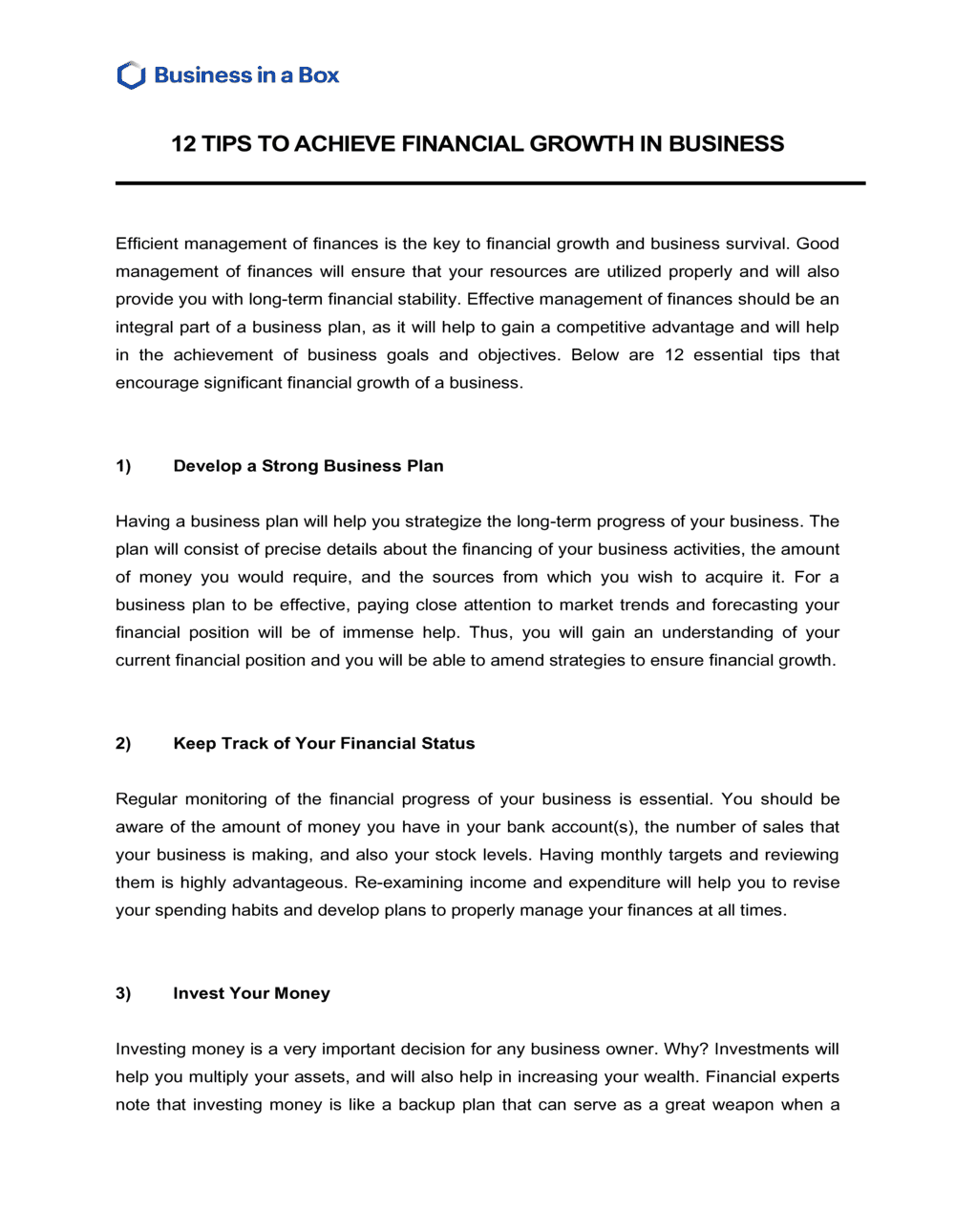
The 12 Tips To Achieve Financial Growth In Business is a structured operational guide that walks business owners and finance leaders through twelve proven strategies β€” from tightening cash flow management to diversifying revenue streams β€” in a single editable Word document. It is a free download you can customize with your own targets, action items, and timelines, then export as PDF for team distribution or board review.
When you need it
Use it when revenue has plateaued, margins are shrinking, or you want a concrete action plan to move from reactive financial management to proactive growth. It is equally useful at the start of a fiscal year, ahead of a strategic planning session, or when preparing for a financing conversation.
What's inside
Twelve actionable sections covering cash flow optimization, cost reduction, pricing strategy, revenue diversification, financial KPIs, budgeting discipline, and investment prioritization β€” each with a rationale, specific action steps, and space to record owner accountability and target dates.

What is a 12 Tips To Achieve Financial Growth In Business guide?

The 12 Tips To Achieve Financial Growth In Business is a structured operational guide that organizes twelve proven financial improvement strategies into a single, actionable Word document. Each tip covers a specific lever β€” from cash flow tightening and overhead control to pricing optimization and revenue diversification β€” with a plain-English rationale, concrete action steps, and fields for targets, owners, and review dates. It functions as both a self-assessment tool and a management accountability document, bridging the gap between understanding that financial performance needs to improve and knowing exactly what to do about it.

Why You Need This Document

Most small businesses that stall financially do so not because of a single catastrophic decision, but because no one has named the specific actions that would move the numbers. Without a structured guide, financial improvement conversations stay at the level of "we need to grow revenue" or "we need to cut costs" β€” statements that are true but not executable. This template converts those generalities into twelve named, numbered actions with assigned owners and deadlines. The cost of not using it is measurable: businesses that track fewer than five financial KPIs monthly are significantly more likely to be surprised by a cash shortfall, an eroding margin, or a revenue concentration risk β€” problems that are preventable when you are looking at the right numbers on a fixed schedule. This template gives you the framework to start looking.

Which variant fits your situation?

If your situation is…Use this template
Setting a full annual revenue and expense planAnnual Budget Plan
Tracking monthly financial performance against targetsMonthly Financial Report
Projecting revenue and cash for the next 12 months12-Month Financial Projections
Diagnosing the root causes of a business performance gapBusiness Performance Review
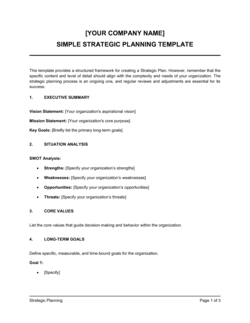
Aligning the leadership team around a 3-year growth strategyStrategic Planning Template
Presenting financial results and growth initiatives to investorsBusiness Plan

Common mistakes to avoid

❌ Setting revenue targets without a baseline

Why it matters: A target of '20% revenue growth' is meaningless without knowing current revenue, margin, and the constraints limiting growth today. You cannot measure progress against an undefined starting point.

Fix: Complete the financial position review in Tip 1 before setting any targets. Every number in the plan should trace back to a documented baseline.

❌ Treating all 12 tips as equal priorities

Why it matters: Applying equal effort to pricing optimization and cash flow management when the business has 30 days of runway left is a resource allocation error that can be fatal.

Fix: Score each tip by urgency (how quickly it becomes a problem) and impact (magnitude of financial effect). Address the top two to three high-urgency, high-impact tips first.

❌ Leaving action items without an assigned owner

Why it matters: Plans without named accountability revert to aspirations. Research on goal-setting consistently shows that assigning a specific person β€” not 'the team' β€” doubles follow-through rates.

Fix: Add a name and a due date to every action item in the template before the document is distributed. Revisit unassigned items at the first review meeting.

❌ Reviewing the plan once and filing it away

Why it matters: A financial growth plan reviewed once and then ignored produces no lasting change β€” it becomes a compliance exercise rather than a management tool.

Fix: Schedule a 90-day checkpoint and a 6-month full review as recurring calendar events at the same time you complete the document. Tie at least one KPI review to each session.

❌ Focusing only on revenue growth while ignoring margin

Why it matters: A business that grows from $500K to $1M in revenue while its gross margin drops from 45% to 30% ends up with less absolute profit and more complexity β€” a net negative outcome.

Fix: Set explicit gross margin and net profit margin targets alongside revenue targets. Review all three together in every KPI session.

❌ Pursuing revenue diversification before the core business is stable

Why it matters: Launching a new product line or entering a new market before the existing revenue engine is reliable splits management attention and capital, often weakening both the core and the new initiative.

Fix: Confirm that core revenue is predictable, margins are at target, and the team has capacity before committing resources to a new revenue stream.

The 10 key sections, explained

Tip 1 β€” Understand your current financial position

Tip 2 β€” Set specific, measurable financial goals

Tip 3 β€” Tighten cash flow management

Tip 4 β€” Reduce and control overhead costs

Tip 5 β€” Optimize pricing strategy

Tip 6 β€” Diversify revenue streams

Tip 7 β€” Improve gross margin per product or service

Tip 8 β€” Track and act on financial KPIs monthly

Tip 9 β€” Invest in revenue-generating activities first

Tip 10 β€” Build a cash reserve and reduce financial dependency

How to fill it out

  1. 1

    Gather your last 12 months of financial statements

    Before filling in any section, pull your P&L, balance sheet, and cash flow statement for the trailing 12 months. These are the baseline every tip will reference.

    πŸ’‘ Export directly from your accounting software (QuickBooks, Xero, or FreshBooks) rather than building from memory β€” errors in baseline data produce misleading targets.

  2. 2

    Complete the financial position summary in Tip 1

    Enter your current revenue, gross margin, net profit margin, and cash position. Note the top three financial strengths and the top three risks you can identify from the statements.

    πŸ’‘ Limit yourself to three strengths and three risks β€” listing ten of each dilutes focus and makes the document harder to act on.

  3. 3

    Set SMART targets for each tip

    For each of the 12 tips, replace the placeholder targets ([AMOUNT], [X]%, [DATE]) with specific numbers drawn from your baseline. Every target needs a number and a deadline.

    πŸ’‘ Set targets you can hit within 90 days for at least half the tips β€” quick wins build momentum and validate the plan.

  4. 4

    Assign an owner to each action item

    Add a name next to every action in the template. If you are a solo operator, assign yourself and block calendar time rather than leaving it as an open task.

    πŸ’‘ Unassigned tasks do not get done. If no one currently owns a tip, that gap is itself a finding worth acting on.

  5. 5

    Build the KPI dashboard in Tip 8

    Select five to eight metrics from the glossary and from your business model. Enter current values, targets, and the review date. Set a recurring monthly calendar event for the KPI review.

    πŸ’‘ Start with gross margin %, operating cash flow, and AR aging β€” these three metrics predict more financial problems earlier than any others.

  6. 6

    Prioritize tips by impact and urgency

    Not all 12 tips carry equal weight for your business. Mark each tip as High, Medium, or Low priority based on the gap between your current position and target. Execute High-priority tips first.

    πŸ’‘ A cash flow problem (Tip 3) always outranks a pricing optimization (Tip 5) β€” fix existential issues before improvement initiatives.

  7. 7

    Set a 90-day review checkpoint

    Schedule a review date 90 days from completion. At that session, compare actuals to the targets you set, update the baseline numbers, and revise tips that are off track.

    πŸ’‘ Treat the 90-day review as a standing meeting, not an optional one β€” plans that are never reviewed produce no lasting change.

  8. 8

    Export as PDF and share with relevant stakeholders

    Once all targets and owners are assigned, export the completed document as PDF and share it with your leadership team, accountant, or board. Keep the editable Word file for future updates.

    πŸ’‘ Send a one-page summary table (tip, owner, target, due date) alongside the full document β€” busy stakeholders will reference the summary daily and the full document for context.

Frequently asked questions

What is a financial growth guide for business?

A financial growth guide is a structured document that walks business owners and finance leaders through a set of specific, actionable strategies for improving revenue, margins, cash flow, and long-term financial health. Unlike a business plan or budget, it focuses on the operational levers that directly drive financial performance β€” pricing, cost control, KPI tracking, and investment prioritization. This template organizes those levers into 12 numbered tips, each with action steps and space for owner accountability.

Who should use this financial growth tips template?

Small business owners managing growth without a CFO, startup founders transitioning from survival mode to a deliberate profitability strategy, finance managers preparing board presentations, and business consultants delivering financial health assessments to clients are the primary users. The template is also useful for franchise owners benchmarking unit-level performance against system standards.

How is this different from a business plan or a budget?

A business plan is a comprehensive external document for investors or lenders, covering market positioning and multi-year financial projections. A budget is a line-by-line allocation of expected revenue and expenses. This financial growth guide is an operational action document β€” it focuses on the specific behaviors, habits, and decisions that improve financial performance, not on projecting or justifying numbers. Use all three in combination: the business plan sets direction, the budget sets limits, and the growth guide drives execution.

How often should I review and update this document?

Review the document at 90 days after completion to check progress against targets, then conduct a full update at the 6-month and 12-month marks. For businesses in a turnaround or rapid-growth phase, a monthly review of the KPI dashboard (Tip 8) with a quarterly full document review is more appropriate. A plan that is more than 12 months old without an update no longer reflects current reality.

What financial KPIs should I track alongside these tips?

The five most broadly applicable KPIs for small businesses are gross margin percentage, net profit margin, operating cash flow, accounts receivable aging (days outstanding), and overhead as a percentage of revenue. Businesses with a sales function should also track customer acquisition cost (CAC) and revenue per customer. Choose five to eight metrics that are directly affected by the tips in this guide and review them on a fixed monthly schedule.

Can I use this template for a specific industry?

Yes. The 12 tips are deliberately written as industry-agnostic principles, but each tip includes placeholder fields you can populate with your own industry benchmarks. A SaaS business will track monthly recurring revenue and churn alongside the standard KPIs; a retail business will focus on inventory turnover and average transaction value. The template's structure accommodates any revenue model.

Do I need an accountant to complete this document?

No β€” the template is designed for business owners without a dedicated finance function. You will need access to your P&L, balance sheet, and cash flow statement (typically exportable from any accounting platform). However, for tips involving pricing strategy, tax efficiency, or investment prioritization, a one-hour session with an accountant or CFO advisor ($150–$400) is worthwhile to validate your targets and avoid common calculation errors.

What is the most impactful tip for a cash-strapped small business?

Tip 3 β€” tightening cash flow management β€” typically delivers the fastest impact for cash-strapped businesses because it addresses the timing of money already owed to you. Reducing average AR collection time from 45 days to 25 days on $200K in annual receivables frees up roughly $11,000 in working capital immediately, with no new sales required. Address cash flow before tackling growth or pricing strategies.

How does this template help with financial goal-setting?

Each of the 12 tips includes a placeholder target field (number, percentage, or date) that converts a general principle into a specific, measurable commitment. The template also includes an owner field for each action and a review-date field, which together create the basic accountability infrastructure that separates financial plans that get executed from those that get filed.

How this compares to alternatives

vs Business Plan

A business plan is a comprehensive external document covering market analysis, competitive positioning, and multi-year financial projections β€” primarily used to raise capital. This financial growth guide is an internal operational document focused on improving performance right now. Use the business plan to explain where you are going; use this guide to change what you do on Monday morning.

vs Strategic Planning Template

A strategic plan covers the full scope of business direction β€” mission, vision, competitive strategy, and organizational goals across three to five years. This financial growth guide is narrower in scope, focused exclusively on financial performance levers. The two documents complement each other: the strategic plan sets the direction, and the financial growth tips drive the financial outcomes that prove the strategy is working.

vs 12-Month Financial Projections

Financial projections are a forward-looking quantitative model β€” they show what revenue, expenses, and cash flow are expected to be. This guide is a qualitative and operational document β€” it describes the actions that produce those numbers. Use the projections to set the targets, and use this guide to assign the behaviors and accountabilities that hit them.

vs Monthly Financial Report

A monthly financial report documents what already happened β€” actual revenue, expenses, and variances against plan. This financial growth guide is a forward-looking action document that determines what should happen. The two are best used together: the monthly report surfaces the gaps; the growth guide contains the actions to close them.

Industry-specific considerations

Retail and e-commerce

Inventory turnover rate, average order value, and return rate are the key financial levers alongside the standard margin and cash flow tips.

Professional services

Billable utilization rate and revenue per employee are the critical metrics; pricing optimization (Tip 5) and overhead control (Tip 4) have outsized impact on net margin.

SaaS and technology

Monthly recurring revenue (MRR), churn rate, and CAC payback period replace traditional revenue metrics; revenue diversification (Tip 6) typically means expanding to annual contracts or adjacent product lines.

Construction and trades

Project-level gross margin tracking, subcontractor cost control, and progress billing discipline are the most relevant applications of the cash flow and margin tips.

Template vs pro β€” what fits your needs?

PathBest forCostTime
Use the templateSmall business owners and operators who manage their own finances and want a structured action frameworkFree2–4 hours to complete; 30 minutes per monthly review
Template + professional reviewBusinesses with $500K+ in revenue that want an accountant or CFO advisor to validate targets and identify blind spots$150–$400 for a one-hour advisory session1 week (complete template, then review with advisor)
Custom draftedMulti-unit operators, businesses preparing for acquisition or investment, or organizations with complex cost structures requiring bespoke financial modeling$1,500–$5,000 for a fractional CFO engagement2–4 weeks

Glossary

Gross Margin
Revenue minus cost of goods sold, expressed as a percentage of revenue β€” a primary measure of how efficiently a business produces its product or service.
Net Profit Margin
Net income divided by total revenue, expressed as a percentage β€” the bottom-line measure of profitability after all expenses, taxes, and interest.
Cash Flow
The net movement of cash into and out of a business over a defined period; positive cash flow means more cash is coming in than going out.
Working Capital
Current assets minus current liabilities β€” the liquid buffer a business has to fund day-to-day operations without drawing on credit.
KPI (Key Performance Indicator)
A quantifiable metric used to evaluate how effectively a business is achieving a specific financial or operational objective.
Revenue Diversification
The practice of expanding income sources so no single customer, product, or channel accounts for a dangerously high percentage of total revenue.
Cost of Customer Acquisition (CAC)
Total sales and marketing spend divided by the number of new customers acquired in the same period.
EBITDA
Earnings Before Interest, Taxes, Depreciation, and Amortization β€” a proxy for operating cash generation commonly used to assess business value and compare performance across companies.
Accounts Receivable (AR) Aging
A report grouping outstanding invoices by how long they have been unpaid, used to identify cash flow risks and prioritize collection efforts.
Overhead
Ongoing fixed and semi-fixed business expenses β€” rent, utilities, salaries, insurance β€” that are not directly tied to producing a specific unit of revenue.
Burn Rate
Monthly net cash outflow, particularly relevant for startups and businesses operating at a loss while scaling toward profitability.
Price Elasticity
A measure of how sensitive customer demand is to a change in price; low elasticity means demand holds steady as prices rise, giving businesses room to increase margins.

Part of your Business Operating System

This document is one of 3,000+ business & legal templates included in Business in a Box.

  • Fill-in-the-blanks β€” ready in minutes
  • Compatible with all office suites
  • Export to PDF and share electronically

Create your document in 3 simple steps.

From template to signed document β€” all inside one Business Operating System.
1
Download or open template

Access over 3,000+ business and legal templates for any business task, project or initiative.

2
Edit and fill in the blanks with AI

Customize your ready-made business document template and save it in the cloud.

3
Save, Share, Send, Sign

Share your files and folders with your team. Create a space of seamless collaboration.

Save time, save money, and create top-quality documents.

β˜…β˜…β˜…β˜…β˜…

"Fantastic value! I'm not sure how I'd do without it. It's worth its weight in gold and paid back for itself many times."

Managing Director Β· Mall Farm
Robert Whalley
Managing Director, Mall Farm Proprietary Limited
β˜…β˜…β˜…β˜…β˜…

"I have been using Business in a Box for years. It has been the most useful source of templates I have encountered. I recommend it to anyone."

Business Owner Β· 4+ years
Dr Michael John Freestone
Business Owner
β˜…β˜…β˜…β˜…β˜…

"It has been a life saver so many times I have lost count. Business in a Box has saved me so much time and as you know, time is money."

Owner Β· Upstate Web
David G. Moore Jr.
Owner, Upstate Web

Run your business with a system β€” not scattered tools

Stop downloading documents. Start operating with clarity. Business in a Box gives you the Business Operating System used by over 250,000 companies worldwide to structure, run, and grow their business.

Start freeΒ Β·Β No credit card required