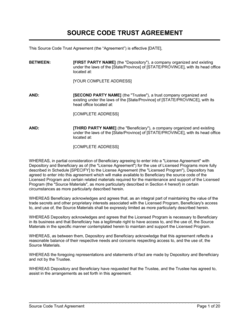
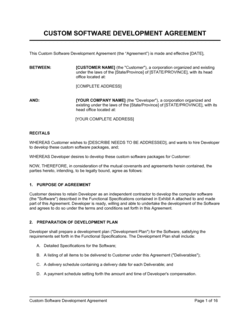
Source Code Trust Agreement 2 Template

Free Word download • Edit online • Save & share with Drive • Export to PDF

22 pages35–45 min to fillDifficulty: ComplexSignature requiredLegal review recommended
Learn more ↓
FreeSource Code Trust Agreement 2 Template

At a glance

What it is
A Source Code Trust Agreement is a legally binding three-party contract between a software developer (depositor), an end-user or licensee (beneficiary), and a neutral third-party trustee, under which the developer deposits source code — and related build documentation — with the trustee to be held in escrow and released to the beneficiary only upon defined trigger events. This free Word download gives you a complete, attorney-drafted starting point you can edit online and export as PDF to protect both sides of a critical software licensing relationship.
When you need it
Use it when a business relies on proprietary software it does not own — such as a licensed ERP, custom platform, or embedded firmware — and needs assurance that it can maintain or rebuild the application if the developer ceases operations, fails to maintain the software, or breaches the underlying license. It is also used by developers to formalize deposit obligations agreed to in a software license or development contract.
What's inside
Trustee appointment and duties, deposit specifications and update schedule, release trigger conditions (insolvency, abandonment, material breach), beneficiary access rights upon release, IP ownership and license grants, confidentiality obligations, verification procedures, fees, indemnification, and termination provisions.

What is a Source Code Trust Agreement?

A Source Code Trust Agreement is a legally binding three-party contract among a software developer (the depositor), a licensee or end-user (the beneficiary), and a neutral custodian (the trustee), under which the developer places source code — together with all build instructions, dependencies, and technical documentation — with the trustee to be held in escrow and released to the beneficiary only upon the occurrence of precisely defined trigger events. Unlike a standard software license, which grants rights to compiled executable software only, a source code trust agreement gives the beneficiary a conditional pathway to the underlying code itself: the raw materials needed to maintain, modify, or rebuild the application independently if the developer is no longer able to fulfil its obligations. The trustee's role is strictly administrative — holding and releasing the deposit according to the contract's terms — not evaluating the quality or completeness of what was deposited.

Why You Need This Document

Every business that runs critical operations on third-party proprietary software faces a single-vendor continuity risk: if the developer becomes insolvent, is acquired, abandons the product, or simply stops providing support, the licensee may find itself unable to maintain, repair, or operate software it depends on daily — with no legal right to look under the hood. Without a source code trust agreement in place before that failure occurs, obtaining access to the source code through litigation or insolvency proceedings can take months or years. Regulators in the financial services, healthcare, and critical infrastructure sectors increasingly treat software escrow not as a best practice but as a mandatory component of third-party risk management. For developers, a well-drafted trust agreement fulfills enterprise procurement requirements, signals operational maturity, and avoids ad-hoc source code disclosure demands. This template gives both sides a proven, balanced starting point — covering deposit specifications, update obligations, release triggers, continuity licensing, and verification rights — that can be customized and executed in hours rather than weeks of from-scratch drafting.

Which variant fits your situation?

If your situation is…Use this template
Two-party arrangement where the developer acts as its own custodianSoftware Escrow Agreement (Two-Party)
Escrow combined with a full software development engagementSoftware Development Agreement with Escrow Addendum
SaaS product where source code access is tied to service continuitySaaS Subscription Agreement with Continuity Clause
Depositing IP assets beyond source code — designs, databases, and documentationTechnology Asset Escrow Agreement
Short-term project delivery where code is transferred outright at completionIP Assignment Agreement
Enterprise licensing deal that governs long-term software use rightsSoftware License Agreement
Verifying deposit integrity through a formal technical auditSource Code Verification Agreement

Common mistakes to avoid

❌ Vague or incomplete deposit specification

Why it matters: A deposit described only as 'all source code' may arrive without build scripts, environment files, or dependency lists — rendering the deposit unbuildable in a crisis release scenario.

Fix: Require a detailed Schedule A signed by a technical lead, listing every component needed to compile and deploy the software from scratch in an isolated environment.

❌ No update obligation or discretionary update language

Why it matters: Software evolves continuously. An escrow holding a three-year-old codebase provides no protection to a beneficiary running the current production version.

Fix: Set a mandatory update window — 30 days after each release — and include a depositor certification that each new deposit reflects the current production version.

❌ Overbroad release triggers without cure periods

Why it matters: Triggers covering any breach of the license agreement expose the depositor to contested releases for minor or disputed infractions, creating operational and legal disruption disproportionate to the issue.

Fix: Limit triggers to material, objectively verifiable events — insolvency, cessation of maintenance for 90+ days, or uncured material breach after 30 days' written notice.

❌ No verification right included

Why it matters: Without a right to test the deposit, the beneficiary has no way to confirm the escrow contains a buildable, current copy of the software until a crisis event forces a release — often too late to be useful.

Fix: Include an annual verification right at the beneficiary's expense, performed by a mutually agreed technical examiner, confirming completeness and buildability.

❌ Continuity license silent on third-party maintenance

Why it matters: Upon release, the beneficiary will almost certainly need to hire an outside developer to maintain the software. A license that permits only the beneficiary's own employees to use the code makes this practically impossible.

Fix: Expressly permit the beneficiary to engage authorized contractors under a written confidentiality obligation, with the depositor's source code treated as third-party confidential information.

❌ Trust agreement terminates automatically with the license

Why it matters: Software licenses are amended, assigned, or replaced regularly. Auto-termination of the escrow leaves gaps in protection during transition periods when the risk of developer failure may actually be higher.

Fix: Include a notice-based termination right — minimum 60 days — that operates independently of the license, so the beneficiary can maintain escrow coverage through license transitions.

The 10 key clauses, explained

Appointment of trustee and acceptance

In plain language: Formally names the trustee, confirms their acceptance of the role, and establishes the scope of their duties — limited to holding and releasing the deposit, not interpreting the code.

Sample language
[DEPOSITOR NAME] and [BENEFICIARY NAME] hereby appoint [TRUSTEE NAME] ('Trustee') as escrow agent under this Agreement. Trustee accepts such appointment and agrees to hold the Deposit Materials in accordance with the terms herein. Trustee's duties are strictly ministerial and Trustee makes no representation regarding the adequacy or functionality of the Deposit Materials.

Common mistake: Failing to expressly limit the trustee's liability to gross negligence or willful misconduct. An unlimited liability clause will cause most professional escrow agents to refuse the appointment or charge significantly higher fees.

Deposit specifications and delivery

In plain language: Defines exactly what must be deposited — file formats, directory structure, build environment, third-party dependencies, and any encryption keys — and the deadline for initial delivery.

Sample language
Depositor shall deliver to Trustee, no later than [DATE], the Deposit Materials as specified in Schedule A, including: (a) all source code files in [LANGUAGE/FORMAT]; (b) build and compilation instructions sufficient to recreate the Licensed Software; (c) a list of all third-party libraries and licenses; and (d) any configuration or environment files required for deployment.

Common mistake: Describing deposit materials in vague terms such as 'all source code.' Without a specific Schedule A, the beneficiary may receive an incomplete deposit that cannot be built into a working application.

Update and refresh obligations

In plain language: Requires the depositor to deliver updated deposit materials within a set number of days after each new software release, patch, or material change.

Sample language
Depositor shall deposit updated Deposit Materials with Trustee within [30] days of each new release, update, patch, or material modification to the Licensed Software. Each updated deposit shall replace the prior deposit unless Trustee is instructed in writing to retain prior versions.

Common mistake: Setting no update timeline or making updates discretionary. A deposit that reflects a version from three years ago provides little continuity value to a beneficiary running a current production system.

Release trigger conditions

In plain language: Lists the specific events that entitle the beneficiary to demand release of the deposit materials, along with the notice procedures and any cure period.

Sample language
Beneficiary may issue a Release Notice to Trustee upon the occurrence of any of the following: (a) Depositor files for bankruptcy or is subject to involuntary insolvency proceedings not dismissed within [60] days; (b) Depositor ceases active maintenance of the Licensed Software for a period exceeding [90] days without written explanation; (c) Depositor commits a material breach of the Underlying License Agreement that remains uncured after [30] days' written notice.

Common mistake: Defining release triggers so broadly — for example, 'any breach of the license agreement' — that the depositor faces constant contested releases. Limit triggers to material, objective events with defined cure periods.

Release procedure and dispute resolution

In plain language: Describes what the beneficiary must include in a release notice, how the trustee notifies the depositor, the depositor's right to object, and how disputes over contested releases are resolved.

Sample language
Upon receiving a Release Notice, Trustee shall notify Depositor in writing within [5] business days. If Depositor does not object within [15] business days, Trustee shall release the Deposit Materials to Beneficiary. If Depositor objects, the dispute shall be submitted to [ARBITRATION BODY] for expedited resolution within [30] days, and Trustee shall withhold release pending the outcome.

Common mistake: Omitting an expedited dispute resolution mechanism. Without one, a contested release can take months in ordinary litigation, defeating the entire purpose of the escrow arrangement.

Continuity license grant

In plain language: Grants the beneficiary a limited, non-transferable license to use the released source code solely to maintain, support, or operate the software for internal purposes — not to resell or redistribute it.

Sample language
Upon release of the Deposit Materials, Depositor hereby grants Beneficiary a non-exclusive, non-transferable, royalty-free license to use, modify, and compile the Deposit Materials solely for the purpose of maintaining, supporting, and operating the Licensed Software for Beneficiary's internal business purposes.

Common mistake: Failing to restrict the continuity license to internal use. Without a restriction, the beneficiary could theoretically sublicense or redistribute the source code, far exceeding the intended scope of the escrow protection.

Verification procedure

In plain language: Establishes the beneficiary's right to request a technical audit of the deposit to confirm it is complete, current, and buildable — and allocates the cost of verification between the parties.

Sample language
Beneficiary may request verification of the Deposit Materials no more than [once per calendar year] at Beneficiary's expense. Trustee shall engage a mutually agreed qualified technical examiner to confirm that the Deposit Materials (a) are complete as specified in Schedule A, (b) correspond to the current production release of the Licensed Software, and (c) can be successfully compiled into a functioning build.

Common mistake: Including no verification right at all. A deposit that has never been tested may be missing build scripts, contain corrupted files, or reflect an outdated version — none of which becomes apparent until a crisis release is attempted.

Confidentiality obligations

In plain language: Binds the trustee and beneficiary to strict confidentiality regarding the deposit materials and permits use only in accordance with the continuity license upon release.

Sample language
Trustee and Beneficiary agree to hold the Deposit Materials in strict confidence using at least the same degree of care as they use to protect their own most sensitive proprietary information, but no less than reasonable care. Beneficiary shall not reverse-engineer, decompile, or disassemble the Deposit Materials except as expressly permitted by the Continuity License.

Common mistake: Using a standard NDA confidentiality standard for source code escrow. Source code warrants a higher standard — specifically prohibiting reverse engineering and restricting access to named individuals on a need-to-know basis.

Trustee fees and party obligations

In plain language: Sets out the trustee's fee schedule, which party bears each fee (setup, annual custody, verification, and release), and the consequences of non-payment.

Sample language
Beneficiary shall pay Trustee a one-time setup fee of $[AMOUNT] and an annual custody fee of $[AMOUNT] per year, payable in advance. Verification fees shall be borne by the requesting party. Failure to pay any fee within [30] days of the due date entitles Trustee to suspend its obligations upon [10] days' written notice to all parties.

Common mistake: Leaving fee allocation silent or stating 'as agreed separately.' Fee disputes between depositor and beneficiary about who pays the trustee can stall the entire arrangement before the first deposit is made.

Term and termination

In plain language: States the duration of the agreement, how it can be terminated by any party, what happens to the deposit materials on termination, and survival of key obligations.

Sample language
This Agreement shall commence on [DATE] and continue until (a) the Underlying License Agreement expires or terminates; (b) all parties agree in writing to terminate; or (c) either party provides [60] days' written notice of termination. Upon termination, Trustee shall return Deposit Materials to Depositor unless a Release Notice is pending. Confidentiality and IP ownership obligations survive termination.

Common mistake: Tying the trust agreement's term exclusively to the underlying license without a notice-based termination right. If the license is amended or replaced, the trust agreement may need to continue under revised terms — requiring flexibility beyond automatic co-termination.

How to fill it out

  1. 1

    Identify and confirm all three parties

    Enter the full legal names and registered addresses of the depositor (software developer), beneficiary (licensee), and trustee (escrow agent or law firm). Confirm the trustee has agreed to act before executing.

    💡 Use the same entity name as appears on the underlying software license agreement — mismatched party names create enforceability questions if a release is ever contested.

  2. 2

    Draft Schedule A — the deposit specification

    List every item that must be deposited: source code files and directory structure, programming language and version, build toolchain, third-party libraries and their licenses, configuration files, and deployment instructions. Be specific enough that a developer unfamiliar with the project could build the software from the deposit alone.

    💡 Have a senior engineer review Schedule A before signing — legal teams routinely under-specify technical requirements, resulting in incomplete deposits.

  3. 3

    Set the update obligation timeline

    Choose a realistic update window — 30 days is standard — and define what triggers an update obligation: new major versions, minor releases, and security patches. Decide whether prior versions are retained or replaced.

    💡 For rapidly iterating software, require monthly deposits on a rolling schedule rather than event-triggered updates — it simplifies compliance.

  4. 4

    Define the release triggers precisely

    List each trigger event with objective, measurable criteria. Include insolvency events, cessation of maintenance, and material breach with defined cure periods. Avoid vague language like 'failure to support.'

    💡 Cross-reference the release triggers against the maintenance and support obligations in the underlying license to ensure alignment — contradictions between the two documents create contested-release risk.

  5. 5

    Set the release and dispute procedure

    Specify the form and contents of a release notice, the trustee's notification timeline, the depositor's objection window, and the forum for expedited dispute resolution. Most parties use AAA or JAMS expedited arbitration.

    💡 Agree on a specific arbitration provider and seat city in the agreement — having to negotiate those details during a contested release adds days of delay when time matters most.

  6. 6

    Draft the continuity license terms

    Confirm the scope of the license granted upon release — internal use only, no redistribution, no sublicensing. State whether the beneficiary may engage a third-party contractor to perform maintenance under the continuity license.

    💡 Expressly permit the beneficiary to hire a maintenance contractor, with the contractor bound by the same confidentiality obligations as the beneficiary — otherwise a key practical use of the release is legally ambiguous.

  7. 7

    Agree on fees and allocate them in writing

    Confirm setup, annual custody, verification, and release fees with the trustee. Allocate each fee to a party and include a payment timeline with consequences for late payment.

    💡 Obtain a fee schedule in writing from the trustee before executing the agreement — trustee fees vary widely ($500–$5,000+ annually) and material fee surprises post-signing create disputes.

  8. 8

    Execute before or simultaneously with the underlying license

    Sign the trust agreement on or before the effective date of the software license it supports. All three parties must execute. The depositor should make the first deposit within the agreed window — do not allow the first deposit to slip past the signature date.

    💡 Schedule a calendar reminder for the first deposit deadline the moment the agreement is signed — depositors routinely miss the initial delivery deadline because no one tracked it.

Frequently asked questions

What is a source code trust agreement?

A source code trust agreement — also called a software escrow agreement — is a three-party contract in which a software developer deposits source code and build documentation with a neutral trustee, to be held in escrow and released to the licensee only when defined trigger events occur, such as the developer's insolvency or abandonment of the software. It gives enterprise users continuity protection without requiring them to own the source code outright. The trustee acts as a neutral custodian and has no obligation to evaluate the quality or adequacy of the deposited code.

When should a business require a source code trust agreement?

Any business that depends on third-party proprietary software for critical operations should consider requiring escrow as a condition of the license. This includes ERP platforms, custom-built applications, embedded firmware, and SaaS products where loss of vendor support would halt operations. Financial regulators in the US, UK, and EU increasingly require escrow arrangements as part of third-party technology risk management programs, particularly for banks, insurers, and critical infrastructure operators.

What is the difference between a source code trust agreement and a standard software license?

A software license grants the right to use the compiled, executable version of software without providing access to the underlying source code. A source code trust agreement is a separate contract that creates a conditional right to access the source code itself — allowing the licensee to maintain, modify, or rebuild the software independently if the developer is no longer able to support it. The two documents work together: the license governs day-to-day use; the trust agreement protects continuity in a failure scenario.

Who typically acts as trustee in a source code trust agreement?

Professional escrow service providers (such as NCC Group, Iron Mountain, or specialized software escrow companies), law firms acting as neutral custodians, and in some cases financial institutions serve as trustees. The trustee's role is strictly ministerial — holding the deposit and following the release procedure — not evaluating the code. Annual fees for professional trustees typically range from $500 to $5,000 depending on the complexity of the deposit and the number of beneficiaries.

What should be included in the deposit materials?

A complete deposit should include all source code files organized by directory structure, the programming language and version used, build and compilation instructions, a list of all third-party libraries and their licenses, configuration and environment files, database schemas, and any encryption keys required to run the software. The deposit should be specific enough that a developer who has never seen the codebase could build and deploy the application from the escrow contents alone. This specification is typically captured in a Schedule A attached to the agreement.

How often does the source code deposit need to be updated?

The standard practice is to require the depositor to refresh the deposit within 30 days of each new software release, major update, or security patch. For rapidly iterating software, monthly rolling deposits are common. The agreement should specify that each update replaces or supplements the prior deposit and must be accompanied by a depositor certification that the new materials reflect the current production version.

What happens when a release trigger occurs?

The beneficiary sends a formal release notice to the trustee describing the trigger event. The trustee notifies the depositor, who has a defined window — typically 15 business days — to object. If no objection is filed, the trustee releases the deposit materials to the beneficiary. If the depositor objects, the dispute goes to expedited arbitration and the trustee holds the materials pending resolution. The beneficiary then uses the released code under the continuity license to maintain or operate the software.

Is a source code trust agreement legally enforceable?

A properly executed source code trust agreement is generally enforceable in most common-law and civil-law jurisdictions as a valid three-party contract. Enforceability depends on the trustee being a genuinely independent party, the release triggers being defined with sufficient specificity to be objectively verifiable, and the continuity license being clearly scoped. In insolvency scenarios, the deposit materials may be treated as assets of the estate — requiring the agreement to be structured carefully to survive an automatic stay or administration moratorium, particularly in the US and UK.

Do I need a lawyer to set up a source code trust agreement?

For straightforward domestic arrangements with a professional escrow provider and a standard trigger structure, a high-quality template reviewed by counsel is often sufficient. Legal review is strongly recommended for cross-border arrangements, heavily regulated industries, agreements involving significant IP value, or situations where the trustee is not a professional escrow service. The agreement interacts with insolvency law in ways that require jurisdiction-specific expertise to get right.

How this compares to alternatives

vs Software License Agreement

A software license agreement grants the right to use compiled, executable software and defines payment, support, and termination terms. It does not give the licensee access to source code. A source code trust agreement is a companion document that creates conditional access to the source code itself, providing continuity protection that the license alone cannot deliver. Both documents are typically executed simultaneously.

vs Software Development Agreement

A software development agreement governs the creation of custom software — deliverables, milestones, payment, and IP ownership. When the developer retains IP ownership under the development agreement, a source code trust agreement is added to give the commissioning party continuity rights without requiring full IP transfer. If IP is fully assigned to the client, a separate trust agreement is unnecessary.

vs IP Assignment Agreement

An IP assignment transfers full ownership of the source code to the assignee — no trustee, no conditions, no escrow. A trust agreement is used when the developer retains ownership but the licensee needs continuity protection. If the developer is willing to transfer ownership outright, an assignment provides stronger protection than escrow, but most commercial developers will not agree to outright assignment of a product they continue to license broadly.

vs Non-Disclosure Agreement

An NDA protects confidential information shared between parties but creates no obligation to deposit, hold, or release materials. A source code trust agreement includes confidentiality provisions as one component but goes much further — establishing a three-party custodial structure, a release mechanism, and a continuity license. Executing only an NDA before sharing source code provides no structural protection against developer failure.

Industry-specific considerations

Financial Services and Banking

Regulatory requirements from the FCA, OCC, and EBA mandate operational continuity plans that frequently include software escrow for third-party core banking and trading systems.

Healthcare and MedTech

FDA-regulated software and clinical systems require validated build environments — deposit specifications must include the exact compiler version, OS, and validation documentation to maintain regulatory compliance after a release.

SaaS and Technology

Enterprise SaaS customers increasingly require escrow as a procurement condition; developers use the trust agreement to formalize deposit obligations already referenced in their master subscription agreements.

Manufacturing and Industrial

Embedded firmware and industrial control system software create single-vendor dependency risk; a trust agreement ensures production lines can continue operating if the firmware developer exits the market.

Jurisdictional notes

United States

Under US bankruptcy law, an automatic stay may temporarily prevent release of escrowed materials when the depositor files for Chapter 11. Structuring the trust agreement to qualify as an executory contract with a clear IP license component — and including an explicit Section 365(n) election — helps preserve the beneficiary's rights during reorganization proceedings. State trade secret laws (Uniform Trade Secrets Act in most states, Defend Trade Secrets Act federally) apply to source code confidentiality obligations.

Canada

Canadian insolvency proceedings under the Companies' Creditors Arrangement Act (CCAA) and the Bankruptcy and Insolvency Act (BIA) may affect release rights similarly to US Chapter 11. Quebec civil law governs contracts executed in the province; French-language requirements under the Charter of the French Language may apply to agreements with Quebec-based entities. IP ownership and license survival should be expressly addressed for cross-provincial arrangements.

United Kingdom

UK administration proceedings can impose a moratorium that delays release of escrowed materials. The agreement should include an express statement that the deposit and the continuity license are intended to survive administration under the Insolvency Act 1986. The UK's Software Directive (derived from the EU Copyright Directive) governs lawful decompilation rights and should be considered when drafting the continuity license scope. FCA-regulated firms face specific third-party technology resilience requirements under PS21/3.

European Union

GDPR applies if the deposit materials include personal data — which is uncommon but possible for analytics or user-data processing modules. The EU's DORA regulation (Digital Operational Resilience Act), effective January 2025, mandates that financial entities maintain contractual arrangements ensuring access to critical software, effectively requiring escrow for many licensed systems. Member state insolvency laws vary significantly; German and French proceedings have different moratorium rules affecting release timelines.

Template vs lawyer — what fits your deal?

PathBest forCostTime
Use the templateStraightforward domestic escrow arrangements with a professional trustee and a single beneficiaryFree1–3 hours to customize and negotiate
Template + legal reviewAgreements involving significant IP value, regulated industries, or cross-border parties$500–$1,500 for a technology lawyer review3–7 days
Custom draftedMulti-beneficiary escrow, insolvency-resilient structures, enterprise transactions over $1M in software value, or heavily regulated environments$2,500–$8,000+2–4 weeks

Glossary

Trustee
The neutral third party — typically a professional escrow agent or law firm — appointed to hold the deposited source code and administer the agreement.
Depositor
The software developer or IP owner who delivers the source code and related materials to the trustee under the terms of the agreement.
Beneficiary
The licensee or end-user who has the right to receive the source code from the trustee upon the occurrence of a defined release trigger.
Deposit Materials
All items placed with the trustee — including source code files, build instructions, configuration scripts, third-party library lists, and technical documentation.
Release Trigger
A specific event — such as the depositor's insolvency, material breach, or cessation of maintenance — that entitles the beneficiary to receive the deposit materials.
Escrow
An arrangement in which assets are held by a neutral third party on behalf of two transacting parties and released only when predetermined conditions are met.
Verification
A technical audit performed by a qualified examiner to confirm that the deposited source code is complete, current, and capable of producing the licensed software when built.
Continuity License
A limited, conditional license granted to the beneficiary upon release of the deposit materials, allowing maintenance or operation of the software without the depositor's involvement.
Material Breach
A failure to perform a fundamental obligation under the underlying software license — such as ceasing support, failing to deliver critical updates, or abandoning the product — that may trigger escrow release.
Insolvency Event
A formal legal proceeding — voluntary or involuntary bankruptcy, receivership, or assignment for the benefit of creditors — that places the depositor's assets under court or administrator control.
Update Obligation
The depositor's contractual duty to re-deposit revised source code whenever a new version, patch, or significant update of the licensed software is released.

Part of your Business Operating System

This document is one of 3,000+ business & legal templates included in Business in a Box.

  • Fill-in-the-blanks — ready in minutes
  • 100% customizable Word document
  • Compatible with all office suites
  • Export to PDF and share electronically

Create your document in 3 simple steps.

From template to signed document — all inside one Business Operating System.
1
Download or open template

Access over 3,000+ business and legal templates for any business task, project or initiative.

2
Edit and fill in the blanks with AI

Customize your ready-made business document template and save it in the cloud.

3
Save, Share, Send, Sign

Share your files and folders with your team. Create a space of seamless collaboration.

Save time, save money, and create top-quality documents.

★★★★★

"Fantastic value! I'm not sure how I'd do without it. It's worth its weight in gold and paid back for itself many times."

Managing Director · Mall Farm
Robert Whalley
Managing Director, Mall Farm Proprietary Limited
★★★★★

"I have been using Business in a Box for years. It has been the most useful source of templates I have encountered. I recommend it to anyone."

Business Owner · 4+ years
Dr Michael John Freestone
Business Owner
★★★★★

"It has been a life saver so many times I have lost count. Business in a Box has saved me so much time and as you know, time is money."

Owner · Upstate Web
David G. Moore Jr.
Owner, Upstate Web

Run your business with a system — not scattered tools

Stop downloading documents. Start operating with clarity. Business in a Box gives you the Business Operating System used by over 250,000 companies worldwide to structure, run, and grow their business.

Start free · No credit card required